
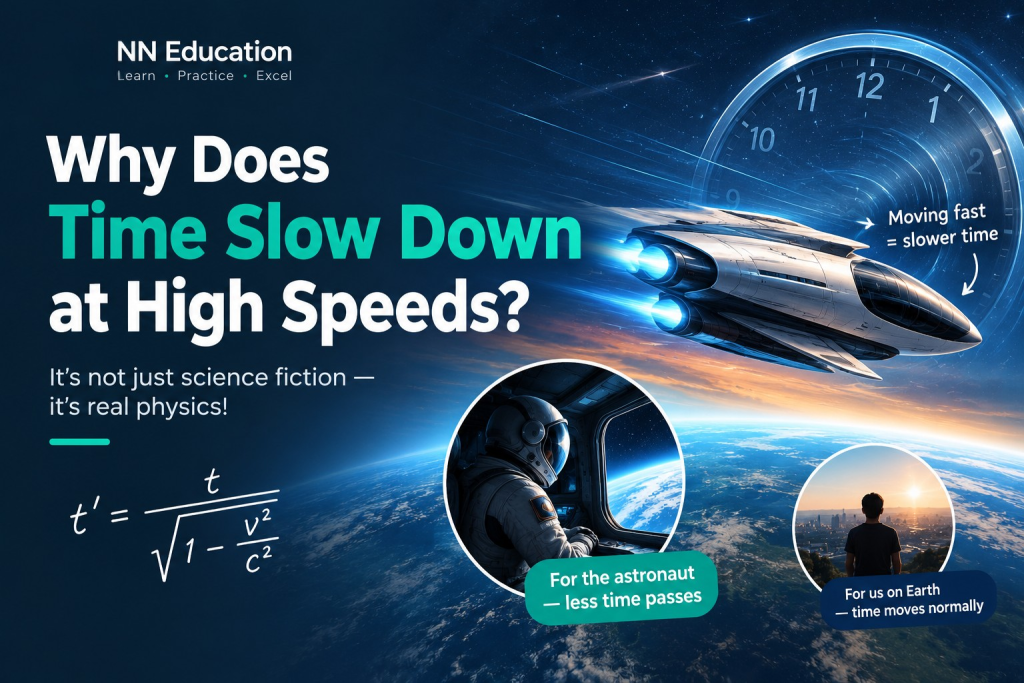
Have you ever wondered what would happen if you could travel through space at a speed close to the speed of light?
Here’s the surprising answer: time would pass more slowly for you compared with someone who stayed on Earth.

This strange effect is called time dilation, and it is one of the most fascinating consequences of Albert Einstein’s Special Theory of Relativity.
But why does time slow down? Is time actually changing? And could a person traveling at extremely high speed really return to Earth younger than their twin?
Let’s understand it step by step.
What Is Time Dilation?
Time dilation means that different observers can measure different amounts of elapsed time between the same events, depending on their relative motion.
When an object moves at speeds approaching the speed of light, a clock moving with that object is measured by an outside observer to tick more slowly.
The effect becomes significant only at extremely high speeds.
For everyday speeds—cars, airplanes, even most spacecraft—the difference is so tiny that we don’t notice it.
But as the speed gets closer and closer to the speed of light, the effect becomes enormous.
Einstein’s Big Idea
In 1905, Albert Einstein published his Special Theory of Relativity.
The theory is based on two important ideas:
- The laws of physics are the same for all observers moving at constant velocity relative to one another.
- The speed of light in vacuum is the same for all inertial observers, regardless of how the observer or the light source is moving.
The second idea creates something extraordinary.
If everyone must measure light traveling at the same speed, then measurements of space and time must adjust between observers.
This leads to effects such as:
- Time dilation
- Length contraction
- Relativity of simultaneity
- The famous relationship between mass and energy, [latex](E = mc^2)[/latex]
The Light Clock: A Simple Way to Understand Time Dilation
Imagine a very simple clock.
Inside it, a beam of light bounces between two mirrors.
Every time the light travels from one mirror to the other and back, the clock completes one “tick.”
This is called a light clock.
For someone traveling alongside the clock, the light simply moves up and down.
But now imagine an observer watching the clock move horizontally at a very high speed.
From this observer’s perspective, the light doesn’t travel straight up and down.
Instead, it follows a diagonal path because the clock itself is moving.
The diagonal path is longer than the vertical path.
But the speed of light must remain exactly the same.
So if light travels a greater distance at the same speed, it must take more time to complete one tick.
Therefore, the moving clock appears to run slower.
This is time dilation.
The Time Dilation Formula
Einstein’s theory gives us the following equation:
[latex]\Delta t = \frac{\Delta t_0}{\sqrt{1-\frac{v^2}{c^2}}}[/latex]
Where:
- [latex]\Delta t[/latex] = time interval measured by an observer who sees the clock moving
- [latex](\Delta t_0)[/latex] = proper time, measured by an observer traveling with the clock
- (v) = relative velocity between the observers
- (c) = speed of light in vacuum
The speed of light is approximately:
[latex]
c = 3.00 \times 10^8 \text{ m/s}
[/latex]
Notice the term:
[latex]
\frac{v^2}{c^2}
[/latex]
As (v) becomes closer to (c), this term becomes closer to 1.
The denominator therefore becomes very small, making the measured time interval much larger.
What Happens at Different Speeds?
Let’s see how dramatic the effect becomes.
At 10% of the speed of light
If v = 0.1c, the effect is still quite small.
A person traveling at this speed would experience only a slight difference in elapsed time compared with someone at rest relative to them.
At 90% of the speed of light
Now things become much more interesting.
At: v = 0.9c, the time dilation factor is approximately:[latex]\gamma \approx 2.29 [/latex]
This means that if 1 hour passes for the traveler, an observer who sees the traveler moving at (0.9c) would measure about 2.29 hours.
At 99% of the speed of light
At: v = 0.99c, the factor becomes approximately: [latex] \gamma \approx 7.09 [/latex]
So 1 hour on the traveler’s clock corresponds to about 7.09 hours for the stationary observer.
And at even higher speeds, the difference becomes enormous.
Does the Traveler Actually Feel Time Slowing Down?
This is an important point.
No.
The traveler does not feel their own time slowing down.
Their heartbeat feels normal.
Their watch ticks normally.
Their thoughts occur normally.
They experience their own proper time in the usual way.
It is only when comparing clocks between observers in relative motion that the difference becomes apparent.
From the traveler’s perspective, it is perfectly reasonable to say:
“My clock is running normally.”
And from Earth’s perspective, the moving clock is also observed to run slowly.
This is one of the counterintuitive features of relativity.
The Twin Paradox
One of the most famous thought experiments involving time dilation is the twin paradox.
Imagine two identical twins.
- Twin A stays on Earth.
- Twin B travels through space at a speed close to the speed of light.
Twin B travels for a while and eventually returns to Earth.
Because of relativistic time dilation, less proper time can have elapsed for the traveling twin than for the twin who remained on Earth.
For example, suppose the traveling twin experiences 5 years during the journey, while 10 years pass according to the Earth-based timeline.
When the traveling twin returns, the twins would no longer be the same age.
The traveling twin would be younger.
But isn’t that a contradiction?
Not really.
The key is that the traveling twin must change frames to turn around and return to Earth, while the Earth twin can remain approximately in the same inertial frame throughout the idealized scenario.
The asymmetry of the journeys resolves the apparent paradox.
This isn’t just a mathematical trick—relativistic time differences have been experimentally verified.
Is Time Really Slowing Down?
This question requires careful wording.
It is tempting to imagine that time is a universal substance flowing more slowly inside a fast-moving spaceship.
That isn’t quite the right way to think about relativity.
Instead, the amount of proper time between events depends on the path through spacetime.
Different observers following different paths through spacetime can measure different elapsed times between events.
So rather than saying simply:
“Time itself slows down.”
A more accurate statement is:
“A moving clock is measured to run slower relative to an observer in another inertial frame.”
This distinction is important when studying relativity.
Time Dilation Is Real
You might think time dilation is only a theoretical prediction.
It isn’t.
Scientists have observed relativistic time differences using extremely accurate clocks and rapidly moving particles.
For example, unstable particles called muons are produced high in Earth’s atmosphere. They have very short lifetimes when measured in their own rest frame.
Yet many muons can reach Earth’s surface before decaying.
From Earth’s frame, their high speed causes their observed lifetime to be extended by relativistic time dilation.
This provides a powerful experimental demonstration of special relativity.
GPS Satellites Also Need Relativity
Relativity isn’t limited to particle accelerators and theoretical physics.
It affects technology we use every day.
GPS systems depend on extremely precise measurements of time.
GPS satellites move rapidly relative to Earth, producing a special-relativistic time dilation effect.
They are also farther from Earth’s gravitational field than clocks on Earth’s surface, producing a gravitational time dilation effect described by General Relativity.
Both effects must be taken into account.
Without relativistic corrections, GPS positioning would quickly become inaccurate.
So the physics developed from Einstein’s theories isn’t merely philosophical—it is part of modern technology.
Can We Travel at the Speed of Light?
According to Special Relativity, an object with mass cannot be accelerated to the speed of light.
As its speed approaches (c), the energy required to continue accelerating it increases dramatically.
Reaching exactly the speed of light would require an infinite amount of energy according to the relativistic model for massive objects.
This is why spacecraft cannot simply accelerate until they reach the speed of light.
Light itself is different because photons have zero rest mass and travel at (c) in vacuum.
What If We Travel Very Close to Light Speed?
Imagine a future spacecraft capable of traveling at 99.9% of the speed of light.
For the travelers, the journey could take considerably less proper time than it would for observers on Earth.
This doesn’t mean the spacecraft is somehow breaking the speed limit of the universe.
Instead, space and time behave differently for observers in relative motion.
The closer the spacecraft gets to the speed of light, the greater the relativistic effects become.
This is one reason relativity makes interstellar travel such a fascinating subject.
The Bigger Picture: Space and Time Are Connected
Before Einstein, space and time were generally treated as separate and absolute.
Einstein showed that they are deeply connected.
We now describe them together as spacetime.
The motion of an observer through space affects how they measure time.
This leads to one of the most beautiful ideas in modern physics:
Space and time are not absolute—they are connected parts of the universe whose measurements depend on the observer’s motion and gravitational environment.
A Simple Way to Remember Time Dilation
For students, remember this basic idea:
Higher relative speed → stronger time dilation.
Or simply:
[latex] v \uparrow \quad \Rightarrow \quad \text{relativistic time dilation} \uparrow [/latex]
But remember that noticeable effects require speeds that are a significant fraction of the speed of light.
At ordinary human speeds, the effect is extremely small.
Frequently Asked Questions
Does time literally stop at the speed of light?
For a massive object, reaching the speed of light is not physically possible according to Special Relativity. The idea of a “clock traveling alongside a photon” is therefore not a valid inertial reference frame.
Do astronauts age more slowly?
Astronauts can experience tiny relativistic differences in elapsed time compared with people on Earth. However, for typical spacecraft speeds, the effect is extremely small.
Is time dilation experimentally proven?
Yes. Relativistic time dilation has been confirmed through experiments involving precise clocks and rapidly moving particles.
Does gravity also slow down time?
Yes. General Relativity predicts gravitational time dilation: clocks in stronger gravitational fields run more slowly relative to clocks farther away from that gravitational field.
Can time travel to the future happen?
In a sense, yes. Traveling at very high speeds can cause less proper time to pass for the traveler than for people who remain behind. This is a real physical effect, although achieving dramatic differences would require enormous speeds and energy.
Final Takeaway
Time isn’t as absolute as it seems.
According to Einstein’s Special Theory of Relativity, the passage of elapsed time depends on how observers move relative to one another.
The faster an object moves relative to an observer, the greater the time dilation measured by that observer.
At everyday speeds, the effect is too small to notice.
But near the speed of light, the difference becomes extraordinary.
So the next time you look at a clock, remember:
Time doesn’t necessarily pass at the same rate for everyone.
The universe has a much stranger relationship between space, motion, and time than our everyday experience suggests.
And that is one of the reasons relativity remains one of the most fascinating ideas in physics.