
An iron block of mass 10 kg rests on a wooden plane inclined at 30° to the horizontal. It is found that the least force parallel to the plane which causes the block to slide up is 100 N. Calculate the coefficient of friction between the two surfaces.
Solution
Given,
Mass of iron block (m) = 10 kg
Angle of inclination of wooden plane (θ) = 30°
Least force required to cause the block to slide (F) = 100 N
Coefficient of friction (μ) =?
We know that,
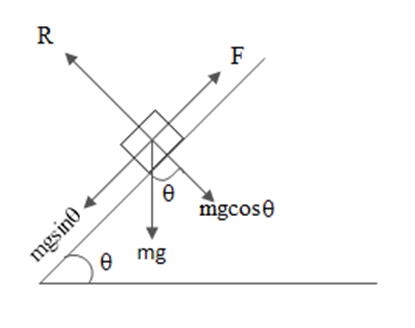
To keep the body in motion, the Force must be equal to the sum of friction and horizontal component of Normal reaction. i.e.
Least force (F) = frictional force + Horizontal component of normal reaction
Or, [latex]100 = \mu R + mg\sin\theta[/latex]
Or, [latex]100 = \mu mg\cos\theta + mg\sin\theta[/latex]
🔒
You've reached the end of the free preview. Continue with NN Premium.
- Complete access to every Premium chapter
- Notes, QBank, solutions & MCQs
- Premium PDFs & study resources
- Entrance preparation & mock tests
One NN Premium subscription unlocks everything.