
Many students hear the word Physics and immediately think of formulas, numerical problems, long derivations, and difficult diagrams.
But here is a surprising truth:
You are already experiencing Physics every second of your life.
You just may not be noticing it.
The phone in your hand, the sound coming from your headphones, the light from your bulb, the car moving down the road, the ball you throw, the airplane flying above you—even the simple act of walking—all involve Physics.
Physics isn’t simply a subject you study for an examination. It is a way of understanding how the world works.
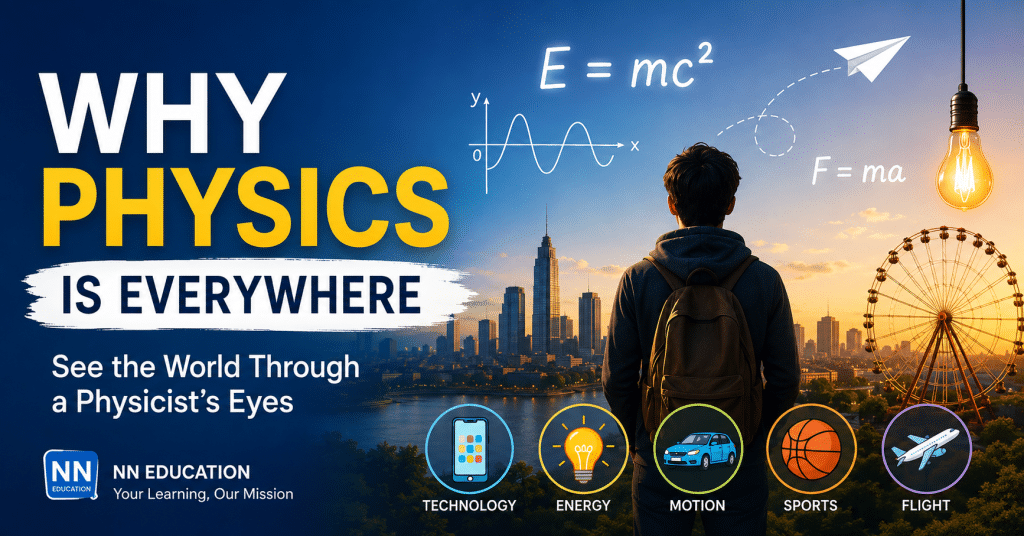
Look Around You. Physics Is Already There.
Imagine you wake up in the morning and reach for your smartphone.
The touchscreen responds to your finger. Your phone communicates using electromagnetic waves. The camera uses optics and light. The battery stores and releases electrical energy. The processor performs millions of operations every second.
That’s Physics.
You get out of bed and walk across the room.
Your feet push against the floor, and friction prevents you from slipping. Your muscles exert forces, while your body maintains balance.
That’s Physics too.
You switch on a light.
Electrical energy is converted into light and other forms of energy.
Again—Physics.
And your day has barely begun.
Your Favorite Things Are Full of Physics
🎧 The Music You Listen To
When you listen to music, you’re experiencing waves.
A speaker vibrates the surrounding air, producing sound waves. Those waves travel through the air and reach your ears, where they are converted into signals that your brain interprets as sound.
Bass, treble, resonance, frequency and amplitude aren’t just textbook terms.
They’re part of the music you hear every day.
🏀 The Sports You Watch
Why does a basketball follow a curved path when thrown?
Why does a football spin?
Why does a cricket ball swing?
Why does a cyclist lean while turning?
The answers involve concepts such as force, momentum, projectile motion, torque, friction, energy and angular motion.
A great athlete may not consciously write equations while playing—but their body is constantly obeying the laws of Physics.
🚗 The Vehicles You Travel In
Every time a vehicle accelerates, brakes or turns, Physics is at work.
The engine provides energy. The tyres interact with the road through friction. Brakes convert kinetic energy into heat. Seat belts protect passengers by dealing with inertia.
Even the shape of a modern car is influenced by Physics.
Engineers don’t simply ask, “Does this look good?”
They also ask:
“How will air flow around it?”
That’s where aerodynamics enters the picture.
✈️ How Can an Airplane Fly?
An airplane weighing thousands of kilograms can rise into the sky because of carefully designed aerodynamic forces.
Lift, thrust, drag and gravity all interact.
And once you start looking at flight through the eyes of Physics, an airplane becomes much more than a machine.
It becomes a beautiful demonstration of several physical principles working together.
Physics Is Also About Asking “Why?”
Perhaps the most important thing Physics teaches isn’t a formula.
It’s curiosity.
Why does the Moon stay in orbit?
Why does a rainbow appear?
Why does ice float?
Why does a spinning top eventually fall?
Why does a mirror reverse some aspects of an image but not others?
Why can we hear music but not see sound?
These questions are the beginning of Physics.
A good Physics student doesn’t simply memorize that
F = ma
and move on.
They ask:
What does it actually mean?
That’s when Physics becomes interesting.
From the Smallest Particle to the Entire Universe
One of the amazing things about Physics is its enormous range.
It can explain what happens when two tiny particles interact.
And the same discipline helps us understand stars, galaxies, black holes and the evolution of the universe.
From the microscopic world to the cosmic world, Physics gives us tools to understand nature.
That’s why Physics has played a major role in technologies ranging from medical imaging and telecommunications to computers, satellites and renewable energy.
So, Should You Be Afraid of Physics?
If Physics sometimes feels difficult, you’re not alone.
But don’t make the mistake of thinking that being good at Physics means memorizing hundreds of formulas.
A much better approach is:
Understand → Visualize → Connect → Practice
First understand the concept.
Then visualize what is happening.
Connect it to something you already know from everyday life.
Finally, practice applying the idea to different situations.
Once you understand why something happens, the equation becomes much easier to remember.
The Secret: Don’t Just Study Physics. Experience It.
The next time you ride a bicycle, think about balance and torque.
When you see a rainbow, think about refraction, reflection and dispersion.
When you hear music, think about waves and frequency.
When you watch a ball being thrown, think about projectile motion.
When you look at the Moon, think about gravity and orbital motion.
Suddenly, your surroundings become a giant Physics laboratory.
And that is perhaps the most beautiful thing about Physics:
The universe is constantly demonstrating the concepts you are learning in your classroom.
You only need to start looking.
Final Thought
Don’t study Physics only because it appears in your examination.
Study it because it teaches you how to see the world differently.
Once you start seeing Physics everywhere, formulas stop looking like random symbols on a page.
They start telling stories about how our universe works.
Keep exploring. Keep questioning. Keep learning.