
Ionic Equilibrium
The dynamic equilibrium between dissociated ions and undissociated electrolyte molecule in its aqueous solution is called ionic equilibrium.
When an electrolyte is dissolved in water, it dissociates into two types of ions. One type of ion carries positive charge (cation) and another carries negative charge (anion).
Let us consider an electrolyte AB, which dissociates as follows:
[latex] AB \longleftrightarrow A^+ + B^-[/latex]
The forward reaction is called ionization reaction and backward reaction is called association reaction.
When weak electrolyte is taken, then undissociated electrolyte molecule dissociates into ions and at the same time, the ions unite together to form molecule. Thus equilibrium is established between undissociated electrolyte molecule and its dissociated ions in its aqueous solution, which is dynamic in nature. Such type of equilibrium is called ionic equilibrium. The dynamic nature of ionic equilibrium means that, some electrolyte molecules dissociate into ions and at the same time same amount of ions combine together to form molecules.
Classification of Electrolytes
On the basis of ionization, substance are classified into 2 types:
i. Electrolytes
ii. Non-electrolytes
Electrolytes
- ionize when dissolved in water
- conduct electricity in its aqueous or molten state
- NaCl, NaOH, HCl, HCOOH, [latex]H_2SO_4, NH_4Cl[/latex] etc.
Non Electrolytes
- do not ionize when dissolved in water
- benzene, ether, [latex]CCl_4, CHCl_3[/latex], kerosene, etc.
On the basis of extent of ionization, electrolytes are classified into two types:
1. Strong Electrolytes
- ionize completely when dissolved in water.
- NaCl, NaOH, KCl, [latex]H_2SO_4, NH_4Cl[/latex] etc.
2. Weak Electrolytes
- ionize partially when dissoved in water.
- [latex]NH_4OH, HCOOH, CH_3COOH, H_2S[/latex] etc.
Ionization of strong and weak electrolyte
The process of ionization in weak electrolyte is reversible. When weak electrolyte is dissolved in water, it dissociates into ions and at the same time, ions combine to form molecule. The equilibrium is dynamic in nature. Let us consider, that an electrolyte AB is dissolved in water,
[latex]AB \longleftrightarrow A^+ + B^-[/latex]
The dynamic nature of equilibrium between electrolyte molecule AB and its dissociated ions is characterized by a constant called as dissociation constant or ionization constant [latex](K_{eq})[/latex] which can be written as follows:
i.e. [latex]K_{eq} = \frac{[A^+][B^-]}{[AB]}[/latex]
For strong electrolyte, there is occurrence of irreversible reaction between electrolyte molecule and its ions. Due to the absence of dynamic equilibrium, [latex]K_{eq}[/latex] cannot be calculated.
In addition the process of ionization is incomplete, only a fraction of molecules dissolved in water are ionized. It is called degree of dissociation or degree of ionization.
Degree of Ionization [latex](\alpha)[/latex]
The fraction of molecules dissociated into ions is called degree of ionization or degree of dissociation. It is denoted by [latex](\alpha)[/latex]. Mathematically,
[latex]\alpha = \frac{\text{No. of molecules ionized}}{\text{Total no. of molecules dissolved}}[/latex]
Also, [latex]\alpha = \frac{\text{amount that dissociates}}{\text{initial concentration (X)}}[/latex]
So, amount that dissociate = [latex]\alpha X[/latex]
Initial concentration = C[latex]\alpha[/latex]
value nearer to 1 → strong electrolyte
value nearer to 0 → weak electrolyte
Ionization of weak electrolyte
Ostwald’s dilution law
The variation of degree of ionization with dilution is called Ostwald’s dilution law. Arrhenius observed for the first time that there is existence of dynamic equilibrium between electrolyte. So, law of mass action can be applied to this dynamic equilibrium. Ostwald applied law of mass action to the dynamic equilibrium for the first time in 1888 and the mathematical outcome is called Ostwald’s dilution law.
Let us consider, an electrolyte AB, which ionizes as follows. i.e.
[latex] AB \longleftrightarrow A^+ + B^-[/latex]
The dissociation constant or ionization constant [latex](K_{eq})[/latex]. For the above reaction can be calculated as
[latex]K_{eq} = \frac{[A^+][B^-]}{[AB]}[/latex] …………………. (i)
If the initial concentration is ‘c’ mole/litre and [latex]\alpha[/latex] be the degree of ionization, Then,

Substituting the values in equation (i), we get,
[latex]K = \frac{C\alpha . C\alpha}{C – C\alpha}[/latex]
= [latex]\frac{C\alpha . C\alpha}{C(1 – \alpha)}[/latex]
= [latex]\frac{C\alpha^2}{1-\alpha}[/latex] ……………… (ii)
For weak electrolyte,
[latex]\alpha << 1[/latex]
So, [latex]1 – \alpha = 1[/latex]
Then, K = [latex]C\alpha^2[/latex] [latex][\because [/latex] From (ii)]
[latex]\alpha = \sqrt{\frac{K}{C}}[/latex]
Thus, Ostwald dilution law states that, “Degree of ionization/dissociation is inversely proportional to the square root of the concentration or directly proportional to the square root of dilution.”
If 1 mole of an electrolyte is dissolved in V litre of the solution, then, we can write,
C = [latex]\frac{1}{V}[/latex] since, C = [latex]\frac{N}{V}[/latex]
Then, [latex]\alpha = \sqrt{K\times V}[/latex] ……….. (iv)
[[latex]\because from equation (iii)]
This equation (iv) is the final form of Ostwald dilution law for weak electrolyte.
For strong electrolyte, [latex]\alpha >> 1[/latex]
So, [latex]1 – \alpha \approx 0[/latex]
Limitations of Ostwald dilution law
Not applicable for strong electrolytes.
Note: On analyzing trend, about [latex]\approx[/latex] 9 marks is asked from this chapter (1 long question worth 8 marks + 1 MCQ). Read carefully.
Theories of Acid and Base.
1) Arrhenius theory of Acid and Base. [water-ion system]
Depending upon the nature of ion produced when a substance is dissolved in water, He defines acid and base as follows.
✓ Acid → Those substances which produce [latex]H^+[/latex] ion when dissolved in water Eg:- HCL, [latex]HNO_3[/latex], [latex]H_2SO_4[/latex] etc.
✓ Base → Those substances which produces [latex]OH^-[/latex] ion when dissolved in water. Eg:- NaOH, KOH, [latex]NH_4OH[/latex] etc.
Limitations of Arrhenius Theory of Acid & Base
→ Free [latex]H^+[/latex] & [latex]OH^-[/latex] doesnot exist in water because of their high reactivity.
→ limited to aquous medium only.
→ Considered water as the only solvent.
→ It fails to explain the acidic nature of non-metallic oxides like [latex]CO_2[/latex]
→ Fails to explain the basic nature of metallic oxide like [latex]Na_2O[/latex].
→ Fails to explain the acidic nature of salt like [latex]AlCl_3[/latex], [latex]FeCl_3[/latex], [latex]BF_3[/latex] etc.
Bronsted-Lowry concept [Proton donor-acceptor system]
→ This concept is more advanced concept than Arrhenius concept because it is not limited to the water as the only solvent. This concept defines acid and base on the basis of tendency of a substance to donate or accept proton during reaction. So this concept is also called as proton donor – acceptor system.
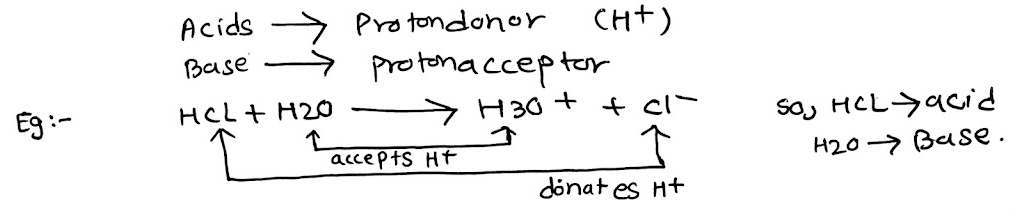
Conjugate acid-base pair
The pair of acid and base which are inter convertible to each other either by donating or by accepting proton are called conjugate acid-base pair.
They differ only by one proton [latex]H^+[/latex]
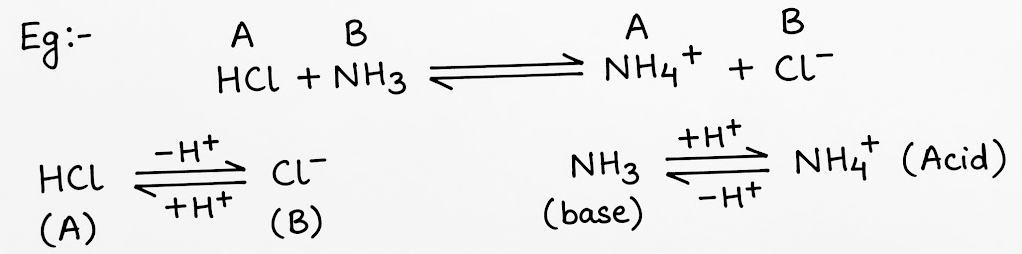
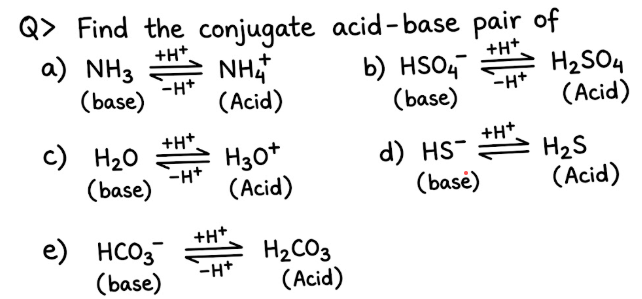
Some conjugate acid-base pair
| Acid | Base | Acid | Base |
| HCl | Cl | [latex]H_2CO_3[/latex] | [latex]HCO_3^{–}[/latex] |
| [latex]H_2SO_4[/latex] | [latex]HSO_4^{-}[/latex] | [latex]HCO_3[/latex] | [latex]CO_3^{–}[/latex] |
| [latex]H_3O^+[/latex] | [latex]H_2O[/latex] | [latex]NH_4^+[/latex] | [latex]NH_3[/latex] |
| [latex]HSO_4^{-}[/latex] | [latex]SO_4^{–}[/latex] | [latex]H_2O[/latex] | OH |
| [latex]CH_3COOH[/latex] | [latex]CH_3COO^{-}[/latex] |
From this, relative strength of acid and base can be determined.
Limitations of Bronsted – Lowry concept
- It fails to explain the acidic nature of non metallic oxides like [latex]CO_2[/latex] and basic nature of metallic oxides like [latex]Na_2O[/latex].
- It also fails to explain the acidic nature of salt like [latex]AlCl_3, BF_3, FeCl_3[/latex], etc.
- It also fails to explain the acid-base reaction in which there is no transfer of proton. Eg.
CaO + [latex]SO_3 \rightarrow CaSO_4[/latex]
Lewis Concept of acid & base [1923]
[Electron pair donor – acceptor system]
Acid: electron acceptor
Base: electron donor
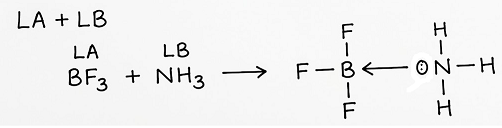
This is the most advanced concept to define the acid and base on the basis of tendency of a substance to accept or donate electron pair. So it is called as electron pair donor acceptor system.
According to Lewis concept,
Acid is the substance which can accept electron pair and base is substance which can donate electron pair.
Lewis Acid: [latex]AlCl_3, BF_3, FeCl_2, H^+, Ag^+, Cu^{++}[/latex] etc.
Lewis Base: [latex]H_2O, NH_3[/latex], ether, alcohol, CN, OH, Cl, etc.
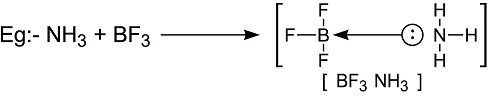
Lewis acid has electron deficient centre and Lewis Base has electron rich centre. After the reaction of LA and LB there is formation of co-ordinate covalent bond which directs from base to acid.
Limitations of Lewis concept
This concept excludes ionization step. So relative strength of acid and base cannot be determined. This concept is too simple and general that it includes all the reaction in which there is formation of coordinate covalent bond occurs.
Autoionization of water
The process in which two water molecules interact to each other to form hydroxyl ion and hydronium ion is called auto ionization of water.
water is an amphoteric solvent i.e. proton can be transferred from one water molecules to the one water molecule to another molecule. During this process, [latex]OH^-[/latex] ion and [latex]H_3O^+[/latex] ion are formed as product. This process is called auto ionization of water.
i.e. [latex]H_2O + H_2O \longleftrightarrow OH^- + H_3O^+[/latex]
(Bronsted acid) (Bronsted base)
# Ionic Product of water (Kw)
→ The product of concentration of ions which are obtained during the autoionization of water is called ionic product of water. It is denoted by (Kw). It is also called as water dissociation constant.
Let us consider the autoionization of water.
i.e. [latex]H_2O \longleftrightarrow H^+ + OH^-[/latex] (simply).
From law of mass action, the dissociation constant can be calculated as
[latex]K_{eq} = \dfrac{[H^+][OH^-]}{[H_2O]}[/latex] …………… (i)
Water is a very weak electrolyte, so, it’s concentration doesnot change during the reaction. so concentration of water can be taken as constant. Hence the above expression can be written as follows.
i.e. [latex]K_{eq} \times [H_2O] = [H^+][OH^-][/latex]
or, [latex]K_w = [H^+][OH^-][/latex] where Kw is the ionic product of water. (Ionic product of water can be defined as the product of concentration of [latex]H^+\ and\ OH^-[/latex] ion at given temperature)
At 25°C [latex]K_w = 1.0 \times 10^{-14}[/latex]
The value of [H+] and [OH-] in the solution determines the nature of solution. In neutral solution, the concentration of [latex]H^+[/latex] ion = concentration of [latex]OH^-[/latex] ion. So the ionic product of water can be written as
[latex]K_w = [H^+][OH^-][/latex]
or, [latex]1.0 \times 10^{-14} = [H^+][OH^-][/latex]
For neutral solution,
[latex][H^+] = [OH^-][/latex]
so, [latex]K_w = [H^+][H^+][/latex]
or, [latex]1.0 \times 10^{-14} = 2[H^+][/latex]
or, [latex][H^+] = 1.0 \times 10^{-7}\ M = [OH^-][/latex]
At 37°C [latex]K_w = 2.5 \times 10^{-14}[/latex] ← Body Temp.
- For Acidic soln [latex][H^+] > [OH^-][/latex]
[latex][H^+] > 1.0 \times 10^{-7}\ M[/latex]
- For basic soln [latex][H^+] < [OH^-][/latex]
[latex][OH^-] > 1.0 \times 10^{-7}\ M[/latex]
Dissociation constant of acid (Ka) & pKa
→ Ka is the acid dissociation constant and pKa is simply the negative logarithm of this constant.
→ Expressed in mole/litre
Acid dissociate as follows:
[latex]HA \leftrightarrow H^+ + A^-[/latex]
so, [latex]K_a = \dfrac{[H^+][A^-]}{[HA]}[/latex]
→ Large Ka value indicates strong acid because it means the acid is largly (completely) dissocrated into ions.
→ Large ka also means, the formation of product in the reaction is favored.
→ ka value for most of weak acid ranges from [latex]10^{-7}[/latex] to [latex]10^{-14}[/latex].
Negative logarithm of acid dissociation constant (Ka) is called (pKa)
i.e [latex]pKa = -\log K_a[/latex] #
smaller pka → stronger acid → range (2-14)
Dissociation constant of base (kb) & (pKb)
→ Kb is the base dissociation constant and pkb is simply the negative logarithm of this constant. (mole/ltr)
→ Base dissociates as:
[latex]BOH \leftrightarrow B^+ + OH^-[/latex]
so, [latex]K_b = \dfrac{[B^+][OH^-]}{[BOH]}[/latex]
→ large value of kb indicates a strong base because it means the base is largely dissociated into ions.
→ large kb also means formation of product in the reaction is favored.
→ Again,
Negative logarithm of base dissociation constant (Kb) is called pKb.
i.e [latex]pKb = -\log kb[/latex]
smaller the pkb, stronger will be the base.
pH
{potentz → potential
H → Hydrogen ion}
→ The acidity & basicity of a soln can be expressed in terms of pH.
→ The negative logarithm of hydrogen ion concentration expressed in molarity is pH.
i.e. [latex]pH = -\log[H^+][/latex]
[latex][H^+] = 10^{-pH}\ (M)[/latex]
→ Magnitude of pH determines nature of soln.
a) pH = 7 (neutral)
b) pH > 7 (basic)
c) pH < 7 (acidic)
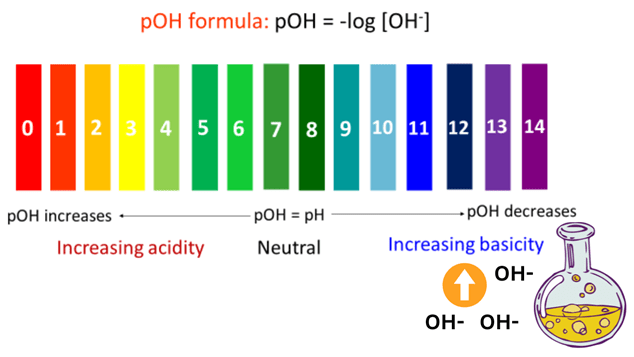
pOH
German word
{potentz → potential
OH → hydroxyl ion}
→ The acidity and basicity of a solution can be expressed interms of pOH.
→ The negative logarithm of hydroxyl ion concentration expressed in molarity is called pOH.
pOH = 7 (neutral)
pOH > 7 (acidic)
pOH < 7 (basic)
pH Scale
→ It is the scale which is used to compute the pH values of different solution.
→ In pH scale, the pH values are arranged in ascending order from left to right in btn 0 to 14.
→ The [H+] concentration are arranged in descending order from left to right between [latex](10^0 – 10^{-14}\ M)[/latex]
Relation between pH & pOH
→ The ionic product of water can be written as,
[latex]K_w = [H^+][OH^-][/latex]
Taking log on both sides, we get,
[latex]\log(K_w) = \log{[H^+][OH^-]}[/latex]
Taking (-ve) sign at both sides
[latex]-\log(K_w) = -\log[H^+] + {-\log[OH^-]}[/latex]
At 25°C, [latex]K_w = 1.0 \times 10^{-14}[/latex]
so, [latex]-\log(1.0 \times 10^{-14}) = -\log[H^+] + {-\log[OH^-]}[/latex]
or, [latex]14 = pH + pOH[/latex]
[latex]\therefore pH + pOH = 14[/latex]
For strong acid & base, [latex]pH = -\log[H^+][/latex]
For weak acid & base, [latex]pH = -\log[H^+] = -\log C\alpha[/latex]
[latex]= -\log\sqrt{K_a C}[/latex]
[latex]pOH = -\log[OH^-] = -\log C\alpha = -\log\sqrt{K_b C}[/latex]
Show that, [latex]p^H + p^{OH}[/latex] = pKw
The ionic product of water can be written as,
[latex]K_w = [H^+][OH^-][/latex]
Taking log on both sides.
[latex]\log K_w = \log{[H^+][OH^-]}[/latex]
or, [latex]\log K_w = \log[H^+] + \log[OH^-][/latex]
or, [latex]-\log K_w = -\log[H^+] + {-\log[OH^-]}[/latex]
or, [latex]pK_w = pH + pOH[/latex]
Common ion Effect.
Supression of degree of dissociation of weak electrolyte by the addition of strong electrolyte having one ion common is called common ion effect.
Eg:- The dissociation of [latex]NH_4OH[/latex] is supressed by the addition of [latex]NH_4Cl[/latex]. This can be explained on the basis of Le-chatelier’s principle as follows:
[latex]NH_4OH \leftrightarrow NH_4^+ + OH^-[/latex] (partially)
(weak base)
[latex]NH_4Cl[/latex] is a strong electrolyte and it ionizes almost completely in its aqueous solution. as:
[latex]NH_4Cl \leftrightarrow NH_4^+ + Cl^-[/latex] (completely)
When NH₄Cl is added to the aqueous soln of NH₄OH, according to Le-chatelier’s principle the reaction shifts backward. due to increase in conc[latex]^n[/latex] of [latex]NH_4^+[/latex] ion (product).
So, [latex]NH_4^+[/latex] ion and [latex]OH^-[/latex] ion combines to form [latex]NH_4OH[/latex]. Hence the degree of dissociation of [latex]NH_4OH[/latex] (weak electrolyte) is suppressed. This effect is common-ion effect.
It decreases solubility of weak electrolyte.
Application of Common-ion effect
- purification of salt
- precipitation of soap etc.
Solubility product
In case of sparingly soluable ionic salt in its saturated solution, dynamic equilibrium exists btn. undissociated salt molecules and its dissociated ions. So law of mass action can be applied to this dynamic equilibrium to calculate ionization constant (Keq).
Let us consider a sparingly soluable salt AB which ionizes as follows in its saturated soln.
[latex]AB \rightleftharpoons A^+ + B^-[/latex]
Applying law of mass action.
[latex]K_{eq} = \frac{[A^+][B^-]}{[AB]}[/latex]
[latex]K_{eq}.[AB] = [A^+][B^-][/latex]
or [latex]K_{sp} = [A^+][B^-][/latex]
This new constant Ksp is called solubility product or solubility product constant. and is equal to the product of ionization constant and the concentration of sparingly soluble ionic salt in its saturated solution. It is dependent upon temperature.
For the salt of AxBy type, the solubility product can be written as follows:
[latex]A_xB_y \rightleftharpoons xA^{y+} + yB^{x-}[/latex]
[latex]\therefore K_{sp} = [A^{y+}]^x [B^{x-}]^y[/latex]
Solubility product can also be defined as the product of molar concentration of its ion in saturated solution, each concentration raised to the power equal to the stoichiometric coefficient of ions in a balanced equation.
Similarly, Ionic product is the product of concentration. of ions in all types of soln.
[latex]K_{sp}[/latex] only in saturated soln.
For AB type of salt
[latex]AB \rightleftharpoons A^+ + B^-[/latex]
[latex]1M \qquad\ \ 1M \quad 1M[/latex]
[latex]’S’\ M \quad ‘S’\ M \quad ‘S’\ M[/latex]
[latex]K_{sp} = [A^+][B^-][/latex]
[latex]= S \times S[/latex]
[latex]K_{sp} = S^2[/latex]
For [latex]AB_2[/latex] salt
[latex]AB_2 \rightleftharpoons A^{+2} + 2B^{-1}[/latex]
[latex]’S’\ M \qquad ‘S’\ M \qquad 2’S’\ M[/latex]
[latex]\therefore K_{sp} = [A^{+2}][B^-]^2[/latex]
[latex]= [S][2S]^2[/latex]
[latex]= S \times 4S^2[/latex]
or, [latex]K_{sp} = 4S^3[/latex]
For [latex]A_2B_3[/latex] salt
[latex]A_2B_3 \rightleftharpoons 2A^{+3} + 3B^{-2}[/latex]
[latex]1’M’ \qquad\quad 2m \qquad\quad 3M[/latex]
[latex]’S’ \qquad\quad\ \ 2S \qquad\quad 3S[/latex]
[latex]K_{sp} = [A^{+3}]^2[B^{-2}]^3[/latex]
[latex]= [2S]^2 \cdot [3S]^3[/latex]
[latex]= 4S^2 \cdot 27S^3[/latex]
[latex]K_{sp} = 108\ S^5[/latex]
Application of common ion effect & solubility product principle
a) Precipitation of sulphides of group II and IIIB basic radicals. [latex][H_2S][/latex]
→ Both group II and IIIB metal ions precipitate out in the form of metal sulphide.
→ But the [latex]k_{sp}[/latex] of group II sulphides is very less than group IIIB metal sulphide
[latex][As^{3+}]\ [Sb^{3+}]\ \ Cu^{2+},\ Hg^{2+},\ Pb^{2+},[/latex]
→ So, to decrease the [latex]k_{sp}[/latex], HCL gas is passed along [latex]H_2S[/latex] to decrease concentration of sulphide ion due to common ion effect.
Group II metals → [latex]Cu^{++},\ Hg^{++},\ Pb^{++},\ Sb^{3+},\ As^{3+},\ Sn^{2+}[/latex]
Group IIIB metals → [latex]Co^{++},\ Ni^{++},\ Zn^{++},\ Mn^{++}[/latex]
[latex]HCL \rightarrow H^+ + CL^-[/latex]
[latex]H_2S \rightarrow 2H^+ + S^{-2}[/latex]
(The [latex]H^+[/latex] in both reactions are “common ion”)
This cause decrease in concentration of sulphide ion, which then decreases Ionic product.
This decreased IP only exceeds the [latex]k_{sp}[/latex] of group II metal sulphides but not group IIIB metal sulphides. So group II metals precipitated.
Here, role of HCL is important.
Solubility product principle
It states that,” For the precipitation to occur, ionic product value must exceed solublity product value.
i.e. [latex]IP > K_{sp}[/latex]
[latex]K_{ip} < K_{sp}[/latex], the soln is unsaturated
[latex]K_{ip} = K_{sp}[/latex], the soln is saturated
[latex]K_{ip} > K_{sp}[/latex], the soln is super saturated
b) precipitation of hydroxides of group IIIA basic radicals.
→ Both group IIIA ([latex]Fe^{3+},\ Al^{3+},\ Cr^{3+}[/latex]) and Group V metal ions precipitate out in the form of metal hydroxide. However the solublity product of Group IIIA metals hydroxide. is less than group V metal hydroxide
→ When [latex]NH_4Cl[/latex] is added along with [latex]NH_4OH[/latex] then the concentration of hydroxide ion in solution is decreases due to common ion effect.
[latex]NH_4Cl \longrightarrow NH_4^+ + Cl^-[/latex]
[latex]NH_4OH \rightleftharpoons NH_4^+ + OH^-[/latex]
(common ion: [latex]NH_4^+[/latex])
→ This decrease in concentration of hydroxide ion causes decrease in ionic product.
→ This decreased ionic product exceed the solubility product [latex](K_{sp})[/latex] of only group IIIA metal hydroxide but not group V metal hydroxide.
→ So only group IIIA metal hydroxide are precipated leaving group V metal ions in the soln.
Group IV ([latex]Zn^{++}[/latex], [latex]Co^{++}[/latex], [latex]Ni^{++}[/latex], [latex]Mn^{++}[/latex] )
→ For the precipitation of group IV radicals (as a sulphide) high conc[latex]^n[/latex] of [latex]S^{2-}[/latex] ion is to be obtained. This is done by adding double volume of NH₄Cl followed by NH₄OH before adding [latex]H_2S[/latex] gas in the original solution.
→ The role of NH₄Cl is to supress the degree of ionization of NH₄OH to maintain a low conc[latex]^n[/latex] of [latex]OH^-[/latex] ions.
[latex]NH_4Cl \longrightarrow NH_4^+ + Cl^-[/latex]
[latex]NH_4OH \rightleftharpoons NH_4^+ + OH^-[/latex]
→ This low conc[latex]^n[/latex] of [latex]OH^-[/latex] ions prevents precipitation of hydroxides of group IIB metals ion. The presence of [latex]OH^-[/latex] ions further increases ionization of [latex]H_2S[/latex] as [latex]OH^-[/latex] consumes [latex]H^+[/latex] to form [latex]H_2O[/latex].
[latex]H_2S \rightleftharpoons 2H^+ + S^{2-}[/latex] (high conc[latex]^n[/latex])
[latex]H^+ + OH^- \longrightarrow H_2O[/latex]
→ This lead to an increase in the conc[latex]^n[/latex] of [latex]S^{2-}[/latex] so that, the IP exceeds the solubility product and only group IV radicals get precipitated.
[latex]Zn^{++} + H_2S \xrightarrow[NH_4OH]{NH_4Cl} ZnS\downarrow + 2H^+[/latex]
white ppt.
Buffer solution and its application
→ The solution which can resist change in pH value even after the addition of small amount of acid or base to it is called buffer solution.
Eg:- Blood ([latex]pH = 7.35[/latex]) maintained by the mixture of [latex]H_2CO_3[/latex] and [latex]HCO_3[/latex].
→ The tendency of buffer solution to resist change in pH value after the addition of acid or base is called buffer action. The buffer action of buffer solution is due to the consumption of H+ or OH- ions from acid or base by buffer solution.
Types of Buffer Solution
i) Acidic buffer solution: The buffer solution whose pH value is lesser than 7 is called acidic buffer solution. It is prepared by mixing equimolar concentration of solution of weak acid and its salt of strong base. For eg:-
[latex]CH_3COOH[/latex] & [latex]CH_3COONa[/latex]. ([latex]pH = 4.74[/latex])
ii) Basic buffer solution: The buffer solution whose pH is more than 7 is called acidic buffer solution. It is prepared by mixing equimolar concentration of solution of weak base and its salt of strong acid. Eg:
[latex]NH_4OH[/latex] & [latex]NH_4Cl[/latex] ([latex]pH = 9.1[/latex])
Henderson’s Equation
i) For acidic buffer, [latex]pH = pK_a + \log\dfrac{[salt]}{[acid]}[/latex]
ii) For basic buffer, [latex]pOH = pK_b + \log\dfrac{[salt]}{[base]}[/latex]
Applications of buffer solution
→ In industries for manufacture of paper, dyes, paints etc.
→ In analytical chemistry and bacteriological research
→ In food and pharmaceutical industries as a preservative.
→ In biological process to maintain the pH of blood about 7.4.
- plasma consists of [latex]H_2CO_3[/latex] and [latex]NaHCO_3[/latex].
- The mechanism of buffer action on blood is:
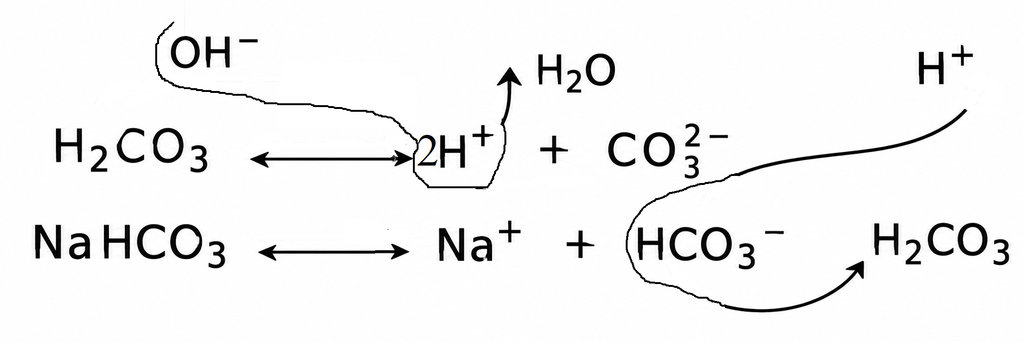
pH of blood remains constant from [latex]7.38 – 7.42[/latex] even during metabolic reaction after eating/drinking acidic or basic foods.
On adding acid add → [latex]H_2CO_3[/latex]
On adding base → [latex]H_2O[/latex]
Selection of Indicators
Qn) Define indicator. How is indicator selected for a particular titration?
→ Indicators are the substance that changes it’s colour at different pH values to indicate that the titration is completed.
Methods for selection of indicators
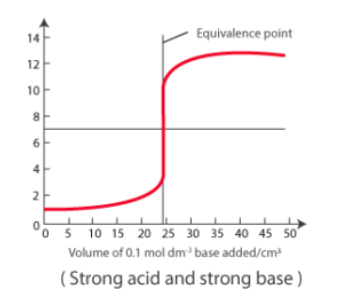
a) Titration of strong Acid and strong base
→ In the titration of strong Acid (HCl) and strong base (NaOH), the step rise of curve occurs at pH from [latex]3[/latex] to [latex]11[/latex]. Any indicator capable of changing it’s colour btn [latex]3[/latex] to [latex]11[/latex] is suitable indicator. In this titration methyl orange ([latex]3.2 – 4.4[/latex]) & phenolphthalein ([latex]8 – 10[/latex]) are used as indicator.
b) Titration of strong acid and weak base
→ In titration of strong Acid (HCL) & weak base ([latex]NH_4OH[/latex]), the step rise of the curve occurs from [latex]3[/latex] to [latex]8[/latex]. And methyl orange ([latex]3.2 – 4.4[/latex]) is used as indicator.
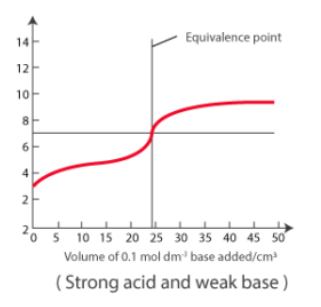
methyl red – [latex]4.2[/latex] to [latex]6.3[/latex]
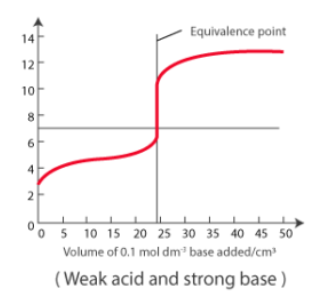
c) Titration of weak Acid and strong base
→ In a titration of weak Acid & strong base, the step rise of the curve occurs from [latex]6[/latex] to [latex]11[/latex]. And phenolphthalein ([latex]8 – 10[/latex]) is used as indicator.
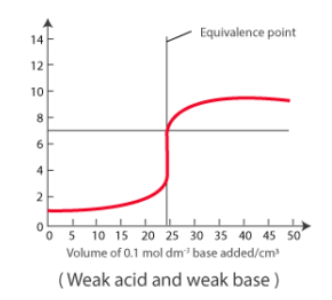
d) Titration of weak acid and weak base
→ In titration of weak acid and weak base, the step rise of the curve occurs from [latex]6[/latex] to [latex]8[/latex]. And Here neither methyl orange nor phenolphthalein is used. In this case, conductometric titration is done.
Salt Hydrolysis
The reaction of either cation or anion or both of the salt with water, which results in the formation of either acidic or basic or very rarely neutral solution is called salt hydrolysis
If the cation of the salt reacts with water, it is called cationic hydrolysis and if the anion of salt reacts with water, it is called anionic hydrolysis.
| Cationic hydrolysis ↓ Resulting soln Acidic | Anionic hydrolysis ↓ Resulting soln Basic |
| Because cation of salt reacts with [latex]OH^-[/latex] ion from water which results in increase in concentration of [latex]H^+[/latex] ion in solution. Hence the resulting soln becomes acidic. | Because anion of salt combines reacts with [latex]H^+[/latex] ion from water which results in increase in concentration of [latex]OH^-[/latex] ion in soln. Hence resulting soln becomes basic |
→ If the rate of cationic hydrolysis becomes equal to the rate of anionic hydrolysis, then resulting solution becomes neutral.
→ Salt hydrolysis is reverse of neutralization reaction
During neutralization rxn, [latex]H^+[/latex] ion from acid reacts with [latex]OH^-[/latex] ion from base which results in formation of water molecule. But in salt hydrolysis, water molecule dissociates into [latex]H^+[/latex] and [latex]OH^-[/latex] ion.
Depending upon the nature of interaction between salt and water, salts are classified into 4 types, which are:
a) salt of strong acid and weak base.
Strong acid :- [latex]H_2SO_4[/latex], [latex]HCl[/latex], [latex]HNO_3[/latex],
weak base :- [latex]Fe(OH)_3[/latex], [latex]NH_4OH[/latex], [latex]AgOH[/latex]
like [latex]NH_4Cl[/latex], [latex]CuSO_4[/latex], [latex]FeCl_3[/latex] etc. are the salts of strong acid and weak base. When this type of salt is dissolved in water, the resulting solution becomes acidic due to cationic hydrolysis:
[latex]HCL + NH_4OH \rightarrow NH_4Cl + H_2O[/latex]
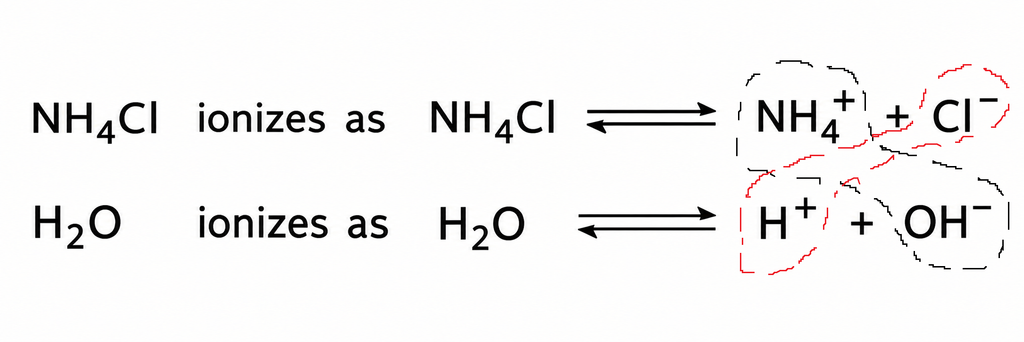
The [latex]NH_4^+[/latex] ion from salt combines with [latex]OH^-[/latex] ion from water to form [latex]NH_4OH[/latex] and [latex]Cl^-[/latex] combines with [latex]H^+[/latex] ion from water to form [latex]HCL[/latex].
i.e. [latex]NH_4^+ + OH^- \leftrightarrow NH_4OH[/latex] (partially ionized)
[latex]H^+ + Cl^- \rightleftharpoons HCl[/latex] (completely ionized)
[latex]NH_4OH[/latex] being weak base ionizes partially and gives small concentration of [latex]OH^-[/latex] ion in solution. [latex]HCl[/latex] is a strong acid which is almost completely ionized to give large amount of [latex]H^+[/latex] ion so resulting salt will be acidic in nature.
Numerical Problems. Based on Solublity Product
1. If the solubility of AgCl is [latex]0.1435\ gL^{-1}[/latex], Find its solubility product.
Solution
Here,
[latex]AgCl \rightarrow Ag^+ + Cl^-[/latex]
[latex]S \qquad\quad S \qquad\ \ S[/latex]
[latex]K_{sp} = [A^+][Cl^-][/latex]
[latex]= S \times S = S^2.[/latex]
solublity of AgCl = [latex]0.1435\ gL^{-1}[/latex]
[latex]= \dfrac{0.1435}{143.5}\ mol.L^{-1}.[/latex]
[latex]= 10^{-3}\ mol\ L^{-1}[/latex]
Now, [latex]K_{sp}[/latex] of AgCl = [latex]S^2[/latex]
[latex]= [10^{-3}]^2[/latex]
[latex]= 10^{-6}[/latex]
salt of weak acid and strong base
like [latex]Na_2CO_3[/latex], [latex]CH_3COONa[/latex], [latex]HCOONa[/latex] etc are the salts of weak acid and strong base, when this type of salt is dissolved in water, the resulting solution becomes basic due to anionic hydrolysis. Eg: [latex]Na_2CO_3[/latex].
[latex]Na_2CO_3 \rightleftharpoons 2Na^+ + CO_3^{–}[/latex]
[latex]H_2O \rightleftharpoons H^+ + OH^-[/latex]
[latex]Na^+[/latex] ion combines with [latex]OH^-[/latex] ion from water
[latex]Na^+ + OH^- \rightleftharpoons NaOH[/latex] (completely ionized).
[latex]CO_3^{–}[/latex] ion combines with [latex]H^+[/latex] ion from water
[latex]2H^+ + CO_3^{–} \rightleftharpoons H_2CO_3[/latex] (partially ionized)
Here concentration of [latex]OH^-[/latex] > concentration of [latex]H^+[/latex] so resulting soln will be basic in nature.
Salt of strong acid and strong base
Salts like [latex]NaCl[/latex], [latex]KCl[/latex], [latex]Na_2SO_4[/latex] etc are salts of strong acid and strong base.
[latex]NaCl \rightleftharpoons Na^+ + Cl^-[/latex] [latex]H_2O \rightleftharpoons H^+ + OH^-[/latex]
[latex]Na^+ + OH^- \rightleftharpoons NaOH[/latex] (completely ionized)
similarly, [latex]H^+ + Cl^- \rightleftharpoons HCl[/latex] (completely ionized).
Here concentration of [latex]OH^-[/latex] = concentration of [latex]H^+[/latex] so resulting solution will be neutral.
Salt of weak acid and weak base
like, [latex](NH_4)_2CO_3[/latex], [latex]CH_3COONH_4[/latex], [latex]HCOONH_4[/latex] etc.
[latex](NH_4)_2CO_3 \rightleftharpoons 2NH_4^+ + CO_3^{–}[/latex]
[latex]NH_4^+[/latex] combines with [latex]OH^-[/latex] [latex]H_2O \rightleftharpoons H^+ + OH^-[/latex]
[latex]NH_4^+ + OH^- \rightleftharpoons NH_4OH[/latex] (partially ionized)
[latex]CO_3^{–}[/latex] combines with [latex]H^+[/latex]
[latex]2H^+ + CO_3^{–} \rightarrow H_2CO_3[/latex] (partially) ionized
Neutral