
You’ve read the chapter. You understand the formula. You even nodded along when your teacher solved a similar problem on the board. Then the exam hands you a numerical, and suddenly your mind goes blank.
If this sounds familiar, you’re not alone — and more importantly, you’re not bad at physics. What’s actually happening is a process problem, not a knowledge problem. Most NEB Grade 11 and 12 students lose marks on numericals not because they don’t know the concept, but because they never learned a reliable method for turning a wall of text into a solvable equation under exam pressure.
This article breaks down exactly that method — a five-step framework you can apply to almost any numerical, from Mechanics to Modern Physics.
Step 1: Read the Problem Twice, Write Nothing the First Time
It’s tempting to grab your pen the moment you see numbers in a question. Resist this. On your first read, don’t write anything — just understand what’s physically happening. Is something falling? Colliding? Heating up? Oscillating?
On the second read, start extracting information. This two-pass habit prevents a common mistake: misreading “initial velocity” as “final velocity,” or missing that a question gives you diameter instead of radius. Those small misreads cause a huge share of lost marks, and they’re entirely avoidable.
Step 2: Build a “Given, Find, Unknown Formula” Table
Before touching any equation, organize the problem into three columns:
- Given — every value explicitly stated, with correct units
- Find — what the question actually asks for (read the last line carefully; this is often different from what students assume)
- Relevant law/formula — the physics principle that connects the given values to the unknown
This step alone eliminates a huge source of panic. Once information is organized, the problem stops looking like a paragraph and starts looking like a puzzle with visible pieces.
Step 3: Check Your Units Before You Calculate
NEB numericals routinely mix units on purpose — grams with kilograms, centimeters with meters, minutes with seconds — to test whether you convert correctly. A formula applied with mismatched units will give you a numerically “clean” but completely wrong answer, and examiners are trained to spot this immediately.
Make unit conversion its own separate step, done before you plug numbers into the formula, not while you’re mid-calculation. This separation reduces careless errors significantly, especially under time pressure.
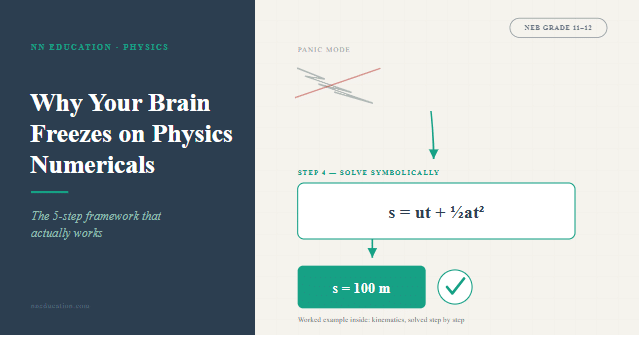
Step 4: Solve Symbolically First, Substitute Last
Many students plug numbers into a formula immediately and simplify as they go. This works for simple one-step problems, but for multi-step numericals, it’s a major source of arithmetic mistakes and wasted time.
Instead, rearrange the formula algebraically to isolate the unknown before substituting any numbers. For example, if you need to find acceleration from a kinematics equation, isolate “a” symbolically first, then plug in values once, at the very end. This approach has two benefits:
- If you make an arithmetic slip, it’s easier to spot and fix
- Partial marks are easier for examiners to award, because your logical steps are visible even if the final number is wrong
Step 5: Sanity-Check the Answer Against Reality
Before moving to the next question, ask: “Does this number make physical sense?” A calculated speed of 3,000 m/s for a thrown ball, or a resistance value that’s negative, is an immediate signal that something went wrong upstream — a sign flip, a unit error, or a misapplied formula.
This final check takes ten seconds but catches a large share of errors that would otherwise go unnoticed until the exam is already submitted.
A Worked Example: Putting the Framework Together
Problem: A car starts from rest and accelerates uniformly at 2 m/s² for 10 seconds. Find the distance covered.
Given: initial velocity (u) = 0 m/s, acceleration (a) = 2 m/s², time (t) = 10 s Find: distance (s) Formula: s = ut + ½at²
Units are already consistent (all SI), so no conversion needed. Solving symbolically:
s = (0)(10) + ½(2)(10)² s = 0 + ½(2)(100) s = 100 m
Sanity check: A car accelerating steadily for 10 seconds covering 100 meters is entirely reasonable — the answer holds up.
Notice how each step of the framework had a clear job. Nothing was rushed, and nothing depended on remembering the “trick” for this specific problem type. That’s the real advantage of a framework over memorized shortcuts: it transfers to problems you’ve never seen before, which is exactly what the NEB board exam is designed to test.
Why This Matters More Than Memorizing More Formulas
A common instinct when numericals feel hard is to memorize more formulas, hoping to recognize the “right one” faster. In practice, this often backfires — a large mental list of formulas without a clear process for applying them tends to increase exam-time confusion rather than reduce it.
The students who consistently perform well on physics numericals aren’t the ones who’ve memorized the most equations. They’re the ones who’ve internalized a process for approaching any problem, so that an unfamiliar question feels like a variation of something they already know how to handle, rather than something entirely new.
Practicing the Framework
The fastest way to build this habit is deliberate, slow practice — not speed. For your next problem set, force yourself to write out all five steps explicitly, even for questions you could technically solve faster. It will feel slow at first. Within two or three weeks of consistent practice, the steps compress into instinct, and your speed on genuinely difficult problems improves as a side effect.
Physics numericals reward structure more than raw talent. Build the structure once, and it holds up whether the topic is projectile motion, current electricity, or nuclear physics.