
A potentiometer wire is 10m long. It has a resistance of 20 [latex]\Omega[/latex]. It is connected in series with a battery of 3V and a resistance of 10 [latex]\Omega[/latex]. Calculate the potential gradient along the wire.
Solution
Length of potentiometer wire = 10 m
Resistance of wire [latex](R_{AB}) = 20 \Omega[/latex]
Emf of battery (E) = 3V
Resistance (R) = 10 [latex]\Omega[/latex]
Potential gradient (k) =?
We have,
Total resistance [latex](R_T) = R_{AB} + R[/latex]
= [latex] 20 \Omega + 10 \Omega = 30 \Omega[/latex]
Total current flowing (I) = [latex]\frac{E}{R_T} = \frac{3}{30} = 0.1 A[/latex]
Now, p.d. across wire [latex](V_{AB}) = IR_{AB} = 0.1\times 20[/latex]
= 2 V
Again,
Potential gradient (k) = [latex]\frac{V_{AB}}{l_{AB}} = \frac{2}{10}[/latex]
= 0.2 V/m
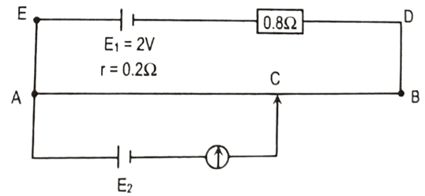
In the given diagram, AB is a potentiometer wire of length 1m and of resistance 4 [latex]\Omega[/latex]. If the balance length AC = 60 cm, what is the value of emf [latex]E_2[/latex]?
Solution
Emf of cell [latex](E_1)[/latex] = 2V
External resistance (R) = [latex]0.8\Omega[/latex]
Internal resistance of cell (r) = [latex]0.2\Omega[/latex]
Resistance of potentiometer wire [latex](R_{AB}) = 4\Omega[/latex]
Length of potentiometer wire [latex](l_{AB}) = 1m[/latex]
Balance length AC [latex](l_{AC}) = 60 cm = 0.6m[/latex]
Total resistance [latex](R_T)[/latex] = 0.8 + 0.2 + 4
= [latex]5\Omega[/latex]
Current flowing (I) = [latex]\frac{E}{R_T} = \frac{2}{5} = 0.4A[/latex]
Now, p.d. across whole wire [latex](V_{AB}) = IR_{AB}[/latex]
= [latex]0.4 \times 4 = 1.6 V[/latex]
Emf of length AC [latex](V_{AC} = E_2) =?[/latex]
We know, P.d. [latex](V) \propto l[/latex]
Or, [latex]\frac{V_{AB}}{V_{AC}} = \frac{l_{AB}}{l_{AC}}[/latex]
Or, [latex]\frac{1.6}{E_2} = \frac{1}{0.6}[/latex]
Or, [latex]E_2 = 0.96 V[/latex]
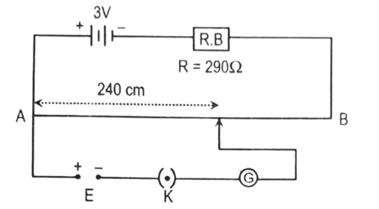
A potentiometer circuit is shown in figure. If the total length of potentiometer wire is 4m and has resistance [latex]10\Omega[/latex] and the balance point is obtained at a length of 240cm, calculate the value of unknown emf E.
Solution
Length of potentiometer wire [latex](l_{AB})[/latex] = 4m
Resistance of wire [latex](R_{AB}) = 10\Omega[/latex]
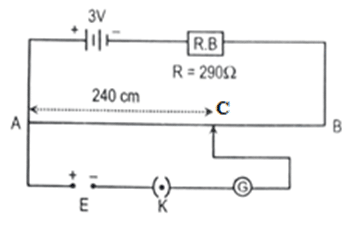
External resistance (R) = [latex]290\Omega[/latex]
Balancing length [latex](l_{AC}) = 240cm = 2.4m[/latex]
Total emf of battery = 3 V
Unknown emf (E = [latex]V_{AC}[/latex]) =?
We know,
Total resistance [latex](R_T) = 10 + 290[/latex]
= [latex]300\Omega[/latex]
Current flowing [latex](I) = \frac{Total\ Emf}{R_T} = \frac{3}{300}[/latex]
= 0.01 A
Now, p.d. across AB [latex](V_{AB}) = IR_{AB} = 0.01\times 10[/latex]
= 0.1 V
Again,
[latex]\frac{V_{AB}}{V_{AC}} = \frac{l_{AB}}{l_{AC}}[/latex]
Or, [latex]\frac{0.1}{E} = \frac{4}{2.4}[/latex]
Or, E = [latex]\frac{0.24}{4} = 0.06 V[/latex]
An unknown resistance [latex]R_1[/latex] is connected in series with resistance [latex]10\Omega[/latex]. This combination is connected to one of the gaps of a meter bridge, while another resistance [latex]R_2[/latex] is connected to next gap. The balance point is obtained at 50 cm. Now, when [latex]10\Omega[/latex] resistance is removed, the balance point is 40cm. Find the value of [latex]R_1[/latex].
Solution
Here, from first case,
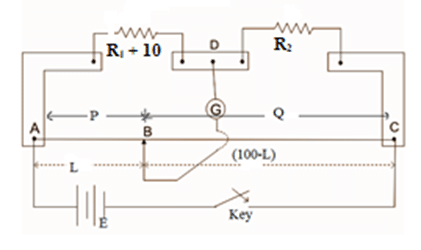
Balance point (L) = 50 cm
So, we have,
[latex]\frac{L}{100-L} = \frac{R_1 + 10}{R_2}[/latex]
Or, [latex]\frac{50}{50} = \frac{R_1 + 10}{R_2}[/latex]
Or, [latex]R_2 = R_1 + 10[/latex] ……….. (i)
From second case,
Balance point (L) = 40 cm
So, we have,
[latex]\frac{L}{100-L} = \frac{R_1}{R_2}[/latex]
Or, [latex]\frac{40}{60} = \frac{R_1}{R_1 + 10}[/latex] [latex][\because from\ eq^{n.}\ (i)][/latex]
Or, [latex]3R_1 = 2R_1 + 20[/latex]
Or, [latex]R_1 = 20\Omega[/latex]
A potentiometer is used to measure the internal resistance of a cell. When the cell in the secondary circuit is short circuited by [latex]5\Omega[/latex] resistor, the null point is at 220 cm. Again, when the cell is shunted by [latex]20\Omega[/latex] resistor, the null point is at 300cm. What is the internal resistance of the cell?
Solution
1st Case
External resistance (R) = 5Ω
Null point ([latex]l_2[/latex]) = 220 cm = 2.2 m
We know,
[latex]r = \left(\dfrac{l_1}{l_2} – 1\right) R[/latex], where, [latex]l_1[/latex] is the balancing length of open circuit
Or, [latex]\dfrac{r}{R} + 1 = \dfrac{l_1}{l_2}[/latex]
Or, [latex]\dfrac{r+R}{R} = \dfrac{l_1}{l_2}[/latex]
Or, [latex]l_2 = l_1 \left(\dfrac{R}{r+R}\right)[/latex]
So, [latex]2.2 = l_1 \left(\dfrac{5}{5+r}\right)[/latex] …….. (i)
Similarly, for 2nd Case
External resistance (R) = 20Ω
Null point ([latex]l_2[/latex]) = 300 cm = 3 m
Using formula,
[latex]l_2 = l_1 \left(\dfrac{R}{r+R}\right)[/latex]
Or, [latex]3 = l_1 \left(\dfrac{20}{20+r}\right)[/latex] …………. (ii)
Dividing equation (ii) by (i), we get,
[latex]\dfrac{3}{2.2} = \dfrac{20}{20+r} \times \dfrac{5+r}{5}[/latex]
Or, [latex]3(20+r) = 8.8(5+r)[/latex]
Or, [latex]60 + 3r = 44 + 8.8r[/latex]
Or, [latex]16 = 5.8r[/latex]
Or, [latex]r = \dfrac{16}{5.8} = 2.76\Omega[/latex]
A galvanometer has a resistance of [latex]10\Omega[/latex]. It gives maximum deflection for a current of 50 mA. Find the shunt resistance to convert it into ammeter of range 2.5A.
Solution
Given,
Resistance of galvanometer (G) = [latex]10\ \Omega[/latex]
Current through galvanometer ([latex]I_g[/latex]) = [latex]50\ mA = 5 \times 10^{-2}\ A[/latex]
Current (I) = 2.5A
Resistance of shunt used ([latex]R_s[/latex]) =?
We know that,
[latex]R_s = \dfrac{I_g(G)}{(I – I_g)}[/latex]
[latex]= \dfrac{(5\times 10^{-2}) \times 10}{2.5 – (5\times 10^{-2})}[/latex]
[latex]= \dfrac{0.5}{2.45}[/latex]
[latex]= 0.2\ \Omega.[/latex]
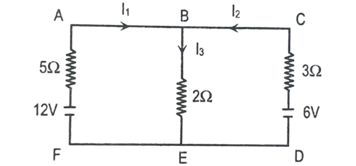
Using Kirchhoff’s laws in the electrical network shown in the adjacent figure.
i. Calculate the value of [latex]I_1[/latex] and [latex]I_2[/latex].
ii. p.d. between points A and F.
Solution
i. From figure, at junction B,
[latex]I_1 + I_2 = I_3[/latex]
In the closed loop AFEBA, using KVL,
[latex]-12 = -5I_1 + 2(-I_3)[/latex]
Or, [latex]12 = 5I_1 + 2(I_1+I_2)[/latex]
Or, [latex]12 = 7I_1 + 2I_2[/latex] …………… (i)
Again, for closed loop BEDCB, using KVL,
[latex]6 = 3I_2 + 2I_3[/latex]
Or, [latex]6 = 3I_2 + 2(I_1+I_2)[/latex]
Or, [latex]6 = 2I_1 + 5I_2[/latex] …………… (ii)
Now, solving equations (i) and (ii), we get,
[latex]-18 = -31I_2[/latex]
Or, [latex]I_2 = 0.58\ A[/latex]
Again, from equation (i), we get,
[latex]12 = 7I_1 + 2 \times 0.58[/latex]
Or, [latex]I_1 = 1.55\ A[/latex]
ii. p.d. between points A and F ([latex]V_{AF}[/latex]) =?
First, p.d. across 5Ω resistor = [latex]I_1 \times 5 = 1.55 \times 5 = 7.75\ V[/latex]
So, p.d. across points A and F = 7.75 + 12 = 19.75 V
The emf of a battery is balanced by a length 75 cm on a potentiometer wire and emf of a standard cell of 1.02 volt is balanced by a length 50 cm of it. Calculate the emf of the battery.
Solution
Emf of a battery [latex](E_1)[/latex] =?
Balancing length [latex](l_1)[/latex] = 75 cm = 0.75 m
Emf of a standard cell [latex](E_2)[/latex] = 1.02 V
Balancing length [latex](l_2)[/latex] = 50 cm = 0.5 m
We know that,
[latex]\dfrac{E_1}{E_2} = \dfrac{l_1}{l_2}[/latex]
Or, [latex]\dfrac{E_1}{1.02} = \dfrac{0.75}{0.5}[/latex]
Or, [latex]E_1 = 1.53\ V[/latex]
A moving coil meter has a resistance of 25Ω and indicates full scale deflection when a current of 4.0 mA flows through it. How could this meter be converted to a milliammeter having a full-scale deflection for a current of 50mA?
Solution
Given,
Resistance of galvanometer (G) = 25 Ω
Current through galvanometer [latex] (I_g) = 4.0\ mA = 4\times10^{-3}\ A[/latex]
Current (I) = 50 mA = [latex]50\times10^{-3}\ A = 5\times10^{-2}\ A[/latex]
Resistance of shunt used [latex](R_s)[/latex] =?
We know that,
[latex]R_s = \dfrac{I_g(G)}{(I-I_g)}[/latex]
[latex]= \dfrac{(4\times10^{-3})\times25}{5\times10^{-2}-4\times10^{-3}}[/latex]
[latex]= \dfrac{0.1}{0.046}[/latex]
[latex]= 2.17\ \Omega[/latex]
The resistance of the coil of a galvanometer is 9.36Ω and a current of 0.0224 A causes it to deflect full scale. The only shunt available has a resistance 0.025Ω. What resistance must be connected in series with the coil to make it an ammeter of range 0 – 20A?
Solution
Given,
Resistance of galvanometer (G) = 9.36 Ω
Current through galvanometer [latex](I_g) = 0.0224\ A[/latex]
Current (I) = 20 A
Resistance of shunt used [latex](R_s)[/latex] = 0.025 Ω
Resistance to be connected in series (R) =?
We know that,
[latex]R_s = \dfrac{I_g(G+R)}{(I-I_g)}[/latex]
Or, [latex]0.025 = \dfrac{0.0224\times(9.36+R)}{20-0.0224}[/latex]
Or, [latex]0.499 = 0.0224(9.36+R)[/latex]
Or, [latex]9.36+R = \dfrac{0.499}{0.0224} = 22.29[/latex]
Or, [latex]R = 12.94\ \Omega[/latex]
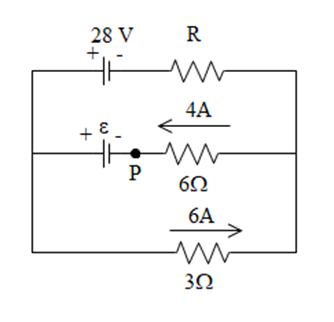
In the adjacent circuit find:
i. the current in resistor R,
ii. resistance R,
iii. the unknown emf [latex]\epsilon[/latex],
iv. if the circuit is broken at P, what is the current in resistor R?
Solution
Given,
(i)
Let, [latex]I_1 = 6A[/latex]
[latex]I_2 = 4A[/latex]
[latex]I_3 = ?[/latex]
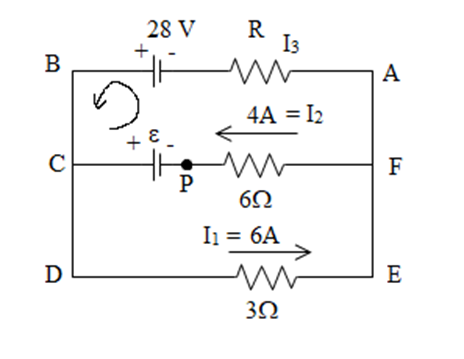
In the junction, F, using KCL, we get,
[latex]I_1 = I_2 + I_3[/latex]
Or, [latex]6 = 4 + I_3[/latex]
Or, [latex]I_3 = 2A[/latex]
So, current in the resistor R = 2A
ii)
In the loop ABDEA, using KVL, we get,
[latex]28 = 6\times3 + I_3.R[/latex]
Or, [latex]28 = 18 + 2R[/latex]
Or, [latex]28 – 18 = 2R[/latex]
Or, [latex]2R = 10[/latex]
Or, [latex]R = \dfrac{10}{2} = 5\Omega[/latex].
iii)
In loop ABCFA, using KVL, we get,
[latex]28 – \epsilon = 6\times(-4) + I_3.R[/latex]
Or, [latex]28 – \epsilon = -24 + 2\times5[/latex]
Or, [latex]28 – \epsilon = -14[/latex]
Or, [latex]\epsilon = 28 + 14[/latex]
Or, [latex]\epsilon = 42\ V[/latex]
iv) If the circuit is broken at P, this means, there is no flow of current in the direction CF.
So, Total resistance in the circuit becomes [latex](R_T) = 5 + 3 = 8\ \Omega[/latex]
Now, The current flowing through R = [latex]\dfrac{V}{R_T}[/latex]
[latex]= \dfrac{28}{8} = 3.5\ A[/latex]
A potentiometer is 10 m long. It has a resistance of 20 Ω. It is connected in series with a battery of 3 V and a resistance of 10 Ω. What is the potential gradient along with wire?
Solution
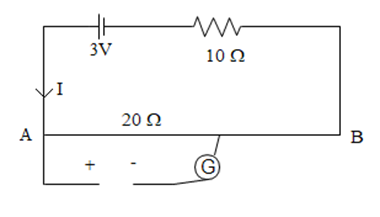
Given,
Length of potentiometer wire [latex](l_{AB}) = 10\ m[/latex]
Resistance of potentiometer wire [latex]R_{AB} = 20\ \Omega[/latex]
Emf (E) = 3V
Resistance (R) = 10 Ω
Potential gradient (K) =?
We know,
Total resistance [latex](R_T) = R_{AB} + R[/latex] [∵ in series]
[latex]= 20 + 10 = 30\ \Omega[/latex]
Current flowing in the circuit [latex](I) = \dfrac{E}{R_T}[/latex]
[latex]= \dfrac{3}{30} = 0.1\ A[/latex]
Now, p.d. across potentiometer wire [latex](V_{AB}) = I \times R_{AB}[/latex]
[latex]= 0.1 \times 20 = 2V[/latex]
So, potential gradient [latex](K) = \dfrac{V_{AB}}{l_{AB}}[/latex]
[latex]= \dfrac{2}{10} = 0.2\ Vm^{-1}[/latex]
What must be the emf E in the circuit so that the current flowing through the 7 Ω resistor is 1.80 A? Each emf source has negligible internal resistance.
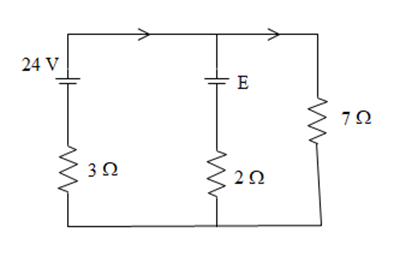
Solution
Given,
Current flowing through 7 Ω resistor [latex](I_1) = 1.8\ A[/latex]
Suppose, current flowing through 2 Ω and 3 Ω resistors be [latex]I_2[/latex] and [latex]I_3[/latex] respectively.
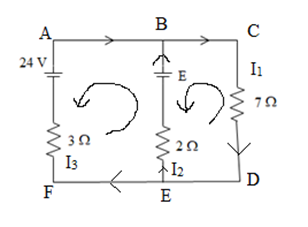
In the junction E, using KCL, we get,
[latex]I_1 = I_2 + I_3[/latex]
Or, [latex]1.8 = I_2 + I_3[/latex] …………………… (i)
Also, in the loop BCDEB, using KVL, we get,
[latex]-E = 7.(-I_1) + 2.(-I_2)[/latex]
Or, [latex]E = 7I_1 + 2I_2[/latex]
Or, [latex]E = 7\times1.8 + 2I_2[/latex]
Or, [latex]E = 12.6 + 2I_2[/latex] …………………… (ii)
Now, in the loop ACDFA, using KVL, we get,
[latex]-24 = 7.(-I_1) + 3.(-I_3)[/latex]
Or, [latex]24 = 7I_1 + 3I_3[/latex]
Or, [latex]24 = 7\times1.8 + 3I_3[/latex]
Or, [latex]24 = 12.6 + 3I_3[/latex]
Or, [latex]11.4 = 3I_3[/latex]
Or, [latex]I_3 = \dfrac{11.4}{3}[/latex]
Or, [latex]I_3 = 3.8\ A[/latex]
From eqn. (i), we get,
[latex]1.8 = I_2 + I_3[/latex]
Or, [latex]1.8 – 3.8 = I_2[/latex]
Or, [latex]I_2 = -2A[/latex]
Again, from eqn. (ii), we get,
[latex]E = 12.6 + 2I_2[/latex]
[latex]= 12.6 + 2(-2)[/latex]
[latex]= 12.6 – 4[/latex]
[latex]= 8.6\ V[/latex]
A simple potentiometer circuit is setup as in fig Q(1), using uniform wire AB, 1.0 m long, which has a resistance of 2 Ω. The resistance of the 4V battery is negligible. If the variable resistor R were given a value of 2.4 Ω, what would be the length AC for zero galvanometer deflection?
Solution
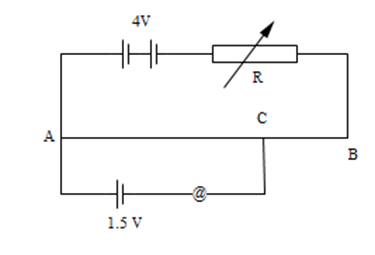
Given,
Length of potentiometer wire [latex](l_{AB}) = 1\ m[/latex]
Resistance of potentiometer wire [latex](R_{AB}) = 2\ \Omega[/latex]
Emf (E) = 4V
Variable resistance (R) = 2.4 Ω
Length of AC [latex](l_{AC})[/latex] =?
Total resistance [latex](R_T) = R_{AB} + R[/latex] [∵ in series]
[latex]= 2 + 2.4 = 4.4\ \Omega[/latex]
Current flowing in the circuit [latex](I) = \dfrac{E}{R_T}[/latex]
[latex]= \dfrac{4}{4.4} = 0.909\ A[/latex]
Now, p.d. across potentiometer wire [latex](V_{AB}) = I \times R_{AB}[/latex]
[latex]= 0.909 \times 1 = 0.909\ V[/latex]
Now, p.d. across AC [latex](V_{AC}) = IR_{AC}[/latex]
Or, [latex]R_{AC} = \dfrac{V_{AC}}{I}[/latex]
[latex]= \dfrac{1.5}{0.909} = 1.65\Omega[/latex]
Since, 2Ω wire has length 1 m.
1.65 Ω wire has length [latex]\dfrac{1}{2} \times 1.65[/latex]
[latex]= 0.825\ m = 82.5\ cm[/latex]
A battery of 6V and internal resistance 0.5 Ω is joined in parallel with another of 10V and internal resistance 1 Ω. The combination sends a current through an external resistance of 12 Ω. Find the current through each battery.
Solution
Given,
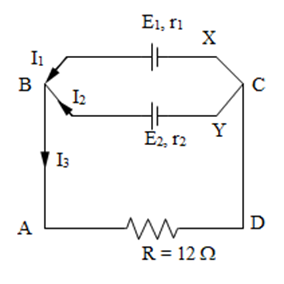
Emf of battery [latex](E_1) = 6\ V[/latex]
Its internal resistance [latex](r_1) = 0.5\ \Omega[/latex]
Emf of another battery [latex](E_2) = 10V[/latex]
Its internal resistance [latex](r_2) = 1\ \Omega[/latex]
External resistance (R) = 12 Ω
Current through battery 1 [latex](I_1)[/latex] =?
Current through battery 2 [latex](I_2)[/latex] =?
We have in junction B, using KCL,
[latex]I_3 = I_1 + I_2[/latex] …………………. (i)
Again, in closed loop ABXCDA, using KVL, we get,
[latex]E_1 = I_1r_1 + I_3R[/latex]
Or, [latex]6 = 0.5I_1 + 12I_3[/latex]
Or, [latex]6 = 0.5I_1 + 12(I_1+I_2)[/latex] [∵ from eqn. (i)]
Or, [latex]6 = 0.5I_1 + 12I_1 + 12I_2[/latex]
Or, [latex]6 = 12.5I_1 + 12I_2[/latex] ………………….. (ii)
Now, in closed loop ABYCDA, using KVL, we get,
[latex]10 = I_2r_2 + I_3R[/latex]
Or, [latex]10 = I_2 + 12I_3[/latex]
Or, [latex]10 = I_2 + 12(I_1+I_2)[/latex] [∵ from eqn. (i)]
Or, [latex]10 = I_2 + 12I_1 + 12I_2[/latex]
Or, [latex]10 = 12I_1 + 13I_2[/latex] ……………………. (iii)
Solving eqns. (ii) & (iii), we get,
[latex]I_1 = -2.27\ A[/latex] & [latex]I_2 = 2.86\ A[/latex]
The total length of the wire of potentiometer if 10 m. A potential gradient of 0.0015 V/cm is obtained when a steady current is passed through this wire. Calculate,
i. The distance of null point on connecting standard cell of 1.018V.
ii. The unknown p.d. if the null point is obtained at a distance of 940 cm, and
iii. The maximum p.d. which can be measured by this instrument.
Solution
Given,
Total length of potentiometer wire (L) = 10 m
Potential gradient (k) = 0.0015 V/cm = 0.15 V/m
(i) distance of null point [latex](l_1)[/latex] =?
Emf of standard cell [latex](V_1) = 1.018\ V[/latex]
We have, for potentiometer,
[latex]V_1 \propto l_1[/latex]
Or, [latex]V_1 = kl_1[/latex]
Or, [latex]l_1 = \dfrac{V_1}{k} = \dfrac{1.018}{0.15} = 6.787\ m[/latex]
(ii) distance [latex](l_2)[/latex] = 940 cm = 9.4 m
Unknown p.d. [latex](V_2)[/latex] =?
We have,
[latex]V_2 = kl_2[/latex]
[latex]= 0.15 \times 9.4[/latex]
[latex]= 1.41\ V[/latex]
(iii) Maximum p.d. that can be measured with this instrument (V) = kL
[latex]= 0.15 \times 10[/latex]
[latex]= 1.5\ V[/latex]
Using Kirchhoff’s laws of current and voltage, find the current in 2 Ω resistor in the given circuit.
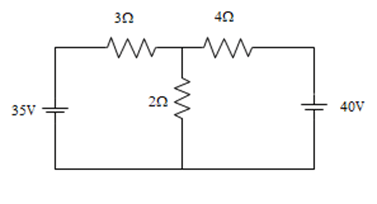
Solution
Given,
Current through 2 Ω resistor [latex](I_2)[/latex] =?
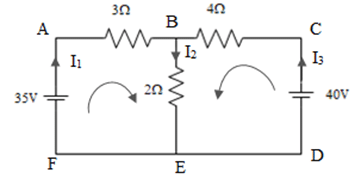
In junction B, using KCL, we get,
[latex]I_2 = I_1 + I_3[/latex] ………………. (i)
In closed loop ABEFA, using KVL,
[latex]35 = 3I_1 + 2I_2[/latex]
Or, [latex]35 = 3(I_2 – I_3) + 2I_2[/latex] [∵ from eqn. (i)]
Or, [latex]35 = 3I_2 – 3I_3 + 2I_2[/latex]
Or, [latex]35 = 5I_2 – 3I_3[/latex] ………………. (ii)
Again, in closed loop BCDEB, using KVL, we get,
[latex]40 = 4I_3 + 2I_2[/latex] …………….. (iii)
Solving eqns. (ii) & (iii), we get, [Multiplying (ii) by 4 and (iii) by 3 and adding]
[latex]140 = 20I_2 – 12I_3[/latex]
[latex]120 = 12I_3 + 6I_2[/latex]
Or, [latex]260 = 26I_2[/latex]
Or, [latex]I_2 = \dfrac{260}{26}[/latex]
[latex]= 10A[/latex]
The driver cell of a potentiometer has an e.m.f. of 2 V and negligible internal resistance. The potentiometer wire has a resistance of 3 ohm. Calculate the resistance needed in series with the wire if a p.d. 5.0 mV is required across the whole wire. The wire is 100.0 cm long and a balanced length of 60 cm is obtained for a thermocouple of e.m.f. E. What is the value of E?
Solution
Given,
Emf (E) = 2V
Resistance of potentiometer wire (R) = 3 Ω
Resistance needed in series (R’) =?
P.d. (V) = 5 mV = [latex]5\times10^{-3}\ V[/latex]
We know that,
[latex]V = IR[/latex]
Or, [latex]V = \dfrac{E}{R+R’}R[/latex]
Or, [latex]5\times10^{-3} = \dfrac{2}{3+R’}\times3[/latex]
Or, [latex]3 + R’ = \dfrac{6}{5\times10^{-3}}[/latex]
Or, [latex]R’ = 1200 – 3[/latex]
[latex]= 1197\Omega[/latex]
Again, by the principle of potentiometer,
[latex]\dfrac{V}{V’} = \dfrac{l}{l’}[/latex]
[latex]Or,\ \dfrac{5\times10^{-3}}{E} = \dfrac{1}{0.6}[/latex]
[latex]Or,\ E = 0.003\ V[/latex]
Or, E = 3 mV