
Periodic Motion is a consistently high-yield chapter in Grade XII Physics, appearing in nearly every NEB and HISSAN board paper through a predictable mix of MCQs, derivations, and numerical problems on simple harmonic motion (SHM). A clear pattern emerges from past papers: theory questions frequently ask students to derive the total energy of a particle executing SHM, prove that a simple pendulum’s motion is simple harmonic, and explain how time period changes with length or mass (e.g., “what happens to time period if length is increased 4 times”). Numerical problems consistently test velocity and acceleration at the mean and extreme positions of a swinging pendulum, along with spring-mass systems and their force constants.
Below is a complete collection of past NEB and HISSAN board questions on this chapter (2072–2082), organized by MCQs, theory questions, and numerical problems. For step-by-step worked solutions to the numerical problems, see the Solutions section for this chapter.
MCQs
The length of a pendulum is increased by 21%. By what percentage, the period of the motion increases?
Show answer
A body is executing SHM with amplitude A. At what displacement from mean position, its kinetic energy will be half of its maximum value?
Show answer
If the time period of oscillation of mass ‘m’ suspended from a spring is 2 sec, what will be the period of oscillation of mass ‘9m’?
Show answer
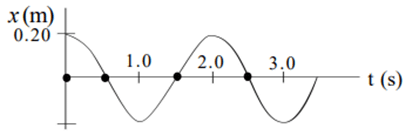
For an oscillating object, the displacement versus time curve shown in figure. What is the velocity of the object in the mean position?
Show answer
What will happen to the time period of a simple pendulum when its length is increased by 4 times?
Show answer
For a simple pendulum, the graph between [latex]l[/latex] and [latex]T^2[/latex] comes out to be
Show answer
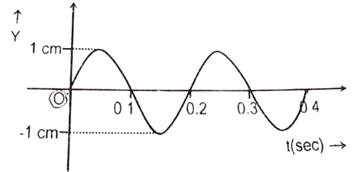
The displacement versus time graph of particles in SHM is shown in figure. The maximum velocity of the particle is
Show answer
The period of oscillation of mass M suspended from a spring is 2 seconds. What will be the period if mass is equal to 4M?
You've reached the end of the free preview. Continue with NN Premium.
- Complete access to every Premium chapter
- Notes, QBank, solutions & MCQs
- Premium PDFs & study resources
- Entrance preparation & mock tests
One NN Premium subscription unlocks everything.