
Periodic motion
The motion that repeats in the regular (equal) interval of time is called periodic motion. Periodic motion can be circular, elliptical, Oscillatory etc.
For example, elliptical → motion of earth.
Oscillatory → Motion of pendulum, motion of swing, motion of air particles in sound wave, motion of tuning fork, motion of guitar wire, motion of water particles when stone is dropped on water.
Circular → a stone tied on the thread and rotated, motion of cycle in curve path etc.
Oscillatory motion or vibratory motion:
To and fro motion about the mean position is called oscillatory or vibratory motion. Small oscillations are called vibration. Here, amplitude is small.
Harmonic motion:
If the motion of any object like displacement, velocity, acceleration etc. can be expressed in terms of harmonic functions like sine, cosine etc. then, the motion is called harmonic motion.
Simple Harmonic motion:
The harmonic motion of simplest type (i.e. amplitude, frequency, period) is called simple harmonic motion.
It deals with an oscillatory motion (to and fro) in which the acceleration produced by the body is directly proportional to the displacement produced & acceleration is always directed towards a fixed point called mean position. i.e., a ∝ y, where a is acceleration & y is displacement.
Or, a =-ky.
Negative sign shows that a and y are in opposite direction.
Note: If a guitar wire is plucked then,
It moves back and forth.
If a paper boat is kept in still water, and if a stone is dropped, paper boat (water particles) moves back and forth i.e. simple harmonic motion.
Equation of Simple Harmonic Motion:
The motion of a particle in a circle is periodic but not oscillatory. But, if we project the motion of the particle to any linear path, the motion becomes periodic as well as oscillatory.
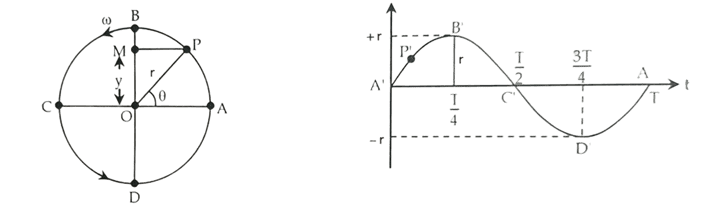
Let us consider, a particle is moving around a circle of radius r with uniform angular velocity [latex]\omega[/latex]. Let, at any instant t, P (x, y) be the position of the particle and [latex]\theta[/latex] be the angle at origin. The projection OM on y-axis from the point P represents the displacement of the particle at time t, as shown in figure along with the graph.
Displacement (y):
In the figure above, OM is the displacement.
In [latex]\Delta[/latex]OPM,
[latex]sin\angle OPM = sin\theta = \frac{OM}{OP}[/latex]
= [latex]\frac{y}{r}[/latex]
Or, y = rSin[latex]\theta[/latex] …………. (i)
Now, angular displacement is [latex]\theta[/latex] for which angular velocity ‘ω’ = [latex]\frac{\theta}{t}[/latex]
Or, [latex]\theta = \omega t[/latex].
Putting the value of [latex]\theta[/latex] in eqn. (i), we get,
y = rSinωt
Velocity (v):
It is the rate of change of displacement. It is denoted by v. i.e. v = [latex]\frac{dy}{dx}[/latex]
We have, y = rSinωt , where, amplitude (A) = r
Or, [latex]\frac{dy}{dt} = \frac{d}{dt}(rSin\omega t)[/latex]
= r[latex]\frac{d(sin\omega t)}{d(\omega t)}\times \frac{d(\omega t)}{dt}[/latex]
Or, v = rωCosωt
Or, v = rω [latex]\sqrt{1 – sin^2\omega t}[/latex]
Or, v = ω [latex]\sqrt{r^2-r^2sin^2\omega t}[/latex]
Or, v = ω[latex]\sqrt{r^2 – y^2}[/latex]
i) At mean position, y = 0.
So, v = ω[latex]\sqrt{r^2 – y^2}[/latex]
Or, v = ω[latex]\sqrt{r^2 – 0}[/latex]
Or, v = ωr.
So, velocity is maximum at mean position.
ii) At extreme position, y = r.
So, v = ω[latex]\sqrt{r^2 – y^2}[/latex]
Or, v = ω[latex]\sqrt{r^2 – r^2}[/latex]
Or, v = 0.
So, velocity is minimum (zero) at extreme position.
Acceleration:
The rate of change of velocity is called acceleration. It is denoted by a.
i.e., a = [latex]\frac{dv}{dt}[/latex]
Or, a = [latex]\frac{d}{dt}(r\omega cos\omega t)[/latex]
= r[latex]\omega \frac{d(cos\omega t)}{d\omega}\times \frac{d\omega t}{dt}[/latex]
= -r[latex]\omega sin\omega t . \omega[/latex]
Or, a = -r[latex]\omega^2 sin\omega t[/latex]
∴ a = – [latex]\omega^2 y[/latex]
i) At mean position, y = 0.
a = – [latex]\omega^2 y = \omega^2.0 = 0[/latex]
i.e., acceleration produced in mean position is zero.
ii) At extreme position, y = r.
So, a = – [latex]\omega^2 r[/latex]
Time Period:
It is the time required for one complete oscillation. It is denoted by T. We have, the magnitude of acceleration of a body executing S.H.M. is:
a = – [latex]\omega^2y[/latex]
a = [latex](\frac{2\pi}{T})^2y[/latex]
Or, a = [latex]\frac{4\pi^2}{T^2}y[/latex]
Or, T2 = [latex]\frac{4\pi^2}{a}y[/latex]
∴ T = 2π [latex]\sqrt{\frac{y}{a}}[/latex]
Frequency:
It is no. of oscillation in one second.
f = 1/T.
= [latex]\frac{1}{2\pi\sqrt{\frac{y}{a}}}[/latex]
= [latex]\frac{1}{2\pi}\sqrt{\frac{Acceleration (a)}{Displacement(y)}}[/latex]
Phase ([latex]\phi[/latex]):
Phase explains the state of particle at any instant of time. The state of particle means where is the particle and what is the direction of motion of the particle.
In fact, phase is the angle (angular displacement) which is represented by [latex]\phi[/latex]. Its unit is radian. Mathematically,
[latex]\phi[/latex] = [latex]\frac{2\pi}{\lambda}[/latex].x where, x = displacement.
Simple Harmonic Motion:
This is an oscillatory motion where an acceleration of a body is directly proportional to displacement and acceleration is always directed towards fixed point. So, if a particle moves in ‘to and fro’ motion in a straight line such that acceleration produced is directly proportional to the displacement from that position, it is said to have S.H.M.
Characteristics of S.H.M.
For a body executing S.H.M.
- It is to and fro motion about their mean position.
- Its acceleration is directly proportional to displacement from mean position. i.e., a ∝ y
- Its acceleration always directed towards mean position.
- It is periodic motion.
Simple Pendulum:
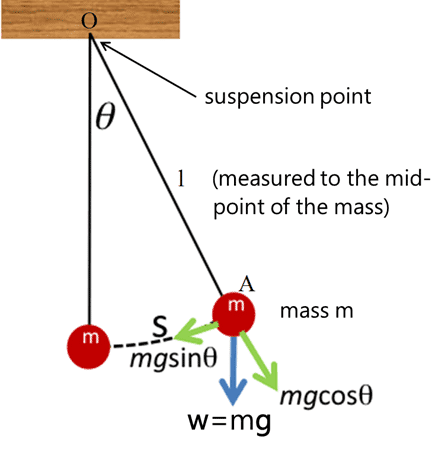
A simple pendulum is a system of a point mass (bob) suspended at the end of a weightless and inextensible thread attached to a rigid support. The length from the point of suspension to the centre of gravity (cg) of the bob is called its effective length as shown in figure.
You've reached the end of the free preview. Continue with NN Premium.
- Complete access to every Premium chapter
- Notes, QBank, solutions & MCQs
- Premium PDFs & study resources
- Entrance preparation & mock tests
One NN Premium subscription unlocks everything.