
A glass rod is rubbed with silk and acquires a charge of magnitude 7.50 nC. What is the change in mass of the rod?
Solution
Charge (Q) = 7.50 nC = [latex]7.50\ nC = 7.5\times 10^{-9}[/latex]
Change in mass of rod [latex](\Delta m)[/latex] =?
The glass rod loses electrons when rubbed with silk, acquiring a positive charge.
From quantization of charge,
Q = ne
Or, [latex]n = \frac{Q}{e}[/latex]
= [latex]\frac{7.5\times 10^{-9}}{1.6\times 10^{-19}}[/latex]
= [latex]4.687\times 10^{10}[/latex]
[latex]\therefore[/latex] Change in mass [latex](\Delta m) = n \times m_e[/latex]
= [latex](4.687\times 10^{10})\times (9.1\times 10^{-31})[/latex]
= [latex]4.265\times 10^{-20}[/latex] kg
Calculate the value of two equal charges if they repel each other with a force of 0.1N when situated 50 cm apart in vacuum. What would be the distance between them if are placed in an insulating medium of dielectric constant 10?
Solution
Given,
Force of repulsion in vacuum (F) = 0.1 N
Distance between charges in vacuum (r) = 50 cm = 0.5 m
Dielectric constant of insulating medium (K) = 10
Value of each charge (q) =?
Distance between charges in medium (r’) =? [for the same force to act]
We know that, by Coulomb’s law, for equal charges [latex](q_1 = q_2 = q)[/latex] in vacuum,
[latex]F = \dfrac{1}{4\pi\varepsilon_0}\dfrac{q^2}{r^2}[/latex]
[latex]F = k\dfrac{q^2}{r^2}[/latex] where [latex]k = \dfrac{1}{4\pi\varepsilon_0} = 9 \times 10^9\ Nm^2C^{-2}[/latex]
[latex]0.1 = (9 \times 10^9) \times \dfrac{q^2}{(0.5)^2}[/latex]
[latex]q^2 = \dfrac{0.1 \times (0.5)^2}{9 \times 10^9}[/latex]
[latex]q^2 = \dfrac{0.025}{9 \times 10^9}[/latex]
[latex]q^2 = 2.778 \times 10^{-12}[/latex]
[latex]q = \sqrt{2.778 \times 10^{-12}}[/latex]
[latex]q = 1.667 \times 10^{-6}\ C[/latex]
[latex]q = 1.667\ \mu C.[/latex]
Now, when the same charges are placed in an insulating medium of dielectric constant (K) = 10, the force between them (in medium) is,
[latex]F = \dfrac{1}{4\pi\varepsilon_0 K}\dfrac{q^2}{r’^2} = \dfrac{k q^2}{K r’^2}[/latex]
where, k = [latex]\frac{1}{4\pi \epsilon_o}[/latex]
[latex]0.1 = \dfrac{(9 \times 10^9) \times (1.667 \times 10^{-6})^2}{10 \times r’^2}[/latex]
[latex]0.1 = \dfrac{0.025}{10 \times r’^2}[/latex]
[latex]r’^2 = \dfrac{0.025}{10 \times 0.1}[/latex]
[latex]r’^2 = 0.025[/latex]
[latex]r’ = \sqrt{0.025}[/latex]
[latex]r’ = 0.1581\ m[/latex]
[latex]r’ = 15.81\ cm.[/latex]
So, the value of each charge is 1.667 μC, and the distance between them in the insulating medium (for the same force) should be 15.81 cm.
Two-point charges are placed on the x-axis as follows:
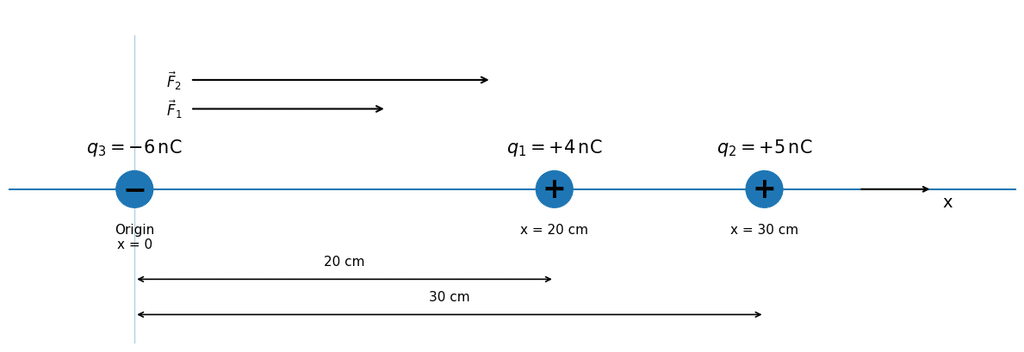
Charge [latex]q_1 = +4nC[/latex] is located at x = 20 cm and charge [latex]q_2 = 5nC[/latex] is at x = 30 cm from the origin. Find the magnitude and direction of the total force experienced by the two charges in a negative point charge, [latex]q_3 = -6nC[/latex] placed at the origin.
Solution
Given,
Charge [latex](q1) = +4\ nC = 4 \times 10^{-9}\ C[/latex], located at [latex]x_1[/latex] = 20 cm = 0.2 m
Charge [latex](q_2) = +5\ nC = 5 \times 10^{-9}\ C[/latex], located at [latex]x_2[/latex] = 30 cm = 0.3 m
Charge [latex](q_3) = -6 nC = 6 \times 10^{-9}\ C[/latex] (magnitude), located at origin (x = 0)
Total force on [latex]q_3[/latex] (F) =?
We know that, by Coulomb’s law,
Force on [latex]q_3[/latex] due to [latex]q_1[/latex], since [latex]q_1[/latex] and [latex]q_3[/latex] are separated by [latex]r_1[/latex] = 0.2 m,
[latex]F_1 = k\dfrac{|q_1 q_3|}{r_1^2}[/latex]
[latex]F_1 = (9 \times 10^9) \times \dfrac{(4 \times 10^{-9})(6 \times 10^{-9})}{(0.2)^2}[/latex]
[latex]F_1 = (9 \times 10^9) \times \dfrac{24 \times 10^{-18}}{0.04}[/latex]
[latex]F_1 = 5.4 \times 10^{-6}\ N[/latex]
Since [latex]q_1[/latex] is positive and [latex]q_3[/latex] is negative, this force is attractive (along the +x direction).
Force on [latex]q_3[/latex] due to [latex]q_2[/latex], since [latex]q_2[/latex] and [latex]q_3[/latex] are separated by [latex]r_2[/latex] = 0.3 m,
[latex]F_2 = k\dfrac{|q_2 q_3|}{r_2^2}[/latex]
[latex]F_2 = (9 \times 10^9) \times \dfrac{(5 \times 10^{-9})(6 \times 10^{-9})}{(0.3)^2}[/latex]
[latex]F_2 = (9 \times 10^9) \times \dfrac{30 \times 10^{-18}}{0.09}[/latex]
[latex]F_2 = 3.0 \times 10^{-6}\ N[/latex]
Since [latex]q_2[/latex] is positive and [latex]q_3[/latex] is negative, this force is also attractive (along the +x direction).
Since both [latex]F_1[/latex] and [latex]F_2[/latex] act on [latex]q_3[/latex] along the same direction (+x direction), the total (net) force on [latex]q_3[/latex] is,
[latex]F = F_1 + F_2[/latex]
[latex]F = (5.4 \times 10^{-6}) + (3.0 \times 10^{-6})[/latex]
[latex]F = 8.4 \times 10^{-6}\ N[/latex]
[latex]F = 8.4\ \mu N.[/latex]
So, the total force experienced by [latex]q_3[/latex] has magnitude 8.4 μN, directed along the positive x-axis (i.e., towards [latex]q_1[/latex] and [latex]q_2[/latex]).
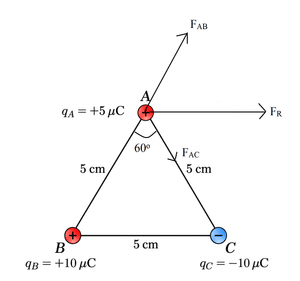
Three charges [latex]+5\mu C[/latex], [latex]+10\mu C[/latex] and [latex]-10\mu C[/latex] are placed in air at the corners A, B and C of an equilateral triangle ABC having each side equal to 5cm. Determine the resultant force on the charge at A.
Solution
Given,
Charge at A [latex](q_A) = +5 μC = 5 \times 10^{-6}[/latex] C
Charge at B [latex](q_B) = +10 μC = 10 \times 10^{-6}[/latex] C
Charge at C [latex](q_C) = -10 μC = 10 \times 10^{-6}[/latex] C (magnitude)
Side of equilateral triangle (r) = AB = BC = CA = 5 cm = 0.05 m
Resultant force on charge at A (F) =?
We know that, by Coulomb’s law,
Force on A due to B [latex](F_{AB}) = k\dfrac{q_A q_B}{r^2}[/latex]
[latex]F_{AB} = (9 \times 10^9) \times \dfrac{(5 \times 10^{-6})(10 \times 10^{-6})}{(0.05)^2}[/latex]
[latex]F_{AB} = (9 \times 10^9) \times \dfrac{50 \times 10^{-12}}{0.0025}[/latex]
[latex]F_{AB} = 180\ N[/latex]
Since [latex]q_A\ and\ q_B[/latex] are both positive, this force is repulsive, i.e. it acts on A along the direction away from B (along BA produced).
Force on A due to C [latex]F_{AC} = k\dfrac{q_A q_C}{r^2}[/latex]
[latex]F_{AC} = (9 \times 10^9) \times \dfrac{(5 \times 10^{-6})(10 \times 10^{-6})}{(0.05)^2}[/latex]
[latex]F_{AC} = 180\ N[/latex]
Since [latex]q_A[/latex] is positive and [latex]q_C[/latex] is negative, this force is attractive, i.e. it acts on A along the direction towards C (along AC).
Now, since ABC is an equilateral triangle, the angle between the line BA (produced) and the line AC is,
[latex]\theta = 180^o – 60^o = 120^o[/latex]
[i.e. the angle between the directions of [latex]F_{AB}\ and\ F_{AC}[/latex] is 120°]
So, resultant force on A, using the law of vector addition (parallelogram law),
[latex]F = \sqrt{F_{AB}^2 + F_{AC}^2 + 2F_{AB}F_{AC}\cos\theta}[/latex]
[latex]F = \sqrt{(180)^2 + (180)^2 + 2(180)(180)\cos 120^o}[/latex]
[latex]F = \sqrt{32400 + 32400 + 2(32400)(-0.5)}[/latex]
[latex]F = \sqrt{64800 – 32400}[/latex]
[latex]F = \sqrt{32400}[/latex]
[latex]F = 180\ N.[/latex]
Now, for direction, let [latex]\beta[/latex] be the angle made by the resultant force with [latex]F_{AB}[/latex], then,
[latex]\tan\beta = \dfrac{F_{AC}\sin\theta}{F_{AB} + F_{AC}\cos\theta}[/latex]
[latex]\tan\beta = \dfrac{180 \times \sin 120^o}{180 + 180 \times \cos 120^o}[/latex]
[latex]\tan\beta = \dfrac{180 \times 0.866}{180 – 90}[/latex]
[latex]\tan\beta = \dfrac{155.88}{90} = 1.732[/latex]
[latex]\beta = \tan^{-1}(1.732) = 60^o[/latex]
So, the resultant force on the charge at A is 180 N, directed parallel to BC (i.e. along the direction from B to C), making an angle of 60° with [latex]F_{AB}[/latex].