
Gas Laws
Boyle’s Law
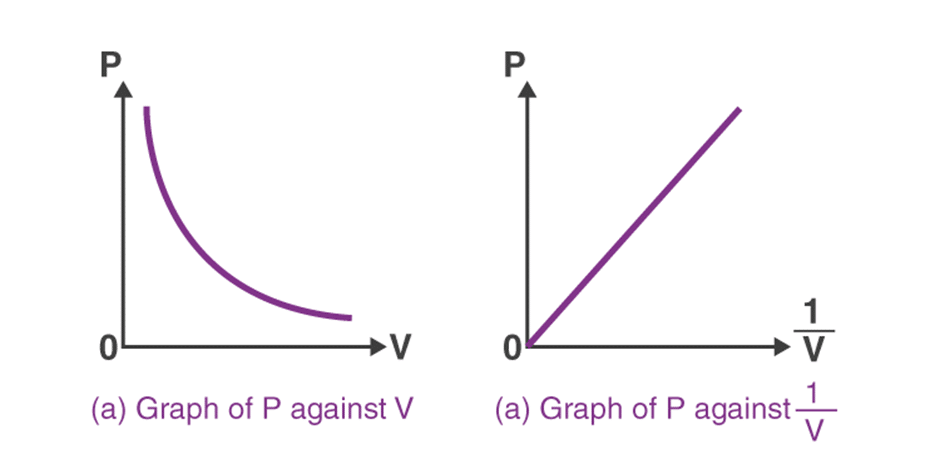
Boyle’s law states that, “at constant temperature, the pressure exerted by a given mass of a gas is inversely proportional to the volume occupied by it.” If P be the pressure exerted by a gas of volume V, then, at constant temperature,
P ∝ [latex]\frac{1}{V}[/latex]
PV = constant
Let, P1 and V1 be the initial pressure and volume of the gas, which is changed to final pressure P2 and V2 at constant temperature T, then, Boyle’s law can be written as,
P1V1 = P2V2 = constant
This is Boyle’s law.
If we plot the graph between P & V, a hyperbolic curve is obtained. Similarly, if we plot the values of P & [latex]\frac{1}{V}[/latex], the following straight line is obtained:
Charles’s law
a. Charles’s law at Constant Pressure (Law of volume)
It states that, “At constant pressure, the volume of the gas increases or decreases by a constant fraction of the volume at 0oC for each degree rise or fall in temperature.”
If Vo be the volume of the gas at 0oC and [latex]V_\theta^oC[/latex] be that at [latex]\theta^oC[/latex] at constant pressure, then, from Charles’s law at constant pressure,
You've reached the end of the free preview. Continue with NN Premium.
- Complete access to every Premium chapter
- Notes, QBank, solutions & MCQs
- Premium PDFs & study resources
- Entrance preparation & mock tests
One NN Premium subscription unlocks everything.