
Introduction
There are 3 modes by which heat is transferred:
i. Conduction
ii. Convection and
iii. Radiation
i. Conduction
The transfer of heat within a medium from one point to another without actual movement of molecules is called conduction. It is carried by means of collision between the vibrating molecules. It is applicable in solid only.
Thermal Conductivity (K)
The measure of ability of solid to conduct heat through it is called thermal conductivity. Let us consider a solid rod of length [latex](l)[/latex] and cross-sectional area (A), whose one face is maintained at higher temperature [latex]\theta_1[/latex] and other face is maintained at lower temperature [latex]\theta_2[/latex].
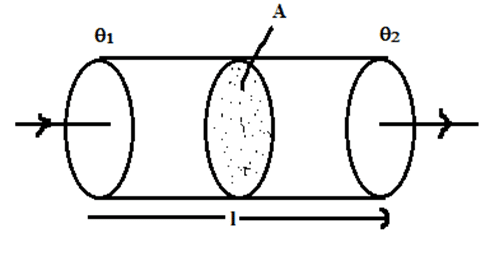
It has been found that, the quantity of heat (Q) flowing through the rod is:
- Directly proportional to the cross-sectional area. i.e., Q ∝ A
- Directly proportional to the temperature difference between the ends of the conductor. i.e., Q ∝ [latex](\theta_1 – \theta_2)[/latex]
- Inversely proportional to the separation between the two faces. i.e., [latex]Q\propto \frac{1}{l}[/latex]
- Directly proportional to the time for which heat flows. i.e., Q ∝ t
Combining all, we get,
Q ∝ [latex]\frac{A(\theta_1 – \theta_2)t}{l}[/latex]
You've reached the end of the free preview. Continue with NN Premium.
- Complete access to every Premium chapter
- Notes, QBank, solutions & MCQs
- Premium PDFs & study resources
- Entrance preparation & mock tests
One NN Premium subscription unlocks everything.