
Calorimeter
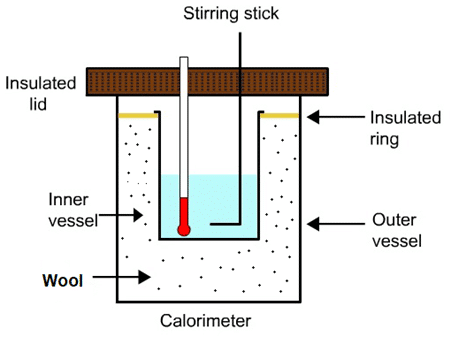
The vessel in which heat exchange in between different bodies at different temperature is observed is called calorimeter. It is made of copper with copper stirrer kept inside a wooden box having lid. A thermometer can be inserted from the hole on the liq. A woollen cloth is kept into the gap between vessel and wooden box.
Heat Equation and Specific Heat Capacity
When same amount of heat is given to a substance of same material but having different masses, the rise in their temperature is also found to be different. Experimentally, it has been found that, the amount of heat (Q):
- required to raise the temperature of substance by certain value [latex](\Delta \theta)[/latex] is directly proportional to the mass (m) of the substance. i.e.
[latex]Q \propto m[/latex] ………… (i) - required for the same mass of the substance is directly proportional to the rise in temperature [latex](\Delta \theta)[/latex]. i.e.
[latex]Q \propto \Delta \theta[/latex] ………. (ii)
Combining equations (i) and (ii), we get,
[latex]Q \propto m(\Delta \theta)[/latex]
[latex]\therefore Q = ms\Delta \theta[/latex] ………….. (iii)
This equation is called the heat equation and the proportionality constant ‘s’ is called the specific heat capacity of the body. From equation (iii), we have,
[latex]s = \frac{Q}{m\times \Delta \theta}[/latex]
When m = 1 unit and [latex]\Delta \theta[/latex] = 1 unit, then [latex]s = Q[/latex] Thus, the specific heat capacity of a body is defined as the amount of heat required to raise the temperature of unit mass of a body through unit change in temperature.
Unit of Specific Heat Capacity
In SI system, its unit is: JKg-1K-1 and in CGS system it is measured in Calg-1K-1.
You've reached the end of the free preview. Continue with NN Premium.
- Complete access to every Premium chapter
- Notes, QBank, solutions & MCQs
- Premium PDFs & study resources
- Entrance preparation & mock tests
One NN Premium subscription unlocks everything.