
Seismic waves
Earthquake is caused by the slight movement of earth’s crust, which causes the vibrations that passes through and around the surface of Earth in the form of seismic waves. The vibrations spread from the focus or hypocentre and reaches first to the epicentre. The earthquake causes huge damage to the epicentral region.
The seismic waves carry energy from focus to the surface of the Earth, which are measured by seismograph. Various types of waves are generated during earthquakes that travel with different velocities. Scientists locate the epicenter by the different time travel of the seismic waves.
There are two types of seismic waves:
- Body wave and
- Surface wave.
Internal (Body) waves: S and P wave
Body waves are of two types:
i. P-wave or primary wave
This is the fastest kind of seismic wave and consequently the first to arrive at a seismic station. This wave travels in all medium – solid, liquid and gas. They just move like sound waves and hence they are called compressional waves. The particles move in the direction of wave. Their speeds are 1450 m/s in water and 5000 m/s in granite.
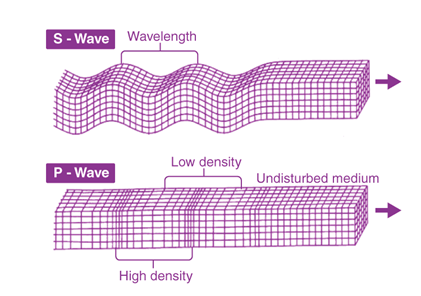
The velocity of p-wave depends on density and compressibility of the medium, whose equation is given by
vp = [latex]\sqrt{\frac{\lambda + 2\mu}{\rho}} = \sqrt{\frac{k+\frac{4}{3}\mu}{\rho}}[/latex]
where, k = bulk modulus of material, [latex]\mu[/latex] shear modulus (modulus of rigidity) and [latex]\rho[/latex] density of material.
You've reached the end of the free preview. Continue with NN Premium.
- Complete access to every Premium chapter
- Notes, QBank, solutions & MCQs
- Premium PDFs & study resources
- Entrance preparation & mock tests
One NN Premium subscription unlocks everything.