
The spontaneous emission of powerful radiation from the nuclei of some substances like uranium, polonium, radium, etc. is called radioactivity.
Types of Radioactivity
i. Natural Radioactivity
The radioactivity exhibited by elements found in nature is called natural radioactivity. These types of radioactivity are shown by the heavier elements found in periodic table.
ii. Artificial Radioactivity
Artificial radioactivity is the radioactivity induced in an element by means of external agency. These types of radioactivity are possible by the modern technique of artificial transmutation of elements.
Radioactive radiations (radiations emitted by radioactive elements)
In order to determine the nature of radiations emitted by radioactive substance, a simple experiment was performed, which is shown in figure below:
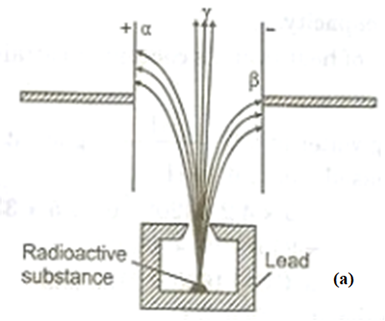
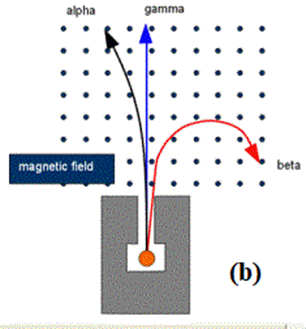
In this experiment, a lead block with small hole is taken, inside which a radioactive substance such as sodium is placed and a narrow beam of radiations emerges out of it. Electric and magnetic field is applied to study the nature of the radiations:
- One component is deflected slightly towards negative plate and thus they carry positive charges and are called α – particles.
- Another component is deflected largely towards positive plate and thus they carry negative charges and are called β – particles.
- The third component of the rays passes without deflection and thus carries no charge and called γ – particles.
Alpha decay
92U238 → 90Th234 + 2He4
You've reached the end of the free preview. Continue with NN Premium.
- Complete access to every Premium chapter
- Notes, QBank, solutions & MCQs
- Premium PDFs & study resources
- Entrance preparation & mock tests
One NN Premium subscription unlocks everything.