
Thomson’s Model of Atom
In 1897, Thomson identified electrons as an elementary particle. It has a negative charge of 1.602 [latex]\times 10^{-19}[/latex] C & mass of 9.1085 [latex]\times 10^{-31}[/latex] Kg. They are found inside a sphere of radius 10-10 m along with some positively charged matter just like plums in pudding. The total positive charge is always equal to the total negative charge inside the atom & hence, an atom is electrically neutral.
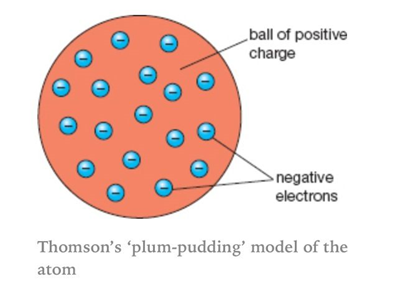
Failure of Thomson’s Atomic model
These are the drawbacks of Thomson’s Atom model:
- The origin of spectral line is not explained by this model, as explained in the case of hydrogen atom.
- The large angle scattering of a- particles from metal foils are also not explained by this model, as explained by Rutherford.
Rutherford a-particles Scattering Experiment
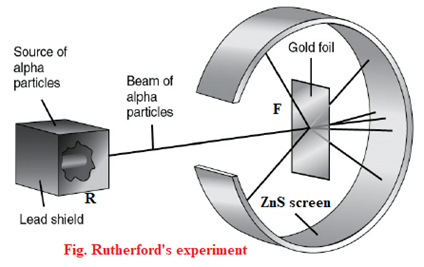
Rutherford investigated the scattering of [latex]\alpha[/latex]-particles and the experimental setup is shown in figure alongside. First, a radioactive material (say Polonium), R, is kept inside a thick box of lead & [latex]\alpha[/latex]-particles are allowed to emit from it. The collimated beam is then allowed to fall on thin gold foils F, where the a-particles are scattered at different angles. The scattered [latex]\alpha[/latex]-particles are allowed to strike on a ZnS coated screen, which produces fluorescence there & is detected by the microscope.
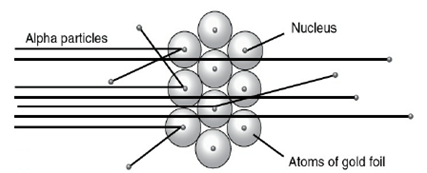
From the experiment, he found:
- Most of the a-particles passes straight through the gold foil.
- Some of them are scattered by small angle.
- Only few of them were scattered through large angle.
- A few of them are scattered backwards.
Rutherford’s Atomic Model
- An atom consists of +ve nucleus, where all positive charge & almost whole mass of the atom are concentrated.
- A nucleus occupies only a small portion in the atom as its size (~10-15 m order) is small as compared to the size of the atom (i.e., ~10-10 m).
- Nucleus is surrounded by the electrons. The total +ve charge in the nucleus is equal to that of the –ve charge. So, the atom is electrically neutral.
- Electrons move very fast around the nucleus just like planets move around the sun. The necessary centripetal force for the electrons to revolve round the nucleus is provided by the electrostatic force of attraction between them.
You've reached the end of the free preview. Continue with NN Premium.
- Complete access to every Premium chapter
- Notes, QBank, solutions & MCQs
- Premium PDFs & study resources
- Entrance preparation & mock tests
One NN Premium subscription unlocks everything.