
Electricity:
The branch of physics that deals with the study of charges is known as electricity. The branch of electricity is divided into two parts:
(i) Electrostatics:
The branch of electricity which deals with the study of charges at rest is known as electrostatics.
(ii) Current electricity:
The branch of electricity which deals with the study of charges in motion is known as current electricity.
Electrical charge: Modern Theory of Electrification:
The charge is the physical property or intrinsic property of the matter that comes automatically with the matter whenever the matter exists and causes electromagnetic interaction, just the mass is the physical property of all matter which causes gravitational attraction.
The matter is made by atoms or molecules. The study of atomic structure of the matter conclude that the matter is electrical in nature. i.e. it contains large number of electrical charge particle, protons and electrons. Under ordinary condition, the matter is electrically neutral because it contains equal no. of positive and negative charge. Whenever, this equality is disturbed, the matter gets charged. When an electron is removed from the neutral atom, it gains a positive charge due to deficiency of an electron. When an electron is supplied to the neutral atom, it gains a negative charge due to excess of an electron. When the matter gains, excess or deficiency of electrons, then the matter is said to be charged. Depending upon the deficiency or excess of electrons on the matter there are two types of electrical charge:
(i) Positive charge:
It represents deficiency of electrons.
(ii) Negative charge:
It represents excess of electrons.
Structure of the Matter (Revised):
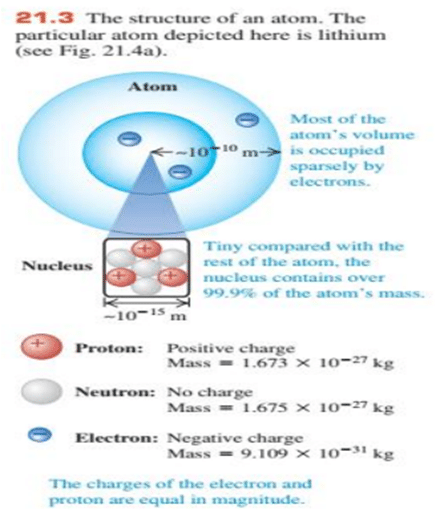
The structure of atoms can be described in terms of three particles: the negatively charged electron, the positively charged proton, and the uncharged neutron. The protons and neutrons in an atom make up a small, very dense core called the nucleus, with dimensions of the order of [latex]10^{-15}[/latex] m. Surrounding the nucleus are the electrons, extending out to distances of the order of [latex]10^{-10}[/latex] m from the nucleus. If an atom were a few kilometers across, its nucleus would be the size of a tennis ball. The negatively charged electrons are held within the atom by the attractive electric forces exerted on them by the positively charged nucleus.
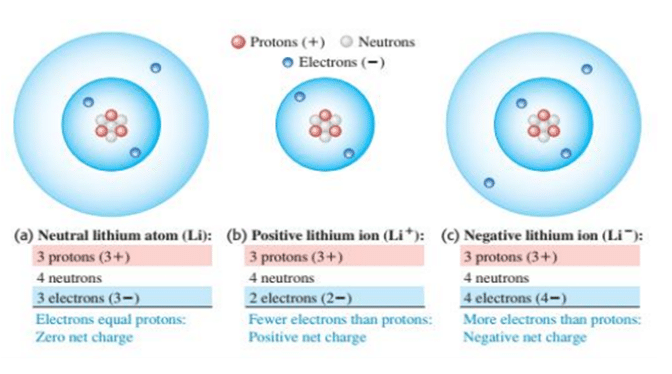
The negative charge of the electron has exactly the same magnitude as the positive charge of the proton. In a neutral atom the number of electrons equals the number of protons in the nucleus, and the net electric charge (the algebraic sum of all the charges) is exactly zero (Fig a). The number of protons or electrons in a neutral atom of an element is called the atomic number of the element. If one or more electrons are removed from an atom, what remains is called a positive ion (Fig. b). A negative ion is an atom that has gained one or more electrons (Fig. c). This gain or loss of electrons is called ionization.
Frictional Electricity:
When a glass rod is rubbed with silk and then separated by insulating medium, the glass rod gains positive charges and the silk acquires negative charges. It is because there is transfer of electron from the glass rod to silk. The charge so produced is static or stationary and does not move from one part of the body to the other part.
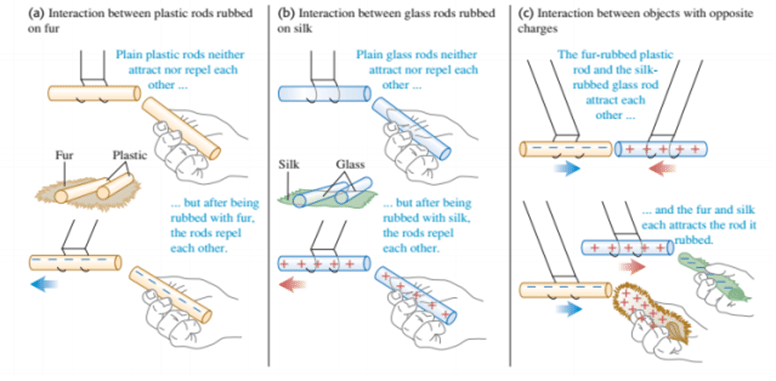
The charges at rest or static charges so produced on the insulating body by rubbing with each other is known as frictional electrostatics.
Properties of charges:
- It is the scalar quantity.
- Like charges repel whereas unlike charges attract.
- The charges produced on a body is independent upon the speed of the body.
- Conservation of charge: The total charge of an isolated system remains constant, i.e. the chare can neither be created nor be destroyed but it can simply be transferred from one body to another body.
- Quantization of charge: Q = ± ne. Any physical charge (Q) is an integral multiple of basic elementary charge e, that is Q = ± ne, where, n = 1, 2, 3, ………… be the integers and e = [latex]1.6 \times 10^{-19}[/latex] coulomb = charge of an electron.
Unit of charge:
The SI unit of charge is coulomb (C). 1 Coulomb of charge is equal to the charge of [latex]625 \times 10^{16}[/latex] electrons.
1 C = [latex]625 \times 10^{16}[/latex] charge of the electron
1 C = [latex]625 \times 10^{16}\times e[/latex]
[latex]e = \frac{1C}{625 \times 10^{16}} = 1.6 \times 10^{-19} \text{ C}[/latex]
+1 C = [latex]625 \times 10^{16}[/latex] deficiency of electrons (+e)
-1 C = [latex]625 \times 10^{16}[/latex] excess of electrons (e)
Conductor:
The substance which allow the electric charge to flow through them are called conductors. Eg – iron, steel, water, copper, etc. The conductors can produce charges by friction but the charges so produced do not remain stationary but spread over the surfaces of the conductors.
Insulator:
The substances which do not allow the electric charge to flow through them are called insulators. Eg – glass, plastic, wood, etc. The insulators can produce charges by friction but the charges so produced remain localized and do not move from one part of the body into another part.
Electrostatic Induction:
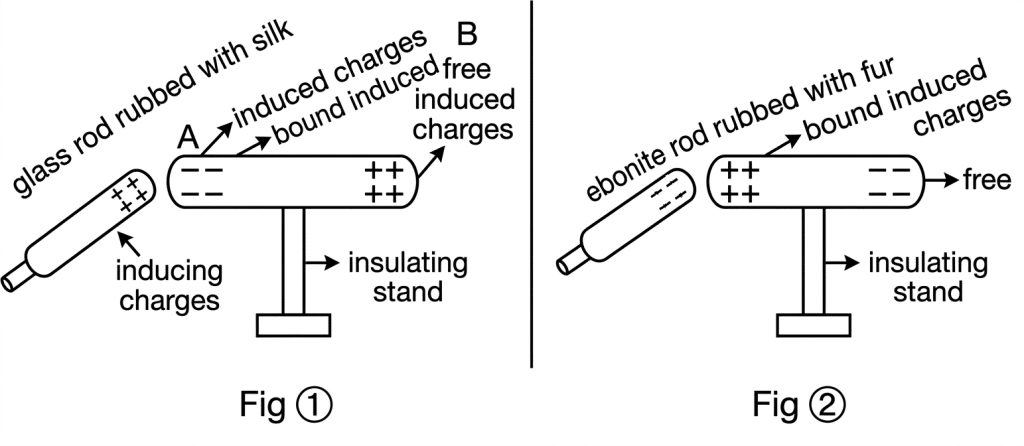
The temporary electrification of a body (conductor) by bringing a charged body close to it is known as electrostatic induction. The charged body such as glass rod, ebonite rod, etc. which produces electrostatic induction are called inducing charges. The charges produced on the uncharged body due to induction are called induced charges. The induced charges closed to the inducing charges are called bound induced charges. The induced charges at far from the inducing charges are called free induced charges.
Charging a body permanently by induction:
A body can be charged permanently as follows:
(i) Charging positively by Induction:
A body can be charged positively in the following ways:
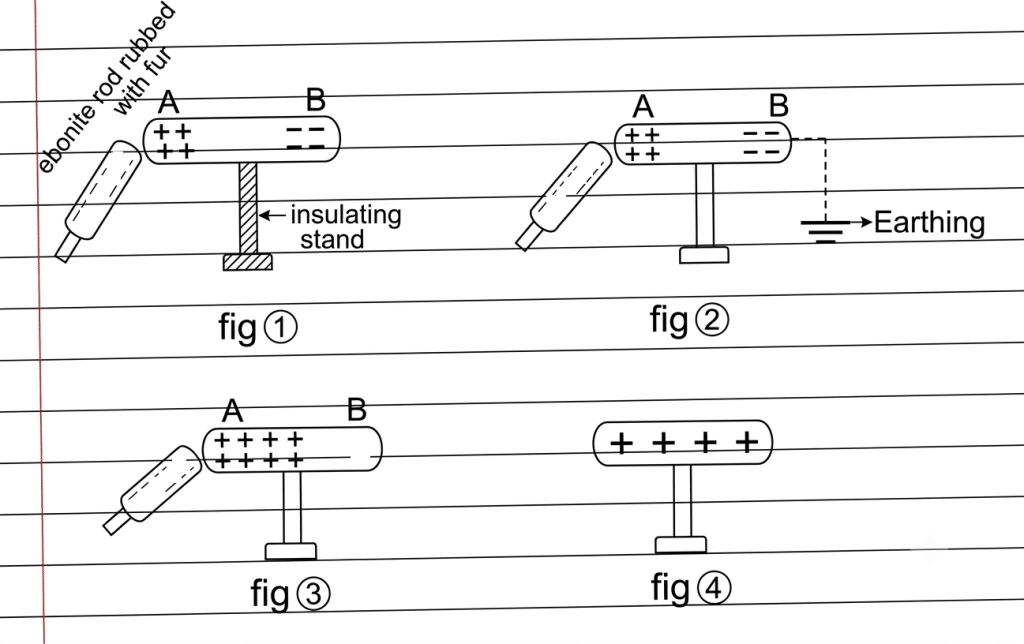
(1) The ebonite rod is charged negatively by rubbing it with fur. The negatively charged ebonite rod is brought close to the conductor AB without touching. In doing so, the end A of the conductor acquires positive charges whereas the end B acquires negative charges by induction method. [Fig. (1)]
(2) With the help of metallic wire, the body AB is connected to the earth. In doing so, the negative free charges flow to the ground (earth). [Fig. (2)]
(3) The metallic wire is removed by keeping ebonite rod as it was shown in fig. (3)
(4) The ebonite rod is removed. The positive charges of the conductor AB become free and spread uniformly throughout the surface of the conductor.
In this way, a body can be charged positively by electrostatic induction method.
(ii) Charging negatively by Induction:
(1) The glass rod is charged positively by rubbing with silk. The positively charged glass rod is brought closed to the conductor AB without touching. In doing so, the end A of conductor acquires negative charge whereas the end B acquires positive charge by induction method. [fig. (1)]
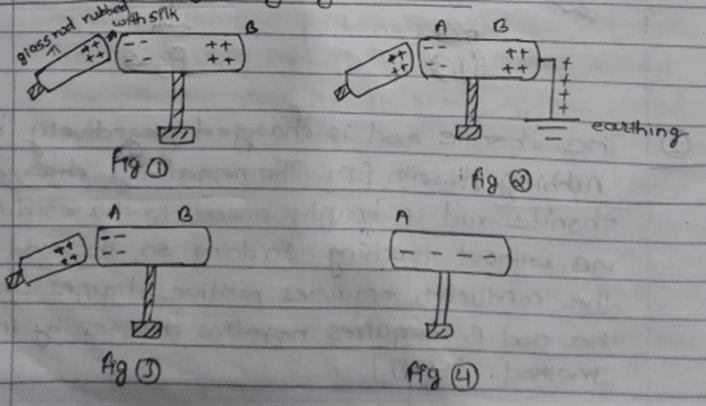
(2) With the help of metallic wire, the body AB is connected to the earth. In doing so, the positive free charges flow to the ground. [fig. (2)]
(3) The metallic wire is removed by keeping glass rod as it was shown in fig. (3).
(4) The glass rod is removed. The negative charges of the conductor AB become free and spread uniformly throughout the surface of the conductor.
Surface Charge Density ([latex]\sigma[/latex]):
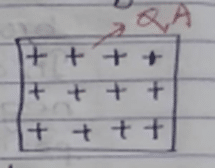
It is defined as the total charge per unit surface area of a body.
Mathematically, [latex]\sigma = \frac{Q}{A}[/latex] ([latex]C/m^2[/latex])
Volume Charge Density ([latex]\rho[/latex]):
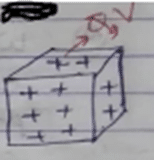
It is defined as the total charge per unit volume of a body.
Mathematically, [latex]\rho = \frac{Q}{V}[/latex] ([latex]C/m^3[/latex])
Linear charge density ([latex]\lambda[/latex]):
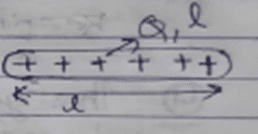
It is defined as the total charge per unit length of a body.
Mathematically, [latex]\lambda = \frac{Q}{l}[/latex] (C/m)
Action of point:
The action of losing charges due to sharp ends/edges is called action of point. [Importance and demerits].
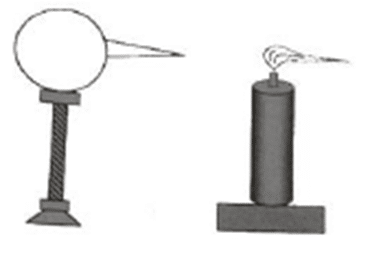
When a body is charged, charges spread all over the surface of the body which may or may not be uniform depends upon the shape and nature of the body. The density of charge at any part of conductor is inversely proportional to the radius of curvature of the surface of that part i.e. greater the curvature (least radius of curvature) at any point, the greater will be the accumulation of charge at that point. So, the density of charge at the pointed (sharp ends) parts of the conductor is very large. The air molecule which come in contact with sharp points become ionized and as a result opposite charge of air neutralize the charge of the body while like charges get repelled by the sharp points therefore the total charge of the body is reduced rapidly. Thus, the leakage of electric charge from the sharp points of the charged conductor is known as action of points. This result s strong electric wind is set up near the pointed ends causes to blow a candle flame aside as shown in figure above.
Coulomb’s Law of Electrical Force:
Coulomb’s law states that, “the magnitude of the electrostatics force of attraction or repulsion between any two charges is directly proportional to the product of magnitude of the charges and inversely proportional to the square of the distance between centres of the charges.”
Explanation:
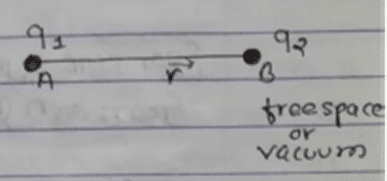
Let us consider two-point charges [latex]q_1[/latex] and [latex]q_2[/latex] at points A and B. Let r be the separation of the charges. Then, according to coulomb’s law, the electrostatics force between two charges is
(i) directly proportional to the product of the magnitude of charges, i.e., [latex]F \propto q_1 q_2[/latex]
(ii) inversely proportional to the square of the distance between them, i.e., [latex]F \propto \frac{1}{r^2}[/latex]
Combining above conditions, we get as,
[latex]F \propto \frac{q_1 q_2}{r^2}[/latex]
Or, [latex]F = \frac{Kq_1 q_2}{r^2}[/latex] …………. (i)
Where, the K is the proportionality constant whose value depends upon the medium in which charges are placed and the system of unit used.
In SI system, free space of vacuum,
[latex]K = \frac{1}{4\pi\epsilon_o}[/latex] where, [latex]\epsilon_o[/latex] = [latex]8.85 \times 10^{12}\ C^2N^{-1}m^{-2}[/latex], is the permittivity of the free space.
[latex]K = \frac{1}{4\pi\epsilon_o} = 9 \times 10^9 \text{ Nm}^2\text{C}^{-2}[/latex]
For CGS system and free space, K = 1.
From equation (i),
[latex]F = \frac{1}{4\pi\epsilon_o}\frac{q_1 q_2}{r^2}[/latex] ………………… (ii) [for SI system in free space]
∴ [latex]F = \frac{q_1 q_2}{r^2}[/latex] ………………. (iii) [For CGS system]
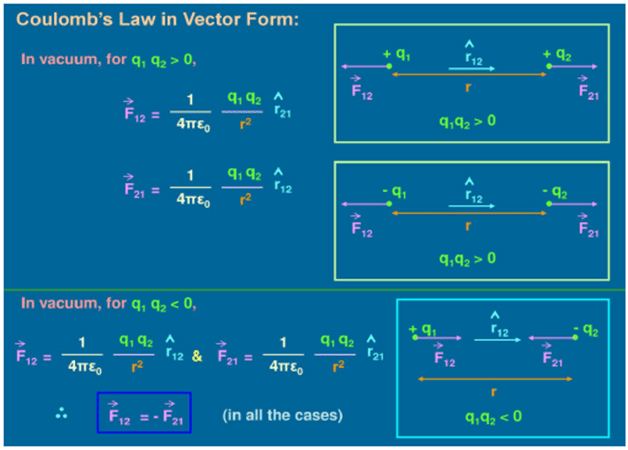
In vector form, [latex]\vec{F} = \frac{1}{4\pi\epsilon_o}\frac{q_1 q_2}{r^2}\hat{r}[/latex] ………………… (iv)
Where, [latex]\hat{r}[/latex] is the unit vector. It gives the direction of the electrostatics force [latex]\vec{F}[/latex]. The direction of the electrostatics force is along the line joining two charges.
The relations (2), (3) & (4) represent the expressions of coulomb’s electrostatic force.
Relative Permittivity ([latex]\epsilon_r \text{ or } K[/latex]):
The permittivity of the medium is known as absolute permittivity and it is denoted by [latex]\epsilon[/latex].
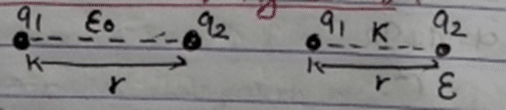
The relative permittivity is defined as the ratio of permittivity of the medium ([latex]\epsilon[/latex]) to permittivity of the vacuum ([latex]\epsilon_o[/latex]). The relative permittivity is also known as dielectric constant (K).
∴ Relative permittivity: [latex]K = \epsilon_r = \frac{\epsilon}{\epsilon_o}[/latex]
Permittivity of medium ([latex]\epsilon[/latex]) = [latex]\epsilon_r \epsilon_o[/latex]
[latex]= K\epsilon_o[/latex]
Suppose the charges [latex]q_1\ and\ q_2[/latex] are placed in a medium of permittivity [latex]\epsilon[/latex] at a distance r apart then the coulomb force between them is given by:
[latex]F_m = \frac{1}{4\pi\epsilon}\frac{q_1 q_2}{r^2} = \frac{1}{4\pi\epsilon_r\epsilon_o}\frac{q_1 q_2}{r^2} = \frac{1}{4\pi K\epsilon_o}\frac{q_1 q_2}{r^2}[/latex] ………….. (i)
Suppose the charges [latex]q_1\ and\ q_2[/latex] are placed in vacuum at a separation r. Then, Coulomb’s force between them is, [latex]F_v = \frac{1}{4\pi\epsilon_o}\frac{q_1 q_2}{r^2}[/latex] …………………. (ii)
∴ [latex]\frac{F_v}{F_m} = K = \epsilon_r[/latex] ……………………. (iii)
Hence, dielectric constant or relative permittivity also defined as the ratio coulomb’s force between two charges at a distance in vacuum to the coulomb’s force between same two charges at same distance in a medium.
If K > 1, then
[latex]\frac{F_v}{F_m} > 1[/latex], then, [latex]F_v > F_m[/latex]
If K = 1, then,
[latex]\frac{F_v}{F_m} = 1[/latex] then, [latex]F_v = F_m[/latex]
Forces between multiple charges:
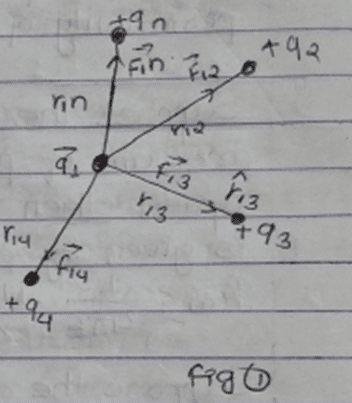
Let us consider, the distribution of charges [latex]q_1, q_2, q_3, ………………. q_n[/latex] in vacuum as shown in fig. (i). Let, [latex]r_{12}, r_{13}, …………………… r_{1n}[/latex] be the distances of the charges [latex]q_1[/latex] from other charges. The resultant force experience by the charge [latex]q_1[/latex] is equal to the vector sum of forces experienced by the charge [latex]q_1[/latex] due to all other charges i.e.
[latex]\vec{F} = \vec{F_{12}} + \vec{F_{13}} + \vec{F_{14}} + ………. + \vec{F_{1n}}[/latex]
Or, [latex]\vec{F} = \frac{1}{4\pi\epsilon_o}\frac{q_1 q_2}{(r_{12})^2}\hat{r_{12}} + \frac{1}{4\pi\epsilon_o}\frac{q_1 q_3}{(r_{13})^2}\hat{r_{13}} + ………. + \frac{1}{4\pi\epsilon_o}\frac{q_1 q_n}{(r_{1n})^2}\hat{r}_{1n}[/latex]
Where, [latex]\hat{r_{12}}, \hat{r_{13}} ……. \hat{r_{1n}}[/latex] are the unit vector represent the direction of the forces [latex]\vec{F_{12}}, \vec{F_{13}}, …… \vec{F_{1n}}[/latex].
The directions of the forces are along the line joining the charges.
Direction of Coulomb’s Electric Force:
Questions:
(i) What do you mean by electrostatic induction? Show how you would charge a body negatively or positively by induction.
(ii) Explain electrification by friction on the basis of modern theory.
(iii) State and explain Coulomb’s law in electrostatics.