
Dispersion of Light
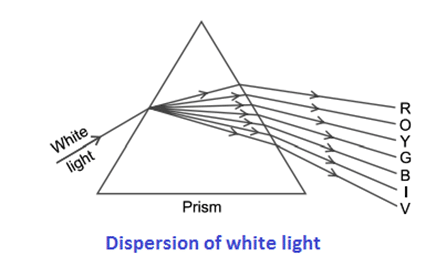
The phenomenon of splitting of the white light into its constituent color (7 colors) is known as the dispersion of light. The red colour is deviated least while the violet color is deviated maximum and other color lies between them. The order of the colours in the spectrum is VIBGYOR from base.
Cause of dispersion
The white light consists of seven coloured light which have different wavelengths. As the light passes through the prism, due to having different wavelengths, they have different refractive indices. According to Cauchy’s dispersion formula,
[latex]\mu = A + \frac{B}{\lambda^2}[/latex]
As the wavelength is increased, then, the refractive index is decreased and vice – versa.
Again, from the relation between angle of deviation and refractive index,
[latex]\delta = A(\mu – 1)[/latex]
This relation shows that, as the value of refractive index increases, then, angle of deviation is also increased and vice – versa. Hence, dispersion occurs.
Angular Dispersion
The angular dispersion is defined as the difference in angle of deviation between two extreme colours of light (i.e., violet and red). It is denoted by [latex]\theta[/latex].
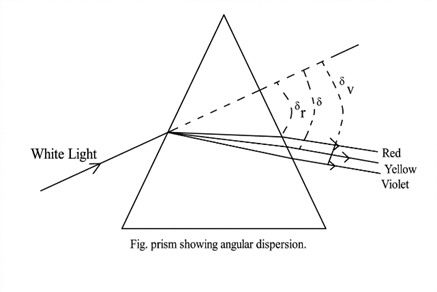
[latex]\therefore[/latex] Angular dispersion [latex](\theta) = \delta_v – \delta_r[/latex]
You've reached the end of the free preview. Continue with NN Premium.
- Complete access to every Premium chapter
- Notes, QBank, solutions & MCQs
- Premium PDFs & study resources
- Entrance preparation & mock tests
One NN Premium subscription unlocks everything.