
Overview
Magnetic Field is one of the heaviest chapters in the electromagnetism unit, both in content and in exam weightage — expect it to contribute across MCQs, theory, and multiple numericals in nearly every board paper. The chapter builds on two core laws: Biot-Savart law (finding the magnetic field due to a small current element, most often applied to circular coils) and Ampere’s circuital law (finding the field due to symmetric current distributions like straight wires and solenoids). A large share of past theory questions simply ask you to state one of these laws and then use it to derive the field for a specific geometry — coil, solenoid, or straight conductor — so knowing all three standard derivations cold covers a large portion of this chapter’s marks.
Beyond the two laws, three other recurring themes show up consistently: the force between parallel current-carrying conductors (which also defines one Ampere), the moving coil galvanometer (its principle, and why the magnetic field is made radial), and the Hall effect (deriving Hall voltage and explaining why it’s larger in semiconductors). The numericals mix formula-based problems — magnetic field at a point on a coil’s axis, force on a current-carrying wire — with occasional “self-supporting wire” problems that combine magnetic force with gravity.
Below is the full set of MCQs, theory questions, and numerical problems from past NEB board exams, organized by course and question type.
⚠️ Common Mistakes Students Make
- Confusing when to use Biot-Savart law vs. Ampere’s circuital law. Biot-Savart is the general tool (works for any current geometry, including coils); Ampere’s law is a shortcut that only works cleanly for highly symmetric setups like straight wires, solenoids, and toroids. Reaching for Ampere’s law on a circular coil problem is a common error.
- Mixing up the direction rules. The right-hand rule (or Fleming’s left-hand rule for force) gets applied inconsistently — remember Fleming’s left-hand rule is specifically for the force on a current in a field, while the right-hand grip rule gives you the field direction around a current.
- Forgetting that force per unit length between parallel wires depends on 1/r, not 1/r². Since this relationship is also used to define one Ampere, getting the exponent wrong here compounds into wrong answers on multiple numerical types.
MCQs
The magnetic field intensity at the center of a circular coil of radius R and carrying current I is
Show answer
A charge of 2 Coulomb is moving with velocity of 0.5 [latex]ms^{-1}[/latex] at an angle of 30o in a magnetic field of 4T. What will be the magnetic force experienced by the charge?
Show answer
Current sensitivity of a moving coil galvanometer is 5 div/mA and its voltage sensitivity is 20 div/V. The resistance of the galvanometer is
Show answer
Theoretical questions
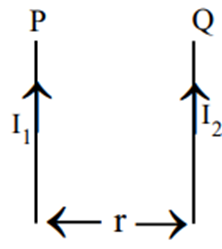
Two parallel wire P and Q carrying currents I1 and I2 are placed in the air at a distance r apart as shown in figure.
i. Obtain expression for the magnitude of force per unit length between them. [2]
ii. What is the nature of force in this case? [1]
iii. What will be the force per unit length between two wires if distance between wires is halved, keeping all other quantities constant? [1]
Use ampere’s circuital law to find the magnetic field due to a straight current carrying conductor. [2]
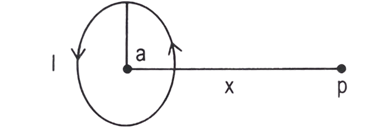
A circular coil of radius ‘a’ is carrying a current I in the direction as shown in figure. Obtain the magnetic field intensity at point P using Biot-Savert’s law. [3]
Obtain an expression for the magnetic field intensity at any point due to a straight current carrying conductor using Ampere’s circuital law. [3]
Derive an expression for the force exerted per unit length between two parallel current carrying conductor is currents are flowing in the same direction. Hence, define one ampere current. [3]
A moving coil is very sensitive device to measure very small current.
i. Define voltage sensitivity of moving coil galvanometer. On which factors does it depend? [2]
ii. Why is magnetic field made radial in a moving coil galvanometer? [2]
Derive an expression for the magnetic field strength inside a long current carrying solenoid using Ampere’s circuital law. [3]
Define one Ampere of current in terms of the force between two parallel current carrying conductors. [1]
How do you explain the contraction of the solenoidal coil while the current is passed through it? [1]
State Biot- Savert law. [2]
Define one Ampere of current in terms of the force between two parallel current carrying conductors. [1]
How do you explain the contraction of the solenoid coil while the current is passed through it. [2]
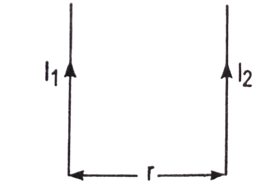
Two conductors X and Y carrying currents and are placed in air at a distance r apart as shown in figure.
i. Find the magnitude of force between them. [2]
ii. What is the nature of force in this case? [1]
iii. Define one ampere current on the basis of the force between parallel current carrying conductors. [1]
Biot-Savert law gives the magnitude of magnetic field produced by a current carrying conductor.
i. State Bio-Savert law. [1]
ii. Use Bio-Savert law to calculate the magnetic field of a circular current carrying coil at its centre. [3]
iii. Also determine the direction of the magnetic field in this case. [1]
When a charge particle moves in a uniform magnetic field, it experiences a force, called the Lorentz force.
Why are the pole pieces of magnets cut into cylindrical form in a galvanometer?
State Biot-Savert law. Using this law, obtain an expression for the magnetic field induction at a point situated on the axis of a current carrying circular coil.
What is meant by Hall effect? Derive an expression of Hall voltage.
State Ampere’s law and use it to find magnetic field due to a long current carrying solenoid.
Can a constant magnetic field set an electron at rest into motion? Explain.
What do you mean by Hall Effect? Why is it more effective in semiconductors?
Define one Ampere in terms of the force between current carrying conductors.
An electron beam and a proton beam are moving parallel to each other in the beginning. Do they always maintain this status? Justify your answer.
Can a charge particle move through a magnetic field without experiencing any force? Explain.
OR Does a charged particle moving through a magnetic field always experience a force? Explain.
How will the magnetic field intensity at the centre of a circular coil carrying current change, if the current through the coil is doubled and the radius of the coil is halved?
Equal currents are flowing through two infinitely long parallel wires. What will be the magnetic field at a point mid – way, when the currents are flowing (i) in the same direction (ii) in the opposite direction?
A solenoid tends to contract when a current passes through it, why?
How can the sensitivity of moving coil galvanometer be increased? Explain.
A charge particle carrying a charge ‘q’ moves in an electric field E. If its specific charge is ‘S’, write an expression of its acceleration in terms of above entities.
Magnetic field at the centre of a solenoid is double than that at its ends. Why?
Hall voltages are much larger for semi – conductors than for good conductors for comparable currents, fields and dimensions. Why?
How will an electron move in a homogenous magnetic field if the velocity of the electron at the initial moment forms an angle ‘ ’ with the force lines of the field?
State Biot-Savert law. Using this law, obtain an expression for the magnetic field induction at a point situated on the axis of a current carrying coil.
What is meant by Hall effect? Derive an expression of Hall voltage.
State Ampere’s law and use it to find magnetic field due to a long current carrying solenoid.
State Biot – Savert law. Use this law to find the magnetic field intensity due to current carrying straight conductor at a distance ‘d’ from it.
State Ampere’s theorem and use it to find the magnetic field due to a long solenoid.
State Biot – Savert law and obtain the expression for the magnetic field at the centre of the circular coil.
State Ampere’s law and use it to find magnetic field due to a long straight current carrying conductor and toroid.
A rectangular coil of N turns is placed in a uniform magnetic field B with its plane parallel to the field. Derive an expression for the torque produce on the coil when a current I is passed through it. Define magnetic moment in terms of torque.
State Biot – Savert law. Use this law, to find the magnetic field due to a current carrying circular coil at any point on the axis of the coil.
Derive an expression for the force per unit length between two infinitely long parallel straight wires carrying current in the same direction. Hence define one ampere.
State and explain Biot – Savert law and use it to find magnetic field due to a long straight current carrying conductor.
State Ampere’s law and deduce an expression for the force between two parallel current carrying wires.
What is Hall effect? Explain and deduce expression for Hall voltage and Hall electric field.
Explain the magnetic effect on a current carrying rectangular coil. Hence, obtain expression for the torque on the coil.
Find an expression for the magnetic field on the axial line of a current carrying circular coil.
Numerical problems
Two long parallel conductors are placed 0.1 m apart and carry currents of 3 A and 2 A, respectively in the same direction. Calculate the force per unit length experienced by each conductor due to the other. [latex](\mu_o = 4\pi \times 10^{-7}\ Hm^{-1})[/latex] [2] Ans: [latex]1.2 \times 10^{-5}\ N/m[/latex]
A circular coil has 100 turns and radius 5cm. Find the magnetic field at a distance 6cm from the centre of the coil at its axis, if a current of 2A is passed through it. [3] Ans: [latex]6.5\times 10^{-4}[/latex] T
A wire of length 0.5 m carrying a current of 2A is placed in a uniform magnetic field of strength 0.4T. Find the maximum and minimum force experienced by it. [2] Ans: 0.4 N and 0 N
A slice of indium antimonide 2.5 mm thick carries a current of 150 mA. A magnetic field of flux density 0.5T, correctly applied, produces a maximum Hall voltage of 8.75 mV between the edges of the slice. Calculate the number of free charge carriers per unit volume assuming they each have a charge of [latex]-1.6\times 10^{-19}\ C[/latex]. [2] Ans: [latex]2.14\times 10^{22}\ m^{-3}[/latex]
An alpha particle of mass [latex]6.65\times 10^{-22}\ kg[/latex] travels with a speed of [latex]6\times 10^6[/latex] m/s at right angle to the magnetic field of 0.2 T. Calculate its acceleration. [2] Ans: [latex]5.77\times 10^{13}\ m/s^2[/latex]
A horizontal straight wire of mass 0.12 gm and length 10 cm is placed perpendicular to a uniform horizontal magnetic field of flux density 0.6T. If the resistance per unit length of the wire is [latex]3.8\ \Omega m^{-1}[/latex], calculate the potential difference that has to be applied between the ends of the wire to make it just self-supporting. [3] Ans: [latex]7.6\times 10^{-3}\ V[/latex]
A straight conductor of length 5cm carries a current of 1.5A. When the conductor is placed in a uniform magnetic field of 0.2T, it experiences a magnetic force of [latex]4.5\times 10^{-3}\ N.[/latex] Find the angle made by the conductor with the magnetic field. Is there any position of the conductor in the field so that it experiences no force? Explain. [2+1] Ans: 17.45o
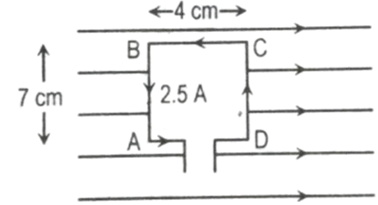
Figure shows a rectangular metal frame ABCD placed in a uniform magnetic field of flux density [latex]4.5\times 10^{-3}\ T[/latex].
i. Calculate the force experienced by side AB. [2]
ii. Why side BC does not experience force? Explain. [2] Ans: [latex]7.875\times 10^{-4}\ N[/latex]
A horizontal straight wire 5 cm long weighing 1.2 g [latex]m^{-1}[/latex] is placed perpendicular to a uniform horizontal magnetic field of flux density 0.6 T. If resistance of the wire is [latex]3.8\Omega m^{-1}[/latex], calculate the p.d. that has to be applied between the ends of the wire to make it just self-supporting. [3] Ans: [latex]3.7\times 10^{-3}\ V[/latex]
A circular coil of 100 turns has a radius of 10 cm and carries a current of 5A. Determine the magnetic field at a point on the axis of the coil at a distance of 5 cm from the center of the coil. [3] Ans: [latex]2.25\times 10^{-3}\ T[/latex]
A closely wound coil has a radius of 6 cm and carries a current of How many turns must it have if the magnetic field at a point 6 cm from the centre of the coil axis is [latex]6.4\times 10^{-4}\ T? (\mu_o = 4\pi \times 10^{-7}\ Hm^{-1})[/latex] Ans: 70 turns
Two long parallel transmission lines, 40.0 cm apart carry 25.0 A and 75.0 A currents. Find location where the net magnetic field of these two wires is zero if these currents are in the same direction.Ans: 0.1 m from 25.0 A wire
Two galvanometers, which are otherwise identical, are fitted with different coils. One has a coil of 50 turns and resistance 10 [latex]\Omega[/latex] while the other has 500 turns and a resistance of 600 [latex]\Omega[/latex]. What is the ratio of the deflection when each is connected in terns to a cell of e.m.f. 25V and internal resistance 50 [latex]\Omega[/latex]? Ans: 13:12
A flat silver strip of width 1.5 cm and thickness 1.5 mm carries a current of 150 A. A magnetic field of 2T is applied perpendicular to the flat face of the strip. The emf developed across the width of the strip is measured to be 17.9 [latex]\mu V[/latex]. Calculate the free electron density in the silver. Ans: 6.98 x 1028 electron/m3
A silver wire has 1 x 1030 free electrons per cubic meter, a cross-sectional area of 2 mm2 and carries a current of 5A. Calculate the force acting on each electron if the wire is now placed in a magnetic field of flux density 0.15 T which is perpendicular to the wire. Ans: 3.75 x 10⁻²⁵ N
A straight horizontal rod of length 20 cm and mass 30 gm is placed in a uniform horizontal magnetic field perpendicular to the rod. If the current of 2A through the rod makes itself supporting in the magnetic field, calculate the magnetic field. Ans: 0.75 T
A coil consisting of 100 circular loops with radius 60 cm carries a current of 5A. Find the magnetic field at a point along the axis of the coil, 80 cm from the centre. ([latex]\mu_o = 4\pi \times 10^{-7}\ Tm/A[/latex]). Ans: [latex]1.13\times 10^{-4}\ T[/latex]
A straight conductor of length 5 cm carries current of 1.5A. The conductor experiences a magnetic force of 4.5 x 10⁻³ N when it is placed in a magnetic field of 0.9 T. What angle the conductor makes with magnetic field? Ans: 3.8o
A circular coil has 100 turns and a mean diameter of 20 cm. It carries a current of 5A. Find the strength of the magnetic field at a point on its axis at a distance of 15 cm from the centre of the coil. Ans: [latex]5.35\times 10^{-4}T[/latex]
The coil of a moving coil galvanometer has 50 turns and its resistance is 10 [latex]\Omega[/latex]. It is replaced by a coil having 100 turns and resistance 50 [latex]\Omega[/latex]. Find the factor by which the current and voltage sensitivities change. Ans: 2, 2/5
A 60 cm long wire of mass 10g is suspended horizontally in a transverse magnetic field of flux density 0.4 T through two springs at its two ends. Calculate the current required to pass through the wire so that there is zero tension in the springs. Ans: 0.42 A
A horizontal wire of length 5 cm & carrying a current of 2A, is placed in the middle of a long solenoid at right angles to its axis, the solenoid has 1000 turns per meter & carries a steady current I. Calculate I if the force on the wire is equal to 10-4 N. ([latex]\mu_o = 4\pi \times 10^{-7}\ Hm^{-1}[/latex]). Ans: 0.79 A
The coil of a moving coil galvanometer has 50 turns and its resistance is [latex]10\Omega[/latex]. It is replaced by a coil having 100 turns and resistance [latex]50\Omega[/latex]. Find the factor by which the current and voltage sensitivities change. Ans: 2, 2/5
A 60 cm long wire of mass 10g is suspended horizontally in a transverse magnetic field of flux density 0.4 T through two springs at its two ends. Calculate the current required to pass through the wire so that there is zero tension in the springs. Ans: 0.42 A
A horizontal straight wire of mass 0.12 gm and length 10cm is placed perpendicular to a uniform horizontal magnetic field of flux density 0.6T. If the resistance per unit length of the wire is [latex]3.8\Omega m^{-1}[/latex], calculate the potential difference that has to be applied between the end of the wire to make it just self-supporting. Ans: [latex]7.6\times 10^{-3}V[/latex]
A copper wire has 1029 free electrons per cubic meter, a cross sectional area of 2mm2 and carries a current of 5 A. Calculate the force acting on each electron if the wire is now placed in a magnetic field of flux density 0.15 T which is perpendicular to the wire. Ans: [latex]3.75\times 10^{-24} N[/latex]
Two long parallel conductors carry respectively currents of 12A and 8A in the same direction. If the wires are 10cm apart, find where a third parallel wire also carrying a current must be placed so that the force experienced by it will be zero. Ans: 0.06 m
An electron of K.E. 10 eV is moving in a circular orbit of radius 11 cm, in a plane at right angles to a uniform magnetic field. Determine the value of the flux density. (mass of an electron = [latex]9.1\times 10^{-31}\ kg,\ e = 1.6\times 10^{-19}C)[/latex] Ans: [latex]9.7\times 10^{-5}\ T[/latex]
A slab of copper, 2 mm thick and 1.50 cm wide, is placed in a uniform magnetic field of flux density 0.40 T, so that maximum flux pass through the slab. When a current of 75 A flows through it, a potential difference of 0.81 [latex]\mu V[/latex] is developed between the edges of the slab. Find the concentration of the mobile electrons in copper. Ans: [latex]1.15\times 10^{29}/m^3[/latex]
A copper wire has [latex]1\times 10^{29}[/latex] free electrons per cubic meter and cross-sectional area 2mm2 carries a current of 6A. Calculate the force acting on each electron if the wire is now placed in uniform magnetic field of flux density 0.1T perpendicularly. Ans: [latex]3\times 10^{-24}N[/latex]
A copper wire 28m long is wound into a flat circular coil 8.0cm in diameter. If the current of 4.50 A flows through the coil, what is the magnetic induction at the centre? Ans: [latex]7.8\times 10^{-3} T[/latex]
An alpha particle makes a full rotation in a circle of radius 1.0 meter in 2.0 sec. Calculate the value of magnetic field induction at the centre of the circle. [latex](\mu_o = 4\pi \times 10^{-7}\ Hm^{-1})[/latex] Ans: [latex]10^{-25}T[/latex]
A long wire carrying a current of 10A is placed perpendicular to magnetic field of flux density 5 Tesla. Calculate the force acting on 2m of the wire. Ans: 100 N
A coil consisting of 100 circular loops with radius 0.60m carries a current of 5A. At what distance from the center, along the axis, the magnetic field magnitude 1/8 as great as it is at the center? Ans: 1.04m
A wire carrying current of 10A and 2m in length is placed in a field of flux density 0.34 Tesla. What is the force on the wire if it is placed at 60o to the field? Ans: 5.88 N