
Overview
Radioactivity & Nuclear Reaction is one of the most numerically predictable chapters in the entire syllabus — nearly every problem reduces to a single equation, N = N₀e^(−λt), applied in different disguises. The theory side is just as consistent: expect a near-guaranteed question asking you to state the radioactive decay law and derive this exact equation, often paired with obtaining the relationship between half-life and decay constant (T½ = 0.693/λ).
Looking at the numericals below, they fall into a handful of repeating patterns: given the half-life and initial quantity, find the amount remaining after some time (or vice versa — given the remaining fraction, find the elapsed time); given activity measurements at two different times, find the decay constant and half-life; or compute the activity of a sample given its mass and half-life using Avogadro’s number to first find the number of atoms. The “what fraction remains after n half-lives” questions are essentially free marks once you know that each half-life halves the remaining quantity, compounding as (1/2)ⁿ.
A smaller theory thread covers the nature of alpha, beta, and gamma radiation — their comparative mass, charge, and penetrating power — along with how a daughter nucleus differs from its parent after each type of decay.
Below is the full set of theoretical questions and numerical problems from past NEB board exams, organized by course and question type.
⚠️ Common Mistakes Students Make
- Confusing half-life (T½) with mean life (τ). These are related but distinct: τ = 1/λ = T½/0.693 ≈ 1.44 × T½. Using half-life where mean life is asked (or vice versa) is a frequent numerical error.
- Forgetting decay is exponential, not linear. Students sometimes calculate “amount decayed after n half-lives” by simple fractional subtraction instead of compounding (1/2)ⁿ — for example, assuming 4 half-lives means 100% decayed (4 × 25%) rather than correctly calculating 93.75% decayed.
- Mixing up activity (A = λN) with the number of remaining atoms (N). Activity depends on both the decay constant and the current number of atoms — a common error is treating activity as constant over time when it actually decreases as N decreases.
Theoretical questions
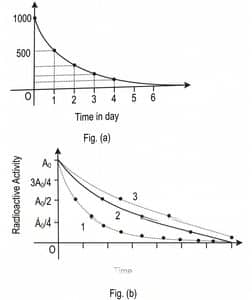
Apply the laws of radioactivity to derive an expression, [latex]N = N_oe^{-\lambda t}[/latex], where symbols have their usual meanings. [3]
You've reached the end of the free preview. Continue with NN Premium.
- Complete access to every Premium chapter
- Notes, QBank, solutions & MCQs
- Premium PDFs & study resources
- Entrance preparation & mock tests
One NN Premium subscription unlocks everything.