
Overview
Polarization is a short chapter by content but a reliable one for marks, almost entirely built around a single relationship: Brewster’s law. Nearly every board exam includes either a direct “state and prove Brewster’s law” question (worth 1–2 marks) or an MCQ/numerical that tests the same idea from a different angle — usually connecting the polarizing angle to the critical angle, or to the refractive index of the medium using tan(θp) = μ. Once you’re comfortable with that one equation and how it links to Snell’s law at the polarizing angle, most of this chapter’s questions become quick, mechanical wins.
The numericals below follow a tight, predictable pattern: you’re either given a refractive index and asked to find the polarizing angle, or given the polarizing angle and asked to work backward to find the refractive index or the velocity of light in that medium. The short-answer questions lean conceptual — expect to be asked whether sound waves or other longitudinal waves can be polarized (they can’t, and explaining why in terms of transverse vs. longitudinal wave nature is the actual test), and how polarized light differs from unpolarized light.
Below is the full set of MCQs, theory questions, and numerical problems from past NEB board exams, organized by course and question type.
MCQs
Which of the following phenomena proves transverse nature of light?
Show answer
A ray of light strikes a glass plate at an angle of 60o. If the reflected and refracted rays are perpendicular to each other. What is the refractive index of glass?
Show answer
A polarizer is used to
Show answer
Critical angle for a glass is 42o. What will be the polarizing angle for it?
Show answer
The critical angle of a certain medium is [latex]sin^{-1}(3/5)[/latex]. Then the polarizing angle of the medium will be
Show answer
The diagram represents a beam of unpolarized light incident on a diamond of refractive index [latex]\mu[/latex]. At an angle of incidence [latex]\theta_p[/latex], the beam reflected from the diamond is completely plane polarized normal to the plane of page. The relation between [latex]\theta_p[/latex] and [latex]\mu[/latex] is
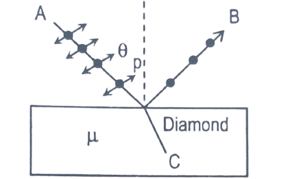
- [latex]\mu sin\theta_p = 1[/latex]
- [latex]\mu cot\theta_p = 1[/latex]
- [latex]\mu tan\theta_p = 1[/latex]
- [latex]\mu cos\theta_p = 1[/latex]
Show answer
A ray of light strikes a glass plate at an angle of incidence 60o. If the reflected and refracted rays are perpendicular to each other in interface, what is the refractive index of glass?
You've reached the end of the free preview. Continue with NN Premium.
- Complete access to every Premium chapter
- Notes, QBank, solutions & MCQs
- Premium PDFs & study resources
- Entrance preparation & mock tests
One NN Premium subscription unlocks everything.