
Overview
Photons is the chapter where the wave-particle nature of light finally pays off — it’s built almost entirely around the photoelectric effect and Einstein’s photoelectric equation (KEmax = hf − W₀), and it’s one of the most numerically consistent chapters in the syllabus. Nearly every board paper draws a theory question defining threshold frequency and work function, paired with a numerical asking you to find the maximum kinetic energy, stopping potential, or threshold wavelength when a metal is illuminated with light of a given wavelength.
A second recurring theme is the stopping-potential-vs-frequency graph — a straight line whose slope gives Planck’s constant (h/e) and whose x-intercept gives the threshold frequency. Several past papers ask you to read Planck’s constant or the work function directly off this graph, so it’s worth practicing that interpretation rather than only the algebraic version of the equation.
The conceptual questions are just as predictable: increasing the intensity of light increases the number of photoelectrons emitted, not their individual energy — only increasing the frequency increases KEmax. This intensity-vs-frequency distinction is tested repeatedly in different wording across the past papers below, so it’s worth being able to explain it in your own words rather than just stating the equation.
Below is the full set of MCQs, theory questions, and numerical problems from past NEB board exams, organized by course and question type.
⚠️ Common Mistakes Students Make
- Confusing the roles of intensity and frequency. Intensity controls how many photoelectrons are emitted (current); frequency controls how energetic each one is (KEmax). A common exam trap asks what happens when intensity is doubled — the answer is more electrons, not more energetic ones.
- Forgetting threshold frequency is a fixed property of the metal, not the light. Each metal has its own work function and corresponding threshold frequency; below that frequency, no photoelectrons are emitted regardless of how intense the light is.
- Mixing up stopping potential with work function in units. Stopping potential (in volts) numerically equals KEmax (in eV) divided by electron charge — students often forget to convert between eV and joules consistently partway through a multi-step numerical.
MCQs
Which of the following one is correct?
Show answer
In photoelectric cell, the relation between cut-off voltage (Vo) and frequency (f) of incident light is best represented by
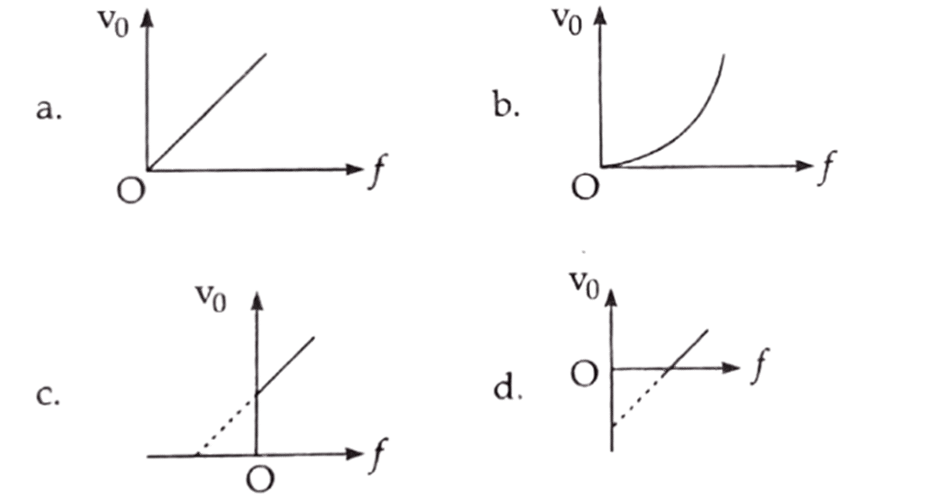
Show answer
Theoretical questions
Photoelectric effect is the phenomenon in which a radiation of a suitable frequency is incident on a metal surface and photoelectrons are emitted.
i. The work function of sodium is 2.3eV. Does sodium shows photoelectric effect with orange light of wavelength 6800 Å?
[Planck’s constant (h) = [latex]6.62\times 10^{-34}Js][/latex]
ii. Draw a graph showing the variation of photoelectric current with collector potential for different frequencies of light [latex]f_1, f_2[/latex] and [latex]f_3[/latex] such that [latex]f_3 > f_2 > f_1[/latex] but having same intensity. [1]
What is photoelectric effect? Describe work function and stopping potential. [3]
Define threshold wavelength. [1]
Explain photoelectric effect and write Einstein’s photoelectric equation. [2]
Sketch the graphs, showing the variation of stopping potential (Vo) with the frequency of incident radiation for two photosensitive materials A and B having threshold frequency fo and fo’ such that fo > fo’. [1]
i. Which of two materials A or B has higher work junction? [1]
ii. What does the value of intercept of graph A on the potential axis gives? [1]
When introducing optoelectronics to a class, a physics teacher writes “One of the important factors affecting photoelectric emission from a metal is the threshold frequency for the metal.”
Define the terms:
i. Photoelectric emission. [1]
ii. Threshold frequency. [1]
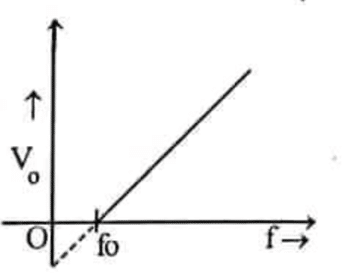
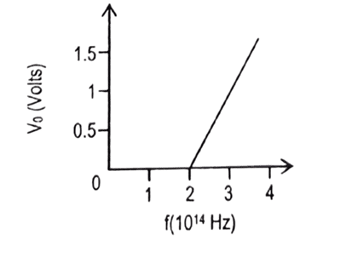
A graph between stopping potential (Vo) with the frequency (f) of incident radiation is shown in figure below. Answer the following questions.
i. Write the Einstein photoelectric equation in terms of stopping potential. [1]
ii. How will you determine Planck’s constant from the graph? [2]
iii. What happens to stopping potential if frequency of incident photon increases gradually? Justify. [2]
Which has more energy – a photon in the infrared or photon in the ultraviolet? Give reasons.
Can photoelectric effect be explained on the basis of wave theory of light? Justify your answer. [2]
If the wavelength of electromagnetic radiation is doubled, what will happen to the energy of the photons?
What happens to the kinetic energy of photoelectrons when the intensity of incident light is doubled? Justify your answer.
Human skin is relatively insensitive to visible light, but ultra violet radiation can cause severe burns. Does this have anything to do with photon energies? Explain.
If we go on increasing the wavelength of light incident on a metal surface, what charges take place in the number of electrons of energy of electrons?
Define photoelectric effect and describe Einstein’s photoelectric equation. Explain the terms-threshold frequency and work function.
What is photoelectric effect? Discuss Einstein’s photoelectric equation. Write some applications of photoelectric effect.
What is photoelectric effect? Explain the effect of increase of (i) frequency (ii) intensity of the incident radiation on photoelectrons emitted by a phototube.
Discuss photoelectric effect and derive Einstein’s photoelectric equation. What is stopping potential?
Explain photoelectric effect to write Einstein’s photoelectric equation. Describe Millikan’s laboratory method to determine Planck’s constant.
OR Explain Millikan’s experiment for the verification of Einstein’s photoelectric equation.
Numerical problems
Calculate the value of Planck’s constant and work function from the given figure. [2]
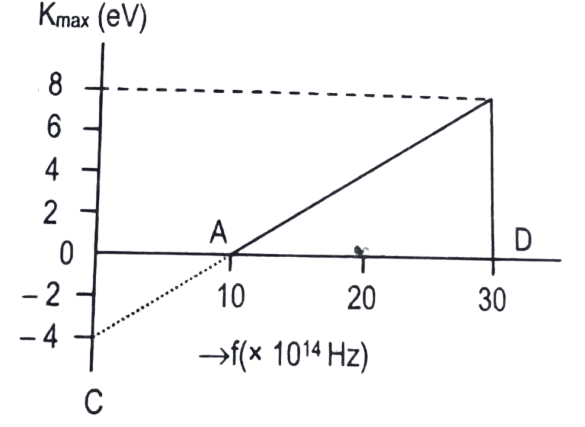
A metal has a work function of 2 eV. Calculate the maximum speed of the emitted photoelectrons when it is illuminated by radiation of wavelength 150 nm. What is the least frequency of the radiation for which electrons are emitted? (Given: Planck’s constant h = [latex]6.62\times 10^{-34}\ Js,\ m = 9.1\times 10^{-31}\ Kg, e = 1.6\times 10^{-19}\ C[/latex]) [3] Ans: [latex]1.48\times 10^6[/latex] m/s
The photon is then incident on the silver surface in a photoelectric experiment and the surface emits an electron with maximum possible kinetic energy. If the work function of silver is 4.7 eV,
i. What do you mean by work function? [1]
ii. Calculate the maximum kinetic energy of the emitted electron. [1]
iii. Determine the stopping potential for the emitted electron. [1] Ans: (ii) 5.56 eV (iii) 5.56 V
The minimum energy required to cause an electron to be emitted from a clean Zinc surface is [latex]6.9\times 10^{-19}\ J[/latex].
i. Calculate the maximum wavelength of electromagnetic radiation which will cause an electron from the Zinc surface. [2]
ii. What would be the effect of irradiating the Zinc surface with radiation of wavelength [latex]4\times 10^{-7}[/latex] m? Justify your answer. [2] Ans: (i) [latex]2.88\times 10^{-7}[/latex] m (ii) No photo electrons are emitted
When light of wavelength [latex]\lambda_1[/latex] is incident on the cathode of a photoelectric tube, the maximum kinetic energy of the emitted electron is 1.8 eV. If the wavelength is reduced to [latex]\frac{\lambda_1}{2}[/latex], the maximum kinetic energy of the emitted electron is 5.5 eV. Find the work function of the cathode materials. [2] Ans: 1.9 eV
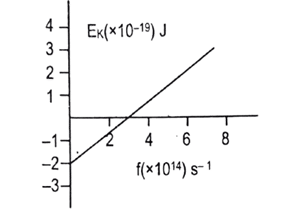
In an experiment on photoelectric effect, the graph between maximum kinetic energy and frequency of incident radiation on the metal surface is found to be straight line as shown in the figure.
Calculate:
i. threshold frequency. [1]
ii. Planck’s constant. [1]
iii. work function of metal in eV. [1] Ans: (i) [latex]3\times 10^{14}\ s^{-1}[/latex] (ii) [latex]6.67\times 10^{-34}\ Js[/latex] (iii) 1.25 eV
The work function of a metal is [latex]6.4\times 10^{-19}\ J[/latex].
Find the change in stopping potential when the wavelength of a radiation is decreased from 400 nm to 300 nm on the same metallic surface. Planck’s constant = [latex]6.62\times 10^{-34}\ Js[/latex] and velocity of light = [latex]3\times 10^8\ m/s[/latex]. Ans: 1.034 V
A clean nickel surface of work function 5.1 eV is exposed to light of wavelength 235 nm. What is the maximum speed of the photoelectrons emitted from its surface? Ans: 2.52 x 10⁵ m/s
Sodium has a work function of 2eV. Calculate the maximum energy and speed of the emitted electrons when sodium is illuminated by a radiation of 150 nm. What is the threshold frequency of radiation for which electrons are emitted from sodium surface? Ans: 10-18 J, 1.5 x 10⁶ m/s, 4.8 x 10¹⁴ Hz
Radiations of wavelength 5400 Å fall on a metal whose work function is 1.9 eV. Find the energy of the photoelectrons emitted and their stopping potential. (Planck’s Constant = 6.62 x 10⁻³⁴ Js). Ans: 0.39 eV, 0.39 V
Light of frequency 5 x 10¹⁴ Hz liberates electrons with energy 2.3 x 10⁻¹⁹ J from a certain metallic surface. What is the wavelength of ultraviolet light which liberates electrons of energy 8.93 x 10⁻¹⁹ J from the same surface? (Given h = 6.62 x 10⁻³⁴ Js, c = 3 x 10⁸ m/s). Ans: 2 x 10⁻⁷ m
400 nm wavelength of light falls on a photo sensitive material of work function 2.3 eV. Compute the maximum energy of photoelectrons. Ans: 0.803 eV
Sodium has a work function of 2eV. Calculate the maximum energy and speed of the emitted electrons when sodium is illuminated by radiation of wavelength 150 nm. (Given mass of electron = 9.1 x 10⁻³¹ kg). Ans: 1 x 10-18 J, 1.48 x 10⁶ m/s
The work function for the surface of aluminium is 4.2 eV. How much potential difference will be required to stop the emission of maximum energy electrons emitted by light of wavelength 2000 Å? (Planck’s constant = 6.6 x 10⁻³⁴ Js). Ans: 1.98 V
Light of wavelength [latex]5\times 10^{-7}[/latex] m falls on a sensitive metal plate with photo electric work function 1.90 eV. Find kinetic energy of the photoelectrons emitted and stopping potential. (given h = [latex]6.62\times 10^{-34} Js)[/latex]. Ans: Ek= 0.58 eV, Vs = 0.58 V
Ultraviolet light of wavelength [latex]3.36\times 10^{-7}\ m[/latex] is made to fall on a smooth surface of potassium. Determine maximum energy of emitted photo electrons and stopping potential. Ans: 1.5 eV, 1.5 V
Electrons with maximum kinetic energy of 3 eV are ejected from a metal surface by ultra-violet radiation of wavelength [latex]1.5\times 10^{-7}\ m.[/latex] Determine work function, threshold wavelength and the stopping potential for the metal (Planck’s constant, h = [latex]6.62\times 10^{-34}\ Js)[/latex]. Ans: 5.275 eV, [latex]2.35\times 10^{-7}\ m[/latex] 3V
The photoelectric threshold wavelength of a tungsten surface is 272 nm. Calculate the maximum velocity of the electrons ejected from this tungsten surface by ultraviolet radiation of frequency [latex]1.45\times 10^{15}\ Hz[/latex] Hz. (h = [latex]6.62\times 10^{-34}\ Js,[/latex] c = [latex]3\times 10^8\ m/s,\ m_e = 9.1\times 10^{-31}\ kg[/latex]). Ans: [latex]7.1\times 10^5\ m/s[/latex]
When ultraviolet light with a wavelength of 400 nm falls on a certain metal surface, the maximum kinetic energy of the emitted electrons is 1.10 eV. What is the maximum kinetic energy of the photoelectrons when light of wavelength 300 nm falls on the same surface? Ans: 2.137 eV
What will be the change in the stopping potential for photoelectrons emitted from a source if the wavelength of incident light is reduced from 400 nm to 360 nm? Ans: 0.34 V
The maximum energy of photoelectrons emitted from a metal plate is 1.2 eV. If the threshold wavelength is [latex]2.48\times 10^{-9}\ m,[/latex] calculate the wavelength of incident light. (Given Planck’s constant is [latex]6.62\times 10^{-34}\ Js)[/latex]. Ans: [latex]2.47\times 10^{-9}\ m[/latex]
Light of wavelength 6000 Å falls on a photosensitive plate of work function 1.9 eV. Find the speed of the photoelectrons emitted. (h = [latex]6.62\times 10^{-34}\ Js[/latex] and [latex]m_e = 9.1\times 10^{-31}\ kg)[/latex] Ans: [latex]2.44\times 10^5\ m/sec[/latex]
When a light of frequency [latex]5.4\times 10^{14}\ Hz[/latex] is incident on a metal surface, the maximum energy of the electrons emitted is [latex]1.2\times 10^{-19}\ J[/latex]. If the same surface is illuminated with light of frequency [latex]6.6\times 10^{14}\ Hz,[/latex] the maximum energy of the electrons is [latex]2\times 10^{-19}\ J.[/latex] Find the value of Planck’s constant. Ans: [latex]6.67\times 10^{-34}\ Js[/latex]
A UV light of 400 nm strikes a cesium surface of work function 1.9 eV. Find the velocity of electron emitted from the cesium surface. [latex]m_e = 9.1\times 10^{-34}\ kg,\ c = 3\times 10^8[/latex] m/s, h = [latex]6.62\times 10^{-34}[/latex] Js. Ans: [latex]6.5\times 10^5\ m/s[/latex]
The photoelectric work function of potassium is 2eV and the surface is illuminated with radiation of wavelength 350 nm. What potential difference have to be applied between a potassium surface and the collecting electrode in order just to prevent collection of electrons? What would be the kinetic energy of the electrons? Ans: 1.5 V, [latex]2.4\times 10^{-19}\ J[/latex]
The maximum kinetic energy of the electrons emitted from a metallic surface is [latex]1.6\times 10^{-19}\ J[/latex] when the frequency of the radiation is [latex]7.5\times 10^{14}\ Hz[/latex]. Calculate the minimum frequency of the radiation for which electrons will be emitted. Assume that h = [latex]6.6\times 10^{-34}\ Js.[/latex] Ans: [latex]5\times 10^{14}\ Hz[/latex]