
Overview
Magnetic Properties of Materials is a heavily MCQ-weighted chapter — notice how the “New Course” section barely appears in the theory questions below, since most of what NEB tests here fits naturally into 1-mark objective questions rather than long derivations. The chapter is really about classifying materials by how they respond to a magnetic field: diamagnetic substances (negative susceptibility, weakly repelled), paramagnetic substances (small positive susceptibility, weakly attracted), and ferromagnetic substances (strongly magnetized, like iron and cobalt), which lose their ferromagnetic behavior above the Curie temperature and become paramagnetic instead.
The second recurring theme is the hysteresis curve — its shape encodes retentivity (leftover magnetization when H returns to zero) and coercivity (the reverse field needed to bring B back to zero), while the area enclosed by the curve represents energy lost per cycle. This directly explains why soft iron (thin hysteresis loop, low energy loss) is used for transformer cores, while steel (wide loop, high retentivity) is preferred for permanent magnets — a “why” question that appears in nearly every version of the past papers below.
A smaller but recurring theory thread involves true dip vs. apparent dip and the relationship between them, along with the permeability-susceptibility relation (μr = 1 + χ).
Below is the full set of MCQs, theory questions, and numerical problems from past NEB board exams, organized by course and question type.
⚠️ Common Mistakes Students Make
- Mixing up retentivity and coercivity. Retentivity is the leftover magnetic flux density (B) when H = 0; coercivity is the reverse magnetizing field (H) needed to bring B back to zero. They’re read off opposite axes of the hysteresis loop.
- Forgetting why soft iron vs. steel matters practically. A thin hysteresis loop (soft iron) means low energy loss per cycle — ideal for transformers, which cycle constantly. A wide loop (steel) means high retentivity — ideal for permanent magnets, which need to stay magnetized. Students often recall the fact without connecting it to the area-under-the-curve reasoning.
- Assuming all magnetic materials follow a hysteresis curve. Hysteresis is a ferromagnetic phenomenon — diamagnetic and paramagnetic materials don’t exhibit it, since their magnetization doesn’t lag behind the applied field in the same way.
MCQs
Which portion of the given figure represents the coercivity?
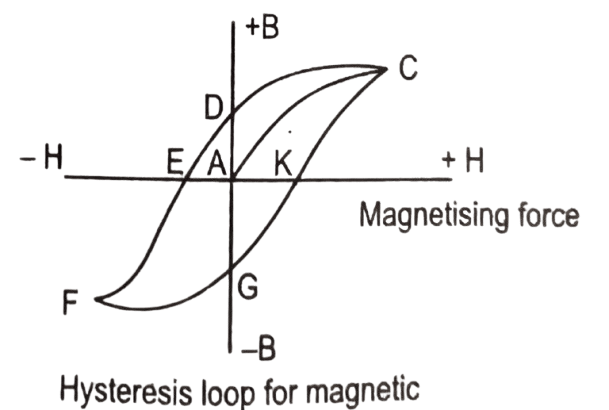
Show answer
Which of the following material has the highest relative permeability?
Show answer
If [latex]\chi[/latex] is the magnetic susceptibility of a material then its relative permeability [latex](\mu_r)[/latex] is
Show answer
The value of magnetizing field (H) when magnetic flux density (B) is equal to zero is called
Show answer
The value of magnetic susceptibility is negative for
You've reached the end of the free preview. Continue with NN Premium.
- Complete access to every Premium chapter
- Notes, QBank, solutions & MCQs
- Premium PDFs & study resources
- Entrance preparation & mock tests
One NN Premium subscription unlocks everything.