
Overview
Electrical Circuits is one of the highest-yield chapters in Grade XII Physics, reliably contributing 8–10 marks across MCQs, theory, and numericals in most board papers. Unlike single-formula chapters, this one covers four related sub-topics that NEB tests in rotation: Kirchhoff’s laws and the Wheatstone bridge, the potentiometer, galvanometer-to-ammeter/voltmeter conversion, and the meter bridge. The most consistent theory question is some version of “state Kirchhoff’s laws and derive the Wheatstone bridge balance condition,” which appears almost every year, sometimes as a full 3-mark derivation and sometimes broken into smaller parts.
The numericals below follow a small set of repeating structures rather than genuinely new problems each year — potentiometer balance-length calculations, shunt/series resistance for galvanometer conversion, and Kirchhoff’s law applications to find unknown resistances or currents. Once you recognize which of the four sub-topics a question belongs to, the formula to apply usually follows immediately. A key concept worth internalizing early: a potentiometer draws no current at the balance point, which is exactly why it measures emf more precisely than a voltmeter.
Below is the full set of MCQs, theory questions, and numerical problems from past NEB board exams, organized by course and question type.
⚠️ Common Mistakes Students Make
- Confusing the ammeter and voltmeter shunt rules. Ammeter = low resistance in parallel; voltmeter = high resistance in series. Remember: Ammeter = pArallel, low resistance.
- Forgetting the “no current at balance” condition for potentiometers. Zero current flows through the galvanometer branch at the balance point — that’s exactly why potentiometers give exact emf readings.
- Mixing up Kirchhoff’s first and second law. The junction rule (first law) governs current/charge conservation; the loop rule (second law) governs voltage/energy conservation. Mislabeling which law justifies which step in a Wheatstone bridge derivation is a common way to lose marks.
MCQs
Kirchhoff’s Voltage Law is based on the principle of conservation of
Show answer
A moving coil galvanometer has a resistance of [latex]90\Omega[/latex]. What is the value of shunt required to send 10% of main current through the galvanometer?
Show answer
Kirchhoff’s voltage law of electrical circuit is based on the principle of conservation of
Show answer
To convert a galvanometer into ammeter
Show answer
If specific resistance of a potentiometer wire is [latex]10^{-7}\ \Omega m,[/latex] current flowing through it is 0.1 A and cross-sectional area of wire is [latex]10^{-6}\ m^2[/latex], then potential gradient will be,
Show answer
Theoretical questions
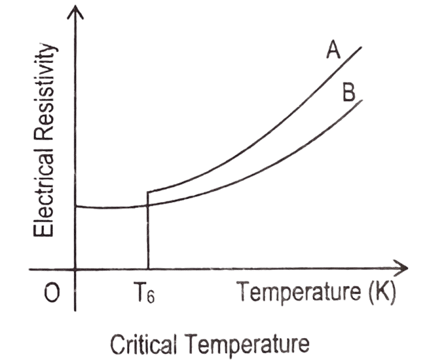
Analyze the given graph and name the type of material represented by graph A and graph B. [2]
How can a galvanometer be converted into an ammeter? Explain. [2]
A student sets up a circuit as shown in figure below to measure the emf of a test cell.
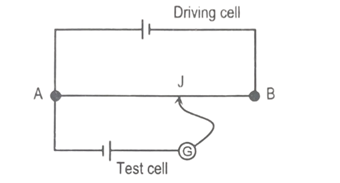
Explain how a galvanometer is converted into an ammeter. [2]
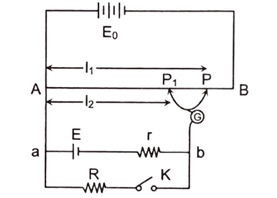
Define potential gradient. Express it in terms of specific resistance of the potentiometer wire. [2]
A potentiometer is equivalent to a voltmeter of infinite resistance. Explain. [2]
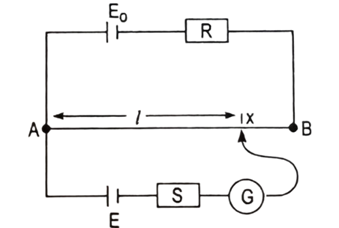
Draw a labelled wheat stone bridge circuit. Write down the balance condition of it. [2]
Kirchhoff’s laws in electricity are very useful in solving the complicated circuit connections.
Equal length of silver wire and iron wire having the same diameters are connected in series tot a dry cell. Which wire becomes hotter?
Draw a circuit diagram of a potentiometer to measure the internal resistance of a cell. Write the formula used.
Draw a Wheatstone bridge circuit and mention the balance condition for it.
State the principle of potentiometer and write down it’s one application.
If the current flowing in the wire of the potentiometer be decreased, what will be the effect on the position of zero deflection in potentiometer? Explain.
Why do we prefer potentiometer of longer length for accurate measurement?
Draw a circuit diagram of meter bridge to determine the resistance of a wire. give the formula used.
Why do we prefer potentiometer to measure emf of a cell rather than a voltmeter?
How can a galvanometer be converted into voltmeter? Explain.
What are Kirchhoff’s laws of current and voltage? State Wheatstone bridge principle and obtain balanced condition of it using Kirchhoff’s laws.
State Kirchhoff’s laws and use them to derive Wheatstone bridge principle.
State Kirchhoff’s laws and use them to derive wheat stone’s bridge principle.
What do you mean by a shunt? Describe its use in converting a galvanometer into an ammeter?
OR Why has an ammeter a very low resistance? How can you convert a galvanometer into an ammeter?
What is the principle of a potentiometer? Explain how can you measure the internal resistance of a cell by using potentiometer?
State and explain Kirchhoff’s laws of current and voltage. Explain how these laws are used to obtain balance condition of Wheatstone’s bridge.
OR What is Wheatstone bridge? Use Kirchhoff’s laws of current and voltage to obtain balance condition of it.
What is a galvanometer? How can you convert it into a voltmeter? Why should the resistance of a voltmeter be high?
State and apply Kirchhoff’s rule of electrical circuits to measure the unknown resistance of a wire by metre bridge with necessary theory and circuit.
OR State principle of meter bridge. Describe how it is used to determine the resistance of a wire.
Numerical problems
Define potential gradient. A potentiometer wire is 10m long. It has a resistance of 20 [latex]\Omega[/latex]. It is connected in series with a battery of 3V and a resistance of 10 [latex]\Omega[/latex]. Calculate the potential gradient along the wire. [1+2] Ans: 0.2 V/m
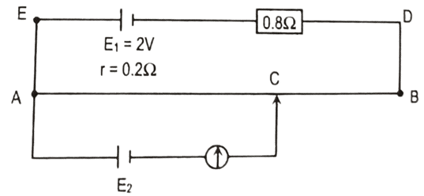
In the given diagram, AB is a potentiometer wire of length 1m and of resistance 4 [latex]\Omega[/latex]. If the balance length AC = 60 cm, what is the value of emf [latex]E_2[/latex]? [3] Ans: 0.96 V
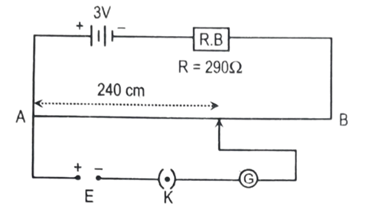
A potentiometer circuit is shown in figure. If the total length of potentiometer wire is 4m and has resistance 10[latex]\Omega[/latex] and the balance point is obtained at a length of 240cm, calculate the value of unknown emf E. [3] Ans: 0.06 V
An unknown resistance [latex]R_1[/latex] is connected in series with resistance 10[latex]\Omega[/latex]. This combination is connected to one of the gaps of a meter bridge, while another resistance [latex]R_2[/latex] is connected to next gap. The balance point is obtained at 50 cm. Now, when [latex]10 \Omega[/latex] resistance is removed, the balance point is 40cm. Find the value of [latex]R_1[/latex]. [3] Ans: [latex]20 \Omega[/latex]
A potentiometer is used to measure the internal resistance of a cell. When the cell in the secondary circuit is short circuited by [latex]5 \Omega[/latex] resistor, the null point is at 220 cm. Again, when the cell is shunted by [latex]20 \Omega[/latex] resistor, the null point is at 300cm. What is the internal resistance of the cell? [3] Ans: [latex]2.76 \Omega[/latex]
A galvanometer has a resistance of [latex]10 \Omega[/latex]. It gives maximum deflection for a current of 50 mA. Find the shunt resistance to convert it into ammeter of range 2.5A. [2] Ans: [latex]0.2 \Omega[/latex]
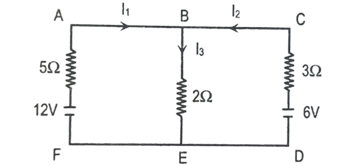
Using Kirchhoff’s laws in the electrical network shown in the adjacent figure.
i. Calculate the value of [latex]I_1[/latex] and [latex]I_2[/latex]. [2]
ii. p.d. between points A and F. [1] Ans: (i) 1.55A, 0.58A (ii) 19.75V
The emf of a battery is balanced by a length 75 cm on a potentiometer wire and emf of a standard cell of 1.02 volt is balanced by a length 50 cm of it. Calculate the emf of the battery. [3] Ans: 1.53 V
A moving coil meter has a resistance of 25 [latex]\Omega[/latex] and indicates full scale deflection when a current of 4.0 mA flows through it. How could this meter be converted to a milliammeter having a full-scale deflection for a current of 50mA? Ans: [latex]2.14 \Omega[/latex]
The resistance of the coil of a galvanometer is [latex]9.36 \Omega[/latex] and a current of 0.0224 A causes it to deflect full scale. The only shunt available has a resistance [latex]0.025\Omega[/latex]. What resistance must be connected in series with the coil to make it an ammeter of range 0 – 20A? Ans: [latex]12.94\Omega[/latex]
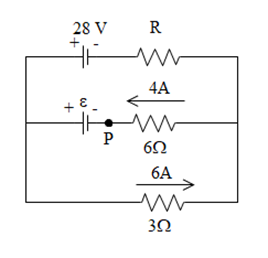
In the adjacent circuit find:
i. the current in resistor R,
ii. resistance R,
iii. the unknown emf ,
iv. if the circuit is broken at P, what is the current in resistor R Ans: 2 A, 5 [latex]\Omega[/latex] 42 V, 3.5 A
A potentiometer is 10 m long. It has a resistance of 20 [latex]\Omega[/latex]. It is connected in series with a battery of 3 V and a resistance of 10 [latex]\Omega[/latex]. What is the potential gradient along with wire? Ans: 0.2 V/m
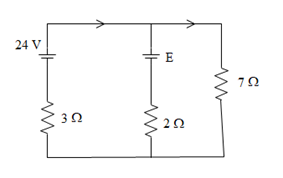
What must be the emf E in the circuit so that the current flowing through the 7 [latex]\Omega[/latex] resistor is 1.80 A? Each emf source has negligible internal resistance. Ans: 8.6 V
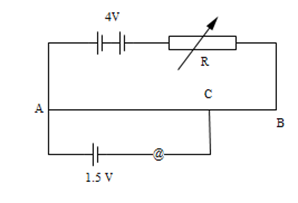
A simple potentiometer circuit is setup as in fig Q(1), using uniform wire AB, 1.0 m long, which has a resistance of 2 [latex]\Omega[/latex]. The resistance of the 4V battery is negligible. If the variable resistor R were given a value of 2.4 [latex]\Omega[/latex], what would be the length AC for zero galvanometer deflection? Ans: 82.5 cm
A battery of 6V and internal resistance 0.5 [latex]\Omega[/latex] is joined in parallel with another of 10V and internal resistance 1 [latex]\Omega[/latex]. The combination sends a current through an external resistance of 12 [latex]\Omega[/latex]. Find the current through each battery. Ans: I1 = – 2.27 A, I2 = 2.87 A
The total length of the wire of potentiometer if 10 m. A potential gradient of 0.015 V/cm is obtained when a steady current is passed through this wire. Calculate,
i. The distance of null point on connecting standard cell of 1.018V.
ii. The unknown p.d. if the null point is obtained at a distance of 940 cm, and
iii. The maximum p.d. which can be measured by this instrument. Ans: 6.68 m, 1.41 V, 1.5 V
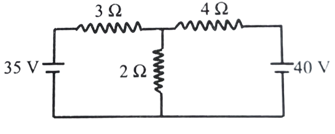
Using Kirchhoff’s laws of current and voltage, find the current in [latex]2\Omega[/latex] resistor in the given circuit:
The driver cell of a potentiometer has an emf of 2V and negligible internal resistance. The potentiometer wire has a resistance of 3 ohm. Calculate the resistance needed in series with the wire if a p.d. 5.0 mV is required across the whole wire. The wire is 100.0 cm long and a balanced length of 60 cm is obtained for a thermocouple of emf E. What is the value of E? Ans: 1197.2 [latex]\Omega[/latex], 3 mV