
Two long parallel conductors are placed 0.1 m apart and carry currents of 3 A and 2 A, respectively in the same direction. Calculate the force per unit length experienced by each conductor due to the other. [latex](\mu_o = 4\pi\times10^{-7}\ Hm^{-1})[/latex]
Solution
Distance between two conductors (r) = 0.1 m
Current in first conductor [latex](I_1) = 3\ A[/latex]
Current in second conductor [latex](I_2) = 2\ A[/latex]
Force per unit length (F) =?
We know that,
[latex]F = \dfrac{\mu_oI_1I_2}{2\pi r}[/latex]
[latex]= \dfrac{(4\pi\times10^{-7})\times3\times2}{2\pi\times0.1}[/latex]
[latex]= 1.2\times10^{-5}\ N/m[/latex]
A wire of length 0.5 m carrying a current of 2A is placed in a uniform magnetic field of strength 0.4T. Find the maximum and minimum force experienced by it.
Solution
length [latex](l)[/latex] = 0.5 m
Current [latex](I)[/latex] = 2A
Magnetic field strength (B) = 0.4 T
Maximum and minimum force (F) =?
The magnetic force (F) = [latex]BIlsin\theta[/latex]
So, maximum force (F) = [latex]BIl\ when,\ \theta = 90^o[/latex]
Or, F = [latex]0.4\times 2\times 0.5[/latex]
= 0.4 N
And, minimum force (F) = [latex]BIlsin0^o\ when,\ \theta = 0^o [/latex]
= 0 N
A slice of indium antimonide 2.5 mm thick carries a current of 150 mA. A magnetic field of flux density 0.5T, correctly applied, produces a maximum Hall voltage of 8.75 mV between the edges of the slice. Calculate the number of free charge carriers per unit volume assuming they each have a charge of [latex]-1.6\times 10^{-19}\ C[/latex].
Solution
Given,
Thickness (t) = 2.5 mm = 2.5 x 10⁻³ m
Current (I) = 150 mA = 150 x 10-3 A
Magnetic flux density (B) = 0.5T
Hall voltage (VH) = 8.75 mV = 8.75 x 10⁻³ V
Concentration of mobile electrons (n) =?
We know that,
Hall voltage (VH) = [latex]\frac{BI}{net}[/latex]
Or, n = [latex]\frac{BI}{V_Het}[/latex]
= [latex]\frac{0.5\times (150\times 10^{-3})}{(8.75\times 10^{-3})\times (1.6\times 10^{-19})\times (2.5\times 10^{-13})}[/latex]
= 2.143 x 10²² electrons/m3
An alpha particle of mass [latex]6.65 \times 10^{-27}\ kg[/latex] travels with a speed of [latex]6 \times 10^{6}\ m/s[/latex] at right angle to the magnetic field of 0.2 T. Calculate its acceleration.
Solution
Mass (m) = [latex]6.65 \times 10^{-27}\ kg[/latex]
Speed (v) = [latex]6 \times 10^{6}\ m/s[/latex]
Magnetic field (B) = 0.2 T
Acceleration (a) =?
We know that,
Charge of alpha particle (q) = [latex]+2e = 2 \times 1.6 \times 10^{-19}\ C = 3.2 \times 10^{-19}\ C[/latex]
Magnetic force (F) = [latex]Bqv\sin\theta[/latex]
[latex]= 0.2 \times (3.2 \times 10^{-19}) \times (6 \times 10^{6}) \sin 90^o[/latex]
[latex]= 3.84 \times 10^{-13}\ N[/latex]
Again, F = ma
Or, [latex]a = \dfrac{F}{m} = \dfrac{3.84 \times 10^{-13}}{6.65 \times 10^{-27}} = 5.774 \times 10^{13}\ m/s^2[/latex]
A horizontal straight wire of mass 0.12 gm and length 10 cm is placed perpendicular to a uniform horizontal magnetic field of flux density 0.6T. If the resistance per unit length of the wire is [latex]3.8\ \Omega m^{-1}[/latex], calculate the potential difference that has to be applied between the ends of the wire to make it just self-supporting.
Solution
Given,
Mass of wire (m) = [latex]0.12\ gm = (0.12 \times 10^{-3})\ kg[/latex]
Length of wire (l) = 10 cm = 0.1 m
Magnetic flux density (B) = 0.6 T
Resistance per unit length of the wire (R/l) = [latex]3.8\ \Omega m^{-1}[/latex]
So, resistance of the wire (R) = (R/l) x l
[latex]= 3.8 \times 0.1 = 0.38\ \Omega[/latex]
P.d. applied to make self – supporting (V) =?
We know that, for self – supporting,
[latex]mg = BIl\sin\theta[/latex]
Or, [latex]mg = \dfrac{BV}{R}l[/latex] [latex][\because \theta = 90^o][/latex]
Or, [latex]V = \dfrac{mgR}{Bl}[/latex]
[latex]= \dfrac{(0.12 \times 10^{-3}) \times 10 \times 0.38}{0.6 \times 0.1}[/latex]
[latex]= 7.6 \times 10^{-3}\ V[/latex]
A straight conductor of length 5cm carries a current of 1.5A. When the conductor is placed in a uniform magnetic field of 0.2T, it experiences a magnetic force of [latex]4.5 \times 10^{-3}\ N[/latex]. Find the angle made by the conductor with the magnetic field. Is there any position of the conductor in the field so that it experiences no force? Explain.
Solution
Given,
Length (l) = 5 cm = 0.05 m
Current (I) = 1.5 A
Magnetic force (F) = [latex]4.5 \times 10^{-3}\ N[/latex]
Magnetic field (B) = 0.2 T
Angle (θ) =?
We know that,
[latex]F = BIl\sin\theta[/latex]
Or, [latex]\sin\theta = \dfrac{F}{BIl}[/latex]
[latex]= \dfrac{(4.5 \times 10^{-3})}{0.2 \times 1.5 \times 0.05}[/latex]
[latex]= 0.3[/latex]
Or, [latex]\theta = \sin^{-1}(0.3)[/latex]
[latex]= 17.457^o.[/latex]
It experiences no force if the angle made by the conductor with the magnetic field is zero ([latex]0^o[/latex]).
Figure shows a rectangular metal frame ABCD placed in a uniform magnetic field of flux density [latex]4.5 \times 10^{-3}\ T[/latex].
i. Calculate the force experienced by side AB.
ii. Why side BC does not experience force? Explain.
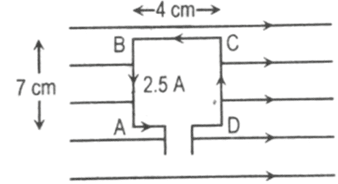
Solution
i. Magnetic field (B) = [latex]4.5 \times 10^{-3}\ T[/latex]
Length of side AB (l) = 7 cm = 0.07 m
Current (I) = 2.5 A
Force (F) =?
We know that,
[latex]F = BIl\sin\theta[/latex]
[latex]= (4.5 \times 10^{-3}) \times 2.5 \times 0.07 \times \sin 90^o[/latex] [latex][\because \text{angle between B and I is 90^o}[/latex]]
[latex]= 7.875 \times 10^{-4}\ N[/latex]
ii. Side BC does not experience force because angle between B and I is [latex]0^o[/latex]
So, Force (F) = [latex]BIl\sin\theta[/latex]
[latex]= (4.5 \times 10^{-3}) \times 2.5 \times 0.07 \times \sin 0^o[/latex] [latex][\because \text{angle between B and I is 0^o}[/latex]]
[latex]= 0\ N[/latex]
A horizontal straight wire 5 cm long weighing [latex]1.2\ g\ m^{-1}[/latex] is placed perpendicular to a uniform horizontal magnetic field of flux density 0.6 T. If resistance of the wire is [latex]3.8\ \Omega m^{-1}[/latex], calculate the p.d. that has to be applied between the ends of the wire to make it just self-supporting.
Solution
Given,
Length of wire (l) = 5 cm = 0.05 m
Mass per unit length (m/l) = [latex]1.2\ gm^{-1} = (1.2 \times 10^{-3})\ kgm^{-1}[/latex]
So, mass of wire (m) = (m/l) x length = [latex](1.2 \times 10^{-3}) \times (0.05)[/latex]
[latex]= 6 \times 10^{-5}\ kg[/latex]
Magnetic flux density (B) = 0.6 T
Resistance per unit length of the wire (R/l) = [latex]3.8\ \Omega m^{-1}[/latex]
So, resistance of the wire (R) = (R/l) x l
[latex]= 3.8 \times 0.05 = 0.19\ \Omega[/latex]
P.d. applied to make self – supporting (V) =?
We know that, for self – supporting,
[latex]mg = BIl\sin\theta[/latex]
Or, [latex]mg = \dfrac{BV}{R}l[/latex] [latex][\because \theta = 90^o][/latex]
Or, [latex]V = \dfrac{mgR}{Bl}[/latex]
[latex]= \dfrac{(6 \times 10^{-5}) \times 9.8 \times 0.19}{0.6 \times 0.05} = 3.724 \times 10^{-3}\ V[/latex]
A circular coil of 100 turns has a radius of 10 cm and carries a current of 5A. Determine the magnetic field at a point on the axis of the coil at a distance of 5 cm from the center of the coil.
Solution
Given,
No. of circular loops (N) = 100
Radius (r) = 10 cm = 0.1 m
Current (I) = 5A
Magnetic field (B) =?
Distance of a point from the centre (x) = 5 cm = 0.05 m
We know that,
Magnetic flux at a point at distance x from the centre of circular coil
[latex]B = \dfrac{\mu_o N I r^2}{2(x^2+r^2)^{3/2}}[/latex]
[latex]= \dfrac{(4\pi \times 10^{-7}) \times 100 \times 5 \times 0.1^2}{2(0.05^2+0.1^2)^{3/2}}[/latex]
[latex]= 2.247 \times 10^{-3}\ T[/latex]
Two galvanometers, which are otherwise identical, are fitted with different coils. One has a coil of 50 turns and resistance [latex]10\ \Omega[/latex] while the other has 500 turns and a resistance of [latex]600\ \Omega[/latex]. What is the ratio of the deflection when each is connected in terns to a cell of e.m.f. 25V and internal resistance [latex]50\ \Omega[/latex]?
Solution
Given,
1st coil:
No. of turns ([latex]N_1[/latex]) = 50
Resistance ([latex]R_1[/latex]) = [latex]10\ \Omega[/latex]
2nd coil:
No. of turns ([latex]N_2[/latex]) = 500
Resistance ([latex]R_2[/latex]) = [latex]600\ \Omega[/latex]
Ratio of deflection [latex]\left(\dfrac{\alpha_1}{\alpha_2}\right)[/latex] =?
Emf (E) = 25V
Internal resistance (r) = [latex]50\ \Omega[/latex]
We know that,
[latex]\dfrac{\alpha_1}{\alpha_2} = \dfrac{\frac{BI_1AN_1}{C}}{\frac{BI_2AN_2}{C}} = \dfrac{BI_1AN_1}{C} \times \dfrac{C}{BI_2AN_2} = \dfrac{I_1N_1}{I_2N_2}[/latex] ………………. (i)
But,
[latex]I_1 = \dfrac{E}{r+R_1} = \dfrac{25}{50+10} = \dfrac{25}{60} = \dfrac{5}{12}[/latex]
Similarly, [latex]I_2 = \dfrac{E}{r+R_2} = \dfrac{25}{50+600} = \dfrac{25}{650} = \dfrac{1}{26}[/latex]
So,
[latex]\dfrac{\alpha_1}{\alpha_2} = \dfrac{I_1N_1}{I_2N_2} = \dfrac{\frac{5}{12} \times 50}{\frac{1}{26} \times 500} = \dfrac{5}{12} \times \dfrac{26}{10} = \dfrac{13}{12} = 13:12[/latex]
A flat silver strip of width 1.5 cm and thickness 1.5 mm carries a current of 150 A. A magnetic field of 2T is applied perpendicular to the flat face of the strip. The emf developed across the width of the strip is measured to be [latex]17.9\ \mu V[/latex]. Calculate the free electron density in the silver.
Solution
Given,
Width (b) = 1.5 cm = 0.015 m
Thickness (t) = 1.5 mm = [latex]1.5 \times 10^{-3}\ m[/latex]
Current (I) = 150 A
Magnetic field (B) = 2T
Emf developed is the hall voltage ([latex]V_H[/latex]) = [latex]17.9\ \mu V = 17.9 \times 10^{-6}\ V[/latex]
Free electron density (n) =?
We know that,
Hall voltage ([latex]V_H[/latex]) = [latex]\dfrac{BI}{net}[/latex]
Or, [latex]n = \dfrac{BI}{V_H et}[/latex]
[latex]= \dfrac{2 \times 150}{(17.9 \times 10^{-6}) \times (1.6 \times 10^{-19}) \times (1.5 \times 10^{-3})}[/latex]
[latex]= 6.983 \times 10^{28}\ electrons/m^3[/latex]
A silver wire has [latex]1 \times 10^{30}[/latex] free electrons per cubic meter, a cross sectional area of 2 mm² and carries a current of 5A. Calculate the force acting on each electron if the wire is now placed in a magnetic field of flux density 0.15 T which is perpendicular to the wire.
Solution
Given,
Electron density (n) = [latex]1 \times 10^{30}\ electrons/m^3[/latex]
Cross – sectional area (A) = [latex]2\ mm^2 = 2 \times 10^{-6}\ m^2[/latex]
Current (I) = 5A
Force acting on each electron (F) =?
Magnetic flux density (B) = 0.15 T
We know that,
Drift velocity (v) = [latex]\dfrac{I}{enA}[/latex]
Now, force acting on each electron (F) = Bev
[latex]= Be \times \dfrac{I}{enA} = \dfrac{BI}{nA}[/latex]
[latex]= \dfrac{0.15 \times 5}{(1 \times 10^{30}) \times (2 \times 10^{-6})}[/latex]
[latex]= 3.75 \times 10^{-25}\ N[/latex]
A straight horizontal rod of length 20 cm and mass 30 gm is placed in a uniform horizontal magnetic field perpendicular to the rod. If the current of 2A through the rod makes itself supporting in the magnetic field, calculate the magnetic field. (g = 10 m/s²).
Solution
Given,
Length of rod (l) = 20 cm = 0.2 m
Mass (m) = 30 gm = 0.03 kg
Current (I) = 2A
Magnetic field (B) =?
We know that, for self – supporting,
[latex]mg = BIl\sin\theta[/latex]
Or, [latex]B = \dfrac{mg}{Il}[/latex] [latex][\theta = 90^o][/latex]
Or, [latex]B = \dfrac{0.03 \times 9.8}{2 \times 0.2}[/latex]
[latex]= 0.75\ T[/latex]
A coil consisting of 100 circular loops with radius 60 cm carries a current of 5A. Find the magnetic field at a point along the axis of the coil, 80 cm from the centre. ([latex]\mu_o = 4\pi \times 10^{-7}\ Tm/A[/latex]).
Solution
Given,
No. of circular loops (N) = 100
Radius (r) = 60 cm = 0.6 m
Current (I) = 5A
Magnetic field (B) =?
Distance of a point from the centre (x) = 80 cm = 0.8 m
We know that,
Magnetic flux at a point at distance x from the centre of circular coil
[latex]B = \dfrac{\mu_o N I r^2}{2(x^2+r^2)^{3/2}}[/latex]
[latex]= \dfrac{(4\pi \times 10^{-7}) \times 100 \times 5 \times 0.6^2}{2(0.8^2+0.6^2)^{3/2}}[/latex]
[latex]= 1.131 \times 10^{-4}\ T[/latex]
A straight conductor of length 5 cm carries current of 1.5A. The conductor experiences a magnetic force of [latex]4.5 \times 10^{-3}\ N[/latex] when it is placed in a magnetic field of 0.9 T. What angle the conductor makes with magnetic field?
Solution
Given,
Length (l) = 5 cm = 0.05 m
Current (I) = 1.5 A
Magnetic force (F) = [latex]4.5 \times 10^{-3}\ N[/latex]
Magnetic field (B) = 0.9 T
Angle (θ) =?
We know that,
[latex]F = BIl\sin\theta[/latex]
Or, [latex]\sin\theta = \dfrac{F}{BIl}[/latex]
[latex]= \dfrac{(4.5 \times 10^{-3})}{0.9 \times 1.5 \times 0.05}[/latex]
[latex]= 0.067[/latex]
Or, [latex]\theta = \sin^{-1}(0.067)[/latex]
[latex]= 3.841^o[/latex]
A circular coil has 100 turns and a mean diameter of 20 cm. It carries a current of 5A. Find the strength of the magnetic field at a point on its axis at a distance of 15 cm from the centre of the coil.
Solution
Given,
No. of circular loops (N) = 100
Diameter (d) = 20 cm = 0.2 m
So, radius (r) = [latex]\dfrac{0.2}{2} = 0.1\ m[/latex]
Current (I) = 5A
Magnetic field (B) =?
Distance of a point from the centre (x) = 15 cm = 0.15 m
We know that,
Magnetic flux at a point at distance x from the centre of circular coil
[latex]B = \dfrac{\mu_o N I r^2}{2(x^2+r^2)^{3/2}}[/latex]
[latex]= \dfrac{(4\pi \times 10^{-7}) \times 100 \times 5 \times 0.2^2}{2(0.15^2+0.2^2)^{3/2}}[/latex]
[latex]= 5.362 \times 10^{-4}\ T.[/latex]
The coil of a moving coil galvanometer has 50 turns and its resistance is [latex]10\ \Omega[/latex]. It is replaced by a coil having 100 turns and resistance [latex]50\ \Omega[/latex]. Find the factor by which the current and voltage sensitivities change.
Solution
Given,
No. of turns ([latex]N_1[/latex]) = 50
Resistance ([latex]R_1[/latex]) = [latex]10\ \Omega[/latex]
No. of turns ([latex]N_2[/latex]) = 100
Resistance ([latex]R_2[/latex]) = [latex]50\ \Omega[/latex]
Now, current sensitivity in the first coil is,
[latex]\left(\dfrac{\alpha}{I}\right)_1 = \dfrac{BN_1A}{k}[/latex]
And, current sensitivity in the second coil is,
[latex]\left(\dfrac{\alpha}{I}\right)_2 = \dfrac{BN_2A}{k}[/latex]
Now, the ratio = [latex]\dfrac{\left(\frac{\alpha}{I}\right)_2}{\left(\frac{\alpha}{I}\right)_1} = \dfrac{BN_2A}{k} \times \dfrac{k}{BN_1A} = \dfrac{N_2}{N_1} = \dfrac{100}{50} = 2[/latex]
Similarly, voltage sensitivity in the first coil is,
[latex]\left(\dfrac{\alpha}{V}\right)_1 = \dfrac{BN_1A}{kR_1}[/latex]
And, voltage sensitivity in the second coil is,
[latex]\left(\dfrac{\alpha}{V}\right)_2 = \dfrac{BN_2A}{kR_2}[/latex]
Now, the ratio = [latex]\dfrac{\left(\frac{\alpha}{V}\right)_2}{\left(\frac{\alpha}{V}\right)_1} = \dfrac{BN_2A}{kR_2} \times \dfrac{kR_1}{BN_1A} = \dfrac{N_2R_1}{N_1R_2} = \dfrac{100 \times 10}{50 \times 50} = \dfrac{2}{5}[/latex]
So, current sensitivity and voltage sensitivity will change by 2 and 2/5 respectively.
A 60 cm long wire of mass 10g is suspended horizontally in a transverse magnetic field of flux density 0.4 T through two springs at its two ends. Calculate the current required to pass through the wire so that there is zero tension in the springs.
Solution
Given,
Length of wire (l) = 60 cm = 0.6 m
Mass (m) = 10 g = [latex]10 \times 10^{-3}\ kg[/latex]
Magnetic flux density (B) = 0.4 T
Current (I) =?
There will be zero tension in the wire if the weight of the wire is equal to magnetic force. i.e.
Weight = Magnetic force
Or, mg = BIl
Or, [latex]I = \dfrac{mg}{Bl}[/latex]
[latex]= \dfrac{(10 \times 10^{-3}) \times 10}{0.4 \times 0.6}[/latex]
[latex]= 0.417\ A[/latex]
A horizontal wire of length 5 cm & carrying a current of 2A, is placed in the middle of a long solenoid at right angles to its axis, the solenoid has 1000 turns per meter & carries a steady current I. Calculate I if the force on the wire is equal to [latex]10^{-4}\ N[/latex]. ([latex]\mu_o = 4\pi \times 10^{-7}\ Hm^{-1}[/latex]).
Solution
Given,
Length of wire (l) = 5 cm = 0.05 m
Current in wire ([latex]I_w[/latex]) = 2A
No. of turns per meter (n) = 1000/m
Current in the solenoid (I) =?
Force on the wire (F) = [latex]10^{-4}\ N[/latex]
We know that,
F = BIl
[latex]= \mu_o n I_w I l[/latex] [latex][\because B = \mu_o n I_w][/latex]
Or, [latex]I = \dfrac{F}{\mu_o n I_w l}[/latex]
[latex]= \dfrac{10^{-4}}{(4\pi \times 10^{-7}) \times 1000 \times 2 \times 0.05}[/latex]
[latex]= 0.796\ A[/latex]
A copper wire has [latex]10^{29}[/latex] free electrons per cubic meter, a cross-sectional area of 2 mm² and carries a current of 5A. Calculate the force acting on each electron if the wire is now placed in a magnetic field of flux density 0.15 T which is perpendicular to the wire.
Solution
Given,
Electron density (n) = [latex]10^{29}\ electrons/m^3[/latex]
Cross – sectional area (A) = [latex]2\ mm^2 = 2 \times 10^{-6}\ m^2[/latex]
Current (I) = 5A
Force acting on each electron (F) =?
Magnetic flux density (B) = 0.15 T
We know that,
Drift velocity (v) = [latex]\dfrac{I}{enA}[/latex]
Now, force acting on each electron (F) = Bev
[latex]= Be \times \dfrac{I}{enA} = \dfrac{BI}{nA}[/latex]
[latex]= \dfrac{0.15 \times 5}{(10^{29}) \times (2 \times 10^{-6})}[/latex]
[latex]= 3.75 \times 10^{-24}\ N[/latex]
An electron of K.E. 10 eV is moving in a circular orbit of radius 11 cm, in a plane at right angles to a uniform magnetic field. Determine the value of the flux density. (mass of an electron = [latex]9.1 \times 10^{-31}\ Kg[/latex], e = [latex]1.6 \times 10^{-19}\ C[/latex]).
Solution
Given,
K.E. of electron (K.E.) = 10 eV
[latex]= (10 \times 1.6 \times 10^{-19})\ J[/latex]
[latex]= 1.6 \times 10^{-18}\ J[/latex]
Radius (r) = 11 cm = 0.11 m
Flux density (B) =?
Mass of electron (m) = [latex]9.1 \times 10^{-31}\ kg[/latex]
Electronic charge (e) = [latex]1.6 \times 10^{-19}\ C[/latex]
We know that,
[latex]K.E. = \dfrac{1}{2}mv^2[/latex]
Or, [latex]v = \sqrt{\dfrac{2 \times K.E.}{m}}[/latex]
[latex]= \sqrt{\dfrac{2 \times (1.6 \times 10^{-18})}{9.1 \times 10^{-31}}}[/latex]
[latex]= 1.875 \times 10^{6}\ m/s[/latex]
Also, electron will revolve around the circular orbit if,
Magnetic force = Centripetal force
Or, [latex]Bev = \dfrac{mv^2}{r}[/latex]
Or, Ber = mv
Or, [latex]B = \dfrac{mv}{er}[/latex]
[latex]= \dfrac{(9.1 \times 10^{-31}) \times (1.875 \times 10^{6})}{(1.6 \times 10^{-19}) \times 0.11}[/latex]
[latex]= 9.695 \times 10^{-5}\ T[/latex]
Two long parallel conductors carry respectively current of 12A and 8A in the same direction. If the wires are 10 cm apart, find where a third parallel wire also carrying a current must be placed so that the force experienced by it will be zero.
Solution
Given,
Current in first conductor ([latex]I_1[/latex]) = 12A
Current in second conductor ([latex]I_2[/latex]) = 8A
Distance between the wires (r) = 10 cm = 0.1 m
Position of third wire =?
Suppose, A and B be two wires and C be the position of 3rd wire, which is at a distance of x m from first wire.
We know that,
[latex]F_1 = \dfrac{\mu_o I_1 I}{2\pi x}[/latex] and [latex]F_2 = \dfrac{\mu_o I_2 I}{2\pi(0.1-x)}[/latex]
But, according to question,
[latex]F_1 – F_2 = 0[/latex]
Or, [latex]F_1 = F_2[/latex]
Or, [latex]\dfrac{\mu_o I_1 I}{2\pi x} = \dfrac{\mu_o I_2 I}{2\pi(0.1-x)}[/latex]
Or, [latex]\dfrac{I_1}{x} = \dfrac{I_2}{0.1-x}[/latex]
Or, [latex]\dfrac{12}{x} = \dfrac{8}{0.1-x}[/latex]
Or, 1.2 – 12x = 8x
Or, 20x = 1.2
Or, [latex]x = \dfrac{1.2}{20} = 0.06\ m[/latex]
Hence, position of 3rd wire is 0.06 m from the first wire.
A slab of copper, 2 mm thick and 1.50 cm wide, is placed in a uniform magnetic field of flux density 0.40 T, so that maximum flux pass through the slab. When a current of 75A flows through it, a potential difference of [latex]0.81\ \mu V[/latex] is developed between the edges of the slab. Find the concentration of the mobile electrons in copper. ([latex]\mu_o = 4\pi \times 10^{-7} Hm^{-1}[/latex]).
Solution
Given,
Thickness (t) = 2 mm = [latex]2 \times 10^{-3}\ m[/latex]
Width (b) = 1.5 cm = 0.015 m
Magnetic flux density (B) = 0.4T
Current (I) = 75 A
Emf developed is the hall voltage ([latex]V_H[/latex]) = [latex]0.81\ \mu V = 0.81 \times 10^{-6}\ V[/latex]
Concentration of mobile electrons (n) =?
We know that,
Hall voltage ([latex]V_H[/latex]) = [latex]\dfrac{BI}{net}[/latex]
Or, [latex]n = \dfrac{BI}{V_H et}[/latex]
[latex]= \dfrac{0.4 \times 75}{(0.81 \times 10^{-6}) \times (1.6 \times 10^{-19}) \times (2 \times 10^{-3})}[/latex]
[latex]= 1.157 \times 10^{29}\ electrons/m^3.[/latex]
An alpha particle makes a full rotation in a circle of radius 1.0 meter in 2.0 sec. Calculate the value of magnetic field induction at the centre of the circle. ([latex]\mu_o = 4\pi \times 10^{-7} Hm^{-1}[/latex]).
Solution
Given,
Charge on α particle (q) = 2e
Radius of circle (r) = 1 m
Time (t) = 2 s
Magnetic field at the centre of the circle (B) =?
We know that,
[latex]B = \dfrac{\mu_o I}{2r} = \dfrac{\mu_o}{2r} \times \dfrac{q}{t}[/latex]
[latex]= \dfrac{(4\pi \times 10^{-7}) \times 2 \times (1.6 \times 10^{-19})}{2 \times 1 \times 2}[/latex]
[latex]= 1.005 \times 10^{-25}\ T[/latex]
A straight horizontal rod X, of mass 50 g and length 0.5 m, is placed in a uniform horizontal magnetic field of 0.2 T perpendicular to X. Calculate the current in X if the force acting on it just balances its weight.
Solution
Given,
Mass of wire X (m) = [latex]50\ gm = (50 \times 10^{-3})\ kg[/latex]
Length of wire (l) = 0.5 m
Magnetic flux density (B) = 0.2 T
Current in the wire (I) =?
We know that, for balancing its weight,
[latex]mg = BIl[/latex] [latex][\theta = 90^o][/latex]
Or, [latex]I = \dfrac{mg}{Bl}[/latex]
[latex]= \dfrac{(50 \times 10^{-3}) \times 10}{0.2 \times 0.5}[/latex]
[latex]= 5\ A[/latex]
A copper wire has [latex]1 \times 10^{29}[/latex] free electrons per cubic meter and cross-sectional area 2 mm² carries a current of 6A. Calculate the force acting on each electron if the wire is now placed in uniform magnetic field of flux density 0.1 T perpendicularly.
Solution
Given,
Electron density (n) = [latex]1 \times 10^{29}\ electrons/m^3[/latex]
Cross – sectional area (A) = [latex]2\ mm^2 = 2 \times 10^{-6}\ m^2[/latex]
Current (I) = 6A
Force acting on each electron (F) =?
Magnetic flux density (B) = 0.1 T
We know that,
Drift velocity (v) = [latex]\dfrac{I}{enA}[/latex]
Now, force acting on each electron (F) = Bev
[latex]= Be \times \dfrac{I}{enA} = \dfrac{BI}{nA}[/latex]
[latex]= \dfrac{0.1 \times 6}{(1 \times 10^{29}) \times (2 \times 10^{-6})}[/latex]
[latex]= 3 \times 10^{-24}\ N[/latex]
A copper wire 28 m long is wound into a flat circular coil 8.0 cm in diameter. If the current of 4.50 A flows through the coil, what is the magnetic induction at the centre? ([latex]\mu_o = 4\pi \times 10^{-7} Hm^{-1}[/latex]).
Solution
Given,
Length of wire (l) = 28 m
Diameter of circular coil (d) = 8 cm = 0.08 m
Radius of circular coil (r) = [latex]\dfrac{d}{2} = \dfrac{0.08}{2} = 0.04\ m[/latex]
Length of circumference of coil (C) = [latex]\pi d[/latex]
[latex]= \dfrac{22}{7} \times 0.08 = 0.251\ m[/latex]
Now, no. of turns of the wire (N) = [latex]\dfrac{l}{C} = \dfrac{28}{0.251} = 111.553 \approx 112\ turns[/latex]
Current (I) = 4.5 A
Magnetic induction at the centre (B) =?
We know that,
[latex]B = \dfrac{\mu_o N I}{2r}[/latex]
[latex]= \dfrac{(4\pi \times 10^{-7}) \times 112 \times 4.5}{2 \times 0.04}[/latex]
[latex]= 7.917 \times 10^{-}\ T[/latex]
A long wire carrying a current of 10 A is placed perpendicular to magnetic field of flux density 5 Tesla. Calculate the force acting on 2 m of the wire.
Solution
Given,
Current (I) = 10 A
Magnetic flux density (B) = 5 T
Length of wire (l) = 2m
Force acting on the wire (F) =?
We know that,
[latex]F = BIl\sin\theta[/latex]
[latex]= 5 \times 10 \times 2 \times \sin 90^o[/latex]
[latex]= 100\ N[/latex]
A coil consisting of 100 circular loops with radius 0.60 m carries a current of 5A. At what distance from the center, along the axis, the magnetic field magnitude [latex]\dfrac{1}{8}[/latex] as great as it is at the center?
Solution
Given,
No. of circular loops (N) = 100
Radius (r) = 0.6 m
Current (I) = 5A
Distance from the centre along the axis (x) =?
It is given that, magnetic field at x is [latex]\dfrac{1}{8}[/latex] times it is at the centre. i.e.
[latex]B = \dfrac{1}{8}B_o[/latex]
Or, [latex]\dfrac{\mu_o N I r^2}{2(x^2+r^2)^{3/2}} = \dfrac{1}{8} \dfrac{\mu_o I N}{2r}[/latex]
Or, [latex](x^2+r^2)^{3/2} = 8r^3[/latex]
Or, [latex]x^2+r^2 = (8r^3)^{2/3}[/latex]
Or, [latex]x^2+r^2 = 4r^2[/latex]
Or, [latex]x^2 = 3r^2[/latex]
Or, [latex]x = \pm\sqrt{3r^2} = \pm\sqrt{3},r[/latex]
[latex]= \pm\sqrt{3} \times 0.6[/latex]
Or, x = 1.039 m. (Taking positive only)
A wire carrying current of 10 A and 2 m in length is placed in a field of flux density 0.34 Tesla. What is the force on the wire if it is placed at 60o to the field?
Solution
Given,
Current in the wire (I) = 10 A
Length of the wire (l) = 2m
Magnetic flux density (B) = 0.34 T
Force on the wire (F) =?
Angle (θ) = 60o
We know that,
[latex]F = BIl\sin\theta[/latex]
[latex]= 0.34 \times 10 \times 2 \times \sin 60^o[/latex]
[latex]= 5.889\ N[/latex]
In the Bohr’s model of hydrogen atom, the electron circulates round the nucleus in a path of radius [latex]5.1 \times 10^{-11}[/latex] metre at a frequency of [latex]6.8 \times 10^{15}\ Hz[/latex]. What value of B is set up at the centre of the orbit?
Solution
Given,
Radius of circular path (r) = [latex]5.1 \times 10^{-11}\ m[/latex]
Frequency (f) = [latex]6.8 \times 10^{15}\ Hz[/latex]
Magnetic flux density (B) =?
We know that,
[latex]B = \dfrac{\mu_o I}{2r} = \dfrac{\mu_o q}{2rT}[/latex] [latex][\because I = \dfrac{q}{T}][/latex]
[latex]= \dfrac{\mu_o n e f}{2r}[/latex] [latex][\because \dfrac{1}{T} = f][/latex]
[latex]= \dfrac{(4\pi \times 10^{-7}) \times 1 \times (1.6 \times 10^{-19}) \times (6.8 \times 10^{15})}{2 \times (5.1 \times 10^{-11})}[/latex]
Or, [latex]B = 13.404\ T[/latex]
Calculate the magnetic flux density at a distance of 1 cm from a very long vertical straight wire carrying current of 5 A. At what distance from the wire is the field flux density [latex]2 \times 10^{-5}\ T[/latex]. ([latex]\mu_o = 4\pi \times 10^{-7} Hm^{-1}[/latex]).
Solution
Given,
Magnetic flux density (B) =?
Distance (r) = 1 cm = 0.01 m
Current (I) = 5A
For second case,
Distance (r’) =?
Magnetic flux density (B’) = [latex]2 \times 10^{-5}\ T[/latex]
We know that, for 1st case,
[latex]B = \dfrac{\mu_o I}{2\pi r}[/latex]
[latex]= \dfrac{(4\pi \times 10^{-7}) \times 5}{2\pi \times 0.01}[/latex]
[latex]= 10^{-4}\ T[/latex]
For second case,
[latex]B’ = \dfrac{\mu_o I}{2\pi r’}[/latex]
[latex]r’ = \dfrac{\mu_o I}{2\pi B’}[/latex]
[latex]= \dfrac{(4\pi \times 10^{-7}) \times 5}{2\pi \times (2 \times 10^{-5})}[/latex]
[latex]= 5 \times 10^{-2}\ m[/latex]
A horizontal straight wire 5 cm long weighing [latex]1.2\ gm^{-1}[/latex] is placed perpendicular to a uniform horizontal magnetic field of flux density 0.6 T. If the resistance of the wire is [latex]3.8\ \Omega m^{-1}[/latex], calculate the p.d. that has to be applied between the ends of the wire to make it just self-supporting.
Solution
Given,
Length of wire (l) = 5 cm = 0.05 m
Mass per unit length of the wire (m/l) = [latex]1.2\ gm^{-1} = 1.2 \times 10^{-3}\ kgm^{-1}[/latex]
Mass of wire (m) = (m/l) x l = [latex](1.2 \times 10^{-3}) \times 0.05 = (6 \times 10^{-5})\ kg[/latex]
Magnetic flux density (B) = 0.6 T
Resistance per unit length of the wire (R/l) = [latex]3.8\ \Omega m^{-1}[/latex]
So, resistance of the wire (R) = (R/l) x l
[latex]= 3.8 \times 0.05 = 0.19\ \Omega[/latex]
P.d. applied to make self – supporting (V) =?
We know that, for self – supporting,
[latex]mg = BIl\sin\theta[/latex]
Or, [latex]mg = \dfrac{BV}{R}l[/latex] [latex][\theta = 90^o][/latex]
Or, [latex]V = \dfrac{mgR}{Bl}[/latex]
[latex]= \dfrac{(6 \times 10^{-5}) \times 10 \times 0.19}{0.6 \times 0.05}[/latex]
[latex]= 3.8 \times 10^{-3}\ V[/latex]