
[2076 ‘B’]
An ion for which the charge per unit mass is 4.40 x 10⁷ c/kg has velocity of 3.52 x 10⁵ m/s and moves in a circular orbit in a magnetic field of flux density 0.4 T. What will be the radius of this orbit?
Solution
Given
Charge per unit mass (e/m) = [latex]4.40\times 10^7[/latex] c/kg
Velocity (v) = [latex]3.52\times 10^5[/latex] m/s
Magnetic flux density (B) = 0.4 T
Radius (r) = ?
We know that,
[latex]Bev = \frac{mv^2}{r}[/latex]
Or, Ber = mv
Or, [latex]r = \frac{mv}{Be}[/latex]
Or, [latex]r = \frac{v}{B\left(\frac{e}{m}\right)} = \frac{3.52\times 10^5}{0.4\times(4.40\times 10^7)}[/latex]
[latex]= 0.02\ m = 2\times 10^{-2}\ m[/latex].
[2075 ‘S’]
Two plane metal plates 4 cm long are held horizontally 3 cm apart in a vacuum, one being vertically above the other. The upper plate is at a potential of 300 V and the lower is earthed. Electrons having a velocity of 10⁷ m/s are injected horizontally midway between the plates and in a direction parallel to the 4 cm edge. Calculate the vertical deflection of the electron beam as it emerges from the plates. (e/m for electron = 1.8 x 10¹¹ CKg⁻¹).
Solution
Given
Length of metal plate (L) = 4 cm = 0.04 m
Separation of metal plates (d) = 3 cm = 0.03 m
P.d. (V) = 300 V
Velocity of electron (v) = [latex]10^7[/latex] m/s
Vertical deflection (y) = ?
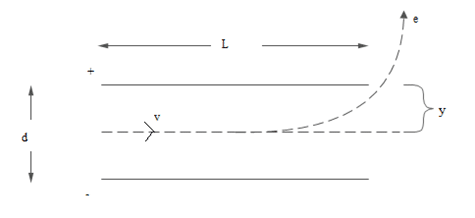
We know that,
Vertical deflection (y) = [latex]ut + \frac{1}{2}at^2[/latex]
[latex]= \frac{1}{2}at^2[/latex] [∵ for vertical motion, u = 0]
[latex]= \frac{1}{2}\frac{F}{m}t^2[/latex] [∵ F = ma]
[latex]= \frac{1}{2}\frac{eE}{m}\left(\frac{L}{v}\right)^2[/latex] [∵ F = eE and t = L/v]
[latex]= \frac{1}{2}\left(\frac{e}{m}\right)\left(\frac{V}{d}\right)\left(\frac{L}{v}\right)^2[/latex] [∵ E = V/d]
[latex]= \frac{1}{2}(1.8\times 10^{11})\left(\frac{300}{0.03}\right)\left(\frac{0.04}{10^7}\right)^2[/latex]
[latex]= 0.0144\ m = 1.44\times 10^{-2}\ m[/latex].
[2075 ‘A’]
An electron moving with a speed of 10⁷ m/s is passed into a magnetic field of intensity 0.1 T normally. What is the radius of the path of the electron inside the field? If the strength of the magnetic field is doubled, what is the radius of the new path? (e/m = 1.8 x 10¹¹ C/kg).
Solution
Given,
Speed (v) = [latex]10^7[/latex] m/s
Magnetic field intensity (B) = 0.1 T
Radius (r) = ?
We have,
[latex]Bev = \frac{mv^2}{r}[/latex]
Or, [latex]Ber = mv[/latex]
Or, [latex]r = \frac{mv}{Be}[/latex]
Or, [latex]r = \frac{v}{B\left(\frac{e}{m}\right)}[/latex]
Or, [latex]r = \frac{10^7}{0.1\times(1.8\times 10^{11})}[/latex]
Or, [latex]r = 5.55\times 10^{-4},m[/latex]
Again, B’ = 2B = 2 x 0.1 = 0.2 T
Now, [latex]r’ = \frac{v}{B’\left(\frac{e}{m}\right)}[/latex]
Or, [latex]r’ = \frac{10^7}{0.2\times(1.8\times 10^{11})}[/latex]
Or, [latex]r = 2.78\times 10^{-4}\ m[/latex].
[2074 ‘S’]
Calculate the potential difference to be maintained between two horizontal conducting plates separated by a distance of 10 mm so that a small charged oil drop of mass 1.31 x 10⁻¹⁴ Kg will remain in equilibrium. Charge in the oil drop is 6.4 x 10⁻¹⁹ C, g = 10 m/s².
Solution
Given,
Potential Difference (V) = ?
Separation of conducting plates (d) = 10 mm = [latex]10\times 10^{-3}[/latex] m
Mass of oil drop (m) = [latex]1.31\times 10^{-14}[/latex] Kg
Charge in oil drop (q) = [latex]6.4\times 10^{-19}[/latex] C
It is given that, the oil drop just remain in equilibrium, So, we have stationary condition for oil drop,
qE = mg
Or, [latex]q\frac{V}{d} = mg[/latex]
Or, [latex]V = \frac{mgd}{q} = \frac{(1.31\times 10^{-14})\times 10\times(10\times 10^{-3})}{(6.4\times 10^{-19})} = 2046.875\ V[/latex].
[2074 ‘A’]
An electron moves in a circular path of radius 20 cm in a uniform magnetic field of 2 x 10⁻³ T. Find the speed of the electron and period of revolution. (Mass of electron = 9.1 x 10⁻³¹ Kg).
Solution
Given,
Radius of circular path (r) = 20 cm = 0.2 m
Magnetic field (B) = [latex]2\times 10^{-3}[/latex] T
Speed of electron (v) = ?
Period of revolution (T) = ?
Mass of electron (m) = [latex]9.1\times 10^{-31}[/latex] Kg
We know that,
[latex]Bev = \frac{mv^2}{r}[/latex]
Or, Ber = mv
Or, [latex]v = \frac{Ber}{m}[/latex]
Or, [latex]v = \frac{(2\times 10^{-3})\times(1.6\times 10^{-19})\times(0.2)}{(9.1\times 10^{-31})} = 7.033\times 10^7\ m/s[/latex]
Now, we also have,
[latex]v = \omega r[/latex]
Or, [latex]\omega = \frac{v}{r}[/latex]
Or, [latex]\frac{2\pi}{T} = \frac{v}{r}[/latex]
Or, [latex]T = \frac{2\pi r}{v} = \frac{2\times 3.14\times 0.2}{7.033\times 10^7} = 1.786\times 10^{-8}\ sec[/latex].
[2073 ‘C’]
An electron having 500 eV energy enters at right angle to a uniform magnetic field of 10⁻⁴ Tesla. If its specific charge is 1.75 x 10¹¹ CKg⁻¹. Calculate the radius of its circular orbit.
Solution
Given,
Energy of electron (K.E.) = 500 eV = [latex]500\times 1.6\times 10^{-19} = 8\times 10^{-17}[/latex] J
Magnetic field (B) = [latex]10^{-4}[/latex] T
Specific charge (e/m) = [latex]1.75\times 10^{11}[/latex] C/Kg
Radius of circular orbit (r) = ?
We know that,
[latex]K.E. = \frac{1}{2}mv^2[/latex]
Or, [latex]v^2 = \frac{2K.E.}{m}[/latex]
Or, [latex]v = \sqrt{\frac{2K.E.}{m}} = \sqrt{\frac{2\times 8\times 10^{-17}}{9.1\times 10^{-31}}} = 1.326\times 10^7\ m/s[/latex]
Again,
[latex]Bev = \frac{mv^2}{r}[/latex]
Or, Ber = mv
Or, [latex]r = \frac{mv}{Be}[/latex]
Or, [latex]r = \frac{v}{B\left(\frac{e}{m}\right)} = \frac{1.326\times 10^7}{10^{-4}\times(1.75\times 10^{11})} = 0.758\ m = 75.8\ cm[/latex].
[2072 ‘D’]
In a Millikan’s oil drop experiment, a drop is observed to fall with a terminal speed 1.4 mm/s in the absence of electric field. When a vertical electric field of 4.9 x 10⁵ V/m is applied, the droplet is observed to continue to move downward at a lower terminal speed of 1.21 mm/s. Calculate the charge on the drop. (Density of oil = 750 kg/m³, viscosity of air = 1.81 x 10⁻⁵ kg/ms, density of air = 1.29 kg/m³).
Solution
Given,
Terminal velocity (v₁) = 1.4 mm/s = [latex]1.4\times 10^{-3}[/latex] m/s
Electric field (E) = [latex]4.9\times 10^5[/latex] V/m
Lower terminal velocity (v₂) = 1.21 mm/s = [latex]1.21\times 10^{-3}[/latex] m/s
Charge on the drop (q) = ?
Density of oil (ρ) = 750 kg/m³
Viscosity of air (η) = [latex]1.81\times 10^{-5}[/latex] Kg/ms
Density of air (σ) = 1.29 Kg/m³
We know that,
[latex]q = \frac{6\pi(v_1-v_2)}{E}\sqrt{\frac{9\eta v_1}{2(\rho-\sigma)g}}[/latex]
[latex]= \frac{6\times 3.14\times(1.4\times 10^{-3}-1.21\times 10^{-3})}{4.9\times 10^5}\sqrt{\frac{9\times(1.81\times 10^{-5})\times(1.4\times 10^{-3})}{2(750-1.29)\times 10}}[/latex]
[latex]= 5.16\times 10^{-19}\ C[/latex].
[2072 ‘E’]
A beam of electrons, moving with velocity of 10⁷ m/s enters midway between two horizontal parallel plates in the direction parallel to the plates which are 5 cm long and 2 cm apart and have a p.d. of V volts between then. Calculate V if the beam if deflected so that it just grazes the edge of the plate. (Assume e/m = 1.76 x 10¹¹ C/Kg).
Solution
Given,
Length of metal plate (L) = 5 cm = 0.05 m
Separation of metal plates (d) = 2 cm = 0.02 m
P.d. (V) = ?
Velocity of electron (v) = [latex]10^7[/latex] m/s
Vertical deflection (y) = 1 cm [∵ electron beam is moving mid – way between them, so, [latex]y = \frac{d}{2}[/latex]]
= 0.01 m
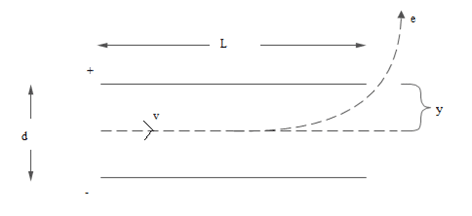
We know that,
Vertical deflection (y) = [latex]ut + \frac{1}{2}at^2[/latex]
[latex]= \frac{1}{2}at^2[/latex] [∵ for vertical motion, u = 0]
[latex]= \frac{1}{2}\frac{F}{m}t^2[/latex] [∵ F = ma]
[latex]= \frac{1}{2}\frac{eE}{m}\left(\frac{L}{v}\right)^2[/latex] [∵ F = eE and t = L/v]
[latex]= \frac{1}{2}\left(\frac{e}{m}\right)\left(\frac{V}{d}\right)\left(\frac{L}{v}\right)^2[/latex] [∵ E = V/d]
Or, [latex]0.01 = \frac{1}{2}(1.76\times 10^{11})\left(\frac{V}{0.02}\right)\left(\frac{0.05}{10^7}\right)^2[/latex]
Or, [latex]V = \frac{0.01\times 2\times 0.02}{(1.76\times 10^{11})}\times\left(\frac{10^7}{0.05}\right)^2 = 90.9\ V[/latex].
An electron is accelerated through a potential difference of 2000 V and then it enters a uniform magnetic field of 0.02 Tesla is a direction perpendicular to it. Find the radius of the path of the electron in the magnetic field. (Mass of an electron is 9.1 x 10⁻³¹ Kg, charge of an electron is 1.6 x 10⁻¹⁹ C).
Solution
Given,
P.d. (V) = 2000 V
Magnetic field (B) = 0.02 T
Radius of the circular path (r) = ?
Mass of electron (m) = [latex]9.1\times 10^{-31}[/latex] Kg
Charge of electron (q) = [latex]1.6\times 10^{-19}[/latex] C
We know that,
[latex]\frac{1}{2}mv^2 = eV[/latex]
Or, [latex]v^2 = \frac{2eV}{m}[/latex]
Or, [latex]v = \sqrt{\frac{2eV}{m}} = \sqrt{\frac{2\times(1.6\times 10^{-19})\times 2000}{(9.1\times 10^{-31})}} = 2.652\times 10^7\ m/s[/latex]
Now, [latex]Bev = \frac{mv^2}{r}[/latex]
Or, Ber = mv
Or, [latex]r = \frac{mv}{Be} = \frac{(9.1\times 10^{-21})\times(2.652\times 10^7)}{0.02\times(1.6\times 10^{-19})} = 7.54\times 10^{-3}\ m[/latex].
Calculate the radius of water drop which would be just remain suspended in an electric field of 300 V/cm and charge with one electron?
Solution
Given,
Radius of water drop (r) = ?
Electric field (E) = 300 V/cm = 30000 V/m
No. of charge (n) = 1
We know that,
Condition for just remaining suspended is,
qE = mg
Or, [latex]neE = \rho Vg[/latex]
Or, [latex]neE = \rho\frac{4}{3}\pi r^3 g[/latex]
Or, [latex]r^3 = \frac{3neE}{4\rho\pi g} = \frac{3\times 1\times(1.6\times 10^{-19})\times 30000}{4\times 1000\times 3.14\times 9.8} = 1.17\times 10^{-21}[/latex]
Or, [latex]r = \sqrt[3]{1.17\times 10^{-19}}[/latex]
[latex]= 1.054\times 10^{-7}\ m[/latex].
An electron beam after being accelerated from rest through a potential difference of 5 KV in vacuum is allowed to impinge normally on a fixed surface. If the incident current is 50 μA, Determine the force exerted on the surface assuming that it brings the electrons to rest. Take mass of electron is 9.1 x 10⁻³¹ Kg.
Solution
Given,
Potential difference (V) = 5 KV = 5000 V
Incident current (I) = 50 μA = [latex]50\times 10^{-6}[/latex] A
Force (F) = ?
Mass of electron (mₑ) = [latex]9.1\times 10^{-31}[/latex] kg
We know that,
[latex]\frac{1}{2}mv^2 = eV[/latex]
Or, [latex]v = \sqrt{\frac{2eV}{m}} = \sqrt{\frac{2\times(1.6\times 10^{-19})\times 5000}{9.1\times 10^{-31}}} = 4.193\times 10^7\ m/s[/latex]
Now,
Force (F) = [latex]\frac{mv}{t}[/latex]
[latex]= \frac{nm_ev}{t}[/latex] [∵ [latex]m = nm_e[/latex]]
[latex]= \frac{Im_ev}{e}[/latex] [∵ [latex]I = \frac{Q}{t} = \frac{ne}{t} \Rightarrow \frac{n}{t} = \frac{I}{e}[/latex]]
[latex]= \frac{(50\times 10^{-6})\times(9.1\times 10^{-31})\times(4.193\times 10^7)}{(1.6\times 10^{-19})}[/latex]
[latex]= 1.192\times 10^{-8}\ N[/latex].
A beam of electrons, moving with a velocity of 10⁷ m/s, enters midway between two horizontal parallel plates in a direction parallel to the plates. Each plate is 5 cm long. These plates are kept 2 cm apart and a potential difference of 90 V is applied between them. Calculate the velocity of the electron – beam with which it just grazes the edge of the positive plate. (e/m = 1.8 x 10¹¹ c/kg).
Solution:
Given
Velocity of electron beam (v’) = [latex]10^7[/latex] m/s
Length of metal plate (L) = 5 cm = 0.05 m
Separation of metal plates (d) = 2 cm = 0.02 m
P.d. (V) = 90 V
Velocity of electron (v) = ?
Vertical deflection (y) = 1 cm = 0.01 m [∵ electrons are moving mid way]
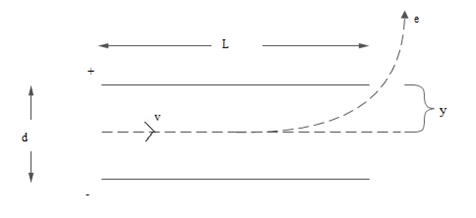
We know that,
Vertical deflection (y) = [latex]ut + \frac{1}{2}at^2[/latex]
[latex]= \frac{1}{2}at^2[/latex] [∵ for vertical motion, u = 0]
[latex]= \frac{1}{2}\frac{F}{m}t^2[/latex] [∵ F = ma]
[latex]= \frac{1}{2}\frac{eE}{m}\left(\frac{L}{v}\right)^2[/latex] [∵ F = eE and t = L/v]
[latex]= \frac{1}{2}\left(\frac{e}{m}\right)\left(\frac{V}{d}\right)\left(\frac{L}{v}\right)^2[/latex] [∵ E = V/d]
Or, [latex]0.01 = \frac{1}{2}(1.8\times 10^{11})\left(\frac{90}{0.02}\right)\frac{0.05^2}{v^2}[/latex]
Or, [latex]0.01 = \frac{1.013\times 10^{12}}{v^2}[/latex]
Or, [latex]v = 1.006\times 10^7\ m/s[/latex].
In the ionosphere, electrons execute 1.4 x 10⁶ revolutions in a second. Find the strength of the magnetic flux density B in this region. (mass of an electron = 9.1 x 10⁻³¹ kg, electronic charge = 1.6 x 10⁻¹⁹ C).
Solution
Given,
Frequency of electrons (f) = [latex]1.4\times 10^6[/latex] rev/s
Strength of magnetic field (B) = ?
Mass of electron (m) = [latex]9.1\times 10^{-31}[/latex] kg
Electronic charge (e) = [latex]1.6\times 10^{-19}[/latex] C
We know that,
For revolving in a orbit, magnetic force = centripetal force
Or, [latex]Bev = \frac{mv^2}{r}[/latex]
Or, [latex]B = \frac{mv}{er} = \frac{m\omega}{e} = \frac{m2\pi f}{e} = \frac{(9.1\times 10^{-31})\times 2\times 3.14\times(1.4\times 10^6)}{(1.6\times 10^{-19})} = 5\times 10^{-5}\ T[/latex].
An electron is accelerated through a potential difference of 2 KV and then it enters a uniform magnetic field of 0.02T, in a direction perpendicular to it. Find the radius of the path of the electron in the magnetic field. (mass of electron = 9.1 x 10⁻³¹ kg).
Solution
Given,
Potential difference (V) = 2 KV = 2000 V
Magnetic field (B) = 0.02 T
Radius of path (r) = ?
Mass of electron (m) = [latex]9.1\times 10^{-31}[/latex] kg
We know that,
[latex]\frac{1}{2}mv^2 = eV[/latex]
Or, [latex]v^2 = \frac{2eV}{m}[/latex]
Or, [latex]v = \sqrt{\frac{2eV}{m}} = \sqrt{\frac{2\times(1.6\times 10^{-19})\times 2000}{(9.1\times 10^{-31})}} = 2.652\times 10^7\ m/s[/latex]
Now, [latex]Bev = \frac{mv^2}{r}[/latex]
Or, Ber = mv
Or, [latex]r = \frac{mv}{Be} = \frac{(9.1\times 10^{-21})\times(2.652\times 10^7)}{0.02\times(1.6\times 10^{-19})} = 7.54\times 10^{-3}\ m[/latex].
In a Thomson experiment, voltage across the plates is 50V and the distance between them is 3 cm. The magnetic field applied to make the beam undeflected is 10⁻⁴ T, what is the velocity of the electron passing between the plates?
Solution
Given,
Voltage across the plates (V) = 50 V
Distance between plates (d) = 3 cm = 0.03 m
Magnetic field (B) = [latex]10^{-4}[/latex] T
Velocity of electron (v) = ?
We know that,
For undeflected beam of electron, magnetic force = electric force. i.e.
Bev = eE
Or, [latex]v = \frac{E}{B} = \frac{V}{dB} = \frac{50}{0.03\times 10^{-4}} = 1.667\times 10^7\ m/s[/latex].
Specific charge of particle is 4.4 x 10⁷ C kg⁻¹. It is moving in a circular orbit with a velocity 3.52 x 10⁵ ms⁻¹ in a magnetic flux density 0.4 T. Find the radius of its orbit.
Solution
Given,
Specific charge of particle (e/m) = [latex]4.4\times 10^7[/latex] Ckg⁻¹
Velocity (v) = [latex]3.52\times 10^5[/latex] ms⁻¹
Magnetic flux density (B) = 0.4 T
Radius of orbit (r) = ?
We know that,
[latex]Bev = \frac{mv^2}{r}[/latex]
Or, Ber = mv
Or, [latex]r = \frac{mv}{Be} = \frac{v}{B\frac{e}{m}} = \frac{3.52\times 10^5}{0.4\times(4.4\times 10^7)} = 0.02\ m[/latex].
An electron having 450 eV of energy moves at right angles to a uniform magnetic field of flux density 1.5 x 10⁻³ T. Find the radius of its circular orbit. [Given specific charge of the electron = 1.76 x 10¹¹ CKg⁻¹).
Solution
Given,
Energy of electron (K.E.) = 450 eV = [latex]450\times 1.6\times 10^{-19} = 7.2\times 10^{-17}[/latex] J
Magnetic flux density (B) = [latex]1.5\times 10^{-3}[/latex] T
Radius of circular orbit (r) = ?
Specific charge of the electron (e/m) = [latex]1.76\times 10^{11}[/latex] Ckg⁻¹
We know that,
[latex]K.E. = \frac{1}{2}mv^2[/latex]
Or, [latex]v^2 = \frac{2K.E.}{m}[/latex]
Or, [latex]v = \sqrt{\frac{2K.E.}{m}} = \sqrt{\frac{2\times(7.2\times 10^{-17})}{9.1\times 10^{-31}}} = 1.258\times 10^7\ m/s[/latex]
Now, [latex]Bev = \frac{mv^2}{r}[/latex]
Or, Ber = mv
Or, [latex]r = \frac{mv}{Be} = \frac{v}{B\frac{e}{m}} = \frac{1.258\times 10^7}{(1.5\times 10^{-3})\times(1.76\times 10^{11})} = 0.048\ m[/latex].
In a Millikan – type apparatus, the horizontal plates are 1.5 cm apart. With the electric field switched off an oil drop is observed to fall with the steady velocity 25 x 10⁻² cms⁻¹ when the field is switched on the upper plate being positive, the drop just remains stationary when the potential difference between the plates is 1500 V. Calculate the radius of the drop and the number of electronic charges. (Given – density of oil = 900 Kgm⁻³ and viscosity air = 1.8 x 10⁻⁵ Nsm², neglect air density).
Solution
Given,
Separation between plates (d) = 1.5 cm = 0.015 m
Velocity when electric field switched off (v₁) = [latex]2.5\times 10^{-2}[/latex] cms⁻¹ = [latex](2.5\times 10^{-2}\times 10^{-2})[/latex] ms⁻¹ = [latex]2.5\times 10^{-4}[/latex] ms⁻¹
Potential difference (V) = 1500 V
Radius of drop (r) = ?
No. of electronic charge (n) = ?
Density of oil (ρ) = 900 kgm⁻³
Viscosity of air (η) = [latex]1.8\times 10^{-5}[/latex] Nsm²
We know that,
[latex]r = \sqrt{\frac{9}{2}\frac{\eta v_1}{(\rho-\sigma)g}} = \sqrt{\frac{9\times(1.8\times 10^{-5})\times(2.5\times 10^{-4})}{2\times 900\times 9.8}} = 1.5\times 10^{-6}\ m[/latex]
Again,
[latex]q = \frac{6\pi\eta rv_1}{E}[/latex]
Or, [latex]ne = \frac{6\pi\eta rv_1}{V/d}[/latex]
Or, [latex]n = \frac{6\pi\eta rv_1d}{eV} = \frac{6\times 3.14\times(1.8\times 10^{-5})\times(1.5\times 10^{-6})\times(2.5\times 10^{-4})0.015}{(1.6\times 10^{-19})\times 1500} = 7.948 \approx 8[/latex].
A beam of electrons is under potential difference of 1.36 x 10⁴ V applied across two parallel plates 4 cm apart and a magnetic field 2 x 10⁻³ T at right angles to each other. If two fields produce no deflection in the electronic beam, calculate (i) the velocity of electrons (ii) the radius of the orbit in which the beam will move, if the electric field is made zero. (Given: mass of electron = 9.1 x 10⁻³¹ kg).
Solution
Given,
Potential difference (V) = [latex]1.36\times 10^4[/latex] V
Separation of parallel plates (d) = 4 cm = 0.04 m
Magnetic field (B) = [latex]2\times 10^{-3}[/latex] T
(i) velocity of electrons (v) = ?
(ii) radius of orbit (r) = ?
Mass of electron (m) = [latex]9.1\times 10^{-31}[/latex] kg
We know that,
For undeflected beam of electron, magnetic force = electric force. i.e.
Bev = eE
Or, [latex]v = \frac{E}{B} = \frac{V}{dB} = \frac{1.36\times 10^4}{0.04\times(2\times 10^{-3})} = 1.7\times 10^8\ m/s[/latex]
Now,
[latex]Bev = \frac{mv^2}{r}[/latex]
Or, Ber = mv
Or, [latex]r = \frac{mv}{Be} = \frac{(9.1\times 10^{-31})\times(1.7\times 10^8)}{(2\times 10^{-3})\times(1.6\times 10^{-19})} = 0.483\ m[/latex].
In Millikan-type apparatus, the horizontal plates are 1.5 cm apart. With the electric field switched off an oil drop is observed to fall with the steady velocity 2.5 x 10⁻² cm/s. When the electric field is switched on, the upper plate being positive, the drop just remains stationary when the p.d. between plates is 1500 V. (a) Calculate the radius of the drop (b) How many electronic charges does it carry?
Solution
Given,
Separation between plates (d) = 1.5 cm = 0.015 m
Velocity when electric field switched off (v₁) = [latex]2.5\times 10^{-2}[/latex] cms⁻¹ = [latex](2.5\times 10^{-2}\times 10^{-2})[/latex] ms⁻¹ = [latex]2.5\times 10^{-4}[/latex] ms⁻¹
Potential difference (V) = 1500 V
Radius of drop (r) = ?
No. of electronic charge (n) = ?
Density of oil (ρ) = 900 kgm⁻³
Viscosity of air (η) = [latex]1.8\times 10^{-5}[/latex] Nsm²
We know that,
[latex]r = \sqrt{\frac{9}{2}\frac{\eta v_1}{(\rho-\sigma)g}} = \sqrt{\frac{9\times(1.8\times 10^{-5})\times(2.5\times 10^{-4})}{2\times 900\times 9.8}} = 1.5\times 10^{-6}\ m[/latex]
Again,
[latex]q = \frac{6\pi\eta rv_1}{E}[/latex]
Or, [latex]ne = \frac{6\pi\eta rv_1}{V/d}[/latex]
Or, [latex]n = \frac{6\pi\eta rv_1d}{eV} = \frac{6\times 3.14\times(1.8\times 10^{-5})\times(1.5\times 10^{-6})\times(2.5\times 10^{-4})0.015}{(1.6\times 10^{-19})\times 1500} = 7.948 \approx 8[/latex].
A beam of proton is accelerated from rest through a potential difference of 2000V and then enters a uniform magnetic field which is perpendicular to the direction of the proton beam. If the flux density is 0.2 T, calculate the radius of the path which the beam describes. (proton mass = 1.7 x 10⁻²⁷ kg, Electronic charge = – 1.6 x 10⁻¹⁹ C).
Solution
Given,
Potential difference (V) = 2000 V
Magnetic flux density (B) = 0.2 T
Radius of path (r) = ?
Mass of proton (m) = [latex]1.7\times 10^{-27}[/latex] kg
Electronic charge (e) = [latex]-1.6\times 10^{-19}[/latex] C
We know that,
[latex]\frac{1}{2}mv^2 = eV[/latex]
Or, [latex]v^2 = \frac{2eV}{m}[/latex]
Or, [latex]v = \sqrt{\frac{2eV}{m}} = \sqrt{\frac{2\times(1.6\times 10^{-19})\times 2000}{(1.7\times 10^{-27})}} = 6.136\times 10^5\ m/s[/latex]
Now, [latex]Bev = \frac{mv^2}{r}[/latex]
Or, Ber = mv
Or, [latex]r = \frac{mv}{Be} = \frac{(1.7\times 10^{-27})\times(6.136\times 10^5)}{0.2\times(1.6\times 10^{-19})} = 0.033\ m[/latex].
Calculate the p.d. in volt necessary to be maintained between two horizontal conducting plates, one 5 mm above the other, so that a small oil drop of mass 1.31 x 10⁻¹⁴ kg with two electrons attached to it remains in equilibrium. (g = 9.8 ms⁻², charge of electron = – 1.6 x 10⁻¹⁹ C).
Solution
Given,
Potential difference (V) = ?
Separation between the plates (d) = 5 mm = [latex]5\times 10^{-3}[/latex] m
Mass of oil drop (m) = [latex]1.31\times 10^{-14}[/latex] kg
No. of electrons (n) = 2
Acceleration due to gravity (g) = 9.8 ms⁻²
Charge of electron (e) = [latex]1.6\times 10^{-19}[/latex] C
We know that,
Condition for oil drop to be in equilibrium,
QE = mg
Or, [latex]\frac{neV}{d} = mg[/latex]
Or, [latex]V = \frac{mgd}{ne} = \frac{(1.31\times 10^{-14})\times 9.8\times(5\times 10^{-3})}{2\times(1.6\times 10^{-19})} = 2.006\times 10^3\ V[/latex].
Find the electric field required to keep a water drop of radius 10⁻⁵ cm just suspended in vacuum when charged with one electron. (electronic charge = – 1.6 x 10⁻¹⁹ C, density of water = 1000 kg/m³).
Solution
Given,
Electric field (E) = ?
Radius of water drop (r) = [latex]10^{-5}[/latex] cm = [latex]10^{-7}[/latex] m
No. of electron (n) = 1
Electronic charge (e) = [latex]1.6\times 10^{-19}[/latex] C
Density of water (ρ) = 1000 kg/m³
We know that,
Condition for oil drop to be in equilibrium,
QE = mg
Or, [latex]neE = \rho Vg[/latex] [∵ [latex]m = \rho V[/latex]]
Or, [latex]neE = \rho\frac{4}{3}\pi r^3 g[/latex]
Or, [latex]E = \frac{4}{3}\frac{\rho\pi r^3 g}{ne} = \frac{\frac{4}{3}\times 1000\times 3.14\times(10^{-7})^3\times 10}{1\times(1.6\times 10^{-19})} = 2.617\times 10^2\ V/m[/latex].
A beam of proton is accelerated from test through a p.d. of 2000 V and then enters a uniform magnetic field which is perpendicular to the direction of the proton beam. If the flux density is 0.4 T, calculate the radius of the path which the beam describes. (proton mass = 1.7 x 10⁻²⁷ kg, electronic charge = – 1.6 x 10⁻¹⁹ C).
Solution
Given,
Potential difference (V) = 2000 V
Magnetic flux density (B) = 0.4 T
Radius of circular path (r) = ?
Mass of proton (m) = [latex]1.7\times 10^{-27}[/latex] kg
Electronic charge (e) = [latex]1.6\times 10^{-19}[/latex] C
We know that,
[latex]\frac{1}{2}mv^2 = eV[/latex]
Or, [latex]v^2 = \frac{2eV}{m}[/latex]
Or, [latex]v = \sqrt{\frac{2eV}{m}} = \sqrt{\frac{2\times(1.6\times 10^{-19})\times 2000}{(1.7\times 10^{-27})}} = 6.136\times 10^5\ m/s[/latex]
Now, [latex]Bev = \frac{mv^2}{r}[/latex]
Or, Ber = mv
Or, [latex]r = \frac{mv}{Be} = \frac{(1.7\times 10^{-27})\times(6.136\times 10^5)}{0.4\times(1.6\times 10^{-19})} = 0.0163\ m[/latex].
An oil drop of mass 3.25 x 10⁻¹⁵ kg falls vertically with uniform velocity, through the air between vertical parallel plates which are 2 cm apart. When a p.d. of 1000 V is applied to the plates the drop moves to the positively charged plate, being inclined at 45° to the vertical. Calculate the charge on the drop.
Solution
Given,
Mass of oil drop (m) = [latex]3.25\times 10^{-15}[/latex] kg
Separation of plates (d) = 2 cm = 0.02 m
Potential difference (V) = 1000 V
Charge on the drop (q) = ?
Suppose, v₁ and v₂ be the vertical and horizontal components of velocity.
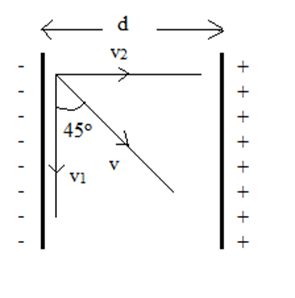
For vertical motion,
[latex]mg = 6\pi\eta rv_1[/latex] …………………. (i)
And, for horizontal motion,
[latex]qE = 6\pi\eta rv_2[/latex] ……………………. (ii)
dividing eqn. (ii) by (i), we get,
[latex]\frac{qE}{mg} = \frac{6\pi\eta rv_2}{6\pi\eta rv_1}[/latex]
[latex]Or, \frac{qE}{mg} = \frac{v_2}{v_1}[/latex]
[latex]Or, \frac{qE}{mg} = \frac{v\sin 45^o}{v\cos 45^o}[/latex]
[latex]Or, \frac{qE}{mg} = 1[/latex]
Or, qE = mg
Or, [latex]q = \frac{mg}{E} = \frac{mg}{V/d} = \frac{mgd}{V} = \frac{(3.25\times 10^{-15})\times 10\times 0.02}{1000}[/latex]
[latex]= 6.5\times 10^{-19}\ C[/latex].