
Work, Energy and Power
SYLLABUS
Work done by a constant force and a variable force, Power, Work-energy theorem; Kinetic and potential energy, Conservation of Energy, Conservative and non-conservative forces, Elastic and inelastic collisions.
What is This Chapter About?
Every physical process in the universe involves energy in some form. A ball rolling down a hill, a stretched rubber band snapping back, a car engine driving pistons, a light bulb glowing — all of these involve the transformation of energy from one form to another. Work, Energy and Power are the three interconnected concepts that allow physicists to describe, quantify, and predict these transformations with precision.
This chapter is one of the most conceptually satisfying in NEB Grade 11 Physics because it reveals a deep and beautiful truth: despite all the complexity of the physical world, energy is always conserved. It simply changes form. Chapter 5 carries 6 teaching hours and is examined consistently in NEB board papers.
Key Concepts You Will Learn
Work Done by a Force
In everyday language, “work” means any physical or mental effort. In physics, work has a precise definition: work is done when a force causes displacement in the direction of the force. Mathematically:
[latex]W = \vec{F} \cdot \vec{s} = Fs\cos\theta[/latex]
, where
[latex]\theta[/latex]
is the angle between the force and displacement vectors.
This dot product definition has important consequences. If a force is perpendicular to displacement — like the normal reaction force on a horizontally moving object — it does zero work. If force and displacement are in opposite directions, work is negative (for example, friction does negative work on a sliding object).
For a variable force — one that changes with position — work is found by integration:
[latex]W = \int F , dx[/latex]
, which geometrically equals the area under the force-displacement graph.
Work-Energy Theorem
The work-energy theorem is one of the most useful results in mechanics. It states that the net work done on an object equals the change in its kinetic energy:
[latex]W_{net} = \Delta KE = \frac{1}{2}mv^2 – \frac{1}{2}mu^2[/latex]
. This theorem directly connects the concept of force (through work) with motion (through kinetic energy), bridging dynamics and energy methods elegantly.
Kinetic and Potential Energy
Kinetic energy is the energy of motion:
[latex]KE = \frac{1}{2}mv^2[/latex]
. It depends on both mass and the square of velocity — doubling speed quadruples kinetic energy.
Potential energy is stored energy due to position or configuration. Gravitational potential energy near the Earth’s surface is
[latex]PE = mgh[/latex]
, where h is height above a reference level. Elastic potential energy stored in a stretched or compressed spring is [latex]PE = \frac{1}{2}kx^2[/latex], where k is the spring constant and x is the extension.
Conservation of Energy
The principle of conservation of energy states that energy can neither be created nor destroyed — it can only be converted from one form to another. The total energy of an isolated system remains constant. For a freely falling body, kinetic energy increases as potential energy decreases, and their sum remains constant throughout the fall. This principle is one of the most fundamental and universally applicable laws in all of physics.
Conservative and Non-Conservative Forces
A conservative force is one for which the work done depends only on the initial and final positions — not on the path taken. Gravity and elastic spring force are conservative. For conservative forces, mechanical energy (KE + PE) is conserved.
A non-conservative force like friction depends on the path taken — it always dissipates energy as heat. When non-conservative forces act, total mechanical energy decreases, but total energy (including heat) is still conserved.
Power
Power is the rate of doing work:
[latex]P = \frac{W}{t} = Fv[/latex]
. Its SI unit is the watt (W), equal to one joule per second. A powerful machine does the same amount of work in less time. The relation [latex]P = Fv[/latex] is particularly useful — it shows that for a vehicle moving at constant speed, engine power equals the driving force times the speed.
Elastic and Inelastic Collisions
A collision is an event where two or more bodies exert forces on each other for a short time. In an elastic collision, both momentum and kinetic energy are conserved. In an inelastic collision, momentum is conserved but kinetic energy is not — some is converted to heat, sound, or deformation energy. In a perfectly inelastic collision, the bodies stick together after impact. Analysing elastic collisions in one dimension gives useful results about the exchange of velocities between equal masses.
Why This Chapter Matters for NEB Exams
Work, Energy and Power appears in every NEB Grade 11 examination. The work-energy theorem, conservation of energy, and power calculations are standard short-answer questions. Problems involving elastic and inelastic collisions — finding velocities after impact using conservation of momentum and energy — are classic long-answer numericals. Distinguishing conservative from non-conservative forces is a frequently tested conceptual point.
Important Topics to Focus On
- Definition and calculation of work done by constant and variable forces
- Proof and application of the work-energy theorem
- Derivation of expressions for kinetic and gravitational potential energy
- Statement and proof of conservation of mechanical energy (using a freely falling body)
- Distinction between conservative and non-conservative forces with examples
- Definition of power and use of [latex]P = Fv[/latex]
- Elastic collision in one dimension — derivation of final velocities
- Distinction between elastic, inelastic, and perfectly inelastic collisions
- Numerical problems on all of the above
Connection to Other Chapters
Work and energy concepts connect backwards to Chapter 4 (Dynamics) — forces do work — and forwards to Chapter 6 (Circular Motion) and Chapter 7 (Gravitation), where energy methods simplify complex problems enormously. In Grade 12, the First Law of Thermodynamics is essentially conservation of energy applied to thermal systems. The elastic potential energy of a spring directly connects to Chapter 2 of Grade 12 (Periodic Motion / SHM). Energy conservation is arguably the single most used principle across all of physics.
Work:
Work is said to be done if certain amount of force applied on a body displace it by a certain distance along the direction of force. Mathematically,
[latex]W = \vec{F}. \vec{S}[/latex]
It means work is scalar product of force and displacement.
i.e., [latex]W = FS\cos\theta[/latex]
when, [latex]\theta = 0^o[/latex].
[latex]W = FS[/latex]
When, [latex]\theta = 90^o[/latex], W = 0.
Unit of work is Joule in SI unit and erg in CGS unit so that, 1 Joule = [latex]10^7[/latex] erg.
Workdone by variable force:
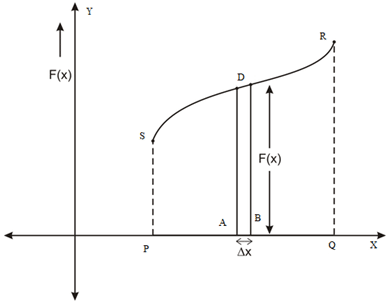
Let us consider, a body moving due to the application of variable force. In certain time, the body transit from P to Q to find workdone in this transition. Let us divide the section PQ into large number of rectangular strips with infinitely small thickness [latex]\Delta x[/latex].
Now, the small workdone by the body moving A to B is:
[latex]\Delta W = F_i \times \Delta x[/latex], where, i = workdone on moving [latex]i^{th}[/latex] strip [AD = area of [latex]i^{th}[/latex] strip]
You've reached the end of the free preview. Continue with NN Premium.
- Complete access to every Premium chapter
- Notes, QBank, solutions & MCQs
- Premium PDFs & study resources
- Entrance preparation & mock tests
One NN Premium subscription unlocks everything.
A car of mass 1000 kg moves at a constant speed of [latex]20ms^{-1}[/latex] along a horizontal road where the friction force is 200 N. Calculate the power developed by the engine.
Solution
Given,
Mass of car (m) = 1000 kg
Speed (v) = 20 m/s
Frictional force = 200 N
Power developed by the engine (P) =?
We have, applied force by the engine (F) = frictional force
= 200 N
Now, power [latex](P) = F.v[/latex]
[latex]= 200 \times 20[/latex]
[latex]= 4000\ W.[/latex]
You've reached the end of the free preview. Continue with NN Premium.
- Complete access to every Premium chapter
- Notes, QBank, solutions & MCQs
- Premium PDFs & study resources
- Entrance preparation & mock tests
One NN Premium subscription unlocks everything.