
Potential, Potential Difference and Potential Energy
SYLLABUS
Potential difference, Potential due to a point Charge, potential energy, electron volt, Equipotential lines and surfaces, Potential gradient
What is This Chapter About?
In mechanics, we found that thinking about energy — rather than forces — often provides the most elegant and powerful way to solve problems. The same shift in perspective is equally valuable in electrostatics. Instead of always thinking about the electric force on a charge, we can think about the electric potential at a point in space — a scalar quantity that encodes the energy available to any charge placed there.
This energy-based approach to electrostatics, developed in Chapter 21 of NEB Grade 11 Physics, is not just mathematically convenient — it reveals deep physical truths about how charges store and release energy, how electric fields relate to energy landscapes, and how electrical circuits work at a fundamental level. Carrying 4 teaching hours, this chapter introduces electric potential, potential difference, potential energy, equipotential surfaces, and the relationship between field and potential — concepts that are essential for understanding capacitors, circuits, and the quantum mechanics of atoms.
Key Concepts You Will Learn
Electric Potential
The electric potential (V) at a point in space is defined as the work done per unit positive charge in bringing a small test charge from infinity to that point, against the electric force:
[latex]V = \frac{W}{q_0}[/latex]
Potential is a scalar quantity — it has magnitude but no direction. This makes it much easier to work with than the vector electric field in many situations. The SI unit of potential is the volt (V) = joule per coulomb (J/C).
For the potential due to a single point charge Q at distance r:
[latex]V = \frac{Q}{4\pi\epsilon_0 r}[/latex]
This falls off as 1/r (more slowly than the field, which falls as 1/r²). For positive Q, V is positive everywhere; for negative Q, V is negative everywhere. At infinity, V = 0 by convention.
Potential Due to Multiple Charges — Superposition
Since potential is a scalar, the total potential due to multiple charges is simply the algebraic sum of the individual potentials:
[latex]V_{total} = V_1 + V_2 + V_3 + \ldots = \sum \frac{Q_i}{4\pi\epsilon_0 r_i}[/latex]
This scalar superposition is far simpler than vector superposition of electric fields — one of the great practical advantages of working with potential rather than field.
Electron Volt
The electron volt (eV) is a unit of energy equal to the kinetic energy gained by an electron (or any particle with charge e) when accelerated through a potential difference of 1 volt:
[latex]1 \text{ eV} = eV = 1.6 \times 10^{-19} \text{ J}[/latex]
The electron volt is extremely convenient for atomic and nuclear physics, where energies are tiny fractions of a joule. For example, the ionisation energy of hydrogen is 13.6 eV — far more natural to express in electron volts than as [latex]2.18 \times 10^{-18}[/latex] J.
Potential Difference
The potential difference (p.d.) between two points A and B is the work done per unit positive charge in moving the charge from B to A:
[latex]V_{AB} = V_A – V_B = \frac{W_{B \to A}}{q_0}[/latex]
Potential difference is what drives current in electrical circuits — current flows from higher to lower potential (for positive charges), exactly as water flows downhill. The potential difference is also called voltage in circuit contexts.
Electric Potential Energy
The electric potential energy of a charge q placed at a point where the potential is V is:
[latex]U = qV[/latex]
For a positive charge at high potential, U is large — the charge has the capacity to do work as it moves to lower potential. For a pair of point charges q₁ and q₂ separated by distance r, their mutual potential energy is:
[latex]U = \frac{q_1 q_2}{4\pi\epsilon_0 r}[/latex]
This energy is positive for like charges (repulsive interaction — energy must be supplied to bring them together) and negative for unlike charges (attractive interaction — energy is released as they come together).
Equipotential Lines and Surfaces
An equipotential surface is a surface on which the electric potential has the same value everywhere. No work is done in moving a charge along an equipotential surface — all points are at the same potential.
Key properties of equipotential surfaces: they are always perpendicular to electric field lines (because no work is done along them, and work = force × distance, meaning the force — and hence E — has no component along the surface); they never cross each other (because potential is unique at every point); and they become closer together where the field is stronger.
For a point charge, equipotential surfaces are concentric spheres. For a uniform field between parallel plates, they are parallel planes equally spaced. For a dipole, they are complex curves that are always perpendicular to the dipole field lines.
Relationship Between Field and Potential — Potential Gradient
The electric field and potential are not independent — they are directly related. The electric field at any point equals the negative potential gradient — the negative rate of change of potential with distance:
[latex]E = -\frac{dV}{dx}[/latex]
Or in the general three-dimensional case, E is the negative gradient of V. The negative sign means the field points from high potential to low potential — in the direction of decreasing potential, just as a ball rolls downhill in the direction of decreasing gravitational potential energy.
For a uniform field between parallel plates, where potential decreases linearly from one plate to the other:
[latex]E = \frac{\Delta V}{\Delta x} = \frac{V}{d}[/latex]
, confirming the result from Chapter 20.
This relationship allows us to move freely between the field description and the potential description of the same physical situation — whichever is more convenient for a given problem.
Why This Chapter Matters for NEB Exams
Potential, Potential Difference and Potential Energy is examined consistently in NEB Grade 11 Physics. The definition of electric potential and the formula for potential due to a point charge are standard short-answer questions. Numerical problems involving potential at a point due to multiple charges (using scalar superposition) are common. The electron volt — defining it and converting between eV and joules — is a frequently tested unit. Equipotential surfaces — drawing them for various charge configurations and explaining their relationship to field lines — appear as both drawing and conceptual questions. The potential gradient relationship
[latex]E = -\frac{dV}{dx}[/latex]
and its application to uniform fields generate standard numerical problems.
Important Topics to Focus On
- Definition of electric potential: [latex]V = \frac{W}{q_0}[/latex] — work done per unit charge from infinity
- Potential due to a point charge:
[latex]V = \frac{Q}{4\pi\epsilon_0 r}[/latex]
Scalar superposition of potentials from multiple charges Electron volt — definition, value, and conversion to joules Potential difference — definition and its role in driving current Electric potential energy: [latex]U = qV[/latex] and
[latex]U = \frac{q_1 q_2}{4\pi\epsilon_0 r}[/latex]
Equipotential surfaces — definition, properties, and diagrams for point charge, uniform field, dipole Perpendicularity of equipotential surfaces and field lines — explanation Potential gradient:
[latex]E = -\frac{dV}{dx}[/latex]
Uniform field: [latex]E = \frac{V}{d}[/latex] Numerical problems on potential, potential energy, and equipotential surfaces
Connection to Other Chapters
Potential builds directly on Chapter 19 (Electric Charges) and Chapter 20 (Electric Field) — it provides the energy perspective complementary to the force/field perspective. Chapter 22 (Capacitor) uses potential difference directly — capacitance is defined as charge per unit potential difference, and energy stored in a capacitor is
[latex]\frac{1}{2}QV[/latex]
. Chapter 23 (DC Circuits) uses potential difference as the driving force for current. In Grade 12, Chapter 23 (Quantization of Energy) uses the electron volt extensively — ionisation energies, photon energies, and X-ray energies are all expressed in eV. The potential energy of charges in electric fields connects to Chapter 21 (Photons) through the photoelectric effect — the work function is the minimum energy (in eV) needed to free an electron from a metal surface. The potential gradient relationship connects to Faraday’s Law in Chapter 18 — a changing magnetic flux induces an electric field, which has a potential gradient driving the induced current.
Electric Potential:
It is defined as the amount of workdone in bringing unit positive charge from infinity to that point against the electrostatic force. If ‘w’ be the workdone in bringing a test charge q’ from infinity to that point, the potential at that point is given by:
[latex]V = \frac{w}{q’}[/latex]
The unit of electric potential is [latex]JC^{-1}[/latex] Or, Volt.
If W = 1 J and q’ = 1 C, then, V = 1V. i.e. The potential is said to be 1 V if 1 J work is done in bringing a unit positive charge from infinity to that point.
Electric Potential due to a point charge:
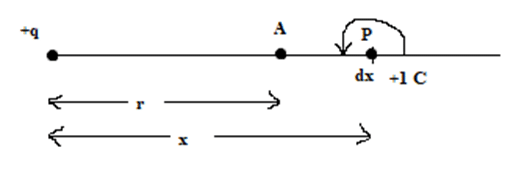
Consider, a point charge ‘+q’ and at a distance ‘r’, there is a point A where, the electric potential is to be determined. Let, another point ‘P’ along the line and at a distance, x where, a unit positive charge is kept.
Then, from Coulomb’s law, the force between the two charges is:
[latex]F = \frac{1}{4\pi\epsilon_o} \frac{q.1}{x^2} = \frac{1}{4\pi\epsilon_o} \frac{q}{x^2}[/latex] ………………………….. (i)
The small workdone in moving the unit charge through a small distance dx is
dW = -Fdx …………….. (ii)
From (i) & (ii),
[latex]dW = -\frac{1}{4\pi\epsilon_o} \frac{q}{x^2} dx[/latex]
You've reached the end of the free preview. Continue with NN Premium.
- Complete access to every Premium chapter
- Notes, QBank, solutions & MCQs
- Premium PDFs & study resources
- Entrance preparation & mock tests
One NN Premium subscription unlocks everything.
Test what you’ve learned in this chapter with a quick self-graded quiz.
Login is free. Then unlock all MCQs + full course access for Rs. 250/year.
- Every Grade XI & XII course — not just this one
- Full notes & step-by-step derivations
- Solved numerical examples
- Practice question banks & all MCQs
Free account on purchase · Full year access