
Electric Charges
SYLLABUS
Electric charges, Charging by induction, Coulomb’s law-Force between two point charges, Force between multiple electric charges.
What is This Chapter About?
Rub a plastic comb through your hair and bring it near small pieces of paper — they leap up and cling to the comb. Walk across a carpet on a dry day and touch a metal doorknob — a spark jumps between your finger and the metal. Peel sticky tape off a surface and it crackles. All of these phenomena involve electric charge — the fundamental property of matter that underlies all electrical and magnetic phenomena in the universe.
Chapter 19 of NEB Grade 11 Physics opens the Electricity and Magnetism section of the course by introducing the concept of electric charge, the mechanisms by which objects become charged, and the precise mathematical law governing the force between charges — Coulomb’s Law. Carrying 3 teaching hours, this chapter establishes the foundation upon which all subsequent electrical and magnetic chapters are built.
Key Concepts You Will Learn
Electric Charge and Charge Carriers
Electric charge is an intrinsic property of certain fundamental particles. The two types of charge are positive (carried by protons) and negative (carried by electrons). Like charges repel each other; unlike charges attract — this is the most fundamental observation in electrostatics.
The SI unit of charge is the coulomb (C). The charge of a single electron is
[latex]e = -1.6 \times 10^{-19}[/latex]
C — the smallest free charge observed in nature. All observable charges are integer multiples of this elementary charge — charge is quantised:
[latex]Q = ne[/latex]
, where n is an integer.
Charge is also conserved — the total electric charge of an isolated system never changes. Charges can be transferred from one body to another but cannot be created or destroyed. This is the law of conservation of charge, as fundamental as conservation of energy and momentum.
In solid conductors, positive charges (protons) are fixed in the crystal lattice and cannot move. Only free electrons can move through a conductor. In liquids and gases, both positive and negative ions can move. The moving charges that carry current in a material are called charge carriers.
Charging by Friction
When two different materials are rubbed together, electrons are transferred from one to the other — the material that loses electrons becomes positively charged and the one that gains electrons becomes negatively charged. This is charging by friction (or triboelectric charging).
The triboelectric series ranks materials by their tendency to gain or lose electrons when rubbed against another material. Glass rubbed with silk loses electrons (glass becomes positive, silk becomes negative). Rubber rubbed with fur gains electrons (rubber becomes negative, fur becomes positive). The specific charges produced depend on the pair of materials and the nature of their surfaces.
Charging by friction does not create charge — it only separates charges that were already present, confirming conservation of charge.
Charging by Induction
A charged body can cause charge redistribution in a nearby uncharged conductor without direct contact — this is charging by induction. When a positively charged rod is brought near a neutral metal sphere, free electrons in the sphere are attracted toward the rod side, leaving the far side with a net positive charge. If the sphere is then earthed (connected to ground) while the rod is still present, electrons flow from earth into the sphere (attracted by the positive rod). Removing the earth connection and then the rod leaves the sphere with a net negative charge — opposite to the inducing charge.
For a spherical conductor, a key result is that the entire charge distributes itself on the outer surface, and for any external point, the charge behaves as if it were all concentrated at the centre. This simplifies enormously the calculation of forces and fields outside spherical conductors.
Coulomb’s Law
The quantitative law governing the electrostatic force between two point charges was established by Charles-Augustin de Coulomb in 1785. Coulomb’s Law states that the force between two point charges [latex]q_1[/latex] and
[latex]q_2[/latex]
separated by distance r in free space is:
[latex]F = \frac{1}{4\pi\epsilon_0}\frac{q_1 q_2}{r^2}[/latex]
where
[latex]\epsilon_0 = 8.85 \times 10^{-12}[/latex]
C² N⁻¹ m⁻² is the permittivity of free space and
[latex]\frac{1}{4\pi\epsilon_0} \approx 9 \times 10^9[/latex]
N m² C⁻². The force is:
Attractive if the charges have opposite signs; repulsive if they have the same sign. It acts along the line joining the two charges. It obeys an inverse square law — doubling the distance reduces the force to one quarter.
Coulomb’s Law is structurally identical to Newton’s Law of Gravitation — both are inverse square laws. However, the electrostatic force is enormously stronger than gravity (by a factor of about [latex]10^{36}[/latex]) and can be both attractive and repulsive (gravity is always attractive).
Force Between Multiple Charges — Superposition
When more than two charges are present, the net force on any one charge is the vector sum of the forces due to each other charge individually. This is the principle of superposition for electrostatic forces. Each pairwise interaction obeys Coulomb’s Law independently, and the results are added vectorially. Problems involving three or more charges require careful vector addition — this is where the vector skills from Chapter 2 become essential.
Why This Chapter Matters for NEB Exams
Electric Charges is examined consistently in NEB Grade 11 Physics. Coulomb’s Law — stating it and solving numerical problems involving force between two or more charges — appears in every board paper. The distinction between conductors and insulators, the mechanism of charging by friction and induction, and the quantisation of charge are standard short-answer questions. Problems involving superposition of forces from multiple charges require vector addition and appear as numerical questions. The comparison between Coulomb’s Law and Newton’s Law of Gravitation is a popular conceptual question.
Important Topics to Focus On
- Properties of electric charge — two types, quantisation
[latex]Q = ne[/latex]
, conservation Distinction between conductors (free electrons) and insulators (no free charges) Charging by friction — mechanism and triboelectric series Charging by induction — step-by-step process and resulting charge sign Result for spherical conductor — charge on surface, acts as point charge externally Coulomb’s Law:
[latex]F = \frac{1}{4\pi\epsilon_0}\frac{q_1 q_2}{r^2}[/latex]
— statement, formula, and units Permittivity of free space [latex]\epsilon_0[/latex] and Coulomb’s constant k Comparison of Coulomb’s Law with Newton’s Law of Gravitation Superposition principle — vector addition of forces from multiple charges Numerical problems on Coulomb’s Law and superposition
Connection to Other Chapters
Electric Charges establishes the foundation for all subsequent electricity and magnetism chapters. Chapter 20 (Electric Field) extends from force to the concept of field — a more powerful way of thinking about how charges interact at a distance. Chapter 21 (Potential) introduces the energy perspective on charge interactions. Chapter 22 (Capacitor) explores charge storage. Chapter 23 (DC Circuits) deals with the flow of charge as current. In Grade 12, Chapter 16 (Magnetic Field) shows that moving charges — currents — create magnetic fields, and the Lorentz force combines electric and magnetic forces on a charge. The elementary charge e from this chapter reappears in Grade 12 Chapter 20 (Electrons) — Millikan’s oil drop experiment measures e directly — and in Chapter 21 (Photons) through the photoelectric equation.
Electricity:
The branch of physics that deals with the study of charges is known as electricity. The branch of electricity is divided into two parts:
(i) Electrostatics:
The branch of electricity which deals with the study of charges at rest is known as electrostatics.
(ii) Current electricity:
The branch of electricity which deals with the study of charges in motion is known as current electricity.
Electrical charge: Modern Theory of Electrification:
The charge is the physical property or intrinsic property of the matter that comes automatically with the matter whenever the matter exists and causes electromagnetic interaction, just the mass is the physical property of all matter which causes gravitational attraction.
The matter is made by atoms or molecules. The study of atomic structure of the matter conclude that the matter is electrical in nature. i.e. it contains large number of electrical charge particle, protons and electrons. Under ordinary condition, the matter is electrically neutral because it contains equal no. of positive and negative charge. Whenever, this equality is disturbed, the matter gets charged. When an electron is removed from the neutral atom, it gains a positive charge due to deficiency of an electron. When an electron is supplied to the neutral atom, it gains a negative charge due to excess of an electron. When the matter gains, excess or deficiency of electrons, then the matter is said to be charged. Depending upon the deficiency or excess of electrons on the matter there are two types of electrical charge:
(i) Positive charge:
It represents deficiency of electrons.
(ii) Negative charge:
It represents excess of electrons.
Structure of the Matter (Revised):
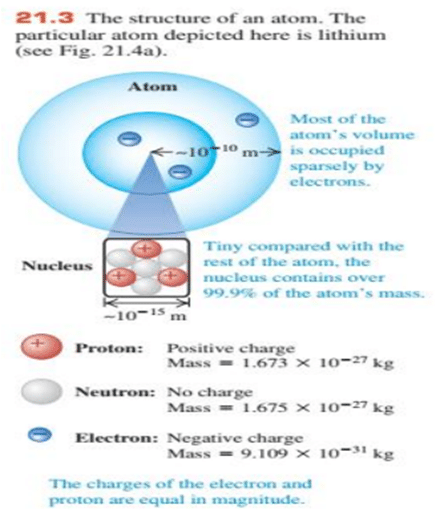
The structure of atoms can be described in terms of three particles: the negatively charged electron, the positively charged proton, and the uncharged neutron. The protons and neutrons in an atom make up a small, very dense core called the nucleus, with dimensions of the order of [latex]10^{-15}[/latex] m. Surrounding the nucleus are the electrons, extending out to distances of the order of [latex]10^{-10}[/latex] m from the nucleus. If an atom were a few kilometers across, its nucleus would be the size of a tennis ball. The negatively charged electrons are held within the atom by the attractive electric forces exerted on them by the positively charged nucleus.
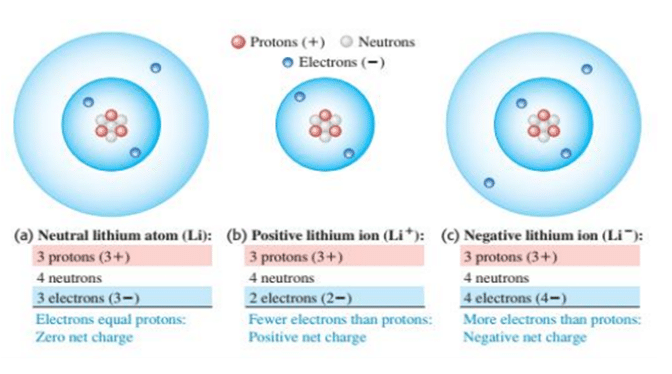
The negative charge of the electron has exactly the same magnitude as the positive charge of the proton. In a neutral atom the number of electrons equals the number of protons in the nucleus, and the net electric charge (the algebraic sum of all the charges) is exactly zero (Fig a). The number of protons or electrons in a neutral atom of an element is called the atomic number of the element. If one or more electrons are removed from an atom, what remains is called a positive ion (Fig. b). A negative ion is an atom that has gained one or more electrons (Fig. c). This gain or loss of electrons is called ionization.
Frictional Electricity:
When a glass rod is rubbed with silk and then separated by insulating medium, the glass rod gains positive charges and the silk acquires negative charges. It is because there is transfer of electron from the glass rod to silk. The charge so produced is static or stationary and does not move from one part of the body to the other part.
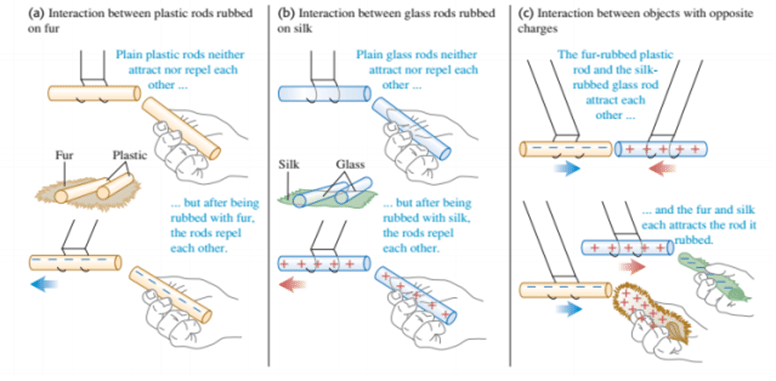
The charges at rest or static charges so produced on the insulating body by rubbing with each other is known as frictional electrostatics.
Properties of charges:
- It is the scalar quantity.
- Like charges repel whereas unlike charges attract.
- The charges produced on a body is independent upon the speed of the body.
- Conservation of charge: The total charge of an isolated system remains constant, i.e. the chare can neither be created nor be destroyed but it can simply be transferred from one body to another body.
- Quantization of charge: Q = ± ne. Any physical charge (Q) is an integral multiple of basic elementary charge e, that is Q = ± ne, where, n = 1, 2, 3, ………… be the integers and e = [latex]1.6 \times 10^{-19}[/latex] coulomb = charge of an electron.
Unit of charge:
The SI unit of charge is coulomb (C). 1 Coulomb of charge is equal to the charge of [latex]625 \times 10^{16}[/latex] electrons.
1 C = [latex]625 \times 10^{16}[/latex] charge of the electron
1 C = [latex]625 \times 10^{16}\times e[/latex]
[latex]e = \frac{1C}{625 \times 10^{16}} = 1.6 \times 10^{-19} \text{ C}[/latex]
+1 C = [latex]625 \times 10^{16}[/latex] deficiency of electrons (+e)
-1 C = [latex]625 \times 10^{16}[/latex] excess of electrons (e)
Conductor:
The substance which allow the electric charge to flow through them are called conductors. Eg – iron, steel, water, copper, etc. The conductors can produce charges by friction but the charges so produced do not remain stationary but spread over the surfaces of the conductors.
Insulator:
The substances which do not allow the electric charge to flow through them are called insulators. Eg – glass, plastic, wood, etc. The insulators can produce charges by friction but the charges so produced remain localized and do not move from one part of the body into another part.
Electrostatic Induction:
The temporary electrification of a body (conductor) by bringing a charged body close to it is known as electrostatic induction. The charged body such as glass rod, ebonite rod, etc. which produces electrostatic induction are called inducing charges. The charges produced on the uncharged body due to induction are called induced charges. The induced charges closed to the inducing charges are called bound induced charges. The induced charges at far from the inducing charges are called free induced charges.
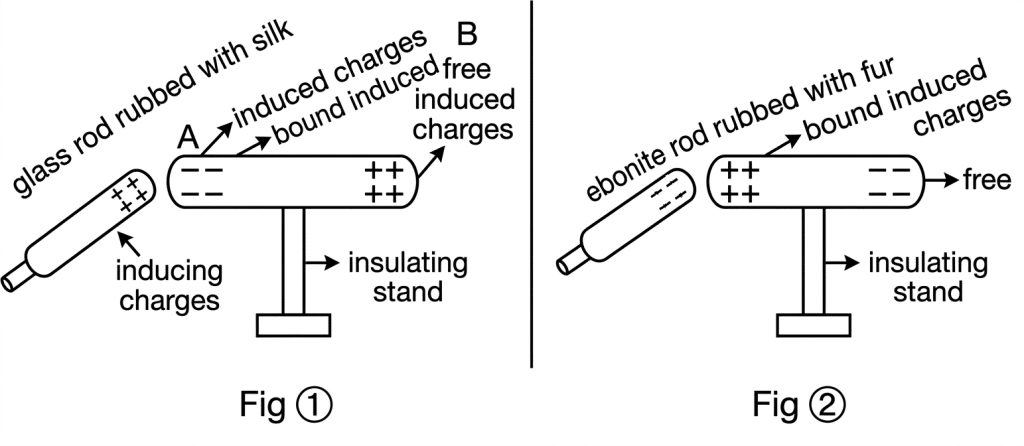
Charging a body permanently by induction:
A body can be charged permanently as follows:
(i) Charging positively by Induction:
A body can be charged positively in the following ways:
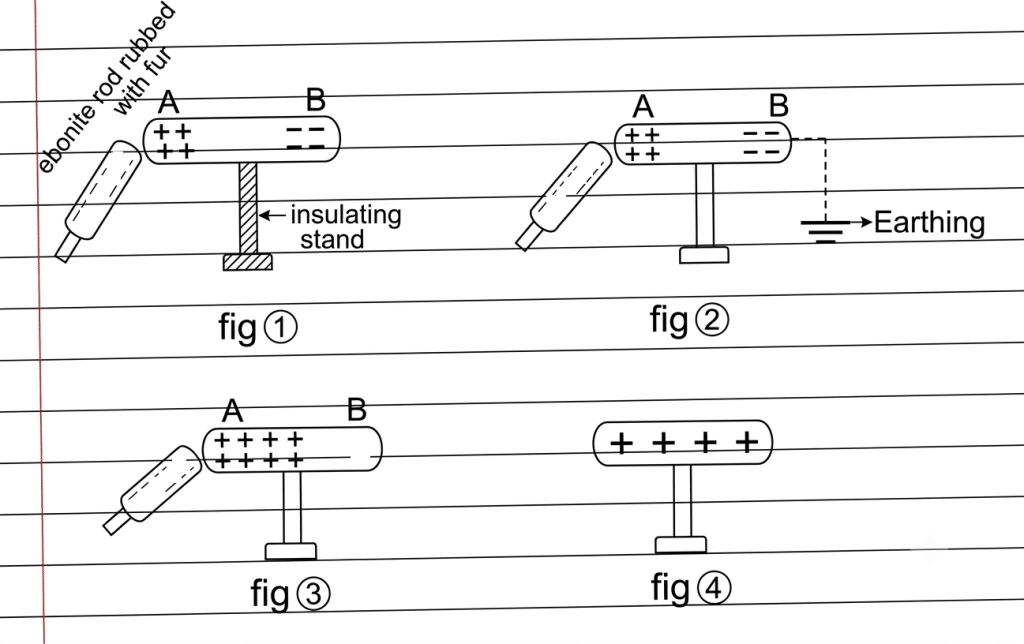
(1) The ebonite rod is charged negatively by rubbing it with fur. The negatively charged ebonite rod is brought close to the conductor AB without touching. In doing so, the end A of the conductor acquires positive charges whereas the end B acquires negative charges by induction method. [Fig. (1)]
(2) With the help of metallic wire, the body AB is connected to the earth. In doing so, the negative free charges flow to the ground (earth). [Fig. (2)]
(3) The metallic wire is removed by keeping ebonite rod as it was shown in fig. (3)
(4) The ebonite rod is removed. The positive charges of the conductor AB become free and spread uniformly throughout the surface of the conductor.
In this way, a body can be charged positively by electrostatic induction method.
(ii) Charging negatively by Induction:
(1) The glass rod is charged positively by rubbing with silk. The positively charged glass rod is brought closed to the conductor AB without touching. In doing so, the end A of conductor acquires negative charge whereas the end B acquires positive charge by induction method. [fig. (1)]
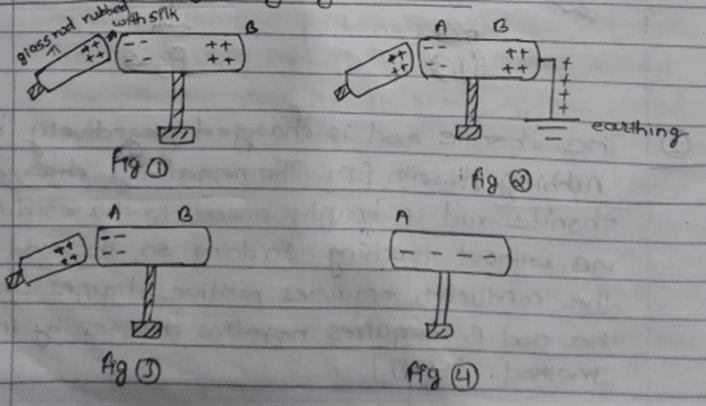
(2) With the help of metallic wire, the body AB is connected to the earth. In doing so, the positive free charges flow to the ground. [fig. (2)]
(3) The metallic wire is removed by keeping glass rod as it was shown in fig. (3).
(4) The glass rod is removed. The negative charges of the conductor AB become free and spread uniformly throughout the surface of the conductor.
Surface Charge Density ([latex]\sigma[/latex]):
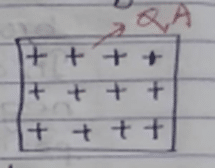
It is defined as the total charge per unit surface area of a body.
Mathematically, [latex]\sigma = \frac{Q}{A}[/latex] ([latex]C/m^2[/latex])
Volume Charge Density ([latex]\rho[/latex]):
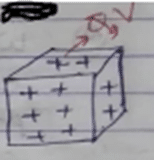
It is defined as the total charge per unit volume of a body.
Mathematically, [latex]\rho = \frac{Q}{V}[/latex] ([latex]C/m^3[/latex])
Linear charge density ([latex]\lambda[/latex]):
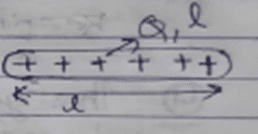
It is defined as the total charge per unit length of a body.
Mathematically, [latex]\lambda = \frac{Q}{l}[/latex] (C/m)
Action of point:
The action of losing charges due to sharp ends/edges is called action of point. [Importance and demerits].
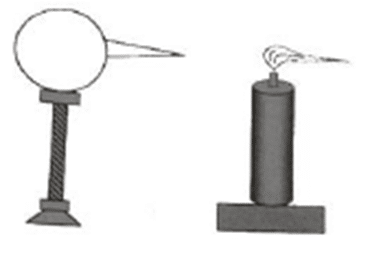
When a body is charged, charges spread all over the surface of the body which may or may not be uniform depends upon the shape and nature of the body. The density of charge at any part of conductor is inversely proportional to the radius of curvature of the surface of that part i.e. greater the curvature (least radius of curvature) at any point, the greater will be the accumulation of charge at that point. So, the density of charge at the pointed (sharp ends) parts of the conductor is very large. The air molecule which come in contact with sharp points become ionized and as a result opposite charge of air neutralize the charge of the body while like charges get repelled by the sharp points therefore the total charge of the body is reduced rapidly. Thus, the leakage of electric charge from the sharp points of the charged conductor is known as action of points. This result s strong electric wind is set up near the pointed ends causes to blow a candle flame aside as shown in figure above.
Coulomb’s Law of Electrical Force:
Coulomb’s law states that, “the magnitude of the electrostatics force of attraction or repulsion between any two charges is directly proportional to the product of magnitude of the charges and inversely proportional to the square of the distance between centres of the charges.”
Explanation:
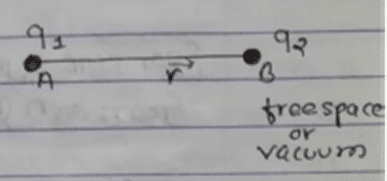
Let us consider two-point charges [latex]q_1[/latex] and [latex]q_2[/latex] at points A and B. Let r be the separation of the charges. Then, according to coulomb’s law, the electrostatics force between two charges is
(i) directly proportional to the product of the magnitude of charges, i.e., [latex]F \propto q_1 q_2[/latex]
(ii) inversely proportional to the square of the distance between them, i.e., [latex]F \propto \frac{1}{r^2}[/latex]
Combining above conditions, we get as,
[latex]F \propto \frac{q_1 q_2}{r^2}[/latex]
Or, [latex]F = \frac{Kq_1 q_2}{r^2}[/latex] …………. (i)
Where, the K is the proportionality constant whose value depends upon the medium in which charges are placed and the system of unit used.
In SI system, free space of vacuum,
[latex]K = \frac{1}{4\pi\epsilon_o}[/latex] where, [latex]\epsilon_o[/latex] = [latex]8.85 \times 10^{12}\ C^2N^{-1}m^{-2}[/latex], is the permittivity of the free space.
[latex]K = \frac{1}{4\pi\epsilon_o} = 9 \times 10^9 \text{ Nm}^2\text{C}^{-2}[/latex]
For CGS system and free space, K = 1.
From equation (i),
[latex]F = \frac{1}{4\pi\epsilon_o}\frac{q_1 q_2}{r^2}[/latex] ………………… (ii) [for SI system in free space]
∴ [latex]F = \frac{q_1 q_2}{r^2}[/latex] ………………. (iii) [For CGS system]
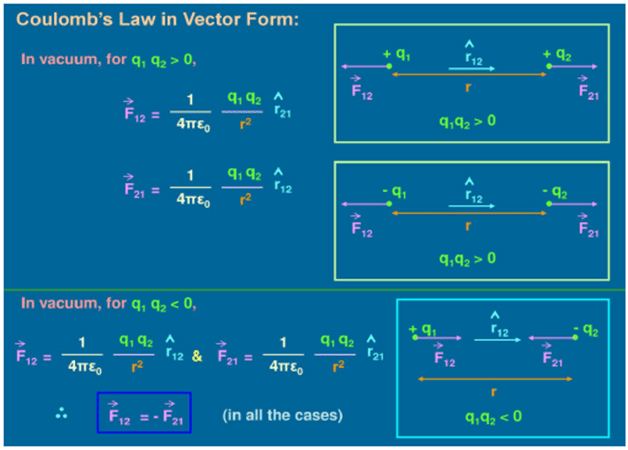
In vector form, [latex]\vec{F} = \frac{1}{4\pi\epsilon_o}\frac{q_1 q_2}{r^2}\hat{r}[/latex] ………………… (iv)
Where, [latex]\hat{r}[/latex] is the unit vector. It gives the direction of the electrostatics force [latex]\vec{F}[/latex]. The direction of the electrostatics force is along the line joining two charges.
The relations (2), (3) & (4) represent the expressions of coulomb’s electrostatic force.
Relative Permittivity ([latex]\epsilon_r \text{ or } K[/latex]):
The permittivity of the medium is known as absolute permittivity and it is denoted by [latex]\epsilon[/latex].
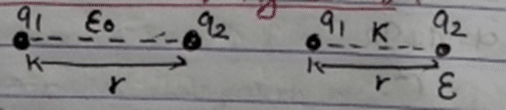
The relative permittivity is defined as the ratio of permittivity of the medium ([latex]\epsilon[/latex]) to permittivity of the vacuum ([latex]\epsilon_o[/latex]). The relative permittivity is also known as dielectric constant (K).
∴ Relative permittivity: [latex]K = \epsilon_r = \frac{\epsilon}{\epsilon_o}[/latex]
Permittivity of medium ([latex]\epsilon[/latex]) = [latex]\epsilon_r \epsilon_o[/latex]
[latex]= K\epsilon_o[/latex]
Suppose the charges [latex]q_1\ and\ q_2[/latex] are placed in a medium of permittivity [latex]\epsilon[/latex] at a distance r apart then the coulomb force between them is given by:
[latex]F_m = \frac{1}{4\pi\epsilon}\frac{q_1 q_2}{r^2} = \frac{1}{4\pi\epsilon_r\epsilon_o}\frac{q_1 q_2}{r^2} = \frac{1}{4\pi K\epsilon_o}\frac{q_1 q_2}{r^2}[/latex] ………….. (i)
Suppose the charges [latex]q_1\ and\ q_2[/latex] are placed in vacuum at a separation r. Then, Coulomb’s force between them is, [latex]F_v = \frac{1}{4\pi\epsilon_o}\frac{q_1 q_2}{r^2}[/latex] …………………. (ii)
∴ [latex]\frac{F_v}{F_m} = K = \epsilon_r[/latex] ……………………. (iii)
Hence, dielectric constant or relative permittivity also defined as the ratio coulomb’s force between two charges at a distance in vacuum to the coulomb’s force between same two charges at same distance in a medium.
If K > 1, then
[latex]\frac{F_v}{F_m} > 1[/latex], then, [latex]F_v > F_m[/latex]
If K = 1, then,
[latex]\frac{F_v}{F_m} = 1[/latex] then, [latex]F_v = F_m[/latex]
Forces between multiple charges:
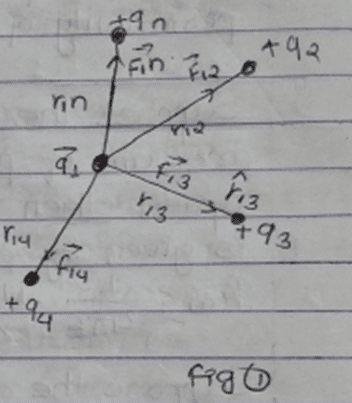
Let us consider, the distribution of charges [latex]q_1, q_2, q_3, ………………. q_n[/latex] in vacuum as shown in fig. (i). Let, [latex]r_{12}, r_{13}, …………………… r_{1n}[/latex] be the distances of the charges [latex]q_1[/latex] from other charges. The resultant force experience by the charge [latex]q_1[/latex] is equal to the vector sum of forces experienced by the charge [latex]q_1[/latex] due to all other charges i.e.
[latex]\vec{F} = \vec{F_{12}} + \vec{F_{13}} + \vec{F_{14}} + ………. + \vec{F_{1n}}[/latex]
Or, [latex]\vec{F} = \frac{1}{4\pi\epsilon_o}\frac{q_1 q_2}{(r_{12})^2}\hat{r_{12}} + \frac{1}{4\pi\epsilon_o}\frac{q_1 q_3}{(r_{13})^2}\hat{r_{13}} + ………. + \frac{1}{4\pi\epsilon_o}\frac{q_1 q_n}{(r_{1n})^2}\hat{r}_{1n}[/latex]
Where, [latex]\hat{r_{12}}, \hat{r_{13}} ……. \hat{r_{1n}}[/latex] are the unit vector represent the direction of the forces [latex]\vec{F_{12}}, \vec{F_{13}}, …… \vec{F_{1n}}[/latex].
The directions of the forces are along the line joining the charges.
Direction of Coulomb’s Electric Force:
Questions:
(i) What do you mean by electrostatic induction? Show how you would charge a body negatively or positively by induction.
(ii) Explain electrification by friction on the basis of modern theory.
(iii) State and explain Coulomb’s law in electrostatics.
MCQs
Equi-potential surface due to a point charge seen from a long distance appear as
Show answer
When two bodies are rubbed against each other, they are electrified. Which one of the following is correct?
Show answer
Divergence of gold leaf is used to study
Show answer
When a wooden sweater worm over a nylon shirt is removed, sparking is observed due to
Show answer
A charge q placed at the centre of the line joining two equal charges Q. The system of three charges will be in equilibrium if q is equal to
Show answer
The distance between two charges is increased by 25% then the percentage change in force is
Show answer
Coulomb force between two charges kept at certain distance is F. If half of separation between them is filled with dielectric of constant [latex]\epsilon_r = 4[/latex], then the new coulomb’s force is
Show answer
A polythene piece, rubbed with wool is found to have negative charge of [latex]4 \times 10^{-7}\ C[/latex]. The number of electrons transferred from wool to polythene is
Show answer
Three charges each of [latex]+1\mu C[/latex] are placed at the corners of an equilateral triangle. If the force between any two charges be F, then, the net force on either charge will be
Show answer
Theoretical questions
Bits of paper are attracted to an electrified comb, even though they have no net charge. How is this possible?
What do you mean by quantization of charge?
How can a body be charged with positive electricity by the method of induction? Explain.
Why metallic chain is used in the tanker transporting highly inflammable liquid?
Explain how a pitch ball can be electrified with positive or negative charge.
Can a charged body attract an uncharged body? Explain.
What is electrostatic shielding?
Why does bodies get electrified when they are rubbed together for a while?
How can a neutral body be charged with negative electricity by induction? Explain.
The tyres of airplane are made from a special rubber which is reasonably good conductor of electricity. What would be the reason behind it?
What do you understand by electrostatic induction? How can you charge a body positively by induction?
What is surface charge density at a point on the surface of a conductor? How does it depend on the shape of the conductor?
Define electrostatic induction. How do you charge a body negatively by induction?
State and explain coulomb’s law in electrostatics. Hence define one coulomb of charge from the coulomb’s law.
Numerical problems
A glass rod is rubbed with silk and acquires a charge of magnitude 7.50 nC. What is the change in mass of the rod? Ans: [latex]42.6 \times 10^{-21}\ kg[/latex]
Calculate the value of two equal charges if they repel each other with a force of 0.1N when situated 50 cm apart in vacuum. What would be the distance between them if are placed in an insulating medium of dielectric constant 10? Ans: [latex]1.67 \times 10^{-4}\ C[/latex], 0.16m
Two-point charges are placed on the x-axis as follows:
Charge [latex]q_1 = +4nC[/latex] is located at x = 20 cm and charge [latex]q_2 = 5nC[/latex] is at x = 30 cm from the origin. Find the magnitude and direction of the total force experienced by the two charges in a negative point charge, [latex]q_3 = -6nC[/latex] placed at the origin. Ans: [latex]57 \times 10^{-5}\ N[/latex] along -ve x-axis
Three charges [latex]+5\mu C[/latex], [latex]+10\mu C[/latex] and [latex]-10\mu C[/latex] are placed in air at the corners A, B and C of an equilateral triangle ABC having each side equal to 5cm. Determine the resultant force on the charge at A.
A glass rod is rubbed with silk and acquires a charge of magnitude 7.50 nC. What is the change in mass of the rod?
Solution
Charge (Q) = 7.50 nC = [latex]7.50\ nC = 7.5\times 10^{-9}[/latex]
Change in mass of rod [latex](\Delta m)[/latex] =?
The glass rod loses electrons when rubbed with silk, acquiring a positive charge.
From quantization of charge,
Q = ne
Or, [latex]n = \frac{Q}{e}[/latex]
= [latex]\frac{7.5\times 10^{-9}}{1.6\times 10^{-19}}[/latex]
= [latex]4.687\times 10^{10}[/latex]
[latex]\therefore[/latex] Change in mass [latex](\Delta m) = n \times m_e[/latex]
= [latex](4.687\times 10^{10})\times (9.1\times 10^{-31})[/latex]
= [latex]4.265\times 10^{-20}[/latex] kg
Calculate the value of two equal charges if they repel each other with a force of 0.1N when situated 50 cm apart in vacuum. What would be the distance between them if are placed in an insulating medium of dielectric constant 10?
Solution
Given,
Force of repulsion in vacuum (F) = 0.1 N
Distance between charges in vacuum (r) = 50 cm = 0.5 m
Dielectric constant of insulating medium (K) = 10
Value of each charge (q) =?
Distance between charges in medium (r’) =? [for the same force to act]
We know that, by Coulomb’s law, for equal charges [latex](q_1 = q_2 = q)[/latex] in vacuum,
[latex]F = \dfrac{1}{4\pi\varepsilon_0}\dfrac{q^2}{r^2}[/latex]
[latex]F = k\dfrac{q^2}{r^2}[/latex] where [latex]k = \dfrac{1}{4\pi\varepsilon_0} = 9 \times 10^9\ Nm^2C^{-2}[/latex]
[latex]0.1 = (9 \times 10^9) \times \dfrac{q^2}{(0.5)^2}[/latex]
[latex]q^2 = \dfrac{0.1 \times (0.5)^2}{9 \times 10^9}[/latex]
[latex]q^2 = \dfrac{0.025}{9 \times 10^9}[/latex]
[latex]q^2 = 2.778 \times 10^{-12}[/latex]
[latex]q = \sqrt{2.778 \times 10^{-12}}[/latex]
[latex]q = 1.667 \times 10^{-6}\ C[/latex]
[latex]q = 1.667\ \mu C.[/latex]
Now, when the same charges are placed in an insulating medium of dielectric constant (K) = 10, the force between them (in medium) is,
[latex]F = \dfrac{1}{4\pi\varepsilon_0 K}\dfrac{q^2}{r’^2} = \dfrac{k q^2}{K r’^2}[/latex]
where, k = [latex]\frac{1}{4\pi \epsilon_o}[/latex]
[latex]0.1 = \dfrac{(9 \times 10^9) \times (1.667 \times 10^{-6})^2}{10 \times r’^2}[/latex]
[latex]0.1 = \dfrac{0.025}{10 \times r’^2}[/latex]
[latex]r’^2 = \dfrac{0.025}{10 \times 0.1}[/latex]
[latex]r’^2 = 0.025[/latex]
[latex]r’ = \sqrt{0.025}[/latex]
[latex]r’ = 0.1581\ m[/latex]
[latex]r’ = 15.81\ cm.[/latex]
So, the value of each charge is 1.667 μC, and the distance between them in the insulating medium (for the same force) should be 15.81 cm.
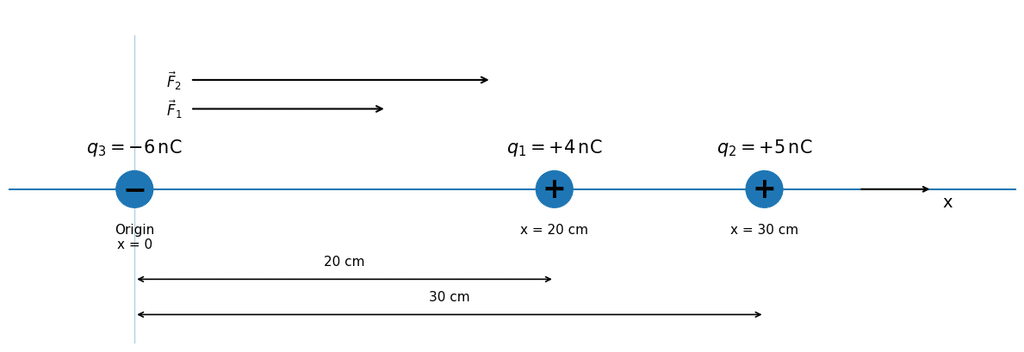
Two-point charges are placed on the x-axis as follows:
Charge [latex]q_1 = +4nC[/latex] is located at x = 20 cm and charge [latex]q_2 = 5nC[/latex] is at x = 30 cm from the origin. Find the magnitude and direction of the total force experienced by the two charges in a negative point charge, [latex]q_3 = -6nC[/latex] placed at the origin.
Solution
Given,
Charge [latex](q1) = +4\ nC = 4 \times 10^{-9}\ C[/latex], located at [latex]x_1[/latex] = 20 cm = 0.2 m
Charge [latex](q_2) = +5\ nC = 5 \times 10^{-9}\ C[/latex], located at [latex]x_2[/latex] = 30 cm = 0.3 m
Charge [latex](q_3) = -6 nC = 6 \times 10^{-9}\ C[/latex] (magnitude), located at origin (x = 0)
Total force on [latex]q_3[/latex] (F) =?
We know that, by Coulomb’s law,
Force on [latex]q_3[/latex] due to [latex]q_1[/latex], since [latex]q_1[/latex] and [latex]q_3[/latex] are separated by [latex]r_1[/latex] = 0.2 m,
[latex]F_1 = k\dfrac{|q_1 q_3|}{r_1^2}[/latex]
[latex]F_1 = (9 \times 10^9) \times \dfrac{(4 \times 10^{-9})(6 \times 10^{-9})}{(0.2)^2}[/latex]
[latex]F_1 = (9 \times 10^9) \times \dfrac{24 \times 10^{-18}}{0.04}[/latex]
[latex]F_1 = 5.4 \times 10^{-6}\ N[/latex]
Since [latex]q_1[/latex] is positive and [latex]q_3[/latex] is negative, this force is attractive (along the +x direction).
Force on [latex]q_3[/latex] due to [latex]q_2[/latex], since [latex]q_2[/latex] and [latex]q_3[/latex] are separated by [latex]r_2[/latex] = 0.3 m,
[latex]F_2 = k\dfrac{|q_2 q_3|}{r_2^2}[/latex]
[latex]F_2 = (9 \times 10^9) \times \dfrac{(5 \times 10^{-9})(6 \times 10^{-9})}{(0.3)^2}[/latex]
[latex]F_2 = (9 \times 10^9) \times \dfrac{30 \times 10^{-18}}{0.09}[/latex]
[latex]F_2 = 3.0 \times 10^{-6}\ N[/latex]
Since [latex]q_2[/latex] is positive and [latex]q_3[/latex] is negative, this force is also attractive (along the +x direction).
Since both [latex]F_1[/latex] and [latex]F_2[/latex] act on [latex]q_3[/latex] along the same direction (+x direction), the total (net) force on [latex]q_3[/latex] is,
[latex]F = F_1 + F_2[/latex]
[latex]F = (5.4 \times 10^{-6}) + (3.0 \times 10^{-6})[/latex]
[latex]F = 8.4 \times 10^{-6}\ N[/latex]
[latex]F = 8.4\ \mu N.[/latex]
So, the total force experienced by [latex]q_3[/latex] has magnitude 8.4 μN, directed along the positive x-axis (i.e., towards [latex]q_1[/latex] and [latex]q_2[/latex]).
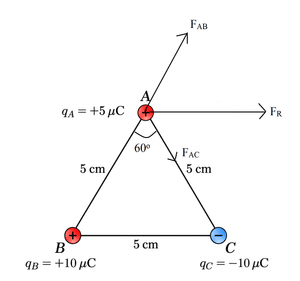
Three charges [latex]+5\mu C[/latex], [latex]+10\mu C[/latex] and [latex]-10\mu C[/latex] are placed in air at the corners A, B and C of an equilateral triangle ABC having each side equal to 5cm. Determine the resultant force on the charge at A.
Solution
Given,
Charge at A [latex](q_A) = +5 μC = 5 \times 10^{-6}[/latex] C
Charge at B [latex](q_B) = +10 μC = 10 \times 10^{-6}[/latex] C
Charge at C [latex](q_C) = -10 μC = 10 \times 10^{-6}[/latex] C (magnitude)
Side of equilateral triangle (r) = AB = BC = CA = 5 cm = 0.05 m
Resultant force on charge at A (F) =?
We know that, by Coulomb’s law,
Force on A due to B [latex](F_{AB}) = k\dfrac{q_A q_B}{r^2}[/latex]
[latex]F_{AB} = (9 \times 10^9) \times \dfrac{(5 \times 10^{-6})(10 \times 10^{-6})}{(0.05)^2}[/latex]
[latex]F_{AB} = (9 \times 10^9) \times \dfrac{50 \times 10^{-12}}{0.0025}[/latex]
[latex]F_{AB} = 180\ N[/latex]
Since [latex]q_A\ and\ q_B[/latex] are both positive, this force is repulsive, i.e. it acts on A along the direction away from B (along BA produced).
Force on A due to C [latex]F_{AC} = k\dfrac{q_A q_C}{r^2}[/latex]
[latex]F_{AC} = (9 \times 10^9) \times \dfrac{(5 \times 10^{-6})(10 \times 10^{-6})}{(0.05)^2}[/latex]
[latex]F_{AC} = 180\ N[/latex]
Since [latex]q_A[/latex] is positive and [latex]q_C[/latex] is negative, this force is attractive, i.e. it acts on A along the direction towards C (along AC).
Now, since ABC is an equilateral triangle, the angle between the line BA (produced) and the line AC is,
[latex]\theta = 180^o – 60^o = 120^o[/latex]
[i.e. the angle between the directions of [latex]F_{AB}\ and\ F_{AC}[/latex] is 120°]
So, resultant force on A, using the law of vector addition (parallelogram law),
[latex]F = \sqrt{F_{AB}^2 + F_{AC}^2 + 2F_{AB}F_{AC}\cos\theta}[/latex]
[latex]F = \sqrt{(180)^2 + (180)^2 + 2(180)(180)\cos 120^o}[/latex]
[latex]F = \sqrt{32400 + 32400 + 2(32400)(-0.5)}[/latex]
[latex]F = \sqrt{64800 – 32400}[/latex]
[latex]F = \sqrt{32400}[/latex]
[latex]F = 180\ N.[/latex]
Now, for direction, let [latex]\beta[/latex] be the angle made by the resultant force with [latex]F_{AB}[/latex], then,
[latex]\tan\beta = \dfrac{F_{AC}\sin\theta}{F_{AB} + F_{AC}\cos\theta}[/latex]
[latex]\tan\beta = \dfrac{180 \times \sin 120^o}{180 + 180 \times \cos 120^o}[/latex]
[latex]\tan\beta = \dfrac{180 \times 0.866}{180 – 90}[/latex]
[latex]\tan\beta = \dfrac{155.88}{90} = 1.732[/latex]
[latex]\beta = \tan^{-1}(1.732) = 60^o[/latex]
So, the resultant force on the charge at A is 180 N, directed parallel to BC (i.e. along the direction from B to C), making an angle of 60° with [latex]F_{AB}[/latex].
Test what you’ve learned in this chapter with a quick self-graded quiz.
Start MCQ Quiz