
Dispersion
SYLLABUS
Pure spectrum and dispersive power, Chromatic and spherical aberration, Achromatism and its applications
What is This Chapter About?
When Isaac Newton passed a beam of sunlight through a glass prism in 1666, he observed something that changed our understanding of light forever — white light separated into a continuous band of colours: red, orange, yellow, green, blue, indigo, and violet. Newton called this spread of colours a spectrum and the phenomenon dispersion. He correctly concluded that white light is not a pure, simple form of light but a mixture of all colours, each with a different property that causes it to bend by a different amount when passing through glass.
Chapter 18 of NEB Grade 11 Physics explores dispersion quantitatively — why it happens, how to measure it, and how its unwanted effects (chromatic aberration in lenses and telescopes) can be corrected. It introduces the concept of dispersive power and the elegant design of achromatic combinations. Carrying 3 teaching hours, this chapter is compact but conceptually rich and directly relevant to the design of all high-quality optical instruments.
Key Concepts You Will Learn
Why Dispersion Occurs
Dispersion occurs because the refractive index of a material depends on the wavelength of light — a property called chromatic dispersion. For most transparent materials (glass, water, diamond), the refractive index is higher for shorter wavelengths (violet light) and lower for longer wavelengths (red light). This wavelength dependence of refractive index is described by Cauchy’s formula:
[latex]n = A + \frac{B}{\lambda^2}[/latex]
where A and B are material constants and
[latex]\lambda[/latex]
is the wavelength. Since violet light has a shorter wavelength than red, it has a higher refractive index in glass and is therefore bent more — violet deviates most and red deviates least when light passes through a prism.
Pure Spectrum
A pure spectrum is one in which each colour occupies a distinct, non-overlapping band — different wavelengths are clearly separated. A pure spectrum is obtained when the light source is a narrow slit, the prism is at minimum deviation, and a lens focuses the parallel beams of different colours onto a screen. Sunlight produces a continuous pure spectrum; a gas discharge lamp produces a line spectrum with specific colours at specific positions corresponding to specific wavelengths emitted by the atoms.
An impure spectrum is one where the colours overlap because the light beam entering the prism is too wide or the system is not properly aligned. Most everyday observations of dispersion (rainbow, prism in sunlight) produce impure spectra where colours blend into one another.
Dispersive Power
The dispersive power (
[latex]\omega[/latex]
) of a prism material quantifies how much it separates different colours relative to the average deviation it produces. It is defined as:
[latex]\omega = \frac{\delta_v – \delta_r}{\delta_y}[/latex]
where [latex]\delta_v[/latex] and [latex]\delta_r[/latex] are the deviations of violet and red light respectively, and
[latex]\delta_y[/latex]
is the deviation of yellow light (taken as the mean). Using the thin prism formula
[latex]\delta = (n-1)A[/latex]
from Chapter 16:
[latex]\omega = \frac{n_v – n_r}{n_y – 1}[/latex]
The numerator [latex](n_v – n_r)[/latex] measures the difference in refractive indices for extreme colours — it quantifies how much the material separates colours. The denominator [latex](n_y – 1)[/latex] represents the mean refracting power. A material with high dispersive power (like flint glass,
[latex]\omega \approx 0.04[/latex]
) separates colours much more than one with low dispersive power (like crown glass,
[latex]\omega \approx 0.016[/latex]
).
Chromatic Aberration
A single lens acts like a prism for off-axis rays — it refracts different wavelengths by different amounts, causing them to focus at different points along the axis. Violet light (high n) focuses closer to the lens; red light (low n) focuses further away. This defect — chromatic aberration — causes coloured fringes around images formed by simple lenses and blurs the image when observed at any single focal plane.
Chromatic aberration is a serious problem in telescopes, cameras, microscopes, and binoculars — it reduces image sharpness and produces colour fringing that degrades image quality.
Spherical Aberration
Spherical aberration occurs because rays striking the outer zones of a spherical lens are refracted more strongly than rays through the centre — they focus at a different point. This causes blurring of images even for monochromatic light. Both chromatic and spherical aberration are major challenges in optical instrument design.
Achromatism — Correcting Chromatic Aberration
An achromatic combination (or achromat) is a pair of lenses — one converging, one diverging — made from different glass types (typically crown glass and flint glass) combined to produce the same focal point for two different wavelengths (usually red and violet). The two lenses are designed so that the dispersion introduced by one is exactly cancelled by the opposite dispersion of the other, while the net refraction (focusing power) is maintained.
The condition for achromatism in a thin doublet (two lenses in contact) is:
[latex]\frac{\omega_1}{f_1} + \frac{\omega_2}{f_2} = 0[/latex]
where [latex]\omega_1[/latex] and
[latex]\omega_2[/latex]
are the dispersive powers and [latex]f_1[/latex] and [latex]f_2[/latex] are the focal lengths of the two component lenses. Since dispersive powers are positive, one focal length must be positive (converging) and the other negative (diverging). Flint glass has higher dispersive power than crown glass, so the flint glass lens (diverging) can be thinner and weaker — the combination still converges light but with greatly reduced chromatic aberration.
Achromatic lenses are used in all high-quality optical instruments — camera lenses, binoculars, telescopes, and microscope objectives all use doublet or triplet achromatic combinations to produce sharp, colour-free images.
Why This Chapter Matters for NEB Exams
Dispersion is examined consistently in NEB Grade 11 Physics. The definition of dispersive power and its formula — both in terms of deviations and refractive indices — is a standard examination question. The condition for achromatism and numerical problems involving it appear regularly. The distinction between chromatic and spherical aberration, and the distinction between pure and impure spectra, are frequent short-answer questions. The physical reason why dispersion occurs — wavelength dependence of refractive index — is a conceptual question that appears in both short-answer and extended response formats.
Important Topics to Focus On
- Why dispersion occurs — wavelength dependence of refractive index, Cauchy’s formula
- Why violet deviates most and red deviates least in a prism
- Pure spectrum — conditions for obtaining it and distinction from impure spectrum
- Dispersive power:
[latex]\omega = \frac{n_v – n_r}{n_y – 1}[/latex]
— definition and calculation Chromatic aberration — explanation and its effect on image quality Spherical aberration — explanation and comparison with chromatic aberration Achromatic combination — principle and condition:
[latex]\frac{\omega_1}{f_1} + \frac{\omega_2}{f_2} = 0[/latex]
Why crown glass and flint glass are used together Applications of achromatic lenses in optical instruments Numerical problems on dispersive power and achromatism
Connection to Other Chapters
Dispersion builds directly on Chapter 16 (Refraction through Prisms) — the thin prism formula
[latex]\delta = (n-1)A[/latex]
is the starting point for dispersive power. It connects to Chapter 17 (Lenses) — chromatic aberration is a defect of lenses explained by dispersion, and achromatic combinations are lens systems designed to overcome it. Chapter 15 (Refraction at Plane Surfaces) provides the refractive index concept central to understanding why different wavelengths refract differently. In Grade 12, the wavelength dependence of refractive index connects to Chapter 12 (Diffraction) — diffraction gratings also separate colours by wavelength, and comparing prismatic dispersion with grating dispersion is instructive. Chapter 21 (Photons) connects wavelength to photon energy through
[latex]E = hf = \frac{hc}{\lambda}[/latex]
— shorter wavelength violet photons have higher energy, which explains why glass interacts more strongly with them and gives them a higher refractive index.
Dispersion of Light
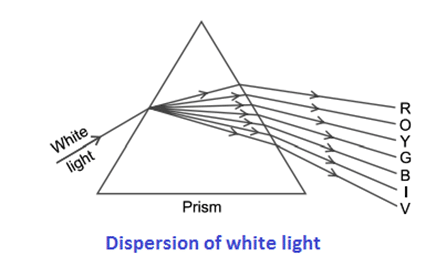
The phenomenon of splitting of the white light into its constituent color (7 colors) is known as the dispersion of light. The red colour is deviated least while the violet color is deviated maximum and other color lies between them. The order of the colours in the spectrum is VIBGYOR from base.
Cause of dispersion
The white light consists of seven coloured light which have different wavelengths. As the light passes through the prism, due to having different wavelengths, they have different refractive indices. According to Cauchy’s dispersion formula,
[latex]\mu = A + \frac{B}{\lambda^2}[/latex]
As the wavelength is increased, then, the refractive index is decreased and vice – versa.
Again, from the relation between angle of deviation and refractive index,
[latex]\delta = A(\mu – 1)[/latex]
This relation shows that, as the value of refractive index increases, then, angle of deviation is also increased and vice – versa. Hence, dispersion occurs.
Angular Dispersion
The angular dispersion is defined as the difference in angle of deviation between two extreme colours of light (i.e., violet and red). It is denoted by [latex]\theta[/latex].
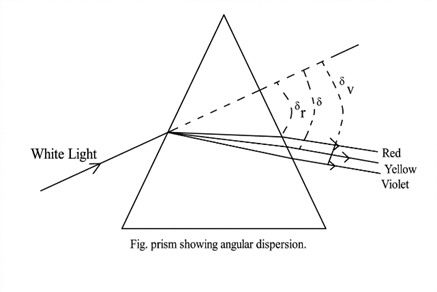
[latex]\therefore[/latex] Angular dispersion [latex](\theta) = \delta_v – \delta_r[/latex]
You've reached the end of the free preview. Continue with NN Premium.
- Complete access to every Premium chapter
- Notes, QBank, solutions & MCQs
- Premium PDFs & study resources
- Entrance preparation & mock tests
One NN Premium subscription unlocks everything.
MCQs
- An achromatic doublet is constructed by lenses of crown glass and flint glass of dispersive powers 0.05 and 0.03. If the focal length of the crown glass is 20 cm, the focal length of the doublet becomes,
a. – 60 cm
b. – 30 cm
c. 12 cm
d. – 12 cm - The power produced by a prism of small angle A
a. depends on materials of prism only
b. depends on A only
c. depends both on material and A
d. depends neither on material nor on A - An impure spectrum of Green, Blue, Orange and Yellow is observed on a screen when light passes through a transparent prism. The refractive index of the prism with respect to the colours will be maximum for
a. Blue
b. Green
c. Orange
d. Yellow - To make an achromatic combination a convex lens of focal length 42 cm having dispersive power 0.14 is placed in contact with a concave lens of dispersive power 0.21. The length of the concave lens should be
a. 14 cm
b. 21 cm
c. 63 cm
d. 42 cm - A beam of light composed of red and green ray is incident obliquely at a point on the face of rectangular glass slab. When coming out on the opposite parallel face, the red and green ray emerge from
a. Two points propagating in two different non parallel directions
b. Two points propagating in two parallel directions
c. One-point propagating in two different directions
d. One-point propagating in the same directions - The focal length of a converging lens is measured for violet, green and red colours. It is respectively fv, fg and fr. We will get
a. fv < fr
b. fg > fr
c. fv = fg
d. fg = fr - The blue colour of the sky is due to the phenomenon of
a. Scattering
b. Dispersion
c. Reflection
d. Refraction - Rainbow is formed due to
a. Scattering and refraction
b. Total internal reflection and dispersion
c. Reflection only
d. Refraction and dispersion - An achromatic lens having a focal length of + 20 cm is to be constructed by combining a crown lens with a flint glass lens. What must be the focal length of the component lenses if the dispersive power of the crown and flint glasses are 0.0158 and 0.0324 respectively?
a. – 21 cm and 10.2 cm
b. – 42 cm and 52.62 cm
c. – 7 cm and 41.25 cm
d. – 21 cm and 7.58 cm - Deviation by a prism is lowest for
a. Violet ray
b. Green ray
c. Red ray
d. Yellow ray
CONCEPTUAL PROBLEMS
- When white light dispersed by a prism, red light appears at the top of the spectrum whereas violet at the bottom. Why?
- Why does the sky appear blue in a day?
- How do the colours of light related with the refractive index of a lens? Explain.
- Define dispersive power of a lens and write expression for it in terms of the refractive indices of lens with respect to different colours used.
- How does the refractive index relate with the wavelength of light?
- A spherical mirror cannot give rise to chromatic aberration. Why?
- The sun looks red at sun – rise and sun – set. Why?
- If a plane glass slab is placed on letter of different colours, then violet-coloured letters appear more and more raised up, why?
Show answer
THEORY BASED PROBLEMS
Show answer
You've reached the end of the free preview. Continue with NN Premium.
- Complete access to every Premium chapter
- Notes, QBank, solutions & MCQs
- Premium PDFs & study resources
- Entrance preparation & mock tests
One NN Premium subscription unlocks everything.