
Reflection at Curved Mirror
SYLLABUS
Real and Virtual images, Mirror formula
What is This Chapter About?
Stand in front of a concave shaving mirror and your face appears magnified. Look into the back of a shiny spoon and you see yourself upside down. Glance at the convex mirror mounted at a blind corner of a road and you see a wide-angle view of traffic. All of these experiences involve reflection at curved mirrors — surfaces that curve inward (concave) or outward (convex) and produce images with properties very different from flat plane mirrors.
Chapter 14 of NEB Grade 11 Physics introduces the quantitative study of image formation by curved mirrors. It is one of the most practically relevant chapters in geometrical optics — curved mirrors are used in telescopes, car headlights, satellite dishes, security systems, dental examinations, and countless other applications. Carrying 2 teaching hours as a concise but important chapter, it establishes the mirror formula and magnification relationships that are essential tools for solving optical problems.
Key Concepts You Will Learn
Types of Curved Mirrors
A concave mirror curves inward like the inside of a bowl. It converges parallel rays of light to a real focal point in front of the mirror. A convex mirror curves outward like the outside of a ball. It diverges parallel rays of light as if they came from a virtual focal point behind the mirror.
The principal axis is the line passing through the centre of curvature C and the pole P of the mirror. The focal point F lies on the principal axis at a distance equal to half the radius of curvature: [latex]f = \frac{R}{2}[/latex]. This relationship — that the focal length is half the radius of curvature — is derived from geometry and is fundamental to all curved mirror calculations.
Real and Virtual Images
A real image is one formed by actual convergence of reflected rays — it can be projected onto a screen and is always inverted. Real images are formed by concave mirrors when the object is beyond the focal point.
A virtual image is one from which reflected rays appear to diverge — it cannot be projected onto a screen and is always upright. Virtual images are formed by convex mirrors for all object positions, and by concave mirrors when the object is between the focal point and the mirror (inside the focal length).
Mirror Formula
The mirror formula relates the object distance u, image distance v, and focal length f of a curved mirror:
[latex]\frac{1}{v} + \frac{1}{u} = \frac{1}{f}[/latex]
This compact equation, derived from the geometry of ray reflection at a curved surface, applies to both concave and convex mirrors provided the standard sign convention is followed consistently. The New Cartesian Sign Convention takes distances measured in the direction of incident light as positive and distances measured against incident light as negative, with the pole of the mirror as the origin.
Magnification
The linear magnification produced by a curved mirror is defined as the ratio of image height to object height:
[latex]m = \frac{h_i}{h_o} = -\frac{v}{u}[/latex]
The negative sign in the magnification formula follows from the sign convention. If m is positive, the image is upright (virtual). If m is negative, the image is inverted (real). If |m| > 1, the image is magnified. If |m| < 1, the image is diminished.
Image Formation by Concave Mirrors
The nature, position, and size of the image formed by a concave mirror depend critically on where the object is placed relative to the focal point and centre of curvature. Key cases include: object at infinity (image at F, real, point-sized), object beyond C (image between F and C, real, inverted, diminished), object at C (image at C, real, inverted, same size), object between C and F (image beyond C, real, inverted, magnified), object at F (image at infinity — reflected rays are parallel), and object between F and P (image behind mirror, virtual, upright, magnified).
Understanding these cases and being able to draw accurate ray diagrams for each is a core skill developed in this chapter.
Applications of Curved Mirrors
Concave mirrors are used as shaving and makeup mirrors (object inside focal length — virtual, upright, magnified image), in torch lights and car headlights (source at focal point — reflected rays emerge as a parallel beam), in reflecting telescopes (collecting and focusing parallel rays from distant stars), and in solar furnaces (concentrating sunlight to very high temperatures at the focal point).
Convex mirrors are used as rear-view mirrors in vehicles (always produce upright, diminished, virtual images regardless of object distance — providing a wide field of view), and as security mirrors in shops and at road junctions.
Why This Chapter Matters for NEB Exams
Reflection at Curved Mirrors is examined regularly in NEB Grade 11 Physics. The mirror formula and magnification formula — applying them to find image position, nature, and size — generate standard numerical problems. Drawing accurate ray diagrams for different object positions is a classic examination question. The derivation of [latex]f = \frac{R}{2}[/latex] and the mirror formula itself appear as short derivation questions. Applications of concave and convex mirrors are popular short-answer topics.
Important Topics to Focus On
- Types of curved mirrors and their properties — concave and convex
- Key terms: pole, principal axis, centre of curvature, focal point, focal length
- Relation between focal length and radius of curvature: [latex]f = \frac{R}{2}[/latex]
- Distinction between real and virtual images
- New Cartesian Sign Convention for curved mirrors
- Mirror formula: [latex]\frac{1}{v} + \frac{1}{u} = \frac{1}{f}[/latex] — derivation and application
- Magnification: [latex]m = -\frac{v}{u}[/latex]
- Image formation by concave mirror for all object positions — ray diagrams
- Image formation by convex mirror — always virtual, upright, diminished
- Applications of concave mirrors (torches, telescopes, solar furnaces)
- Applications of convex mirrors (rear-view mirrors, security mirrors)
- Numerical problems on mirror formula and magnification
Connection to Other Chapters
Reflection at Curved Mirrors connects to Chapter 15 (Refraction at Plane Surfaces) and Chapter 17 (Lenses) — together these three chapters form the core of geometrical optics, using the same sign conventions and analogous formulae. The mirror formula is structurally identical to the lens formula, making the two chapters strongly complementary. In Grade 12, curved mirror principles connect to Chapter 10 (Nature and Propagation of Light) — where Huygens’ Principle explains reflection — and to Chapter 12 (Diffraction) — where the resolving power of reflecting telescopes is discussed. The parabolic reflectors used in satellite dishes and radio telescopes are curved mirror applications on an enormous scale.
Optics
The study of nature and propagation of light is called optics. This branch of physics further classifies into two types: (i) Ray optics and (ii) Wave optics.
Ray optics deals with particle nature of light whereas wave optics considers light as a wave.
Ray Optics
The study of particle nature of light comes under ray optics. It works under following assumptions:
(i) Rectilinear propagation of light
(ii) Laws of reflection
(iii) Laws of refraction
Laws of Reflection:
- The incident rays, the reflected rays and the normal at the point of incidence, all the three lies in one plane.
- The angle of incidence and the angle of reflection are equal to one another.
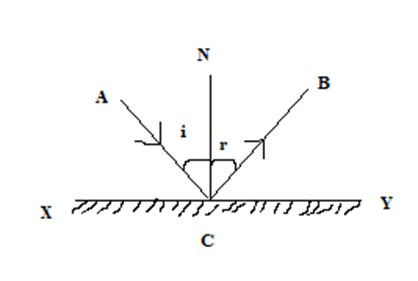
i.e., for a normal incidence, ∠i = 0, ∠r = 0. Hence, a ray of light falling normally get back to its original path.
Spherical Mirrors:
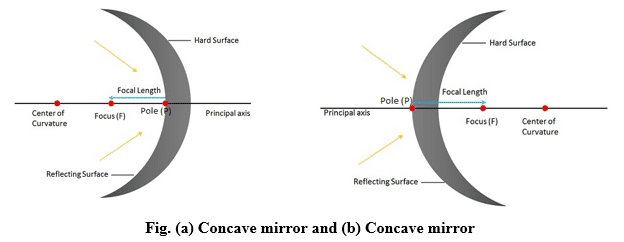
A spherical mirror, is a part of a hollow sphere with one of its sides highly silvered.
If the outer surface of the part of the sphere is silvered and inner surface becomes reflecting, such mirror is called concave mirror. If the inner surface of the part of the sphere is silvered and outer surface becomes reflecting, such mirror is called the concave mirror.
Some Definitions
- Centre of Curvature (C): The centre of curvature of a spherical mirror is the centre of the sphere of which the mirror is a part.
- Radius of Curvature (R): The radius of curvature of a spherical mirror is the radius of the sphere of which the mirror is a part.
- Pole of the mirror (P): The centre (or the middle point) of the spherical mirror is called the pole.
- Principal axis: The line passing through the centre of curvature (C) and the pole (P) of the spherical mirror is called the principal axis.
- Focus (F): The focus of the spherical mirror is the point on the principal axis at which the incident rays parallel to the principal axis actually meet or appears to meet after reflection. For concave mirror, the incident rays parallel to the principal axis actually meet at the focus & in case of convex mirror, the incident rays parallel to the principal axis don’t actually meet but they appear to be coming from the focus after reflection.
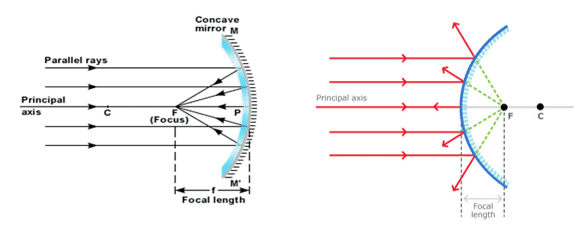
- Focal length (f): The focal length (f) of a spherical mirror is the distance between the focus (F) and the pole (P) of the mirror. In the figure above, the distance, PF = f is the focal length.
The Concave Mirror:
Sign convention:
- All distances are measured from the pole of the mirror.
- Positive sign is used for real distances.
- Negative sign is used for virtual distances.
- For real image, magnification is positive & for virtual image, it is negative.
- The focal length & the radius of curvature are always positive.
Relation between R and f:
Let us consider, a concave mirror having focal length f and radius of curvature (R). Let, a ray of light AB parallel to the principal axis incident at B & after reflection, it passes through the focus (F). Let, C & P be the centre of curvature & the pole of the mirror.
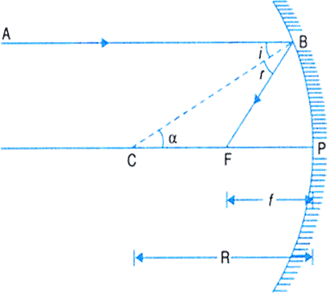
In the figure above, ∠i = ∠ABC = angle of incidence.
∠r = ∠CBF = angle of reflection
And, from the laws of reflection,
∠i = ∠r
i.e. ∠ABC = ∠CBF …………………. (1)
But, ∠ABC = ∠BCF [∵alternate angle]
[latex]\therefore[/latex] ∠BCF = ∠CBF
So, [latex]\Delta[/latex]CBF is an isosceles triangle.
[latex]\therefore[/latex] CF = FB
If the aperture of the mirror is small, then, point B approaches to P. Then,
FB = FP
So, PC = CF + FP
= FB + FP
Or, R = f + f
[latex]\therefore[/latex] R = 2f.
Hence, the focal length of the concave mirror is a half of its radius.
Differences between real and virtual image
| Real Image | Virtual Image |
| 1. It can be projected on the screen. | 1. It cannot be projected on the screen. |
| 2. It is formed by the actual intersection of the reflected rays. | 2. It is formed by the virtual intersection of the reflected rays. |
| 3. It is inverted with respect to the object. | 3. It is erect with respect to the object. |
| 4. The image formed by human eyes, convex lens, photographic camera, etc. are the real images. | 4. The image formed by concave lens, plane mirror, etc. are the virtual images. |
Mirror Formula
Concave mirror
i. When real image is formed
Let us consider, a concave mirror of focal length f and radius of curvature R. Let, an object AB is placed in front of it. A ray of light AR parallel to the principal axis, after reflection, passes through focus (F). Another ray AC passing through centre of curvature retraces its path. These rays intersect at a point A’, where a real, inverted image A’B’ is formed.
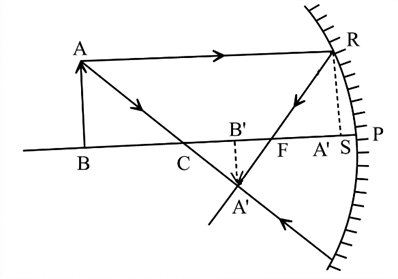
From figure, PF = f = focal length
PB = u = object distance
PB’ = v = Image distance.
Δs ABC & A’B’C are similar triangle,
[latex]\dfrac{AB}{A’B’} = \dfrac{BC}{B’C}[/latex] ……….. (i)
Again, Δs RSF & A’B’F are similar triangles.
[latex]\dfrac{RS}{A’B’} = \dfrac{FS}{FB’}[/latex]
Since, RS = AB,
[latex]\dfrac{AB}{A’B’} = \dfrac{FS}{FB’}[/latex] ……………… (ii)
From equations (i) & (ii), we get,
[latex]\dfrac{BC}{B’C} = \dfrac{FS}{FB’}[/latex]
If aperture of the mirror is small, then, points S and P will be very close to each other. So,
[latex]FS \approx FP[/latex]
Then, above equation becomes,
[latex]\dfrac{BC}{B’C} = \dfrac{FP}{FB’}[/latex]
Or, [latex]\dfrac{PB-PC}{PC-PB’} = \dfrac{FP}{PB’-FP}[/latex]
Or, [latex]\dfrac{u-R}{R-v} = \dfrac{f}{v-f}[/latex]
Or, [latex]\dfrac{u-2f}{2f-v} = \dfrac{f}{v-f}[/latex]
Or, [latex]uv – uf – 2fv + 2f^2 = 2f^2 – fv[/latex]
Or, [latex]uv = -fv + uf + 2fv[/latex]
Or, [latex]uv = fv + uf[/latex]
Dividing both sides by, uvf, we get,
[latex]\dfrac{uv}{uvf} = \dfrac{fv}{uvf} + \dfrac{uf}{uvf}[/latex]
Or, [latex]\dfrac{1}{f} = \dfrac{1}{u} + \dfrac{1}{v}[/latex]
This is the required mirror formula for concave mirror as the image formed is real.
ii. When virtual image is formed
Let, MN be the small aperture of concave mirror. An object AB is held perpendicular to the principal axis of the mirror between the focus and pole (P) as shown in figure. A virtual image (erect & magnified) of the object is formed as shown in figure. From figure,
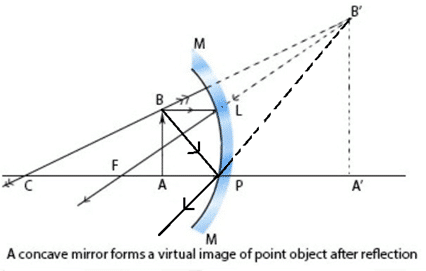
PC = R = radius of curvature
PF = f = focal length
PA = u = object distance
PA‘ = -v = image distance
In [latex]\Delta ABC[/latex] ~ [latex]\Delta A’B’C'[/latex]
[latex]\frac{AB}{A’B’} = \frac{AC}{A’C}[/latex] …………………………………… (1)
Again, from [latex]\Delta ABP[/latex] ~ [latex]\Delta A’B’P[/latex],
[latex]\frac{AB}{A’B’} = \frac{PA}{PA’}[/latex] ………………………….. (2)
From eqns. (1) & (2), we get,
[latex]\frac{AC}{A’C} = \frac{PA}{PA’}[/latex]
Or, [latex]\frac{PC – AP}{PC + PA’} = \frac{PA}{PA’}[/latex]
Or, [latex]\frac{R – u}{R – v} = \frac{u}{-v}[/latex]
Or, -vR + uv = uR – uv
Or, vR + uR = 2uv
Dividing both sides by uvR, we get,
[latex]\frac{2uv}{uvR} = \frac{uR}{uvR} + \frac{vR}{uvR}[/latex]
Or, [latex]\frac{2}{R} = \frac{1}{v} + \frac{1}{u}[/latex]
Or, [latex]\frac{2}{2f} = \frac{1}{u} + \frac{1}{v}[/latex]
Or, [latex]\frac{1}{f} = \frac{1}{u} + \frac{1}{v}[/latex]
This is the required mirror formula for concave mirror as the image formed is virtual.
Image formed by a concave mirror
a. When the object is at infinity
Image is formed at focus when the object is at infinity. i.e. if u = ∞,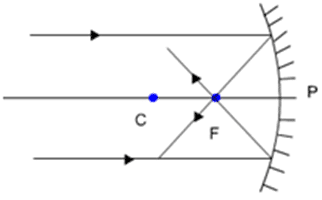
[latex]\frac{1}{f} = \frac{1}{u} + \frac{1}{v}[/latex]
[latex]\therefore \frac{1}{f} = \frac{1}{\infty} + \frac{1}{v}[/latex]
Or, v = f
Nature of Image
- Real
- Highly diminished.
b. When the object is beyond C
Image is formed between focus (F) and centre of curvature (C), when the object is placed beyond C.
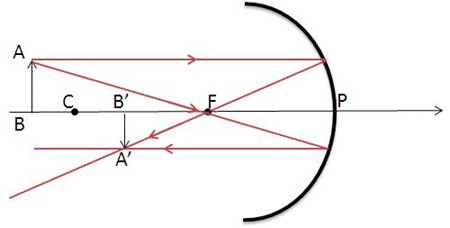
Nature of image
- Real
- Diminished
- Inverted
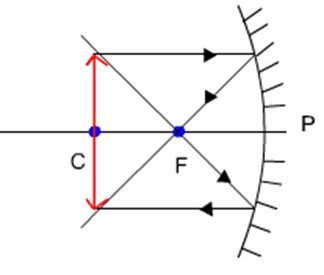
c. When the object is at C
Image is formed at the centre of curvature (C) when the object is placed at centre of curvature (C). i.e., when u = R = 2f, then,
[latex]\frac{1}{f} = \frac{1}{u} + \frac{1}{v}[/latex]
[latex]\frac{1}{f} = \frac{1}{2f} + \frac{1}{v}[/latex]
Or, [latex]\frac{1}{v} = \frac{1}{f} – \frac{1}{2f}[/latex]
Or, v = 2f = R
Nature of Image
- Real
- Inverted
- Same size of the object.
d. Object between F and C
The image is formed beyond centre of curvature (C) when the object is placed between focus (F) and centre of curvature (C).
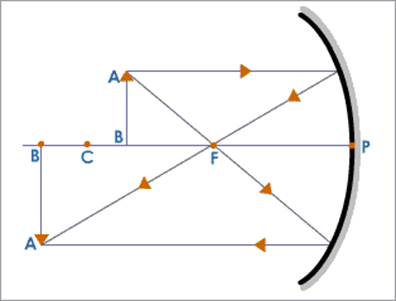
Nature of Image
- Real
- Inverted
- Magnified
e. Object at F
The image is formed at infinity when the object is placed at focus (F).
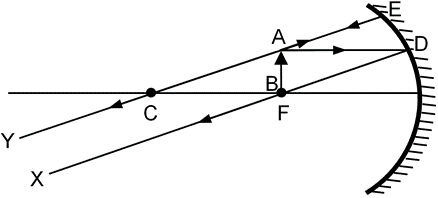
Nature of Image
- Real
- Inverted
- Highly magnified
We have, u = f, then,
[latex]\frac{1}{f} = \frac{1}{u} + \frac{1}{v}[/latex]
[latex]\therefore \frac{1}{f} = \frac{1}{f} + \frac{1}{v}[/latex]
Or, [latex]\frac{1}{v} = 0 [/latex]
Or, v = ∞
f. Object between F & P
The image is formed on the other side of the mirror, when the object is placed between focus (F) and pole (P). In the ray diagram, we can see that, the reflected rays do not meet at a point but it seems to appear from the opposite side of the mirror. So,
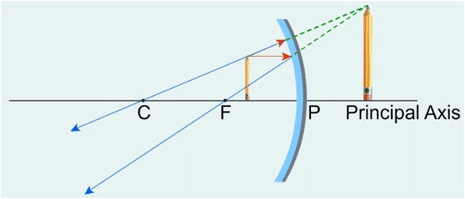
Nature of Image
- Virtual
- Erect
- Magnified.
Convex Mirror
Sign Conventions
- All distances are measured from the pole of the mirror.
- Positive sign is used for real distances.
- Negative sign is used for virtual distances.
- Magnification is always taken as negative.
- The focal length & the radius of curvature are always taken as negative.
Relation between R and f
Let us consider, a ray of light AB parallel to the principal axis is incident at B on convex lens of focal length f and radius of curvature R. After reflection, it passes through BD and it appears to be coming from the focus F.
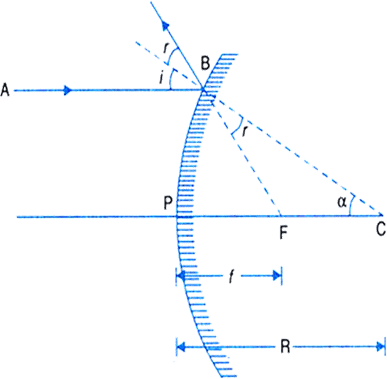
Here, ∠i = ∠ABN = angle of incidence.
∠r = ∠DBN = angle of reflection.
Now, ∠CBF = ∠DBN = ∠r (VOA).
And, ∠ABN = ∠BCF = ∠i (Corresponding angle).
∵ ∠i = ∠r
So, CF = BF. Now, if the aperture of the mirror is small, then, B and P are very close. So, FP = FB = CF. Thus,
CP = CF + FP = PF + PF
[latex]\therefore[/latex] R = f + f.
[latex]\therefore[/latex] R = 2f.
Or, f = [latex]\frac{R}{2}[/latex]
i.e., focal length of convex mirror is half of the radius of curvature.
Mirror formula for convex mirror
Let, MN be the small aperture of mirror. A ray of light from an object AG parallel to principal axis incident at point G and reflected along GQ. Another ray of light AP is reflected along PD. Third ray AE is reflected back. When these rays are produced back, they are intersecting at a point A’, where, a virtual, erect and diminished image (A’B’) is formed.
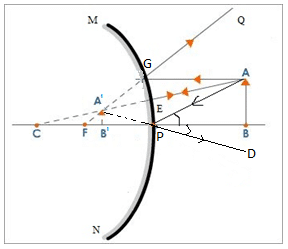
From figure, PB = u = object distance.
PC = R = radius of curvature.
PB = -v = image distance for virtual image.
PF = f = focal length.
In [latex]\Delta ABC[/latex] ~ [latex]\Delta A’B’C[/latex],
[latex]\frac{AB}{A’B’} = \frac{BC}{B’C}[/latex] ………………… (i)
Again, in [latex]\Delta ABP[/latex] ~ [latex]\Delta A’B’P[/latex]
[latex]\frac{AB}{A’B’} = \frac{PB}{PB’}[/latex] ……………….. (ii)
From eqn. (i) and (ii), we get,
[latex]\frac{BC}{B’C} = \frac{PB}{PB’}[/latex]
Or, [latex]\frac{PC+PB}{PC – PB’} = \frac{PB}{PB’}[/latex] [∵ PB’ = -v, for virtual image]
Or, [latex]\frac{-R + u}{-R+v} = \frac{u}{-v}[/latex]
Or, vR – uv = -uR + uv
Or, vR + uR = 2uv
Dividing both sides by uvR, we get,
Or, [latex]\frac{vR}{uvR} + \frac{uR}{uvR} = \frac{2uv}{uvR}[/latex]
Or, [latex]\frac{1}{u} + \frac{1}{v} = \frac{2}{R}[/latex]
[latex]\frac{1}{u} + \frac{1}{v} = \frac{2}{2f}[/latex]
[latex]\therefore \frac{1}{u} + \frac{1}{v} = \frac{1}{f}[/latex].
This is the required mirror formula for convex mirror as the image formed is virtual.
Linear Magnification
It is defined as the ratio of size of the image obtained by mirror to the size of the object. It is denoted by m.
[latex]\therefore m = \frac{size\ of\ image\ (I)}{size\ of\ object\ (O)}[/latex]
It can also be defined as the ratio of image distance to the object distance.
Linear magnification (m) = [latex]\frac{v}{u}[/latex]
Magnification is positive for real image and negative for virtual image.
Application of spherical mirror
a. Concave Mirror
- Reflecting telescope.
- Dental mirror.
- Make-up and shaving mirror.
b. Convex mirror
- Driving mirror as rear view of vehicles.
- Safe view at dangerous corners.
MCQs
The field of view is minimum for
Show answer
A concave mirror has radius of curvature 20 cm . An object is placed 10 cm from the pole of the mirror. The image will be at
Show answer
An object is placed at 2f from the pole of convex mirror. The magnification will be
Show answer
A concave mirror of focal length 30cm produces 5 times magnified image. The object distance will be
Show answer
A bright spot situated 60 cm in front of a convex mirror forms a virtual image 20 cm behind the mirror. The focal length of the mirror is
Show answer
The focal length of a concave mirror is f, the distance of the object to the principal focus is p. The ratio of the size of the image to the size of the object is:
Show answer
Theoretical questions
Use graphical method to locate image of an erect object placed before a concave mirror between its pole and the focus. Hence write down the nature of image so formed.
OR Trace the position of an image formed by a concave mirror when real object is placed at a distance less than its focal length.
A concave mirror is often used as an aid for applying cosmetics to the face, why?
Convex mirrors are used as rear-view mirrors in cars, why?
Does focal length change when the curve mirror is dipped in liquid? Why?
OR, A spherical mirror be immersed in water. Will its focal length change?
Spherical mirror may behave as a plane mirror as a special case. Explain.
A spherical mirror is cut in half horizontally. Will an image be formed by the bottom half of the mirror? How?
Distinguish between real and virtual images.
Can a convex mirror ever form real image? Justify your answer.
The bottom of the side mirrors of your motorbike notes “objects in mirror closer than they appear”. Is it true? Why?
Derive mirror formula in the case of concave mirror. Also discuss the nature of images.
OR, Point out the difference between real image and virtual image. Obtain a relation connecting the object distance, image distance and focal length of concave mirror.
How will you make difference between real and virtual images? Obtain an expression for the relation between object distance, image distance and the focal length in the case of convex mirror.
What do you mean by principal focus of a convex mirror? Prove mirror formula for a convex mirror and also show that m = v/u for the same mirror.
What do you understand by the principal focus of a spherical mirror? Derive relation between object distance, image distance and the focal length if object is placed between the centre of curvature and the focus of a concave mirror.
Two plane mirrors are inclined to one another at an angle of 90o. Draw a reasonable accurate ray diagram and find the number of images produced by this system.
Numerical problems
At what position an object be placed in front of a concave mirror of radius of curvature 0.4 m so that an erect image of magnification 3 be produced? Ans: 13.3 cm
A pole 4 m long is laid along the principal axis of a convex mirror of focal length 1 m. The end of the pole nearer the mirror is 2m from it. Find the length of image of the pole. Ans: 0.190 m
A mirror forms an erect image 30 cm from the object and twice its height. What is its radius of curvature? Ans: 0.4 m
An erect image, three times the size of the object is obtained with a concave mirror of radius of curvature 36 cm. What is the position of the object? Ans: 12 cm
An object 10 cm high is placed infront of a convex mirror of focal length 20 cm and the object is 30 cm from the mirror. Find the height of the image. Ans: 0.04 m
Calculate the focal length of a concave mirror when an object placed at a distance of 40 cm makes image equal to the size of the object. Ans: 20 cm
A metre scale is placed along the axis of a convex mirror of focal length 25 cm, its nearer end being at a distance of 50 cm. Calculate the size of the image formed. Ans: 4.76 cm
A convex mirror with a radius of curvature 30 cm forms a real image 20 cm from its pole. Explain how it is possible and find whether the image is erect or inverted. Ans: u = – 8.57 cm, It is possible when object is virtual.
1. At what position an object be placed in front of a concave mirror of radius of curvature 0.4 m so that an erect image of magnification 3 be produced? At what position an object be placed in front of a concave mirror of radius of curvature 0.4 m so that an erect image of magnification 3 be produced?
Solution
Given,
Object distance (u) =?
Radius of curvature (R) = 0.4 m
Magnification (m) = 3
We know,
Focal length (f) = [latex]\frac{R}{2} = \frac{0.4}{2} = 0.2[/latex] m
Now, magnification (m) = [latex]\frac{v}{u}[/latex]
Or, 3 = [latex]\frac{v}{u}[/latex]
Or, v = 3u
Since, image is erect, v = -3u
Now, using mirror formula,
[latex]\frac{1}{f} = \frac{1}{u} + \frac{1}{v}[/latex]
Or, [latex]\frac{1}{0.2} = \frac{1}{u} – \frac{1}{3u}[/latex]
Or, [latex]\frac{1}{0.2} = \frac{3 – 1}{3u}[/latex]
Or, [latex]\frac{1}{0.2} = \frac{2}{3u}[/latex]
Or, 3u = 0.4
Or, u = [latex]\frac{0.4}{3}[/latex]
= 0.133 m = 13.3 cm
2. A pole 4 m long is laid along the principal axis of a convex mirror of focal length 1 m. The end of the pole nearer the mirror is 2m from it. Find the length of image of the pole.
Solution
Given,
Length of pole (l) = 4m
Focal length of convex mirror (f) = -1 m
Nearer end:
Object distance (u) = 2m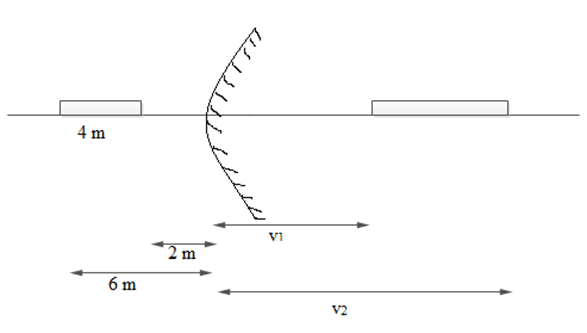
Using mirror formula,
[latex]\frac{1}{f} = \frac{1}{u} + \frac{1}{v}[/latex]
Or, [latex]-\frac{1}{1} = \frac{1}{2} + \frac{1}{v_1}[/latex]
Or, [latex]\frac{1}{v_1} = -1 – \frac{1}{2} = – \frac{3}{2}[/latex]
Or, v1 = [latex]-\frac{2}{3}[/latex] = – 0.667 m
Again, far end:
Object distance (u’) = 6 m
Using mirror formula,
[latex]\frac{1}{f} = \frac{1}{u} + \frac{1}{v_2}[/latex]
Or, [latex]-\frac{1}{1} = \frac{1}{6} + \frac{1}{v_2}[/latex]
Or, [latex]\frac{1}{v_2} = -1-\frac{1}{6} = -\frac{7}{6}[/latex]
Or, v2 = [latex]-\frac{6}{7}[/latex] = – 0.857 m
Now, length of image of pole ([latex]\Delta v[/latex]) = v2 – v1
= – 0.857 – ( – 0.667)
= – 0.857 + 0.667
= – 0.19 m.
3. A mirror forms an erect image 30 cm from the object and twice its height. What is its radius of curvature?
Solution
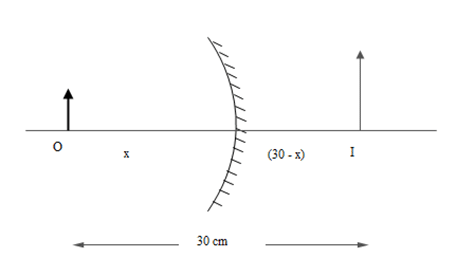
Given,
Distance between object and image (d) = 30 cm
Let, object distance (u) = x
So, image distance (v) = 30 – x
According to question,
Magnification (m) = 2
Or, [latex]\dfrac{v}{u} = 2[/latex]
Or, [latex]\dfrac{30-x}{x} = 2[/latex]
Or, 30 – x = 2x
Or, 30 = 3x
Or, x = 10 cm
i.e. object distance (u) = 10 cm
and, image distance (v) = 30 – x = 30 – 10 = 20 cm
But the image is erect, so, v = – 20 cm
Now, Using mirror formula,
[latex]\dfrac{1}{f} = \dfrac{1}{u} + \dfrac{1}{v}[/latex]
[latex]= \dfrac{1}{10} – \dfrac{1}{20}[/latex]
[latex]= \dfrac{1}{20}[/latex]
∴ f = 20 cm
So, radius of curvature (R) = 2f = 2 x 20 = 40 cm = 0.4 m.
4. An erect image, three times the size of the object is obtained with a concave mirror of radius of curvature 36 cm. What is the position of the object?
Solution
Given,
Magnification (m) = 3
Radius of curvature (R) = 36 cm
∴ f = [latex]\dfrac{R}{2} = \dfrac{36}{2} = 18[/latex] cm
Object distance (u) =?
We know,
m = [latex]\dfrac{v}{u}[/latex]
Or, 3 = [latex]\dfrac{v}{u}[/latex]
Or, v = 3u
Or, v = -3u [∵ image is erect]
Using mirror formula, we get,
[latex]\dfrac{1}{f} = \dfrac{1}{u} + \dfrac{1}{v}[/latex]
Or, [latex]\dfrac{1}{18} = \dfrac{1}{u} + \dfrac{1}{(-3u)}[/latex]
Or, [latex]\dfrac{1}{18} = \dfrac{1}{u} – \dfrac{1}{3u}[/latex]
Or, [latex]\dfrac{1}{18} = \dfrac{3-1}{3u}[/latex]
Or, [latex]\dfrac{1}{18} = \dfrac{2}{3u}[/latex]
Or, 3u = 36
Or, u = [latex]\dfrac{36}{3}[/latex] = 12 cm
5. An object 10 cm high is placed infront of a convex mirror of focal length 20 cm and the object is 30 cm from the mirror. Find the height of the image.
Solution
Given,
Height of object (O) = 10 cm
Focal length (f) = – 20 cm
Object distance (u) = 30 cm
Height of the image (I) =?
We know that,
[latex]\dfrac{1}{f} = \dfrac{1}{u} + \dfrac{1}{v}[/latex]
Or, [latex]-\dfrac{1}{20} = \dfrac{1}{30} + \dfrac{1}{v}[/latex]
Or, [latex]-\dfrac{1}{20} – \dfrac{1}{30} = \dfrac{1}{v}[/latex]
Or, [latex]-\dfrac{1}{12} = \dfrac{1}{v}[/latex]
Or, v = – 12 cm
Again, we know,
m = [latex]\dfrac{I}{O} = \dfrac{v}{u}[/latex]
Or, [latex]\dfrac{I}{10} = \dfrac{-12}{30}[/latex]
Or, I = – 4 cm.
Hence, the size of the image is 4 cm.
6. Calculate the focal length of a concave mirror when an object placed at a distance of 40 cm makes image equal to the size of the object.
Solution
Given,
Focal length (f) =?
Object distance (u) = 40 cm
Since, image and object size is same, magnification (m) = 1
We know that,
m = [latex]\dfrac{v}{u}[/latex]
Or, 1 = [latex]\dfrac{v}{40\ cm}[/latex]
Or, v = 40 cm
Again, we have,
[latex]\dfrac{1}{f} = \dfrac{1}{u} + \dfrac{1}{v}[/latex]
Or, [latex]\dfrac{1}{f} = \dfrac{1}{40} + \dfrac{1}{40}[/latex]
Or, [latex]\dfrac{1}{f} = \dfrac{2}{40}[/latex]
Or, [latex]\dfrac{1}{f} = \dfrac{1}{20}[/latex]
Or, f = 20 cm
Hence, the focal length of concave mirror is 20 cm.
7. A metre scale is placed along the axis of a convex mirror of focal length 25 cm, its nearer end being at a distance of 50 cm. Calculate the size of the image formed.
Solution
Given,
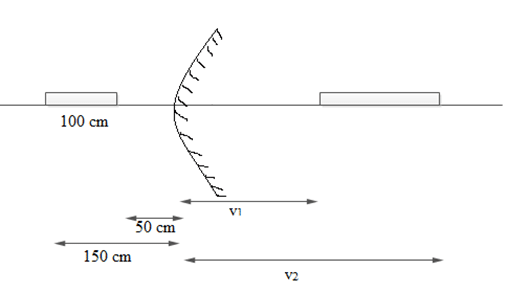
Length of pole (l) = 1m = 100 cm
Focal length of convex mirror (f) = – 25 cm
Nearer end:
Object distance (u) = 50 cm
Using mirror formula,
[latex]\dfrac{1}{f} = \dfrac{1}{u} + \dfrac{1}{v}[/latex]
Or, [latex]-\dfrac{1}{25} = \dfrac{1}{50} + \dfrac{1}{v_1}[/latex]
Or, [latex]\dfrac{1}{v_1} = -\dfrac{1}{25} – \dfrac{1}{50} = -\dfrac{3}{50}[/latex]
Or, [latex]v_1 = -\dfrac{50}{3} = -16.667\ cm[/latex]
Again, far end:
Object distance (u’) = 150 cm
Using mirror formula,
[latex]\dfrac{1}{f} = \dfrac{1}{u} + \dfrac{1}{v_2}[/latex]
Or, [latex]-\dfrac{1}{25} = \dfrac{1}{150} + \dfrac{1}{v_2}[/latex]
Or, [latex]\dfrac{1}{v_2} = -\dfrac{1}{25} – \dfrac{1}{150} = -\dfrac{7}{150}[/latex]
Or, [latex]v_2 = -\dfrac{150}{7} = -21.429\ cm[/latex]
Now, length of image of pole (Δv) = v2 – v1
= – 21.429 – ( – 16.667)
= – 21.429 + 16.667
= – 4.762 cm.
8. A convex mirror with a radius of curvature 30 cm forms a real image 20 cm from its pole. Explain how it is possible and find whether the image is erect or inverted.
Solution
Radius of curvature (R) = – 30 cm
Image distance (v) = 20 cm
Focal length (f) = [latex]\dfrac{R}{2} = -\dfrac{30}{2} = -15\ cm[/latex]
We know that,
[latex]\dfrac{1}{f} = \dfrac{1}{u} + \dfrac{1}{v}[/latex]
Or, [latex]-\dfrac{1}{15} = \dfrac{1}{u} + \dfrac{1}{20}[/latex]
Or, [latex]-\dfrac{1}{15} – \dfrac{1}{20} = \dfrac{1}{u}[/latex]
Or, [latex]\dfrac{1}{u} = -\dfrac{7}{60}[/latex]
Or, u = [latex]-\dfrac{60}{7} = -8.571[/latex] cm
Hence, it is possible when the object is virtual and it is at a distance of 8.571 cm from the mirror.