
Quantity of Heat
SYLLABUS
Newton’s law of cooling, Measurement of specific heat capacity of solids and liquids, Change of phases: Latent heat, Specific latent heat of fusion and vaporization, Measurement of specific latent heat of fusion and vaporization, Triple point
What is This Chapter About?
Why does a cup of tea cool down faster than a large pot of the same tea at the same temperature? Why does water take so long to boil compared to cooking oil? Why does ice stay cold in a drink long after it has melted? These everyday observations all involve the same underlying physics — the relationship between heat energy, temperature change, and the nature of the material absorbing or releasing that heat.
Chapter 11 of NEB Grade 11 Physics introduces the quantitative study of heat — how much heat energy is needed to raise the temperature of different substances, how heat is exchanged during mixing, and what happens when a substance changes its state entirely from solid to liquid or liquid to gas. Carrying 6 teaching hours, this is one of the most practically relevant chapters in the course, with direct connections to cooking, refrigeration, climate science, and engineering.
Key Concepts You Will Learn
Heat Capacity and Specific Heat Capacity
The heat capacity of a body is the amount of heat needed to raise its temperature by one degree Celsius (or one kelvin):
[latex]C = \frac{Q}{\Delta T}[/latex]
. It depends on both the material and the amount of that material — a large iron block has a greater heat capacity than a small iron block.
To make comparisons between materials independent of quantity, we define specific heat capacity (c) as the heat needed per unit mass per degree of temperature change:
[latex]c = \frac{Q}{m\Delta T}[/latex]
, or equivalently
[latex]Q = mc\Delta T[/latex]
. This is one of the most used equations in all of thermal physics.
Water has an exceptionally high specific heat capacity of 4200 J kg⁻¹ K⁻¹ — much higher than most other common substances. This means water heats up and cools down more slowly than metals or oils, which is why coastal regions have milder climates than inland areas, why oceans act as giant heat reservoirs, and why water is used as a coolant in car engines and industrial processes. Cooking oil, by contrast, has a low specific heat capacity — it heats up quickly, which is exactly what you want for frying.
Newton’s Law of Cooling
When a hot body is placed in cooler surroundings, it loses heat to those surroundings. Newton’s Law of Cooling states that the rate of loss of heat of a body is directly proportional to the difference in temperature between the body and its surroundings, provided this difference is small:
[latex]\frac{dQ}{dt} \propto (T – T_0)[/latex]
where T is the temperature of the body and
[latex]T_0[/latex]
is the temperature of the surroundings. This leads to an exponential decrease in temperature with time: the body cools quickly at first when the temperature difference is large, and more slowly as it approaches the surrounding temperature. Newton’s Law of Cooling is used in forensic science to estimate time of death, in food safety to model cooling rates of cooked food, and in engineering to design cooling systems.
Principle of Calorimetry
When two bodies at different temperatures are mixed in an insulated container (a calorimeter), heat flows from the hotter to the cooler body until they reach a common final temperature. The principle of calorimetry states that heat lost by the hotter body equals heat gained by the cooler body — conservation of energy applied to thermal systems:
[latex]m_1 c_1 (T_1 – T_f) = m_2 c_2 (T_f – T_2)[/latex]
This principle is the basis for measuring the specific heat capacity of solids and liquids experimentally. A solid of known mass is heated to a known temperature, then dropped into a calorimeter containing water of known mass and temperature. The final equilibrium temperature, combined with the principle of calorimetry, allows the specific heat capacity of the solid to be calculated.
Latent Heat
When a substance changes its physical state — from solid to liquid, or from liquid to gas — heat is absorbed without any change in temperature. This heat is called latent heat (from the Latin word for “hidden”), because it does not produce any visible temperature change. The graph of temperature against heat supplied shows horizontal plateaus at the melting point and boiling point — during these phases, all heat goes into breaking intermolecular bonds rather than increasing molecular kinetic energy.
Specific latent heat of fusion ([latex]L_f[/latex]) is the heat needed per unit mass to convert a solid to liquid at its melting point:
[latex]Q = mL_f[/latex]
. For water,
[latex]L_f = 3.34 \times 10^5[/latex]
J/kg.
Specific latent heat of vaporisation ([latex]L_v[/latex]) is the heat needed per unit mass to convert a liquid to gas at its boiling point: [latex]Q = mL_v[/latex]. For water, [latex]L_v = 2.26 \times 10^6[/latex] J/kg — much larger than
[latex]L_f[/latex]
because converting liquid to vapour requires breaking all intermolecular bonds, while melting only partially weakens them.
Effect of Pressure on Melting and Boiling Points
Increasing external pressure raises the boiling point of a liquid — pressure cookers exploit this to cook food faster at higher temperatures. Increasing pressure lowers the melting point of ice — this unusual behaviour (opposite to most substances) is related to the fact that ice is less dense than liquid water, and pressure favours the denser phase. This is why ice under the blade of an ice skate melts slightly, providing lubrication.
Evaporation and Boiling
Evaporation occurs at any temperature from the surface of a liquid — only the fastest-moving molecules escape. It is a cooling process (the liquid loses its most energetic molecules, reducing average kinetic energy). Boiling occurs at a specific temperature throughout the bulk of the liquid when the saturated vapour pressure equals the external pressure. The key differences are that evaporation is a surface phenomenon at any temperature while boiling is a bulk phenomenon at a specific temperature.
Triple Point
The triple point of a substance is the unique combination of temperature and pressure at which all three phases — solid, liquid, and gas — coexist in equilibrium simultaneously. For water, the triple point occurs at exactly 273.16 K and 611.7 Pa. The triple point is used as the defining fixed point for the Kelvin temperature scale because it is perfectly reproducible in any laboratory.
Why This Chapter Matters for NEB Exams
Quantity of Heat is one of the most consistently examined chapters in NEB Grade 11 Physics. Numerical problems using [latex]Q = mc\Delta T[/latex] and the principle of calorimetry are standard in every paper. Latent heat problems — finding heat needed for phase changes or combined heating and phase change — appear regularly. The distinction between evaporation and boiling, the effect of pressure on melting and boiling points, and the definition of triple point are common short-answer questions. Newton’s Law of Cooling and the method for measuring specific heat capacity are also frequently examined.
Important Topics to Focus On
- Definitions of heat capacity and specific heat capacity with formula [latex]Q = mc\Delta T[/latex]
- High specific heat capacity of water and its real-world significance
- Newton’s Law of Cooling — statement, mathematical form, and applications
- Principle of calorimetry — derivation and experimental measurement of specific heat capacity
- Latent heat — why temperature does not change during phase transitions
- Specific latent heat of fusion and vaporisation — definitions, values for water, and numerical problems
- Temperature-heat graph showing plateau at melting and boiling points
- Effect of pressure on boiling point (pressure cooker) and melting point (ice skating)
- Differences between evaporation and boiling
- Definition and significance of the triple point
- Numerical problems combining heating and phase change
Connection to Other Chapters
Chapter 11 builds on Chapter 9 (Heat and Temperature) and Chapter 10 (Thermal Expansion) — temperature change is now quantified in terms of heat energy. It connects forward to Chapter 12 (Rate of Heat Flow), where the mechanisms of heat transfer are studied. In Grade 12, Chapter 4 (First Law of Thermodynamics) uses the concept of latent heat (internal energy change during phase transitions) and specific heat capacities of gases (
[latex]C_p[/latex]
and [latex]C_v[/latex]). The triple point connects to absolute temperature scale used throughout thermodynamics. The principle of calorimetry is an application of energy conservation from Grade 11 Chapter 5 (Work, Energy and Power).
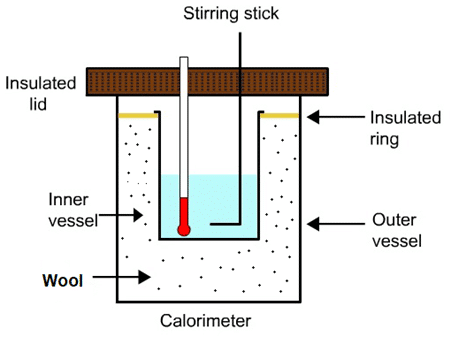
Calorimeter
The vessel in which heat exchange in between different bodies at different temperature is observed is called calorimeter. It is made of copper with copper stirrer kept inside a wooden box having lid. A thermometer can be inserted from the hole on the liq. A woollen cloth is kept into the gap between vessel and wooden box.
Heat Equation and Specific Heat Capacity
When same amount of heat is given to a substance of same material but having different masses, the rise in their temperature is also found to be different. Experimentally, it has been found that, the amount of heat (Q):
- required to raise the temperature of substance by certain value [latex](\Delta \theta)[/latex] is directly proportional to the mass (m) of the substance. i.e.
[latex]Q \propto m[/latex] ………… (i) - required for the same mass of the substance is directly proportional to the rise in temperature [latex](\Delta \theta)[/latex]. i.e.
[latex]Q \propto \Delta \theta[/latex] ………. (ii)
Combining equations (i) and (ii), we get,
[latex]Q \propto m(\Delta \theta)[/latex]
[latex]\therefore Q = ms\Delta \theta[/latex] ………….. (iii)
This equation is called the heat equation and the proportionality constant ‘s’ is called the specific heat capacity of the body. From equation (iii), we have,
[latex]s = \frac{Q}{m\times \Delta \theta}[/latex]
When m = 1 unit and [latex]\Delta \theta[/latex] = 1 unit, then [latex]s = Q[/latex] Thus, the specific heat capacity of a body is defined as the amount of heat required to raise the temperature of unit mass of a body through unit change in temperature.
Unit of Specific Heat Capacity
In SI system, its unit is: JKg-1K-1 and in CGS system it is measured in Calg-1K-1.
You've reached the end of the free preview. Continue with NN Premium.
- Complete access to every Premium chapter
- Notes, QBank, solutions & MCQs
- Premium PDFs & study resources
- Entrance preparation & mock tests
One NN Premium subscription unlocks everything.
MCQs
Dimensional formula of specific heat is
A body of mass 400 g and specific heat 0.1 in cgs system of units has a water equivalent
A liquid boils when its vapor pressure is
The substance which expands on melting, the increase in pressure results
In Kathmandu, water can be boiled at [latex]100^oC[/latex] by
Surfusion is
In the steady state, the temperature of the body
You've reached the end of the free preview. Continue with NN Premium.
- Complete access to every Premium chapter
- Notes, QBank, solutions & MCQs
- Premium PDFs & study resources
- Entrance preparation & mock tests
One NN Premium subscription unlocks everything.
A copper calorimeter of mass 300 gm contains 500 gm of water at temperature [latex]15^o[/latex] C. A 560-gm block of aluminium of temperature [latex]100^oC[/latex] is dropped in the calorimeter and the temperature is observed to increase to [latex]22.5^o[/latex]C. Find the specific heat capacity of aluminium. (Specific heat capacity of copper [latex](s_c)[/latex] = [latex]400\ JKg^{-1}K^{-1}[/latex]).
Solution
Given,
Mass of calorimeter [latex](m_c)[/latex] = 300 gm = 0.3 kg
Mass of water [latex](m_w)[/latex] = 500 gm = 0.5 kg
Temperature [latex]\theta_1[/latex] = [latex]15^o[/latex]C
Mass of aluminium block [latex](m_a)[/latex] = 560 gm = 0.56 kg
Temperature [latex]\theta_2[/latex] = [latex]100^o[/latex]C
Temperature of mixture [latex]\theta[/latex] = [latex]22.5^o[/latex]C
Specific heat capacity of copper [latex](s_c)[/latex] = [latex]400 JKg^{-1}K^{-1}[/latex]
Specific heat capacity of aluminium [latex](s_a)[/latex] =?
According to principle of calorimetry,
Heat lost by aluminium = heat gained by calorimeter + heat gained by water
You've reached the end of the free preview. Continue with NN Premium.
- Complete access to every Premium chapter
- Notes, QBank, solutions & MCQs
- Premium PDFs & study resources
- Entrance preparation & mock tests
One NN Premium subscription unlocks everything.