
Pressure Amplitude
Sound is a longitudinal wave which consists of alternate compressions and rarefactions. Due to this, the volume of the medium is altered and hence, there is a variation of pressure. Hence, the longitudinal waves are also called pressure waves.
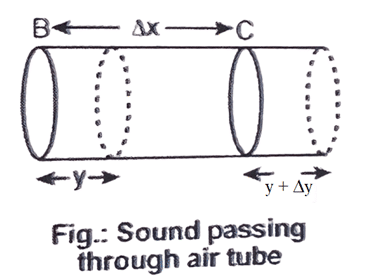
Let us consider a sound wave travelling in a medium along +ve x-axis as,
y = a sin(ωt-kx) ….. (i)
where, a = displacement amplitude or simply amplitude, [latex]\omega[/latex] = angular frequency and k = propagation constant.
Consider a tube BC of air of cross-sectional area A and length [latex]\Delta x[/latex] and P be the instantaneous pressure variation at a point. So, its volume will be:
V = V1 = [latex]A.\Delta x[/latex]
When the wave passes the end of the cylinder, it is displaced by y and the other end is displaced by [latex]y + \Delta y[/latex].
Hence, the change in volume of the cylinder is: ΔV = V2 – V1
= [latex]A.(y+\Delta y + \Delta x – y) – A.\Delta x[/latex]
= [latex]A.\Delta y[/latex]
Now, [latex]\frac{\Delta V}{V} = \frac{A.\Delta y}{A.\Delta x} = \frac{\Delta y}{\Delta x}[/latex]
On the limit Δx → 0, the fractional change in volume is:
You've reached the end of the free preview. Continue with NN Premium.
- Complete access to every Premium chapter
- Notes, QBank, solutions & MCQs
- Premium PDFs & study resources
- Entrance preparation & mock tests
One NN Premium subscription unlocks everything.