
A swimmer’s speed along the river (downstream) is 20 Km/h and can swim upstream at 8 km/h. calculate the velocity of the stream and the swimmer’s possible speed in still water.
Solution
Swimmer’s speed downstream = 20 km/h
Swimmer’s speed upstream = 8 km/h
Now, velocity of stream =?
Also, swimmer’s speed in still water =?
Let, the swimmer’s speed in still water be x km/h and that of stream be y km/h.
According to question, in case of downstream,
x + y = 20 ………………… (i)
also, in case of upstream,
x – y = 8 ………………….. (ii)
Now, solving these equations, we get,
On adding,
2x = 28
Or, [latex]
x = \frac{28}{2} = 14\ km/h
[/latex]
Putting the value of x in equation (i), we get,
14 + y = 20
Or, y = 6 km/h
Hence, swimmer’s speed in still water = 14 km/h
And, the velocity of stream = 6 km/h.
A body is projected upwards making an angle [latex]\theta[/latex] with the horizontal with a velocity of 300 ms-1. Find the value of [latex]\theta[/latex] so that the horizontal range will be maximum. Hence find its range and time of flight.
Solution
Angle of projection [latex](\theta)[/latex] =? for maximum horizontal range.
Velocity (u) = 300 m/s
Horizontal range (Rmax) =?
And, time of flight (T) =?
We know that,
[latex]
\text{Horizontal range (R)} = \frac{u^2sin2\theta}{g}
[/latex]
This will be maximum if
[latex]
Sin2\theta = 1
[/latex]
[latex]
Or, Sin2\theta = Sin90^o
[/latex]
[latex]
Or, 2\theta = 90^o
[/latex]
[latex]
Or, \theta = 45^o
[/latex]
So, angle of projection is 45o.
Now,
Maximum horizontal range
[latex]
(R_{max}) = \frac{u^2}{g}
[/latex]
[latex]
= \frac{300^2}{10}
[/latex]
[latex]
= \frac{90000}{10} = 9000 m
[/latex]
Also,
[latex]
\text{time of flight (T)} = \frac{2usin\theta}{g}
[/latex]
[latex]
= \frac{2\times 300 \times sin45^o}{10}
[/latex]
[latex]
= \frac{600\times \frac{1}{\sqrt{2}}}{10}
[/latex]
[latex]
= \frac{60}{\sqrt{2}} = 42.43 s
[/latex]
A stone on the edge of a vertical cliff is kicked so that its initial velocity is 9 m/s horizontally. If the cliff is 200 m high, calculate:
i. Time taken by stone to reach the ground.
ii. How far from the cliff the stone will hit the ground?
Solution
Initial velocity (u) = 9 m/s (Horizontally)
Height of the cliff (h) = 200 m
Time taken by stone to reach the ground (t) =?
Also, horizontal range of the stone (R) =?
We know that, for vertical motion,
[latex]
h = ut + \frac{1}{2}gt^2
[/latex]
[latex]
Or, h = \frac{1}{2}gt^2
[/latex] [∵ for vertical motion, u = 0]
[latex]
Or, 200 = \frac{1}{2}gt^2
[/latex]
[latex]
Or, 200\times 2 = 10t^2
[/latex]
[latex]
Or, t^2 = \frac{400}{10}
[/latex]
Or, t2 = 40
[latex]
Or, t = \sqrt{40} = 6.32\ sec[/latex]
Now, for horizontal range (R) = u x t
= 9 x 6.32
= 56.92 m
A projectile is fired from ground level with a velocity 500 m/s at [latex]30^o[/latex] to the horizontal. Find its horizontal range, the greatest height and the time to reach the greatest height.
Solution
Given,
Initial velocity (u) = 500 m/s
Angle [latex]\theta[/latex] = 30o
Horizontal range (R) = ?
Greatest height (Hmax) = ?
Time to reach the greatest height (t) = ?
We know,
Horizontal range [latex](R) = \dfrac{u^2 \sin 2\theta}{g}[/latex]
[latex]= \dfrac{(500)^2 \sin(2 \times 30^o)}{10}[/latex]
[latex]= \dfrac{250000 \times \sin 60^o}{10}[/latex]
[latex]= 21650.63\ m[/latex]
Now, greatest height [latex](H_{max}) = \dfrac{u^2 \sin^2\theta}{2g}[/latex]
[latex]= \dfrac{500^2 \sin^2 30}{2 \times 10}[/latex]
[latex]= 3215\ m[/latex]
Now, time to reach maximum height [latex](t) = \dfrac{u\sin\theta}{g}[/latex]
[latex]= \dfrac{500 \times \sin 30}{10}[/latex]
[latex]= 25\ s[/latex]
A batter hits a baseball so that it leaves the bat with an initial speed 37 m/s at an angle of [latex]53^o[/latex], find the position of the ball and the magnitude and direction of its velocity after 2 seconds. Treat the baseball as a projectile.
Solution
Given,
Initial velocity (u) = 37 m/s
Angle of projection [latex]\theta[/latex] = 53o
Now, [latex]u_x = u\cos\theta = 37 \times \cos 53^o = 22.267[/latex]
[latex]u_y = u\sin\theta = 37.\sin 53^o = 29.549[/latex]
time (t) = 2 seconds
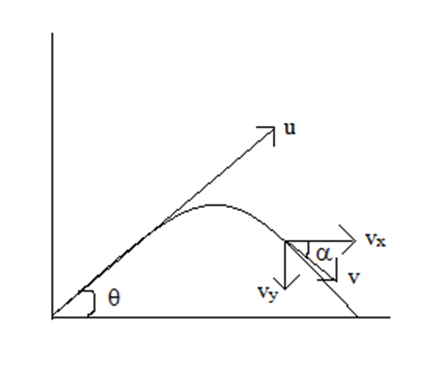
First, let’s find time of flight [latex](T) = \dfrac{2u\sin\theta}{g}[/latex]
[latex]= \dfrac{2 \times 37\sin 53^o}{10}[/latex]
[latex]= 5.909\ sec[/latex]
So, after 2 second, the object is in air.
Now, [latex]v_x = u_x = 22.267\ m/s[/latex]
And, [latex]v_y = u_y – gt[/latex]
[latex]= 29.549\ -\ 10 \times 2[/latex]
[latex]= 9.549\ m/s[/latex]
Again, resultant of velocity,
[latex]v = \sqrt{v_x^2 + v_y^2}[/latex]
[latex]= \sqrt{(22.267)^2 + (9.549)^2}[/latex]
[latex]= 24.228\ m/s[/latex]
For direction, from figure,
[latex]\tan\alpha = \dfrac{v_y}{v_x}[/latex]
[latex]= \dfrac{9.549}{22.267}[/latex]
[latex]\alpha = \tan^{-1}(0.429)[/latex]
So, [latex]\alpha = 23.21^o[/latex]
A baseball is thrown towards a player with an initial velocity 20 [latex]ms^{-1}[/latex] and [latex]45^o[/latex] with the horizontal. At the moment, the ball is thrown the player is 50 m from the thrower. At what speed and in what direction must he run to catch the ball at the same height at which it is released?
Solution
Given,
Initial velocity (u) = 20 m/s
Angle of projection [latex]\theta = 45^o[/latex]
Distance of player from the thrower (d) = 50 m
Speed the player must run (v) = ?
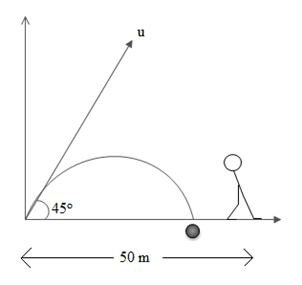
First of all, let’s find the horizontal range of the baseball.
[latex]R = \dfrac{u^2 \sin 2\theta}{g}[/latex]
[latex]= \dfrac{20^2 \sin(2 \times 45^o)}{10}[/latex]
[latex]= \dfrac{400}{10} = 40\ m[/latex]
This means, the ball falls in front of the player. So the player must run towards the thrower.
Time of flight [latex](T) = \dfrac{2u\sin\theta}{g}[/latex]
[latex]= \dfrac{2 \times 20 \times \sin 45^o}{10}[/latex]
[latex]= \dfrac{40}{10 \times \sqrt{2}} = 2.83\ s[/latex]
Now, the player should cover (50 – 40) = 10 m distance in 2.83 s.
So, speed of the player [latex](v) = \dfrac{10}{2.83} = 3.53\ ms^{-1}.[/latex]
An airplane is flying with a velocity of 90.0 m/s at an angle of 23.0o above the horizontal. When the plane is 114 m directly above a dog that is standing on level ground, a suitcase drops out of luggage compartment. How far from the dog will the suitcase land? You can ignore air resistance.
Solution
Given,
Initial velocity (u) = 90 m/s
Angle of airplane above the horizontal [latex](\theta)[/latex] = 23o
Height of the suitcase fallen (h) = 114 m
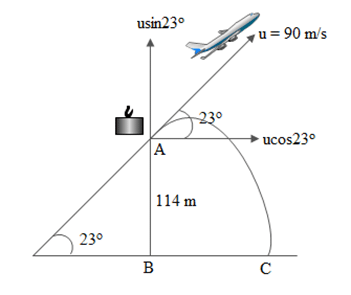
Let, position of the dog be at B. The distance of the suitcase fell on the ground and the dog (BC) =?
Now, [latex]u_x = u\cos\theta = 90 \times \cos 23^o = 82.845\ m/s[/latex]
[latex]u_y = u\sin\theta = 90 \times \sin 23^o = 35.166\ m/s[/latex]
Again, for vertical motion,
[latex]h = -u_y t + \dfrac{1}{2}gt^2[/latex] [∵ suitcase is falling downward we take − [latex]u_y[/latex]]
[latex]114 = -35.166t + \dfrac{1}{2} \times 10 \times t^2[/latex]
[latex]5t^2 – 35.166t – 114 = 0[/latex]
Solving using quadratic equation, we get,
[latex]t = \dfrac{-(-35.166) \pm \sqrt{(-35.166)^2 – 4 \times 5 \times (-114)}}{2 \times 5}[/latex]
[latex]= \dfrac{35.166 \pm \sqrt{3516.648}}{10} = 9.447\ s[/latex] [∵ using +ve sign only]
Now, the distance of the suitcase fell on the ground and the dog (BC) = ux x t
[latex]= 82.845 \times 9.447 = 782.64\ m.[/latex]
A bullet is fired with a velocity of 100 m/s from the ground at an angle of [latex]60^o[/latex] with the horizontal. Calculate the horizontal range covered by the bullet. Also calculate the maximum height attained.
Solution
Given,
Initial velocity (u) = 100 m/s
Angle of projection [latex](\theta) = 60o[/latex]
Horizontal range (R) =?
Maximum height [latex](H_{max})[/latex] =?
We know that,
[latex]R = \dfrac{u^2 \sin 2\theta}{g}[/latex]
[latex]= \dfrac{(100)^2 \sin(2 \times 60)}{10}[/latex]
[latex]= 866\ m[/latex]
Now, maximum height [latex](H_{max}) = \dfrac{u^2 \sin^2\theta}{2g}[/latex]
[latex]= \dfrac{(100)^2 \sin^2 60}{2 \times 10}[/latex]
[latex]= 375\ m.[/latex]
A car travelling with a speed of 15 m/s is braked and it slows down with uniform retardation. It covers a distance of 88 m as its velocity reduces to 7 m/s. If the car continues to slow down with same rate, after what further distance will it be brought to rest?
Solution
Given,
Speed of car (u) = 15 m/s
Distance covered (s) = 88 m
Final velocity (v) = 7 m/s
Further distance if the car is brought to rest (s’) =?
We know,
[latex]v^2 = u^2 + 2as[/latex]
[latex]7^2 = 15^2 + 2a \times 88[/latex]
[latex]176a = 49 – 225[/latex]
[latex]176a = -176[/latex]
[latex]a = -1\ m/s^2[/latex]
Now, for 2nd case,
Initial velocity (u) = final velocity of previous case = 7 m/s
Final velocity (v) = 0 m/s
Retardation (a) = – 1 m/s
So, using formula,
[latex]v^2 = u^2 + 2as[/latex]
[latex]0^2 = 7^2 + 2 \times (-1) \times s[/latex]
[latex]-2s = -49[/latex]
[latex]s = \dfrac{49}{2} = 24.5\ m.[/latex]
A stone is projected horizontally with 20 m/s from the top of a tall building. Calculate its position and velocity after 3 sec neglecting the air resistance.
Solution
Given,
Initial velocity (u) = 20 m/s along horizontal.
Time (t) = 3 s
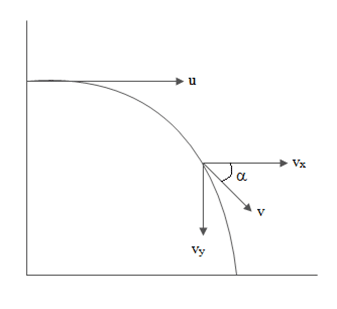
After 3 s,
[latex]v_x = u = 20\ m/s[/latex]
[latex]v_y = u_y + gt[/latex]
[latex]= 10 \times 3[/latex] [∵ uy = 0, along vertical motion]
[latex]= 30\ m/s[/latex]
Now, resultant velocity of the stone is
[latex]v = \sqrt{v_x^2 + v_y^2}[/latex]
[latex]= \sqrt{(20)^2 + (30)^2}[/latex]
[latex]= 36.06\ m/s[/latex]
Now, [latex]\alpha[/latex] be the direction of the stone at the point, then,
[latex]\tan\alpha = \dfrac{v_y}{v_x}[/latex]
[latex]= \dfrac{30}{20} = 1.5[/latex]
[latex]\alpha = \tan^{-1}(1.5)[/latex]
[latex]= 56.31^o.[/latex]
An object with mass m moves along the x – axis. Its position as a function of time is given by x(t) = [latex]At – Bt^3[/latex], where A and B are constants. Calculate the net force on the object as a function of time.
Solution
Given,
Position function [latex]x(t) = At – Bt^3[/latex]
Net force on the object (F) = ma
[latex]= m\dfrac{d^2x}{dt^2}[/latex]
[latex]= m\dfrac{d}{dt}\left(\dfrac{dx}{dt}\right)[/latex]
[latex]= m\dfrac{d}{dt}\left(\dfrac{d}{dt}(At – Bt^3)\right)[/latex]
[latex]= m\dfrac{d}{dt}(A – 3Bt^2)[/latex]
[latex]= m \times (-6Bt)[/latex]
[latex]= -6mBt[/latex]
So, magnitude of net force is 6mBt.
A man wishes to swim across a river 600 m wide. If he can swim at the rate of 4 km/h in still water and the river flows at 2 km/h. Then in what direction must he swim to reach a point exactly opposite to the starting point and when will he reach it?
Solution
Given,
Width of river (d) = 600 m
Velocity of swimmer relative to river [latex](v_{sr})[/latex] = 4 km/hr
Velocity of river relative to ground [latex](v_{rg})[/latex] = 2 km/hr
Direction of the swimmer with the direction river [latex](\alpha) = 90 + \theta[/latex] =?
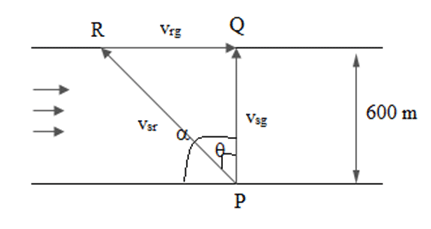
Time to reach the opposite point (t) =?
From the figure above,
[latex]\sin\theta = \dfrac{v_{rg}}{v_{sr}}[/latex]
[latex]= \dfrac{2}{4} = \dfrac{1}{2}[/latex]
So, [latex]\theta = 30^o[/latex]
So, direction of the swimmer with the direction of river is [latex]\alpha = 90 + \theta = 90 + 30 = 120^o.[/latex]
Now, the velocity of the swimmer relative to ground, using Pythagoras theorem in triangle ΔPQR,
[latex]v_{sg} = \sqrt{v_{sr}^2 – v_{rg}^2}[/latex]
[latex]= \sqrt{4^2 – 2^2} = \sqrt{16-4} = 3.46\ km/hr[/latex]
Now, time taken to reach the opposite point [latex](t) = \dfrac{d}{v_{sg}} = \dfrac{0.6}{3.46} = 0.173\ hr[/latex]
[latex]= 0.173 \times 60 \times 60[/latex]
[latex]= 622.8\ s.[/latex]
A body falls freely from the top of a tower and during the last second of its fall, it falls through 25 m. Find the height of tower.
Solution
Given,
Let, time taken to fall from A to C be ‘t’.
According to question,
AC – AB = 25 m
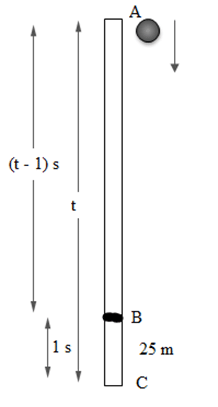
[latex]\dfrac{1}{2}gt^2 – \dfrac{1}{2}g(t-1)^2 = 25[/latex]
[latex]\dfrac{1}{2} \times 10 \times t^2 – \dfrac{1}{2} \times 10 \times (t^2 – 2t + 1) = 25[/latex]
[latex]5t^2 – 5t^2 + 10t – 5 = 25[/latex]
[latex]10t = 30[/latex]
[latex]t = 3\ s[/latex]
Now, the height of the tower is,
[latex]AC = \dfrac{1}{2}gt^2[/latex]
[latex]= \dfrac{1}{2} \times 10 \times 3^2[/latex]
[latex]= 5 \times 9 = 45\ m[/latex]
A projectile is launched with an initial velocity of 30 [latex]ms^{-1}[/latex] at an angle of [latex]60^o[/latex] above the horizontal. Calculate the magnitude and direction of its velocity 5s after launch.
Solution
Given,
Initial velocity of projectile (u) = [latex]30\ ms^{-1}[/latex]
Angle of projection [latex](\theta) = 60^o[/latex]
Time (t) = 5 s
Magnitude and direction of velocity =?
Now, [latex]u_x = u\cos\theta = 30 \times \cos 60^o = 15\ m/s[/latex]
[latex]u_y = u\sin\theta = 30 \times \sin 60^o = 25.98\ m/s[/latex]
time (t) = 5 seconds
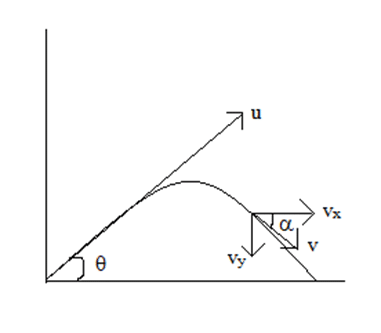
First, let’s find time of flight [latex](T) = \dfrac{2u\sin\theta}{g}[/latex]
[latex]= \dfrac{2 \times 30 \sin 60^o}{10}[/latex]
[latex]= 5.196\ sec[/latex]
So, after 5 second, the object is in air.
Now, [latex]v_x = u_x = 15\ m/s[/latex]
And, [latex]v_y = u_y – gt[/latex]
[latex]= 25.98 – 10 \times 5[/latex]
[latex]= -24.02\ m/s[/latex]
Again, resultant of velocity,
[latex]v = \sqrt{v_x^2 + v_y^2}[/latex]
[latex]= \sqrt{(15)^2 + (-24.02)^2}[/latex]
[latex]= 28.32\ m/s[/latex]
For direction, from figure,
[latex]\tan\alpha = \dfrac{v_y}{v_x}[/latex]
[latex]= \dfrac{24.02}{15}[/latex]
[latex]\alpha = \tan^{-1}(1.601)[/latex]
So, [latex]\alpha = 58.01^o[/latex]
An airplane pilot wishes to fly due west. A wind of 80 km/hr is blowing towards the south. If the speed of the plane in still air is 320 km/hr, in which direction should the pilot head? What is the speed of the plane with respect to the ground?
Solution
Given,
Velocity of wind [latex](v_w)[/latex] = 80 km/hr
Speed of plane in still air [latex](v_p)[/latex] = 320 km/hr
Direction of the plane [latex](\theta)[/latex] =?
Speed of the plane with respect to the ground [latex](v_{pg})[/latex] =?
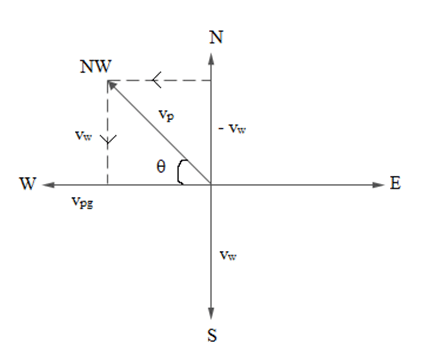
From the vector diagram above,
[latex]\sin\theta = \dfrac{v_w}{v_p}[/latex]
[latex]= \dfrac{80}{320} = 0.25[/latex]
[latex]\theta = \sin^{-1}(0.25) = 14.48^o[/latex]
Now, from the above diagram, using Pythagoras theorem,
Velocity of plane with respect to ground, [latex](v_{pg}) = \sqrt{v_p^2 – v_w^2}[/latex]
[latex]= \sqrt{(320)^2 – (80)^2} = 309.83\ km/hr[/latex]
[latex]\sim 310\ km/hr[/latex]
So, the pilot should head at an angle [latex]14.48^o[/latex] North of West and the magnitude of velocity of plane with respect to ground be 310 km/hr.
A projectile is fired from the ground level with a velocity of 500 [latex]ms^{-1}[/latex] at [latex]30^o[/latex] to horizontal. Find the horizontal range, and greatest vertical height to which it rises. What is the least speed with which it could be projected in order to achieve the same horizontal range? [g = 10 [latex]Nkg^{-1}[/latex]].
Solution
Given,
Velocity (u) = 500 m/s
Angle of projection [latex](\theta) = 30^o[/latex]
Horizontal range (R) =?
Greatest vertical height [latex](H_{max})[/latex] = ?
Acceleration due to gravity (g) = 10 [latex]NKg^{-1}[/latex]
Least speed for the same horizontal range (u’) =?
We know that,
Horizontal range [latex](R) = \dfrac{u^2 \sin 2\theta}{g}[/latex]
[latex]= \dfrac{(500)^2 \sin(2 \times 30^o)}{10}[/latex]
[latex]= \dfrac{250000 \times \sin 60^o}{10}[/latex]
[latex]= 21650.64\ m[/latex]
Maximum height [latex](H_{max}) = \dfrac{u^2 \sin^2\theta}{2g}[/latex]
[latex]= \dfrac{(500)^2 \sin^2 30^o}{2 \times 10}[/latex]
[latex]= \dfrac{250000 \times \left(\frac{1}{2}\right)^2}{20}[/latex]
[latex]= 3125\ m[/latex]
Again, for least speed for same horizontal range,
[latex]R_{max.} = \dfrac{u’^2}{g}[/latex]
[latex]u’^2 = R_{max.}g[/latex]
[latex]= 21650.64 \times 10[/latex]
[latex]u’ = \sqrt{216506.4} = 465.30\ m/s.[/latex]
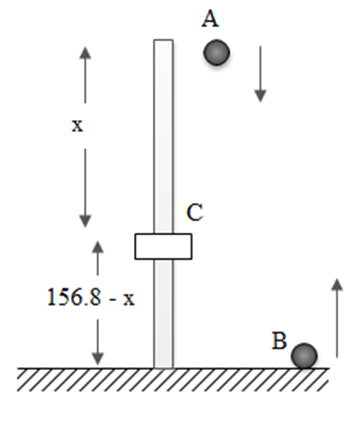
An object is dropped from the top of the tower of height 156.8 m and at the same time another object is thrown vertically upward with the velocity of 78.1 [latex]ms^{-1}[/latex] from the foot of the tower, when and where the object meets?
Solution
Given,
Height of the tower (h) = 156.8 m
Let, at point c, both the ball meets.
For point A:
u = 0 m/s
AC = x m
Time taken to cover x m is,
[latex]x = ut + \dfrac{1}{2}gt^2[/latex]
[latex]x = \dfrac{1}{2} \times 10 \times t^2[/latex] [u = 0 m/s from top]
[latex]x = 5t^2 \dots\dots\dots\dots\dots\dots\dots (i)[/latex]
Now, from point B,
[latex]156.8 – x = u’t – \dfrac{1}{2}gt^2[/latex]
[latex]156.8 – x = 78.1t – \dfrac{1}{2} \times 10 \times t^2[/latex]
[latex]156.8 – x = 78.1t – 5t^2[/latex]
[latex]156.8 – x = 78.1t – x[/latex] [From eqn. (i)]
[latex]156.8 = 78.1t[/latex]
[latex]t = \dfrac{156.8}{78.1} = 2\ s[/latex]
Now, from eqn. (i),
Distance from the top = [latex]5t^2 = 5 \times 2^2[/latex]
[latex]= 5 \times 4 = 20\ m.[/latex]
Hence, both the ball will meet at 20 m below the top after 2s.
A body is projected horizontally from the top of a tower 100 m high with a velocity of 9.8 [latex]ms^{-1}[/latex]. Find the velocity with which it hits the ground.
Solution
Given,
Height of the tower (h) = 100 m
Initial velocity (vx) = 9.8 ms-1 along horizontal motion
Velocity it hits the ground (v) = ?
We know that,
Time to reach the ground:
[latex]h = ut + \dfrac{1}{2}gt^2[/latex]
[latex]100 = \dfrac{1}{2} \times 10 \times t^2[/latex] [∵ for vertical motion, u = 0]
[latex]100 = 5t^2[/latex]
[latex]t^2 = 20[/latex]
[latex]t = \sqrt{20} = 4.47\ s[/latex]
Now, vertical component of velocity [latex](v_y) = gt = 10 \times 4.47[/latex]
[latex]= 44.7\ m/s[/latex]
So, resultant velocity [latex](v) = \sqrt{v_x^2 + v_y^2}[/latex]
[latex]= \sqrt{(9.8)^2 + (44.7)^2} = 45.76\ m/s[/latex]
For the direction,
[latex]\tan\phi = \dfrac{v_y}{v_x} = \dfrac{44.7}{9.8}[/latex]
[latex]\phi = \tan^{-1}(4.56) = 77.63^o[/latex] with the horizontal.