
Overview
Musical instruments are the practical face of this chapter: a guitar string tightened by turning a tuning peg, an organ pipe producing different notes depending on whether it’s open or closed at one end — both are direct applications of standing waves, and NEB exams draw on this connection constantly. The recurring theoretical question here is proving which harmonics (odd only, or both odd and even) can form in open versus closed pipes, along with defining end correction — a concept that shows up in nearly every resonance-tube numerical as well.
Two distinct numerical patterns dominate this chapter, and it helps to recognize which one a question is asking for before starting: stretched-string problems, where frequency depends on tension, length, and mass per unit length (and doubling the tension does not double the frequency — it scales with the square root), and organ-pipe/resonance-tube problems, where frequency depends on pipe length and whether it’s open or closed. Mixing up which formula applies to which setup is the most common mistake students make here.
The complete set of past NEB and HISSAN questions for this chapter is below, organized by theory and numerical problems. Step-by-step numerical solutions are available on the Solutions page for this chapter.
Theoretical questions
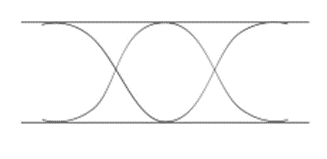
The given figure shows standing wave formed in an open organ pipe.
i. Which mode of vibration is shown? [1]
ii. Obtain the frequency of vibration for this mode. [1]
Discuss the different modes of vibration of an air column in an open organ pipe. [3]
Describe the various modes of vibration of air column in a closed organ pipe. [3]
How stationary waves are formed in an open organ pipe? [1]
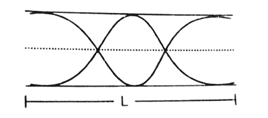
The diagram shows a standing wave in an open organ pipe.
i. Redraw the diagram and show the position of nodes and antinodes. [1]
ii. Derive an expression for frequency of this mode. [2]
What will be the effect of velocity of transverse wave in a stretched string if the radius of the string is doubled? [2]
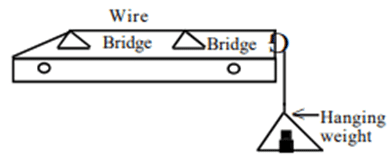
Given figure represents the sonometer wire under certain tension T.
A musician tunes his guitar by turning the screws provided at the end, why? [2]
What do you mean by harmonics and overtones? [2]
Define an organ pipe. [1]
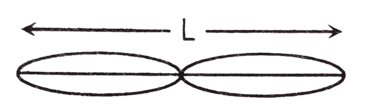
The given figure shows the first overtone of a stretched string of length L.
i. Define harmonics and overtones. [1]
ii. Calculate the frequency of this mode. [2]
iii. If the tension of the string is increased 4 times, what will be the frequency of this mode? [2]
The frequency of a fundamental note of a closed organ pipe and that of an open organ pipe are the same. What is the ratio of their lengths?
By what factor does the velocity of transverse wave in the string change when the tension in the stretched string is increased by four times.
The six strings of a guitar are of same length and are under nearly the same tension, but have different thickness. On which string do waves travel the fastest?
How does the pitch of an organ pipe change with temperature?
A tuning fork has two prongs. Why?
What is resonance? Describe an experiment to determine the velocity of sound in air and end correction of the tube by resonance method.
Prove, with necessary diagrams, that both types of harmonics odd and even can be obtained in an organ pipe open at both ends. What is end correction of a pipe?
What is meant by end correction? Discuss the vibration of air column of open pipe and show that both harmonics are produced on it.
Define end correction. Show that both harmonics, odd and even, can be produced in an open pipe open at both ends.
State the laws of transverse vibration in a stretched string. Describe various modes of vibration in a stretched string.
What do you understand by “harmonics” and “overtone” in the case of organ pipe? Also prove that only odd harmonics are produced in closed ended organ pipe.
OR What is end correction of a pipe? Describe the different modes of vibration of air column in an organ pipe closed at one end.
What are harmonics? Explain the formation of overtones in an open and a closed organ pipe.
Describe an experiment with the necessary theory by which the speed of sound in air is determined by using resonance tube method.
What is the difference between an open and a closed pipe? Explain with proper sketches for the formation of second overtones in each case. Also express the length of pipes in terms of the wavelength of sound.
Numerical problems
Guitar string of length 1.5 m is made of steel of density [latex]7800 \text{kg/m}^3[/latex] and Young’s modulus [latex]2\times 10^{11} N/m^2[/latex]. It produces an elastic strain of 1% in the string. Calculate: [3]
i. stress developed in the string.
ii. frequency of second mode of vibration. Ans: [latex]2\times 10^9 N/m^2[/latex], [latex], 337 \text{Hz}[/latex]
A sonometer wire of density [latex]9\ \text{gm/cm}^3[/latex] and length 1 m is subjected to an extension of 0.05 cm. What is the lowest frequency of transverse vibration in the wire? Assume Young’s modulus [latex]Y = 9\times 10^{10} Nm^{-2}[/latex]. [2] Ans: [latex]35.36\ \text{Hz}[/latex]
A steel wire of length 1 m long has a mass of 80 gm and is stretched with a tension of 1000 N. Calculate the fundamental frequency of transverse vibration. [2] Ans: [latex]112\ \text{Hz}[/latex]
In a resonance tube experiment, the first and second resonance positions were observed at 17 cm and 52.6 cm respectively. The frequency of tuning fork used was [latex]512 \text{Hz}[/latex] and the room temperature was [latex]27^\circ C[/latex]. Calculate the velocity of sound in air at room temperature and end correction of the pipe. What would be the velocity of sound in air if the temperature drops to [latex]0^\circ C[/latex]? [3] Ans: [latex]364.5 \text{m/s}, 347.75 ,\text{m/s}, 0.008 \text{m}[/latex]
What is the ratio of length of two pipes, an open organ pipe A and a closed organ pipe B both vibrating in third overtones are in resonance? Justify. [2] Ans: [latex]\frac{8}{7}[/latex]
An organ pipe open at both ends is 0.5 m long. What is the fundamental frequency if velocity of sound is [latex]350 ,\text{m/s}[/latex]? [2] Ans: [latex]350 \text{Hz}[/latex]
One day when speed of sound is [latex]340 ,\text{m/s}[/latex], the fundamental frequency of a closed organ pipe is [latex]220 \text{Hz}[/latex] (a) How long is this pipe? (b) The second overtone of this pipe has the same wavelength as third harmonic of an open pipe. How long is the open pipe? Ans: [latex]0.386 \text{m}, 0.31 \text{m}[/latex]
A wire whose mass per unit length is [latex]10^{-3} \text{kg/m}[/latex] is stretched by a load of 4 kg over the two bridges of a sonometer wire 1 m apart. It is struck at its middle point, what would be the wavelength and frequency of its fundamental vibration? Ans: [latex]2 \text{m}, f = 100 \text{Hz}[/latex]
A steel wire of length 20 cm and mass 5 gram is under the tension of 500 N and is tied down at both ends. Calculate the frequency of fundamental mode of vibration. Ans: [latex]353.5 \text{Hz}[/latex]
A pianofort wire having a diameter of 0.90 mm is replaced by another wire of the same material but with diameter 0.93 mm. If the tension of the wire is as before. What is percentage change in the frequency of fundamental note? Ans: [latex] 3.2 %[/latex]
On a day when the speed of sound is [latex]345 \text{m/s}[/latex], the fundamental frequency of a closed organ pipe is [latex]220 \text{Hz}[/latex]. The second overtone of this pipe has the same wavelength as the third harmonic of an open pipe. How long is the open pipe? Ans: [latex]47 \text{cm}[/latex]
A wire with mass 40 g is stretched so that its ends are tied down at points 80 cm apart. The wire vibrates in its fundamental mode with frequency [latex]60 \text{Hz}[/latex]. Calculate the speed of propagation of transverse waves in the wire and the tension in the wire. Ans: [latex]v = 96 \text{m/s}, T = 460.8 \text{N}[/latex]
A cord of length 1.5 m is fixed at both ends. Its mass per unit length is 1.2 g/m and the tension is 12N.
In a resonance tube experiment, the first and the second resonance positions were observed at 17cm and 52.6cm respectively. The tuning fork used was frequency 512Hz and the temperature was 27oC. Calculate the velocity of sound in air at 0oC and the end correction of the tube. Ans: 347.75 m/sec and 0.008 m
An open pipe 30 cm long and a closed pipe 23 cm long, both of the same diameter, each sounds their first overtone. If they are in resonance, find the end correction of these pipes. Ans: 1 cm
A piano string 1.5m long is made of steel of density 7800 kg/m3 and Young’s modulus [latex]2\times 10^{11}\ Nm^{-2}[/latex] If is maintained at a tension which produced an elastic strain of 1% in the string. Calculate the frequency of transverse vibration of the string when it is vibrating in second mode of vibration. Ans: 168.79 Hz, 337.6 Hz
A uniform tube 60 cm long stands vertically with its lower end dipping into water. When the length above the water is 14.8cm and again when it is 48 cm, the tube resounds to a vibrating tuning fork of frequency 512 Hz. Find the lowest frequency to which the tube will resound when it is open at both ends. Ans: 267.27 Hz
A steel wire of length 40 cm and the diameter 0.25 mm vibrates in unison with a tube, open at both ends and of effective length 60 cm, when each is sounding its fundamental notes. The air temperature is 27oC. Find the tension in the wire. Given – velocity of sound in air at 0oC = 332 [latex]ms^{-1}[/latex] and density of steel = 7800 [latex]kgm^{-3}[/latex]. Ans: 20.6 N
A piano string has a length of 2.0m and a density of 8000 [latex]kgm^{-3}[/latex]. When the tension in the string produces a strain of 1%, the fundamental note obtained from the string in transverse vibration is 170 Hz. Calculate the Young’s modulus value for the material of string. Ans: [latex]3.7\times 10^{10}\ Nm^{-2}[/latex]
A wire of diameter 0.04 cm and made of steel of density 8000 [latex]kgm^{-3}[/latex] is under a constant tension of 80N. What length of this wire should be plucked to cause it to vibrate with a frequency of 840 Hz? Ans: 0.168 m
An organ pipe is tuned to a frequency of 440 Hz when the temperature is 27oC. Find its frequency when the temperature drops to 0oC. Assume both ends of the pipe open. Ans: 419. 73 Hz
A steel wire of 2m long whose mass is 3g is under tension of 500N and is tied down at both ends. Calculate the frequency and wavelength for fundamental mode of vibration. Ans: 144.3 Hz, 4m