
The study of rotational motion of a rigid body is said to be rotational dynamics. A solid body in which the particles are compactly arranged and their positions are not disturbed by any external force applied on it is called rigid body.
Equations of angular motion
- Consider, a rigid body rotating about a fixed axis with constant angular acceleration [latex]\alpha [/latex]
So,
[latex]\alpha = \frac{d\omega}{dt}[/latex]
[latex]d\omega = \alpha dt[/latex] ………….. (i)
Using initial conditions, if t = 0, [latex]\omega = \omega_o[/latex]
And, if t = t, [latex]\omega = \omega[/latex]
Integrating [latex]eq^n. (i)[/latex], we get,
[latex]\int_{\omega_o}^{\omega}d\omega = \alpha \int_{0}^{t} dt[/latex]
Or, [latex][\omega]_{\omega_o}^{\omega} = \alpha[t]_{0}^{t}[/latex]
Or, [latex]\omega – \omega_o = \alpha t[/latex]
- Suppose, [latex]\omega[/latex] be the angular velocity of the rigid body at an instant t.
So,
[latex]\omega = \frac{d\theta}{dt}[/latex]
Or, [latex]d\theta = \omega dt[/latex]
Or, [latex]d\theta = (\omega_o + \alpha t)dt[/latex] ………… (ii)
Using initial conditions, if t = 0, [latex]\theta = 0[/latex]
And, if t = t, [latex]\theta = \theta[/latex]
Integrating [latex]eq^n.[/latex] (ii), we get,
[latex]\int_{\theta_o}^{\theta} d\theta = \int_{0}^{t} (\omega_o + \alpha t)dt[/latex]
Or, [latex]\int_{\theta_o}^{\theta} d\theta = \int_{0}^{t} \omega_o dt + \alpha \int_{0}^{t} tdt[/latex]
Or, [latex][\theta]_{\theta_o}^{\theta} = \omega_o[t]_{0}^{t} + \alpha [\frac{t^2}{2}]_{0}^{t}[/latex]
Or, [latex]\theta – 0 = \omega_o(t-0) + \frac{1}{2}\alpha (t^2 – 0)[/latex]
- The angular acceleration can be expressed as:
[latex]\alpha = \frac{d\omega}{dt} = \frac{d\omega}{d\theta}.\frac{d\theta}{dt}[/latex]
Or, [latex]\alpha = \frac{d\omega}{d\theta}.\omega[/latex]
Or, [latex]\omega.d\omega = \alpha.d\theta[/latex] …………….. (iii)
Using initial conditions, if t = 0, [latex]\theta = 0, \omega = \omega_o[/latex]
And, if [latex]t = t, \theta = \theta, \omega = \omega[/latex]
Integrating eqn. (iii), we get,
[latex]\int_{\omega_o}^{\omega}\omega.d\omega = \int_{0}^{\theta}\alpha.d\theta[/latex]
Or, [latex][\frac{\omega^2}{2}]_{\omega_o}^{\omega} = \alpha \int_{0}^{\theta}d\theta[/latex]
Or, [latex](\frac{\omega^2 – \omega_o^2}{2}) = \alpha[\theta]_{0}^{\theta}[/latex]
Or, [latex]\omega^2 – \omega_o^2 = 2\alpha(\theta – 0)[/latex]
Moment of Inertia
Moment of inertia of any rigid body is defined as the resistance or inability of the body to change its state/rotation by itself.
It can also be defined as the sum of the products of masses of the particles of a body and square of their respective perpendicular distance from the axis of rotation. It is analogous to mass in linear motion.
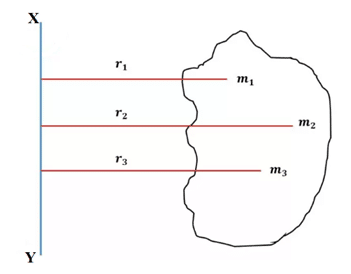
Let us consider, a rigid body consisting of large number of small particles of masses [latex]m_1, m_2, \ldots, m_n[/latex] at the distance [latex]r_1, r_2, r_3, \ldots, r_n[/latex] from the axis of rotation XY.
But, the moment of inertia of the particles [latex]m_1, m_2, \ldots, m_n[/latex] about the axis XY are given by,
[latex]I_1 = m_1r_1^2, I_2 = m_2r_2^2[/latex] and so on.
So, Total MI (I) = [latex]I_1 + I_2 + \ldots + I_n[/latex]
Or, [latex]I = m_1r_1^2 + m_2r_2^2 + \ldots + m_nr_n^2[/latex]
[latex]\therefore I = \sum_{i=1}^{n} m_i r_i^2[/latex]
Its unit is [latex]Kgm^2[/latex].
Note: Moment of inertia of any rigid body depends on following factors:
i. Mass
ii. Mass distribution
iii. Shape
iv. Axis of rotation
v. Distance from axis
vi. Compactness
Kinetic energy of rotation of a body
Let us consider, a rigid body where YY’ be the axis of rotation as shown in figure. m1, m2 and mn be the masses of different particles of rigid body at the distance r1, r2, …….. r2 from axis of rotation. We know that,
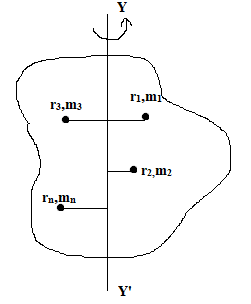
Total kinetic energy of rotation i.e.
KErot. = KE1 + KE2 + ….. KEn
Or, KErot.
= [latex]\frac{1}{2}m_1v_1^2 + \frac{1}{2}m_2v_2^2 + …….. + \frac{1}{2}m_nv_n^2[/latex]
= [latex]\frac{1}{2}(m_1r_1^2 + m_2r_2^2 + …….. + m_nr_n^2)\omega^2[/latex]
[latex][\omega = \frac{v}{r}, \omega_1 = \frac{v_1}{r_1}, \omega_n = \frac{v_n}{r_n}][/latex]
= [latex]\frac{1}{2}\sum_{r=1}^{n}(m_ir_i^2)\omega^2[/latex]
KErot. = [latex]\frac{1}{2}I\omega^2[/latex]
∴ Rotational kinetic energy is defined as half the product of moment of inertia (I) and square of angular velocity (ω).
Radius of Gyration (K)
Let, [latex]m_1, m_2, ………, m_n[/latex] are the masses of the particles of the body having mass M and [latex]r_1, r_2, ……….., r_n[/latex] are their respective perpendicular distance from the given axis. Then, its moment of inertia is:
I = m1r12 + m2r22 + ………… + mnrn2
Let, m1 = m2 = …………. mn = m.
∴ I = m (r12 + r22 + ……….. + rn2)
Or, I = [latex]\frac{mn}{n}[/latex] (r12 + r22 + ……….. + rn2)
[latex]\therefore I[/latex] = M ([latex]\frac{r_1^2+r_2^2+…………..+r_n^2}{n}[/latex])
where, M = mn = total mass of the body
Comparing it with I = [latex]MK^2[/latex], we get,
K = [latex]\sqrt{\frac{r_1^2+r_2^2+…………+r_n^2}{n}}[/latex]
Definition
It is defined as the root mean square of the distance of the particles of the body from the axis of rotation.
Moment of inertia of a thin uniform rod
a. About an axis passing through centre and perpendicular to length
Let us consider, a thin uniform rod of length ‘l’ and mass ‘M’, YY’ be the axis of rotation from the centre of rod as shown in figure.
Now, let us choose small portion of the rod of length dx and mass dm at the distance x from the axis of rotation.
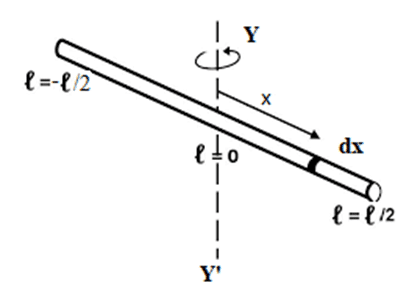
So, mass per unit length of rod = [latex]\frac{M}{l}[/latex]
[latex]\therefore[/latex] mass of the strip (dm) = [latex]\frac{M}{l}.dx[/latex]
Or, [latex] dm = \frac{M}{l}.dx[/latex]
So, moment of inertia of the small strip is
[latex]dI = dm.x^2[/latex]
Or, [latex]dI = \frac{M}{l}x^2 dx[/latex] …………… (i)
Now, moment of inertia of rod about the axis YY’ is
[latex]I = \int_{-l/2}^{l/2}dI[/latex]
= [latex]\frac{M}{l}\int_{-l/2}^{l/2}x^2 dx[/latex]
= [latex]\frac{M}{l}[\frac{x^3}{3}]_{-l/2}^{l/2}[/latex]
= [latex]\frac{M}{3l}[(\frac{l}{2})^3-(\frac{-l}{2})^3][/latex]
= [latex]\frac{M}{3l}[\frac{l^3}{8}+\frac{l^3}{8}][/latex]
= [latex]\frac{2Ml^2}{24l}[/latex]
∴ [latex]I = \frac{Ml^2}{12}[/latex] ……………… (ii)
Now, let, K be the radius of gyration of the rod about the axis YY’, then,
[latex]I = MK^2[/latex] …………… (iii)
From eqns. (ii) and (iii), we get,
[latex]K^2 = \frac{l^2}{12}[/latex]
Or, [latex]K = \frac{l}{\sqrt{12}}[/latex]
[latex]\therefore K = \frac{l}{2\sqrt{3}}[/latex]
b. About an axis passing through one of the edge and perpendicular to the length
Let us consider, a thin uniform rod of length ‘l’ and mass “M”. YY’ be the axis of rotation through one end of rod as shown in figure.
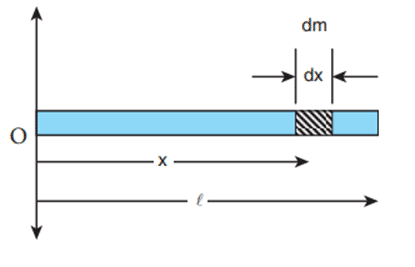
Now, let us choose small strip of the rod of length dx and mass dm at the distance x from the axis of rotation.
So, mass per unit length of rod = [latex]\frac{M}{l}[/latex]
Mass of small strip (dm) = [latex]\frac{M}{l}.dx[/latex]
So, moment of inertia of the small strip is dI = dmx2
[latex]dI = \frac{M}{l}.dx.x^2[/latex] …………….… (i)
Now, moment of inertia of the rod about the axis YY’ is
[latex]I = \int_{0}^{l}\frac{M}{l}x^2 dx[/latex]
= [latex]\frac{M}{l}[\frac{x^3}{3}]_{0}^{l}[/latex]
= [latex]\frac{Ml^2}{3}[/latex]
[latex]\therefore I = \frac{Ml^2}{3}[/latex] ………. (ii)
Let, K be the radius of gyration of the rod about the axis YY’, then,
[latex]I = MK^2[/latex] ……………. (iii)
From equations (ii) and (iii), we get,
[latex]\frac{Ml^2}{3} = MK^2[/latex]
Or, [latex]K^2 = \frac{l^2}{3}[/latex]
∴ K = [latex]\frac{l}{\sqrt{3}}[/latex]
Relation between Torque ([latex]\tau[/latex]) and angular acceleration ([latex]\alpha[/latex])
Let us consider, a rigid body where YY’ be the axis of rotation as shown in figure. [latex]m_1, m_2, …………, m_n[/latex] be the masses of different particles of rigid body at the distance r1, r2, ……. rn from the axis of rotation.
The torque [latex](\tau)[/latex] will produce a constant angular acceleration [latex](\alpha)[/latex]. The magnitude of linear acceleration of a particle of mass [latex]m_1[/latex] is related with angular acceleration as, [latex]a = r_1\alpha[/latex].
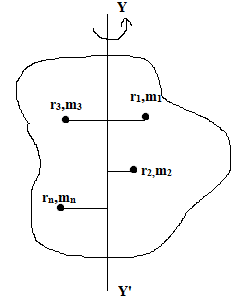
Since, Total torque [latex](\tau)[/latex] of rigid body = sum of torque due to all particles.
i.e. [latex]\tau = \tau_1 + \tau_2 + ……………… + \tau_n[/latex] ……. (i)
but, from definition,
[latex]\tau_1[/latex] = F1r1 = [latex]m_1a_1r_1 = m_1(r_1\alpha)r_1 = m_1r_1^2\alpha[/latex]
Now, from equation (i)
[latex]\tau = [m_1r_1^2 + m_2r_2^2 + ………. + m_nr_n^2]\alpha[/latex]
= [latex](\sum_{i=1}^{n}m_i r_i^2)\alpha[/latex]
= Iα
∴ τ = Iα.
Angular Momentum (L)
It is defined as the moment of linear momentum. It is the product of linear momentum of body or the particle and perpendicular distance from axis of rotation.
i.e. L = Pr.
Or, L = mvr.
Or, L = m(ωr)r = mωr2.
Unit: Kgm2s-1
Vectorically, [latex]\vec{L} = \vec{r}\times \vec{P}[/latex]
Relation between angular momentum (L) and moment of inertia (I)
Let us consider, a rigid body YY’ be the axis of rotation as shown in figure. m1, m2, …. mn be the masses of different particles of rigid body at the distance r1, r2, ………. rn form the axis of rotation.
Total angular momentum of rigid body = sum of angular momentum due to all particles.
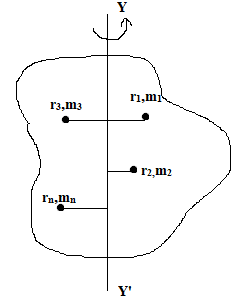
i.e. L = L1 + L2 + ……… Ln.
but, from definition,
L1 = P1r1 = m1v1r1 = m1ωr12
[∵ ω1 = ω2 = ……….. = ωn = ω]
Now, L = L1 + L2 + ……… Ln.
= [latex][m_1r_1^2 + m_2r_2^2 + ……. + m_nr_n^2]\times \omega[/latex]
= [latex][\sum_{i=1}^{n}m_i r_i^2]\times \omega[/latex]
= Iω
∴ L = Iω.
Relation between angular momentum (L) and Torque (𝛕)
Let us consider, a rigid body where YY’ be the axis of rotation as shown in figure. m1 = m2 = …………. mn be the masses of different particles of rigid body at the distance r1, r2, …. rn from the axis of rotation.
We know that, Total torque of rigid body
([latex]\tau[/latex]) = Iα ……… (i)
And, L = Iω. ………. (ii)
Differentiating (ii), with respect to t, we get,
[latex]\frac{dL}{dt} = I \frac{d\omega}{dt}[/latex]
= [latex]I\alpha[/latex] ………….… (iii)
From (i) and (iii), we get,
[latex]\tau = \frac{dL}{dt}[/latex]
Principle of conservation of angular momentum
If no external torque acts on the body or system (if the body of system is isolated), then, the total angular momentum of a body or system is always constant or conserved. i.e.
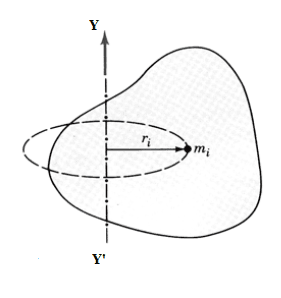
If [latex]\tau[/latex] = 0, L = Constant.
Proof
Let us consider, a body of mass ‘m’ which is in rotational motion having angular momentum ‘L’ rotating with angular velocity ‘ω’, I is the total moment of inertia in the body.
We know,
[latex]\tau = \frac{dL}{dt}[/latex]
If external torque [latex]\tau[/latex] = 0, then,
[latex]\frac{dL}{dt}[/latex] = 0.
i.e. L = constant.
Iω = Constant.
Or, I1ω1 = I2 ω2
Hence, the total angular momentum of body is conserved.
Work and Power Developed in rotational motion
Two equal and opposite parallel forces acting on a body at different points forms a couple, which is responsible to bring a body into rotational motion.
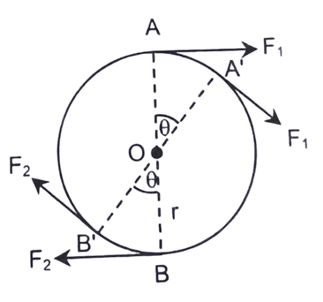
Let us consider, a wheel of radius ‘r’ rotates from A to A’ through angular displacement θ. Here, F₁ and F₂ are two opposite forces acting tangentially.
Now, [latex]\theta = \frac{AA’}{r} = \frac{BB’}{r}[/latex]
∴ [latex]AA’ = BB’ = r\theta[/latex]
The workdone by force F₁ = F₁ × AA’
= [latex]F_1 r\theta = \tau_1 \theta[/latex], where, [latex]\tau_1 = F_1 r[/latex] = torque
Similarly, workdone by force F₂ = [latex]\tau_2 \theta[/latex]
Total workdone by couple (W) = [latex]\tau_1 \theta + \tau_2 \theta = (\tau_1 + \tau_2)\theta[/latex]
W = [latex]\tau[/latex]θ ……………… (1)
So, workdone by couple is equal to product of torque and angular displacement.
Now, differentiating equation (1) w.r.t. time, we get,
[latex]\frac{dW}{dt} = \frac{d}{dt}(\tau\theta)[/latex]
[latex]= \tau \left(\frac{d\theta}{dt}\right)[/latex]
[latex]= \tau\omega[/latex]
So, power developed (P) = [latex]\frac{dW}{dt} = \tau\omega[/latex]
Comparison Table
| Translational Motion | Rotational Motion |
| 1. S → Linear displacement. | Angular displacement ([latex]\theta[/latex]). [latex]\theta = \frac{S}{r}[/latex] ∴ S = [latex]\theta[/latex]r. |
| 2. Linear velocity (v) | Angular velocity (ω), v = ωr. |
| 3. Acceleration (a) | Angular acceleration (α); a = αr |
| 4. Mass (m) | Moment of inertia (I) = mk2 |
| 5. Linear momentum (P) = mv. | Angular momentum, L = Pr = mvr = mωr2 = Iω. |
| 6. Force (F) = [latex]\frac{dP}{dt}[/latex] = ma. | Torque (τ) = [latex]\frac{dL}{dt}[/latex] = Iα [latex]\tau[/latex] = Fr = [latex]\vec{r}\times \vec{F}[/latex] |
| 7. Work (w) = FS | Work done by Torque = [latex]\tau \theta[/latex] |
| 8. K.E. = [latex]\frac{1}{2}mv^2[/latex] | K.E. of rotation = [latex]\frac{1}{2}I\omega^2[/latex] |
| 9. Equation of motion: i. v = u + at ii. S = ut + [latex]\frac{1}{2}at^2[/latex] iii. v2 = u2 + 2aS | Equation of motion: ω = ωo + αt [latex]\theta[/latex] = ωo + [latex]\frac{1}{2}at^2[/latex] ω2 = ωo + 2α[latex]\theta[/latex] |