
i. Crystalline Solids:
The solids in which the atoms, molecules and ions, which constitutes the solids are arranged in definite pattern in 3D, is called crystalline solids. They have homogeneous composition, have sharp melting and boiling points. The bonds in the solids are strong. E.g. rock salt, sugar, etc.
ii. Amorphous Solids:
The solids in which atoms, molecules and ions are not arranged in regular symmetrical patterns are called amorphous solids. Their composition may not be homogeneous. They do not have sharp melting and boiling points. Example ordinary glass, Sulphur, plastics, etc.
Energy band:
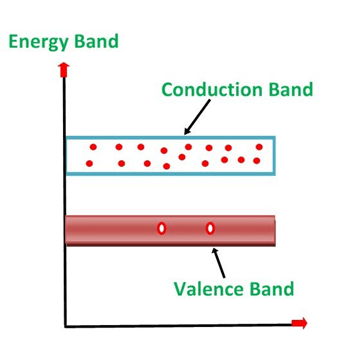
The range of energy possessed by an electron in a solid is known as energy band. There are various energy bands:
i. Valence band:
The outermost electrons present in the outermost shell of an atom is called valence electrons. The range of energy possessed by these valence electrons is known as valence band.
ii. Conduction band:
At ordinary temperature, valence electrons have tendency to leave valence band. And these valence electrons are responsible for the conduction of current in a conductor and so they are called conduction electrons. The range of energy possessed by the conduction electrons are called conduction band.
iii. Forbidden energy gap or band gap ([latex]E_g[/latex]):
The separation between top of the valence band and bottom of the conduction band is called forbidden energy band or band gap. On the basis of band theory, metal, insulator and semiconductor are distinguished.
You've reached the end of the free preview. Continue with NN Premium.
- Complete access to every Premium chapter
- Notes, QBank, solutions & MCQs
- Premium PDFs & study resources
- Entrance preparation & mock tests
One NN Premium subscription unlocks everything.