
Capacitors:
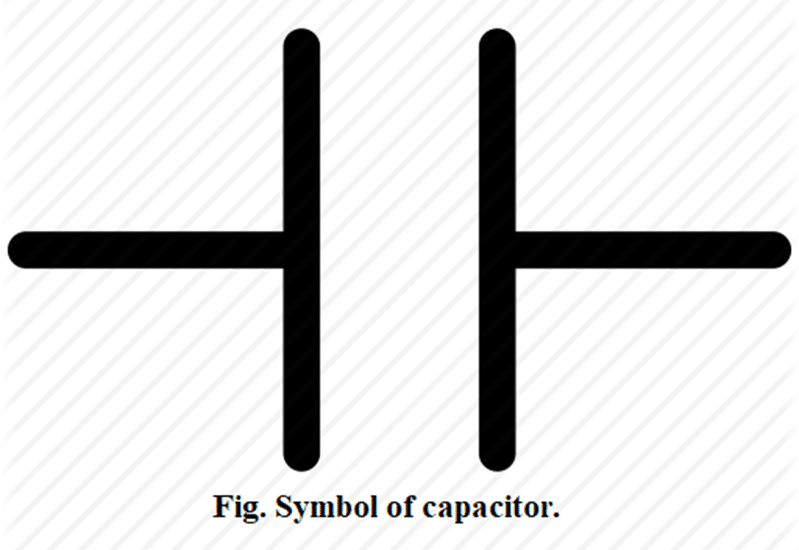
A capacitor is a device which store electric charges on it. Basically, it consists of 2 conducting surfaces separated by an insulating material or vacuum. The conducting surfaces are called plates and the insulating materials are called di – electric. There are various types of capacitors.
Capacitance of a capacitor:
The charge holding capacity of a capacitor is called its capacitance. When charge is given to the capacitor, the potential difference between the plates increase. If Q be the charge on either plate of the capacitor and V be the potential difference across the plates of the capacitor, then, it is given that,
[latex]Q \propto V[/latex].
Or, [latex]Q = CV[/latex], where, C is a constant called capacitance of a capacitor.
We have, [latex]C = Q/V[/latex]. Hence, the capacitance of a capacitor may be defined as the ratio of charge on either plate of the capacitor to the potential difference of the capacitor. The unit of capacitance is [latex]CV^{-1}[/latex] or Farad (F).
From the relation,
[latex]C = Q/V[/latex].
The capacitance of a capacitor is said to be 1 Farad if its potential difference rises by 1V when a charge of 1C is given to it. The smaller units of the capacitance are mF, μF (micro Farad), nF (nano Farad), where,
1 mF = [latex]10^{-3}[/latex] F
1 μF = [latex]10^{-6}[/latex] F
1 nF = [latex]10^{-9}[/latex] F
You've reached the end of the free preview. Continue with NN Premium.
- Complete access to every Premium chapter
- Notes, QBank, solutions & MCQs
- Premium PDFs & study resources
- Entrance preparation & mock tests
One NN Premium subscription unlocks everything.