
Electric Potential:
It is defined as the amount of workdone in bringing unit positive charge from infinity to that point against the electrostatic force. If ‘w’ be the workdone in bringing a test charge q’ from infinity to that point, the potential at that point is given by:
[latex]V = \frac{w}{q’}[/latex]
The unit of electric potential is [latex]JC^{-1}[/latex] Or, Volt.
If W = 1 J and q’ = 1 C, then, V = 1V. i.e. The potential is said to be 1 V if 1 J work is done in bringing a unit positive charge from infinity to that point.
Electric Potential due to a point charge:
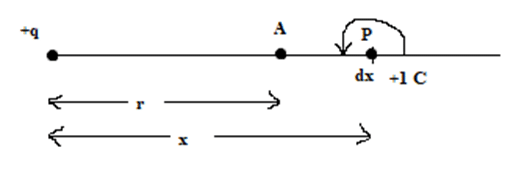
Consider, a point charge ‘+q’ and at a distance ‘r’, there is a point A where, the electric potential is to be determined. Let, another point ‘P’ along the line and at a distance, x where, a unit positive charge is kept.
Then, from Coulomb’s law, the force between the two charges is:
[latex]F = \frac{1}{4\pi\epsilon_o} \frac{q.1}{x^2} = \frac{1}{4\pi\epsilon_o} \frac{q}{x^2}[/latex] ………………………….. (i)
The small workdone in moving the unit charge through a small distance dx is
dW = -Fdx …………….. (ii)
From (i) & (ii),
[latex]dW = -\frac{1}{4\pi\epsilon_o} \frac{q}{x^2} dx[/latex]
You've reached the end of the free preview. Continue with NN Premium.
- Complete access to every Premium chapter
- Notes, QBank, solutions & MCQs
- Premium PDFs & study resources
- Entrance preparation & mock tests
One NN Premium subscription unlocks everything.