
Conical Pendulum:
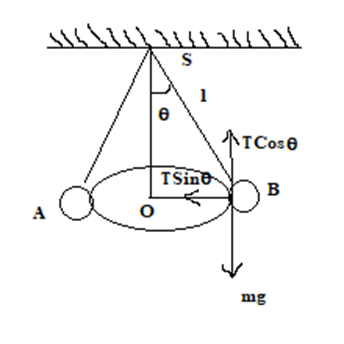
A conical pendulum consists of a heavy bob suspended by perfectly flexible inextensible and massless string from a rigid support so that the bob moves in a horizontal plane with uniform speed and the string sweeps over the surface of cone.
Suppose, a heavy bob of mass ‘m’ is suspended by a fine silk thread of effective length ‘l’ from the rigid support ‘s’. suppose, the bob is moving in a horizontal circle of radius ‘r’ with uniform speed ‘v’ so that the thread makes an angle [latex]\theta[/latex] with the vertical.
From the figure, [latex]\Delta SOB[/latex],
[latex]\sin\theta = \frac{r}{l}[/latex]
Or, [latex]r = l\sin\theta[/latex] ………….. (i)
Let ‘T’ be the tension on the thread and its rectangular are [latex]T\cos\theta[/latex] and [latex]T\sin\theta[/latex]. The component [latex]T\cos\theta[/latex] balances the weight of the bob i.e., mg and [latex]T\sin\theta[/latex] is directed towards the centre which gives necessary centripetal force for the circular motion. Therefore,
[latex]T\cos\theta = mg[/latex] …….. (ii)
[latex]T\sin\theta = \frac{mv^2}{r}[/latex] ……………… (iii)
Dividing [latex]eq^n[/latex] (iii) by (ii), we get,
[latex]\tan\theta = \frac{v^2}{rg}[/latex]
Or, [latex]v = \sqrt{rg\tan\theta}[/latex] …………. (iv)
The time period of the pendulum is defined as the time taken to complete one rotation and is described by:
You've reached the end of the free preview. Continue with NN Premium.
- Complete access to every Premium chapter
- Notes, QBank, solutions & MCQs
- Premium PDFs & study resources
- Entrance preparation & mock tests
One NN Premium subscription unlocks everything.