
Electric Field
It is defined as a region or a space around a charge within which any other charged particle experiences electrostatic force. It is strong near the charge and decreases gradually when distance increases from the charge.
Electric field intensity (at a point):
It is defined as the force experienced by a unit positive charge placed at the point. It measures the strength of electric field at the point.
If ‘F’ be the force experienced by a small test charge ‘q’ placed at a point in an electric field then, the electric field intensity at that point is E. i.e.
E = [latex]\frac{F}{q’}[/latex].
The electric field intensity is a vector quantity whose direction is a vector quantity whose direction is in the direction of force. Its unit is [latex]NC^{-1}[/latex] or N/C.
Electric field intensity due to a point charge:
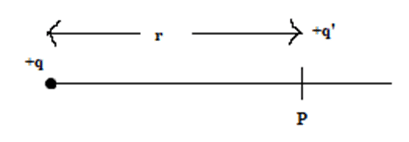
Consider, a point charge ‘+q’ kept in free space (air or vacuum). To find the electric field intensity at a point P at a distance ‘r’ from the charge ‘+q’. Put a ‘+q’ charge at the point P. Now, the force between the two charges is F. i.e.
F = [latex]\frac{1}{4\pi\epsilon_o} \frac{qq’}{r^2}[/latex] ………………….. (i)
If ‘E’ be the electric field intensity at P due to charge +q, then, from the definition,
E = [latex]\frac{F}{q’} = \frac{1}{4\pi\epsilon_o} \frac{qq’}{r^2 q’}[/latex] [∵ From (i)]
∴ E = [latex]\frac{1}{4\pi\epsilon_o} \frac{q}{r^2}[/latex]
If the charge is placed in a medium having permittivity [latex]\epsilon[/latex], then, the electric field intensity becomes E, i.e.
E = [latex]\frac{1}{4\pi\epsilon} \frac{q}{r^2}[/latex]
Electric lines of force:
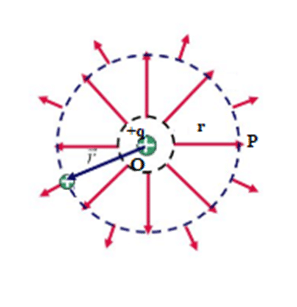
Electric field is represented by electric lines of force. The electric lines of force as an imaginary path along which a small positive test charge is supposed to move when free to do so in an electric field.
Properties of electric lines of force
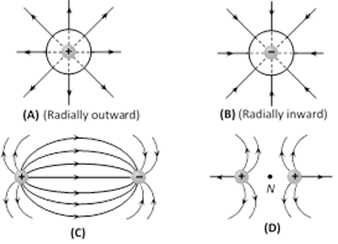
i) The electric lines of force start from positive charges and end on a negative charge.
ii) The tangent at any point to the electric lines of force gives the direction of electric field at that point.
iii) Two electric lines of force never intersect each other.
iv) Electric lines of force have tendency to contract longitudinally or length wise. This explains attraction between unlike charge.
v) They have tendency to exert lateral pressure upon each other which explains repulsion between two like charge.
vi) The lines of force are always perpendicular to the surface of the charged conductor.
vii) The electric line do not pass through a closed conductor that means no electric lines of force exist within the conductor.
Electric flux:
The number of electric lines of force passing through a surface area in a direction normal to the surface is called electric flux through that surface. It is denoted by [latex]\phi[/latex]. Its unit is [latex]Nm^2C^{-1}[/latex] or Vm.
It is found that electric lines of force are more crowded in the region where the electric field intensity is high and less crowded where it is low. Hence, the electric field intensity at a point in the electric lines of force passing per unit area through a surface held perpendicular to the direction of the lines of force at the point.
If [latex]\phi[/latex] be the flux passing perpendicularly through the surface area A, then, the electric field intensity at that point is:
E = [latex]\frac{\phi}{A}[/latex]
[latex]\phi = E \times A[/latex]
Electric flux due to a point charge:
Consider, a point charge +q is placed at center of an imaginary sphere of radius ‘r’. The lines of force from the charge are radially outward and so are normal to the surface. Hence, the total flux passing through the surface is [latex]\phi[/latex]. i.e., [latex]\phi = E \times A[/latex]
Where, E = Electric field intensity which is at the distance ‘r’ and A = Area of the sphere = [latex]4\pi r^2[/latex]
Again, electric field intensity due to a point charge at distance ‘r’ is given by:
E = [latex]\frac{1}{4\pi\epsilon_o} \frac{q}{r^2}[/latex], where, [latex]\epsilon_o = Permittivity\ of\ a\ free\ space[/latex].
Substituting the value of E, we get,
[latex]\phi = \frac{1}{4\pi\epsilon_o} \frac{q}{r^2} \times 4\pi r^2[/latex]
[latex]\phi_T = \frac{q}{\epsilon_o}[/latex]
If charge is placed in a medium having permittivity [latex]\epsilon[/latex], then, the flux is:
[latex]\phi_T = \frac{q}{\epsilon}[/latex]
Gauss’s Theorem:
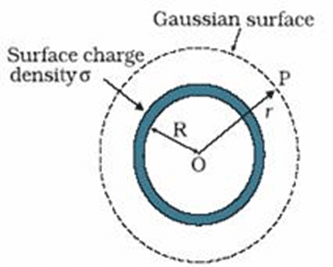
It states that the total flux passing through any close surface is equal to [latex]\frac{1}{\epsilon_o}[/latex] times the total charge enclosed by the surface. If [latex]\phi[/latex] be the total flux and q be the charge enclosed by the surface, then, [latex]\phi[/latex] is
[latex]\phi = \frac{1}{\epsilon_o} \times q[/latex]
[latex]\phi = \frac{q}{\epsilon_o}[/latex]
Where, [latex]\epsilon_o[/latex] = Permittivity of the free space.
If charge is placed in a medium having permittivity [latex]\epsilon[/latex], then, the Gauss’s theorem becomes,
[latex]\phi = \frac{q}{\epsilon}[/latex]
The imaginary or hypothetical closed surface considered in Gauss’s theorem which may be of any shape is called Gaussian surface.
Application of Gauss’s theorem:
a) To find the electric field intensity due to a charged sphere and outside it.
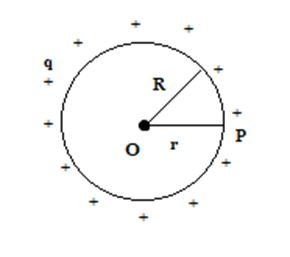
Consider, a charged sphere having radius ‘r’ and carrying charge q. To find the electric field intensity at point P outside the sphere and at a distance R from the centre of the sphere. Draw a concentric sphere passing through the point P as a Gaussian surface. Now, from Gauss’s theorem, the total flux passing through the sphere is [latex]\phi. i.e.[/latex]
[latex]\phi = \frac{q}{\epsilon_o}[/latex] ………………… (i)
Where, [latex]\epsilon_o[/latex] = Permittivity of the free space.
But the total flux passing through a surface area A, where, electric field intensity is E, is given by: [latex]\phi = A \times E[/latex] ……………… (ii)
From eqn. (i) and (ii), we get,
E x A = [latex]\frac{q}{\epsilon_o}[/latex]
Or, E = [latex]\frac{q}{A . \epsilon_o} = \frac{q}{\epsilon_o 4\pi R^2}[/latex]
∴ E = [latex]\frac{1}{4\pi\epsilon_o} . \frac{q}{R^2}[/latex]
b) To find the electric field intensity due to a charged sphere and on the surface of it:
Consider, a charged sphere having radius ‘r’ and carrying a charge q.
To find electric field intensity at point P and on the surface of it and at a distance R from the centre of the sphere. Draw a concentric sphere passing through the point P as a Gaussian’s surface. Now, from the Gauss’s theorem, the total flux passing through the surface is
[latex]\phi = \frac{q}{\epsilon_o}[/latex] …………………… (i)
Where, [latex]\epsilon_o = Permittivity\ of\ free\ space[/latex].
But the total flux passing through a surface area ‘A’ where electric field intensity is E, which is given by:
[latex]\phi = E \times A[/latex] ……………………….. (ii)
From eqn. (i) and (ii), we get,
E x A = [latex]\frac{q}{\epsilon_o}[/latex]
Or, E = [latex]\frac{q}{\epsilon_o A} = \frac{q}{\epsilon_o} . \frac{1}{4\pi R^2}[/latex]
∴ E = [latex]\frac{1}{4\pi\epsilon_o} . \frac{q}{R^2}[/latex]
c) To find the electric field intensity due to a charged sphere and inside it:
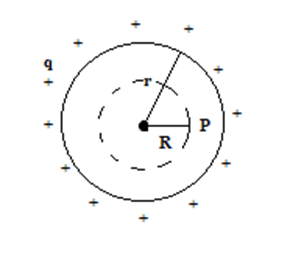
Consider, a charged sphere having radius r and carrying a charge q. To find electric field intensity at point P and inside the surface and at a distance R from the centre of the sphere. Draw a concentric circle passing through the point P as the Gaussian’s surface. Now, from the Gauss’s theorem, we get,
[latex]\phi = \frac{q}{\epsilon_o}[/latex] ………………… (i)
But, the total flux passing through the surface area A and electric field intensity E is:
[latex]\phi = E \times A[/latex] ……………. (ii)
We have,
E x A = [latex]\frac{q}{\epsilon_o}[/latex]
∴ E = [latex]\frac{q}{R^2} \times \frac{1}{4\pi\epsilon_o}[/latex]
= 0 [∵ q = 0, No charge]
d) To find the electric field intensity due to a plane charged conductor:
Consider, a plane charged conductor having surface charge density [latex]\sigma[/latex]. To find the electric field intensity at point P. suppose, a cylindrical surface having base area A and perpendicular to the plane charged conductor as a Gaussian surface. The charge enclosed by the Gaussian’s surface is q. i.e. q = [latex]\sigma A[/latex]
From Gaussian theorem, the total flux is given by:
[latex]\phi = \frac{q}{\epsilon_o}[/latex] ………………….. (i)
Where, [latex]\epsilon_o[/latex] = Permittivity of the free space.
But, [latex]\phi = E \times A[/latex] …………… (ii)
Where, E = Electric field intensity.
From (i) and (ii),
E x A = [latex]\frac{q}{\epsilon_o} = \frac{\sigma A}{\epsilon_o}[/latex]
∴ E = [latex]\frac{\sigma}{\epsilon_o}[/latex]
e) To find the electric field intensity due to a line charged conductor:
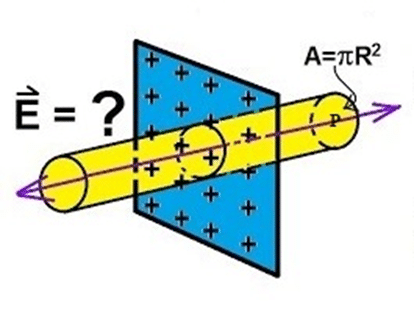
Consider, an infinite long charged conductor (line charge) having linear charge density [latex]\lambda[/latex] to find the electric field intensity at P at the distance r from the line charge. Suppose, a cylindrical surface of length ‘l’ and radius ‘r’ and coaxial with wire as a Gaussian surface. The charge enclosed by this surface, is q, i.e.
q = [latex]\lambda l[/latex]
Since, no flux passes through the cross – sectional areas, the area through which the flux passes is the curved surface of the cylinder, which is equal to [latex]2\pi r l[/latex]. Now,
From Gauss’s theorem,
[latex]\phi = \frac{q}{\epsilon_o} = \frac{\lambda l}{\epsilon_o}[/latex] …………… (i)
But, the flux in terms of electric field is given by:
[latex]\phi = E \times A[/latex] …………….. (ii)
From (i) and (ii), we get,
E x A = [latex]\frac{\lambda l}{\epsilon_o}[/latex]
Or, E = [latex]\frac{\lambda l}{\epsilon_o A} = \frac{\lambda l}{\epsilon_o} . \frac{1}{2\pi r l}[/latex]
∴ E = [latex]\frac{\lambda}{2\pi r \epsilon_o}[/latex]