
Polarization
The ordinary light in which vibration of electric and magnetic fields are distributed along all possible directions in a plane perpendicular to the direction of the wave is called unpolarized light. It is represented by a double arrow with a dot.
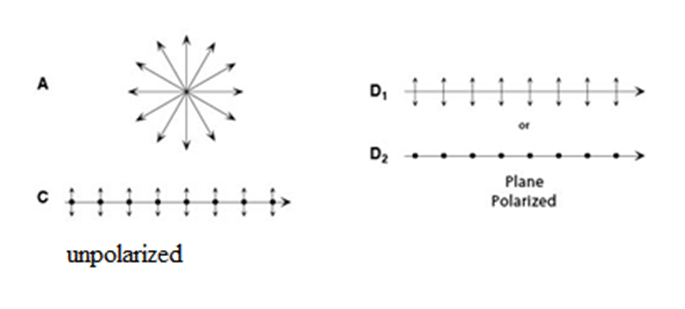
When light is passed through certain crystals (Tourmaline crystal), the transmitted light has a property having vibration in only one plane. The phenomenon in which the vibration of light waves is confined to a single plane, is called polarization. It is represented by either double arrows or dot only.
Polarisation by reflection – Brewster’s Law
The polarization of light takes place when it is reflected from a transparent medium.
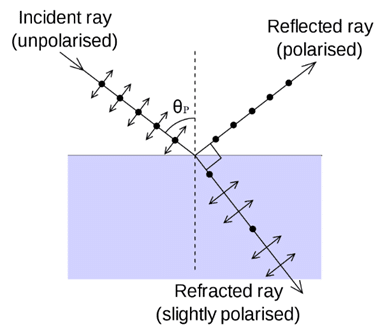
Consider an un-polarized light is incident on a transparent medium having refractive index μ. In this process, some light passes through the transparent medium and some part of it gets reflected. This reflected light has a property of plane polarization. The degree of polarization of the reflected light depends on the angle of incidence and the refractive index of the transparent medium. For this medium, when the angle of incidence is increased gradually, the degree of polarization of the reflected light also increases. For a particular angle of incidence, the reflected light becomes completely plane polarised. This angle of incidence is called polarizing angle or Brewster’s angle. For the glass having refractive index 1.50, the polarizing angle is 57o.
Brewster’s law
This law states that “the tangent of polarising angle is equal to the refractive index of the transparent medium on which light is incident.” If [latex]\theta_p[/latex] be the polarizing angle for the transparent medium having refractive index μ, then, according to Brewster’s law:
[latex]Tan\theta_p[/latex] = μ
You've reached the end of the free preview. Continue with NN Premium.
- Complete access to every Premium chapter
- Notes, QBank, solutions & MCQs
- Premium PDFs & study resources
- Entrance preparation & mock tests
One NN Premium subscription unlocks everything.