
Diffraction of light
When light waves pass through a small aperture or an obstacle, they spread out into the geometric shadow of the aperture or obstacle. This phenomenon of spreading of light waves into the geometric shadow is called diffraction of light. Depending upon the nature of incident wavefront, diffraction is divided into two types:
Fresnel diffraction
When spherical or cylindrical wavefront is incident on an obstacle or aperture, the diffraction pattern obtained is called Fresnel diffraction. In this case, the source or the screen or both are at finite distances from the obstacle or aperture. The diffracted wavefronts are also spherical or cylindrical and no modification is needed by lenses and mirrors.
Fraunhoffer’s diffraction
When plane wavefront is incident on obstacle or aperture, the diffraction pattern obtained is called Fraunhoffer’s diffraction. In this case, the source and the screen are at infinite distance from the obstacle or aperture. Lenses and mirrors are used to obtain plane wavefront (incident or diffracted).
Diffraction of light at a single slit (Fraunhoffer’s Diffraction)
Let us consider a narrow-slit AB of width ‘d’ is illuminated by monochromatic light source (S). The spherical wavefront XY originating from ‘S’ is made ‘a plane wavefront’ by the lens L1. The plane wavefront passes through the slit AB and is incident on the lens L2. The waves in the direction of OP come to focus at P, which is the position of central maximum.
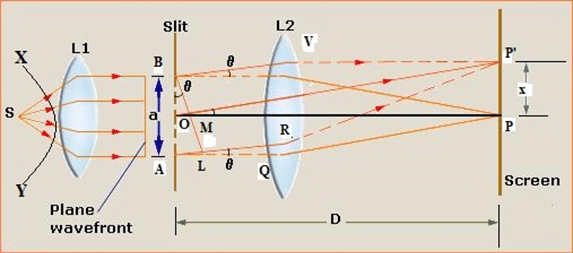
AR is the direction of secondary waves inclined at an angle [latex]\theta[/latex] to the direction OP. All the wavelets travelling with an angle [latex]\theta[/latex] focused at P’ which will have some path difference (AL). In [latex]\Delta ABL,[/latex]
[latex]sin\theta = \frac{AL}{AB} = \frac{AL}{d}[/latex]
[latex]\therefore\ AL = dsin\theta[/latex]
The whole wavefront can be considered to be two halves OA and OB and if the path difference between the secondary wavelets from A and B is [latex]\lambda[/latex], then, path difference between secondary waves from A and O will be [latex]\frac{\lambda}{2}[/latex]. Similarly, it is [latex]\frac{\lambda}{2}[/latex] for OB as well.
Thus, destructive interference takes place and the point will be of minimum intensity.
You've reached the end of the free preview. Continue with NN Premium.
- Complete access to every Premium chapter
- Notes, QBank, solutions & MCQs
- Premium PDFs & study resources
- Entrance preparation & mock tests
One NN Premium subscription unlocks everything.