
Interference of light
When two light waves from two sources meet at a point, they produce a resultant wave according to the principle of superposition. As a result, there is redistribution of light energy and bright and dark bands are produced. This phenomenon is called interference of light.
During superposition, if crest of one wave falls on the crest of the other or the trough of one fall on the trough of the other, the resultant amplitude becomes maximum. This type of interference is called constructive interference and intensity of light is maximum in this case. On the other hand, if the crest of one wave falls on the trough of the other or vice versa, the resultant amplitude becomes minimum. This type of interference is called destructive interference and the intensity of light becomes minimum.
The condition for constructive interference is, path difference (x) = [latex]n\lambda[/latex]
The condition for destructive interference is, path difference (x) = [latex](2n-1)\frac{\lambda}{2}[/latex]
Coherent sources
Coherent sources are sources which emit waves of the same frequency and possess constant phase difference (i.e., phase difference remains constant with time ‘t’). Since, two independent sources can never be coherent because, they may emit light of same wavelength or frequency, they are not in same phase or they may not have the constant phase difference. So, coherent sources are obtained from a source by division of wavefront. Eg. Laser light.
Intensity in Double Slit Experiment
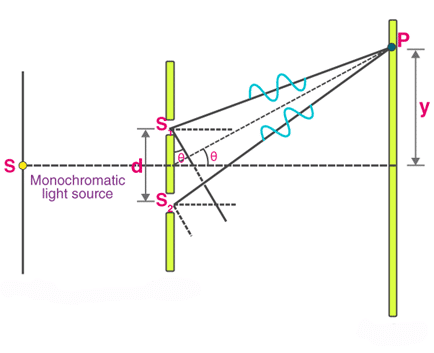
Let us consider, two light waves from two coherent sources S1 and S2 meet at a point P on the screen. The displacement of the waves is given by:
[latex]y_1 = a_1sin\omega t[/latex] and
[latex]y_2 = a_2sin(\omega t + \phi )[/latex], where, [latex]a_1[/latex] and [latex]a_2[/latex] be their amplitudes and [latex]\phi[/latex] be the constant phase difference between them.
According to principle of superposition, the displacement of the resultant wave is
[latex]y = y_1 + y_2[/latex]
You've reached the end of the free preview. Continue with NN Premium.
- Complete access to every Premium chapter
- Notes, QBank, solutions & MCQs
- Premium PDFs & study resources
- Entrance preparation & mock tests
One NN Premium subscription unlocks everything.