
Statements of Second Law of Thermodynamics:
Kelvin’s Statement:
It states that, “It is impossible to create a heat engine that can convert all of the heat it absorbs from a hot reservoir into useful work without losing heat to a cold reservoir”
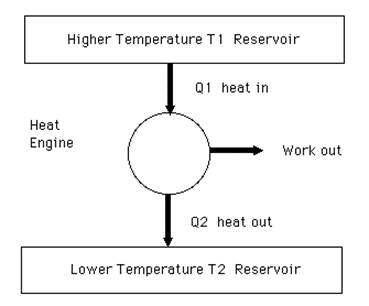
It is applicable to heat engines. In heat engine, the working substance takes some heat from the source (at higher temperature) and converts a part of it into mechanical workdone and it rejects the remaining part to the sink (at lower temperature). So, presence of sink is essential for continuous conversion of heat into work. So, we cannot obtain continuous supply of work from single body.
Clausius Statement:
It states that, “It is impossible for a self-acting machine unaided by any external agency to convey heat from one body to another at a higher temperature. i.e., we cannot make heat flow from a colder body to a warmer body without doing external work. It is based on the performance of refrigerator, which is a heat engine working on the backward direction. In the refrigerator, the working substance takes in heat from a cold body, a certain amount of work is done on it by some outside agency and rejects a larger amount of heat to a hotter body. So, refrigerator can transfer heat from a cold body to hot body with the aid of an external agency.
Heat Engine:
It is a device used to convert heat energy into mechanical energy. The block diagram of heat engine is shown in the given figure. Heat engine consists of three parts:
- Source
- Sink and
- Working substance
(i) Source:
Source is the reservoir of heat at high temperature T1.
(ii) Sink:
Sink is the reservoir of heat at temperature T2, when T2 < T1.
You've reached the end of the free preview. Continue with NN Premium.
- Complete access to every Premium chapter
- Notes, QBank, solutions & MCQs
- Premium PDFs & study resources
- Entrance preparation & mock tests
One NN Premium subscription unlocks everything.