
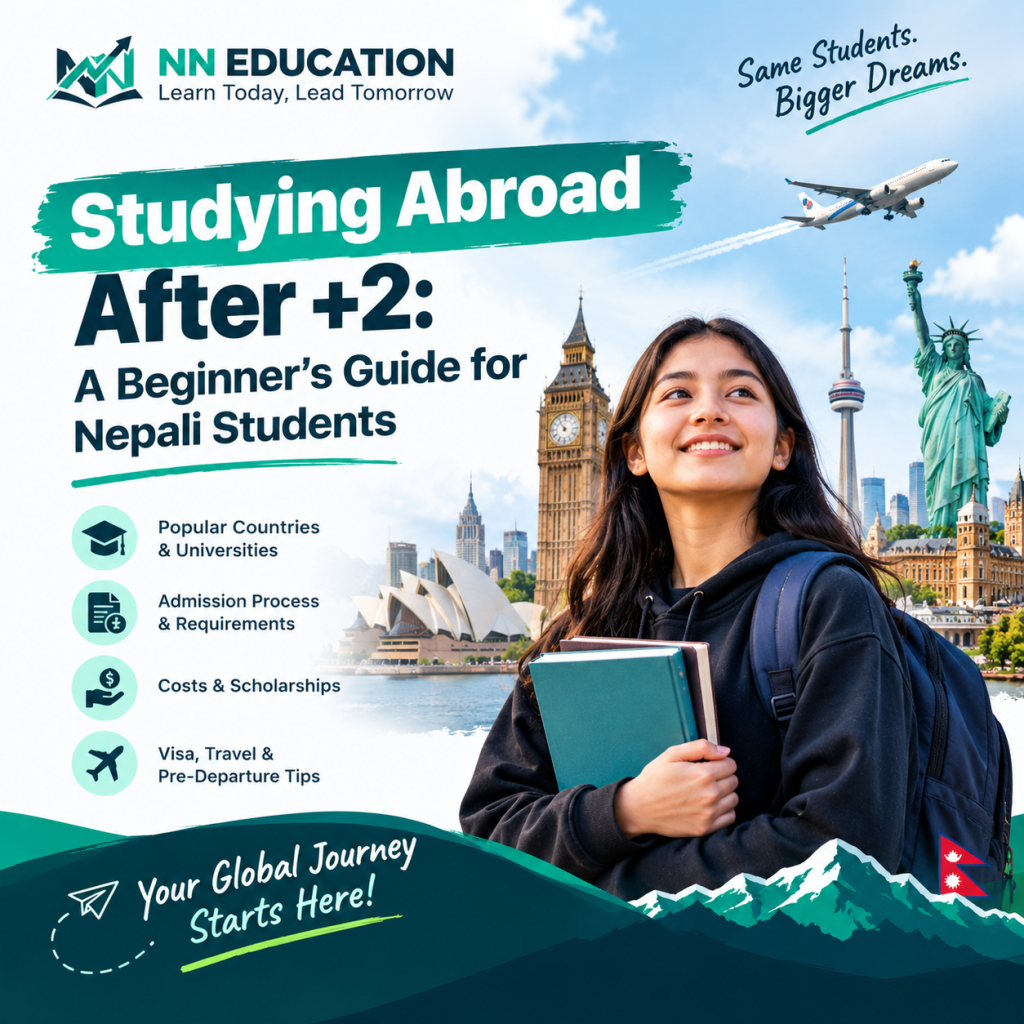
Studying abroad after +2 is realistic for many Nepali students, but it is a planning project of six to twelve months, not a last-minute decision. This guide walks you through the whole path: choosing a country, understanding the real costs, meeting the requirements, getting your No Objection Certificate (NOC) from Nepal’s Ministry of Education, and applying for a visa.
The interest is huge. Nepal’s Ministry of Education now issues well over 100,000 NOCs a year for higher education abroad (about 114,000 in one recent fiscal year, according to Spotlight Nepal). Rules, fees and visa policies change often, so use the figures below as a starting point and confirm everything on official websites before you pay anyone.
Why Study Abroad, and Is It Right for You?
Studying abroad is worth it when you have a clear academic reason, a realistic budget and a backup plan; it is a poor choice when the only reason is “everyone is going.”
Students usually go for four reasons:
- Programmes that are hard to find at home, such as specialised engineering, health sciences, data science or design.
- Exposure to research and modern labs, which matters especially for science students.
- International experience that can make a CV stand out.
- Work or residency pathways after graduation, though these depend on laws that change often.
Before you commit, ask yourself three honest questions. Can your family afford the full cost, not just the first-year tuition? Are you ready to live alone, cook, budget and study in a new language environment? And have you compared your target course with strong options in Nepal or nearby countries? Spending your family’s savings on a mediocre course abroad is a bigger risk than a good degree at home.
Popular Destinations for Nepali Students
Japan, Canada, Australia, the UK and the USA take roughly 80% of Nepali students who go abroad, but no single country is “best”; the right one depends on your budget, course and visa chances. The table below uses 2023/24 NOC counts and typical costs from a 2026 comparison guide. Treat the money figures as approximate ranges.
| Country | NOCs issued 2023/24 | Tuition per year | Living cost per year | English test | Visa difficulty for Nepalis |
|---|---|---|---|---|---|
| Japan | ~34,700 | JPY 500,000-1,200,000 | JPY 900,000-1,400,000 | Varies; often Japanese-language proof | Lower for language schools, moderate for universities |
| Canada | ~16,000 | CAD 15,000-35,000 | CAD 12,000-15,000 | IELTS or TOEFL | High |
| Australia | ~14,400 | AUD 24,000-45,000 | AUD 26,000-30,000 | IELTS (most common) | High and rising |
| United Kingdom | ~13,300 | GBP 12,000-25,000+ | GBP 10,000-18,000 | IELTS UKVI | Moderate |
| United States | ~11,300 | USD 20,000-55,000 | USD 12,000-20,000 | TOEFL or IELTS | Moderate to high |
| South Korea | not listed | KRW 3,000,000-8,000,000 | KRW 6,000,000-9,000,000 | TOPIK or IELTS | Moderate |
A few points matter more than the numbers:
- Australia reportedly placed Nepal in its highest-risk visa assessment level in early 2026, so expect closer checks and longer processing.
- The USA has become harder. Only about 1,670 Nepalis travelled there for study by mid-July 2026, against more than 14,000 in 2024. Stricter rules reported for September 2026 include a four-year cap on stay and a much shorter period after graduation, so check the latest rules before applying.
- Japan, South Korea and Germany are growing choices because costs are lower, though language preparation is important.
- Smaller cities can cost 25-40% less to live in than Sydney, London or Toronto.
What It Really Costs
The real cost is tuition plus living expenses for every year of your course, plus several smaller costs before you even leave Nepal. Use the tuition and living ranges in the destinations table above, and then add these fixed costs:
| Cost | Approximate amount | Note |
|---|---|---|
| IELTS (computer-delivered) | NPR 33,000 | IDP Nepal fee; paper-based is NPR 36,200 |
| NOC application fee | NPR 2,000 | Reported fee on the Ministry portal |
| Visa fee, health insurance, air ticket | Varies by country | Check the embassy or immigration website |
| Proof of funds | Set by each country | Usually covers tuition plus living costs for a set period |
All amounts are approximate and can change without notice, so confirm them with the test centre or ministry before paying.
Education loans. Nepali banks offer education loans for study abroad, but most are secured. For example, one bank lists collateral or a fixed deposit equal to 100% of the loan, and another lends up to 80% of a property’s market value or 90% of a fixed deposit. Families without property often find these loans hard to get, so plan the money early.
Proof of funds. Several countries, especially Australia and Canada, look favourably on money that has been in the family’s accounts for months. A large lump sum arranged at the last minute can raise questions.
The total money leaving Nepal for overseas education was NPR 132.23 billion in the first 11 months of one recent fiscal year, according to Nepal Rastra Bank data reported by Spotlight Nepal. Study abroad is a big financial decision, so compare total cost against the realistic salary of graduates in your field.
Requirements: Tests, Documents and the NOC
Every application rests on three things: good Grade XII results, proof of English (or the local language), and a clean set of documents, including your NOC.
Academic documents. For a bachelor’s degree abroad you will normally need your SEE marksheet and your Grade XII marksheet and certificate. Keep several certified copies, and ask your college early for transcripts and recommendation letters.
English test. IELTS is the most common, with TOEFL, PTE and Duolingo accepted by some universities. Always check each university’s minimum score, because it differs by course. If you are heading to Japan or South Korea, begin language study as soon as possible. Many courses there are taught in Japanese or Korean.
Other tests. Some US universities ask for the SAT, though many have made it optional, so check each one. Science students aiming for engineering or medicine should also check subject requirements, especially Physics, Chemistry and Mathematics.
No Objection Certificate (NOC). Nepal’s Ministry of Education, Science and Technology requires an NOC for students going abroad for higher study. You need it for visa paperwork and to send tuition money abroad through banks.
- Apply online through the ministry’s official NOC portal. The reported fee is NPR 2,000.
- You generally need your offer letter from a recognised institution before you apply.
- Typical documents include your citizenship certificate, academic certificates and the offer letter.
- Some course types, such as medicine, need extra eligibility approval, and the ministry has at times restricted NOCs for short non-degree courses. Check that your course qualifies before you pay any deposit.
Never pay an agent or any “fast-track” middleman extra money for the NOC. Media reports have exposed bribery and fake documents around NOC processing, and a fraudulent file can ruin your visa.
Scholarships to Look For
Fully funded scholarships exist for Grade XII graduates, but they are competitive, have fixed deadlines and never charge application fees. Start looking at least a year ahead.
- Japanese Government (MEXT) Undergraduate Scholarship. Applications go through the Embassy of Japan in Kathmandu. The 2027 round closed in early June 2026, and the next round is expected to open around April 2027. Reported benefits include tuition, a monthly stipend of about JPY 117,000 and return airfare, and most undergraduate courses are taught in Japanese. The science stream exam covers Japanese, English, Mathematics, Chemistry, and Physics or Biology, which suits Physics students.
- Other government scholarships. South Korea (GKS) and China (CSC) run undergraduate scholarship programmes. Check their official websites for eligibility and dates.
- University merit scholarships. Many universities in the UK, Canada, Australia and the USA offer partial scholarships based on your Grade XII results. Apply to these in your admission application.
Scholarship warning: MEXT states that it charges no application fee and has no connection with anyone who asks for one. Treat any such request as a scam.
Step-by-Step Timeline From Grade XII to Departure
Start 10 to 12 months before your intake, because most countries expect applications 8 to 12 months ahead. Here is a simple order to follow:
- Choose your field first, then the country. Match the course to your Grade XII subjects and your career goal.
- Set a budget with your family. Decide the maximum total cost and how it will be funded, including any loan.
- Shortlist 5 to 8 universities across safe, realistic and ambitious choices. Check entry requirements and scholarships.
- Take your English test (or begin language study for Japan or Korea). Leave time to retake it if needed.
- Prepare documents: transcripts, certificates, passport, recommendation letters and a personal statement that explains why this course and this country.
- Apply to universities before each deadline and track every portal.
- Accept an offer and pay the deposit only after you check the course is eligible for an NOC.
- Apply for your NOC on the ministry’s official portal.
- Arrange proof of funds and apply for your student visa on the destination country’s official website.
- Book accommodation and flights, buy insurance, and attend a pre-departure briefing once your visa is approved.
Main intakes vary by country: Australia usually starts in February and July, Japan in April and October, and Canada and the UK in September and January. The USA mainly uses the autumn (August or September) intake.
Student Visa Basics and Common Mistakes
A tourist visa cannot be used for a full degree, so you need a student visa (Canada calls it a study permit), and you can only apply seriously once you hold an offer letter from a recognised institution. You apply online through the immigration portal of your destination country.
Visa officers want to see three things: a genuine intention to study, enough money, and a believable plan for your future. Refusals for Nepali applicants are most often linked to:
- Incomplete or inconsistent documents.
- A course that does not match your academic background with no clear explanation.
- Weak financial evidence, such as sudden deposits with no history.
- Poor interview answers that show you do not know your own course or university.
- Unexplained gaps in your education.
To strengthen your case, write your own statement of purpose in your own words, learn your course details thoroughly, and keep every financial document organised. Never submit forged certificates or bank statements. A fake document can lead to a long ban on future applications.
Beware of Scams and Unreliable Consultancies
A good consultancy can save you time, but a bad one can cost you lakhs and a refused visa, so check any agent as carefully as you check a university. Use these rules:
- Verify the university yourself on its official website and, where possible, with the government of the destination country.
- Be suspicious of guarantees. No honest agent can promise a visa or a scholarship.
- Pay fees to the university or test centre directly and keep every receipt. Avoid cash payments with no paperwork.
- Read every document before signing, and keep your own copies of all forms and certificates.
- Never let anyone forge or “arrange” documents, bank statements or an NOC.
- Ask for written fees and what is refundable if the visa is refused.
If something feels rushed or too good to be true, stop and ask a teacher, a family member or the official office.
Conclusion
The best way to study abroad is to start early, budget honestly and rely on official sources, not on promises. Choose your course first, build your funds and English skills over months, use only the official NOC portal, and apply to more than one country if possible. Keep a strong backup plan in Nepal, because rules and visa decisions can change quickly.
If you are in Grade XII now, use the next few months to compare courses, take your English test and talk to teachers, alumni and your family about money. Careful preparation is the best protection against stress and scams.
Sources
Figures were checked in October 2026 and can change. Confirm fees, visa rules and deadlines on official websites before you apply.
- Spotlight Nepal: New US student visa regulations (NOC counts, US trends, outflow of money)
- Gabble: Best countries to study abroad for Nepali students (2023/24 NOC counts, tuition and living ranges, visa difficulty)
- NEB GPA Calculator: Student visa process for Nepali students (NOC steps, documents, visa rejection reasons)
- IDP Nepal: IELTS test fee
- Embassy of Japan in Nepal: MEXT scholarship
- Everest Bank education loan and Machhapuchchhre Bank education loan
- Onlinekhabar: NOC branch bribery report
- ICEF Monitor: Nepal moves to curb non-degree study abroad