
Volumetric Analysis
SYLLABUS
Introduction to gravimetric analysis, volumetric analysis and equivalent weight, Relationship between equivalent weight, atomic weight and valency, Equivalent weight of compounds (acid, base, salt, oxidizing and reducing agents), Concentration of solution and its units in terms of: Percentage, g/L, molarity, molality, normality and formality, ppm and ppb, Primary and secondary standard substances, Law of equivalence and normality equation, Titration and its types: Acid-base titration, redox titration (related numerical problems)
Volumetric Analysis: 1SAQ + 1MCQ ~6marks
Concept of Equivalent Mass
Element
Equivalent mass is the combining capacity of a substance by its weight.
Actually it is defined as the no. of parts by weight of an element that combines or displaces [latex]1.008[/latex] parts by weight of hydrogen or [latex]8[/latex] parts by weight of oxygen or [latex]35.5[/latex] parts by weight of chlorine.
Let us take an example of Mg reacted with dil. [latex]H_2SO_4[/latex].
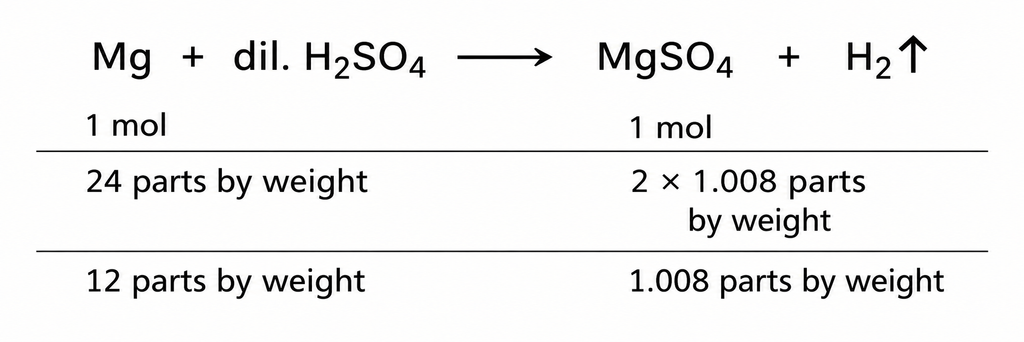
∴ Equivalent mass of Mg is 12.
Here, 12 parts by weight of Mg displaces [latex]1.008[/latex] parts by weight of hydrogen.
Similarly, if mg is burns in air
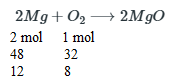
In this example 12 parts by weight of mg combines with 8 parts by weight of Oxygen. Hence the equivalent mass of Mg is 12.
Relationship between E, A and V
Let E = Equivalent mass of element
A = Atomic mass of that element
V = valency
According to definition of Valency,
If an atom combines with ‘V’ atoms of hydrogen then valency of atom is V. Now, the mass of V atom of hydrogen = [latex]1.008\ V[/latex]
Again, [latex]1.008\ V[/latex] parts by weight of hydrogen combines with A parts by weight of atom.
or, [latex]1.008[/latex] parts by weight of hydrogen combines with [latex]\dfrac{A}{V}[/latex] parts by weight of atom.
∴ Equivalent mass (E) = [latex]\dfrac{A}{V}[/latex]
Eg:-
Eq. weight of Na = [latex]\dfrac{A}{V} = \dfrac{23}{1} = 23[/latex]
Eq. mass of mg = [latex]\dfrac{A}{V} = \dfrac{24}{2} = 12[/latex]
Eq. mass of ca = [latex]\dfrac{40}{2} = 20[/latex]
But, if an atom has variable valency, then its equivalent mass can only be determined when its compound is known. For eg:-
Note:- ous → lower valency
ic → higher valency
Eq. mass of Fe in [latex]Fe_2O_3[/latex] = [latex]\dfrac{56}{3} = 18.67[/latex]
Eq. mass of Fe in FeO = [latex]\dfrac{56}{2} = 28[/latex]
Eq. mass of Cu in [latex]CuCl_2[/latex] = [latex]\dfrac{63.5}{2} = 31.75[/latex]
Eq. mass of Cu in [latex]Cu_2Cl_2[/latex] = [latex]63.5/1 = 63.5[/latex]
Q) 4.8g of divalent metal combine with oxygen to form 8g of oxide. Find the molecular mass of metal chloride.
Solution:
The molecular formula of metal chloride be [latex]MCl_2[/latex]
Here, wt. of metal = [latex]4.8\ g[/latex]
wt. of oxide = [latex]8\ g[/latex]
wt. of oxygen = [latex]8 – 4.8 = 3.2\ gm[/latex]
Now, [latex]3.2[/latex] parts by wt. of Oxygen combines with [latex]4.8[/latex] parts by wt. of metal.
or, [latex]8[/latex] parts by wt. of oxygen combines with [latex]\dfrac{4.8}{3.2} \times 8[/latex] parts by wt. of metal
= [latex]12[/latex] parts by wt. of metal.
Now, [latex]A = 12 \times 2\ (V \times E) = 24[/latex]
∴ Mw of [latex]MCl_2[/latex] = [latex]24 + 2 \times 36.5 = [/latex] 97 ans.
Equivalent mass of Acid
It is defined as the no. of parts by weight of it that contains [latex]1.008[/latex] parts by weight of replaceable hydrogen.
Alternatively, it is defined as the ratio of molecular weight to its basicity.
i.e. Eq. mass = [latex]\dfrac{Molecular\ mass}{Basicity}[/latex]
where, Basicity is no. of replaceable hydrogen.
For eg:-
| Acid | Basicity | Eq. mass |
| HCl | 1 (mono basic) | m/1 |
| [latex]H_2SO_4[/latex] | 2 (di-basic) | m/2 |
Acid | Basicity | Eq. mass
[latex]HCl[/latex] | 1 (mono basic) | [latex]M/1[/latex]
[latex]H_2SO_4[/latex] | 2 (di-basic) | [latex]M/2[/latex]
[latex]H_3PO_4[/latex] | 3 (tri-basic) | [latex]M/3[/latex]
[latex]H_4P_2O_7[/latex] | 4 | [latex]M/4[/latex]
[latex]H_3PO_3[/latex] | 2 | [latex]M/2[/latex]
[latex]CH_3COOH[/latex] | 1 | [latex]M/1[/latex]
latex_2[/latex] | 2 | [latex]M/2[/latex]
[latex]HNO_3[/latex] | 1 | [latex]M/1[/latex]
Note:- Not all the hydrogens present in an acid are replaceable hydrogen, only those hydrogens are replaceable hydrogen which are bonded to highly electronegative elements like halogens or oxygen.
The basicity of a polybasic acid may differ from reaction to reaction. For eg:- Phosphoric acid ([latex]H_3PO_4[/latex]) reacts with KOH and may forms three different products as given below.
[latex]H_3PO_4 + KOH \rightarrow KH_2PO_4 + H_2O \Rightarrow[/latex] Basicity 1
[latex]H_3PO_4 + KOH \rightarrow K_2HPO_4 + H_2O \Rightarrow[/latex] Basicity 2
[latex]H_3PO_4 + KOH \rightarrow K_3PO_4 + H_2O \Rightarrow[/latex] Basicity 3
Sometimes, the molecular mass of a substance changes due to its existence in hydrated and anhydrous form. And Hence equivalent mass does.