
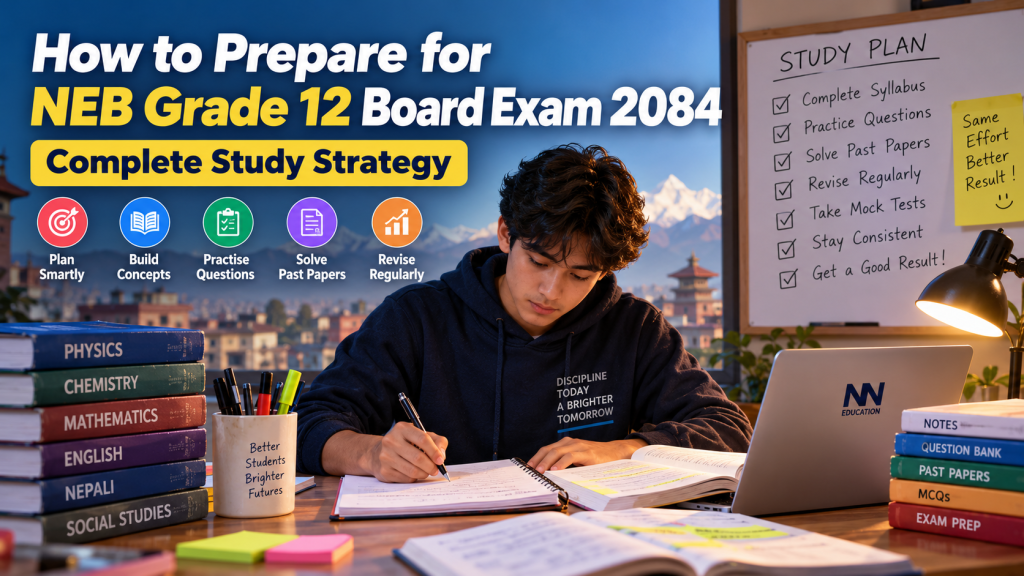
Preparing for the NEB Grade 12 Board Exam 2084 can feel overwhelming, especially when you have several subjects, a large syllabus and limited time to revise everything.
But board exam preparation does not have to mean studying for 10 or 12 hours every day.
What matters more is what you study, how you revise it and how consistently you practise.
A student who studies four focused hours with a proper plan can often achieve more than someone who spends the entire day reading without knowing what to prioritise.
In this guide, we will discuss a practical study strategy for Grade 12 students in Nepal—from completing the syllabus and practising past papers to revising effectively during the final weeks before the NEB examination.

1. Start With the Syllabus, Not Random Chapters
One of the biggest mistakes students make is opening a textbook and simply studying whatever chapter appears next.
Before serious preparation begins, understand the complete syllabus of every subject.
Create a simple checklist containing all the chapters and divide them into three groups:
- Strong: Chapters you already understand well.
- Average: Chapters you understand but still make mistakes in.
- Weak: Chapters that require significant revision or concept building.
Your weak chapters deserve attention, but that does not mean spending all your time on them.
A better strategy is to improve weak chapters while regularly revising your strong ones so that you do not forget topics you already know.
Your goal should gradually become:
Learn → Practise → Test → Revise
Simply completing a chapter once is not enough.
2. Follow the Three-Layer Study Strategy
A good NEB preparation plan can be divided into three layers.
Layer 1: Build Concepts
First, understand the basic concepts of the chapter.
Use your textbook, class notes, teacher’s explanation, video lessons or reliable online study materials.
Do not immediately try to memorise every answer.
Ask yourself:
- What is the main idea of this chapter?
- Which formulas or principles are important?
- Can I explain the concept without looking at the book?
- Which parts are still confusing?
Once the concepts are clear, move to practice.
Layer 2: Practise Questions
Now solve questions related to the chapter.
Depending on the subject, this may include:
- Short-answer questions
- Long-answer questions
- Numericals
- Derivations
- Multiple-choice questions
- Grammar exercises
- Writing tasks
- Diagram-based questions
- Past NEB questions
This stage converts your understanding into exam performance.
Layer 3: Revise and Test Yourself
After studying a chapter, close your book and try to recall what you learned.
You can:
- Write important formulas from memory.
- Explain a concept aloud.
- Solve questions without checking the solution.
- Take a short MCQ test.
- Attempt a previous examination question.
- Create a one-page chapter summary.
This is much more effective than repeatedly reading the same notes.
3. Do Not Give Every Chapter Equal Time
Not all chapters require the same amount of preparation.
Suppose one Physics chapter takes you three hours to understand properly while another takes only 45 minutes.
Giving both chapters exactly two hours would make little sense.
Instead, divide your study time according to:
Difficulty + Importance + Your Current Preparation Level
A useful priority system is:
High Priority
Important chapter + weak understanding
Study these first.
Medium Priority
Important chapter + reasonable understanding
Practise and revise these regularly.
Lower Priority
Strong chapter + already revised several times
Do not ignore these, but shorter revision sessions may be enough.
The purpose of prioritisation is not to predict exactly which questions will appear. It is to use your available preparation time efficiently.
4. Make a Realistic Daily Study Routine
An unrealistic timetable usually survives for only two or three days.
Instead of writing:
Study Physics – 4 hours
write specific tasks such as:
Physics: Revise electrostatics notes + solve 10 numericals + attempt 15 MCQs.
Tasks are easier to measure than study hours.
A Grade 12 student’s study day might look like this:
Morning
Study a concept-heavy subject when your mind is fresh.
For example:
6:00–7:30 AM: Physics or Mathematics
Afternoon
Complete college assignments, practise questions or study another major subject.
4:00–5:30 PM: Chemistry/Accountancy/Mathematics
Evening
Use shorter sessions for revision.
7:00–8:00 PM: English/Nepali/Social Studies
8:15–9:00 PM: MCQs, formulas or revision of previously studied chapters
You do not need to copy this exact routine.
Create one according to your school schedule, energy level and subjects.
The important part is consistency.
5. Use the 50-10 Study Method
Long, unfocused study sessions often become less productive.
Try:
50 minutes of focused study + 10 minutes of break
During those 50 minutes:
- Keep your phone away.
- Avoid social media.
- Study only one topic.
- Do not continuously switch subjects.
During the break, stand up, drink water or walk around.
After three or four sessions, take a longer break.
A few genuinely focused sessions are usually more valuable than sitting with an open book for an entire day.
6. Past Papers Should Be a Major Part of Your Preparation
Previous NEB question papers are one of the most useful resources available during board exam preparation.
They help you understand:
- How questions are written
- Common question formats
- Which concepts appear frequently
- How deeply a topic may be tested
- How much time you need to complete a paper
- Which chapters still require revision
But do not make the mistake of memorising only old questions.
A new examination can test the same concept in a different way.
Use past papers to understand the pattern and concepts, not as a replacement for studying the syllabus.
You can practise Grade 12 previous examination questions from the Past Papers section of NN Education.
7. Solve Past Papers in Two Stages
Do not immediately start solving every question paper under full examination conditions.
Stage One: Learning Mode
During early preparation:
- Solve questions chapter by chapter.
- Check the solution when necessary.
- Identify mistakes.
- Review the related concept.
Here, your goal is learning.
Stage Two: Exam Mode
When your syllabus is mostly complete:
Choose a full question paper.
Set a timer.
Keep your books and notes away.
Attempt the paper exactly as you would in the examination hall.
After finishing, analyse:
- Which questions took too long?
- Where did you lose marks?
- Which chapters caused difficulty?
- Which answers were incomplete?
- Did you run out of time?
Your mistakes will tell you what to revise next.
8. Create a Mistake Notebook
This is one of the simplest ways to improve your score.
Keep one small notebook—or a digital note—only for mistakes.
Whenever you make an important mistake, write it down.
For example:
Physics: Used the wrong sign convention in a lens numerical.
Mathematics: Forgot the constant of integration.
Chemistry: Confused two similar reactions.
English: Incorrect format used in a writing question.
Review this notebook every few days.
Students often spend most of their time learning new material while repeatedly making the same old mistakes.
Your mistake notebook prevents that.
9. How to Prepare for Physics
Physics requires both conceptual understanding and problem-solving practice.
Do not prepare Physics by memorising definitions alone.
For every chapter:
- Understand the main concepts.
- Learn important formulas and their meanings.
- Practise derivations where required.
- Solve numerical problems yourself.
- Practise conceptual questions.
- Attempt MCQs.
- Solve previous NEB questions.
For numericals, develop the habit of writing:
Given → Required → Formula → Calculation → Final Answer with Unit
Do not simply look at a solved numerical and assume you understand it.
Cover the solution and solve it yourself.
NN Education provides chapter-wise Physics notes, numerical solutions, question banks, MCQs and other resources that can be used during this process.
10. How to Prepare for Mathematics
Mathematics cannot be mastered by reading solutions.
You have to solve problems yourself.
For each chapter:
- Understand the basic formulas and methods.
- Solve easier examples first.
- Move gradually towards difficult problems.
- Practise previous questions.
- Record difficult questions for revision.
If you cannot solve a problem, study the solution—but then close it and solve the same problem again without looking.
That second attempt is important.
During revision, spend more time solving than reading.
11. How to Prepare for Chemistry
Divide Chemistry into conceptual, numerical and memory-based areas.
For each chapter, identify:
- Important concepts
- Chemical reactions
- Definitions
- Numerical problems
- Conditions required for reactions
- Exceptions
- Important diagrams or structures
Instead of repeatedly reading reactions, practise writing them from memory.
Short revision sheets can be especially useful for Chemistry.
12. Do Not Neglect English, Nepali and Other Subjects
Science and Management students sometimes spend almost all their preparation time on major technical subjects.
That can be a mistake.
Your overall result depends on performance across subjects.
For language subjects, practise:
- Writing formats
- Grammar
- Reading comprehension
- Important textual concepts
- Long-answer structure
- Time management
Reading model answers can help, but practising your own answers is even more important.
13. Use Active Recall Instead of Repeated Reading
Suppose you read a chapter today and understand everything.
That does not guarantee that you will remember it a month later.
After studying, close the book and ask yourself questions.
For example:
What are the three main concepts from this chapter?
Can I write the formula without looking?
Can I explain this topic to another student?
Can I solve this numerical without checking the example?
The more your brain is forced to retrieve information, the easier future recall becomes.
14. Follow a Revision Cycle
Do not wait until the final month to revisit a chapter.
A simple revision cycle could be:
First revision: Within 1–2 days
Second revision: About one week later
Third revision: A few weeks later
Final revision: Before the examination
These intervals do not need to be exact.
The important principle is to revisit material repeatedly instead of studying everything only once.
15. What to Do When You Have Several Months Left
If the board examination is still several months away, focus primarily on completing concepts properly.
Your priorities should be:
1. Complete the syllabus
2. Strengthen weak chapters
3. Practise chapter-wise questions
4. Start solving past questions
5. Build revision notes
Do not behave as though the examination is next week.
This is the best period for fixing conceptual weaknesses.
16. What to Do During the Final Three Months
At this stage, most of the syllabus should be familiar.
Shift towards:
- Revision
- Question solving
- Previous papers
- Numerical practice
- MCQs
- Writing practice
- Identifying weak areas
Try to complete at least one meaningful revision of every major subject before entering the final month.
17. What to Do During the Final 30 Days
The final month is not the ideal time to learn your entire syllabus from zero.
Your focus should increasingly move from learning to retrieval and practice.
A good 30-day strategy is:
Days 30–21
Revise weak chapters and finish remaining topics.
Days 20–11
Practise chapter-wise questions and past papers.
Days 10–4
Take timed tests and revise mistakes.
Final 3 Days Before Each Subject
Review:
- Formulas
- Important concepts
- Common mistakes
- Short notes
- Difficult questions
- Previous questions you struggled with
Avoid attempting to completely relearn every chapter at the last moment.
18. Do Not Depend Only on “Important Questions”
Important-question collections can be useful for focused revision.
But they should come after you understand the syllabus, not instead of it.
No responsible teacher or study platform can guarantee the exact questions that will appear in an examination.
Use expected questions to practise high-value concepts, but prepare broadly enough to handle unfamiliar questions as well.
Students preparing for final revision can also explore the Exam Prep resources on NN Education, where focused preparation materials can complement complete chapter study.
19. Practise MCQs Regularly
MCQs are useful even when preparing for descriptive questions.
Why?
Because an MCQ quickly exposes whether you genuinely understand a concept.
If you answer incorrectly, do not simply memorise the correct option.
Read the explanation and ask:
Why was my answer wrong?
Even 10–20 quality MCQs during a revision session can reveal gaps in understanding.
Students can use the NN Education MCQ section for additional practice.
20. Learn to Write Answers for the Examiner
Knowing an answer and presenting it clearly are two different skills.
In the examination:
- Answer what has actually been asked.
- Keep handwriting readable.
- Use appropriate headings where helpful.
- Show steps in mathematical problems.
- Mention units in numerical answers.
- Draw labelled diagrams when relevant.
- Avoid unnecessary paragraphs that do not answer the question.
Do not try to make every answer unnecessarily long.
A clear, accurate and properly structured answer is better than several pages of unrelated information.
21. Manage Your Time Inside the Examination Hall
Before starting, read the question paper carefully.
Identify:
- Questions you know well
- Questions requiring calculations
- Questions likely to take longer
Do not spend an excessive amount of time trying to perfect one answer while leaving easier questions unfinished.
Keep track of time throughout the examination.
Try to reserve a few minutes at the end for checking:
- Question numbers
- Unanswered questions
- Units
- Calculations
- Diagrams
- Missing pages or sub-questions
22. Stop Chasing Too Many Study Resources
Having more PDFs does not automatically improve preparation.
Many students collect:
- Five sets of notes
- Several guidebooks
- Dozens of YouTube playlists
- Hundreds of downloaded PDFs
They then spend more time choosing resources than studying.
Choose a small number of reliable resources and use them properly.
For example:
Textbook + concise notes + question bank + past papers + MCQ practice
is often enough.
Your preparation should become simpler as the examination approaches, not more complicated.
23. Take Care of Sleep and Health
Reducing sleep drastically before the examination is rarely a good strategy.
Your brain needs rest for concentration and memory.
During preparation:
- Maintain a reasonable sleep schedule.
- Drink enough water.
- Eat properly.
- Take short physical breaks.
- Avoid studying continuously for hours without rest.
Especially during the final week, protecting your concentration is more useful than trying to stay awake throughout the night.
24. Common NEB Preparation Mistakes to Avoid
Many students lose valuable preparation time because of a few repeated habits.
Avoid:
- Starting serious preparation only in the final weeks
- Reading without practising questions
- Ignoring weak chapters
- Memorising past-paper answers without understanding concepts
- Collecting too many resources
- Spending too much time making perfect notes
- Avoiding numerical problems because they seem difficult
- Studying only favourite subjects
- Using the phone during every study break
- Sacrificing sleep before examinations
You do not need a perfect routine.
You need a routine that you can follow consistently.
A Simple NEB Grade 12 Preparation Formula
If the entire article feels like too much to remember, use this simple formula:
Step 1: Understand
Learn the concept properly.
Step 2: Practise
Solve questions, numericals and MCQs.
Step 3: Test
Attempt questions without looking at notes.
Step 4: Analyse
Find your mistakes and weak areas.
Step 5: Revise
Return to those topics regularly.
Then repeat the cycle.
That is much more effective than simply reading the same textbook again and again.
Frequently Asked Questions
When should I start preparing for the NEB Grade 12 Board Exam?
Serious preparation should begin well before the final examination period. Ideally, revise throughout the academic year rather than trying to complete the entire syllabus in the final month.
How many hours should a Grade 12 student study daily?
There is no single correct number.
The quality of your study sessions matters more than simply counting hours. A few focused hours with clear objectives can be more productive than an entire day of distracted study.
Are NEB past papers important?
Yes. Previous questions are valuable for understanding question styles, practising time management and identifying important concepts. However, they should complement your syllabus preparation rather than replace it.
Is one month enough to prepare for the NEB Grade 12 exam?
It depends on your current preparation.
If you have studied throughout the year, one month can be enough for intensive revision and practice. If you are starting most subjects from the beginning, you will need to prioritise carefully.
Should I study only important questions before the board exam?
No.
Important questions can help during revision, but relying entirely on predicted questions is risky. Build your concepts and cover the syllabus first.
How can I improve my Physics numerical-solving skills?
Practise numericals yourself instead of only reading solved examples. Write the known quantities, identify what is required, choose the correct formula and complete the calculation with proper units.
Where can I practise NEB Grade 12 past questions and study resources?
Students can use NN Education for Grade 12 study resources, including chapter materials, Physics numerical solutions, question banks, MCQs, past papers and exam-preparation resources.
Final Thoughts
The NEB Grade 12 Board Exam is important, but successful preparation does not require panic.
Start early.
Understand your concepts.
Practise questions.
Solve past papers.
Track your mistakes.
Revise repeatedly.
And during the final weeks, focus more on recalling and applying what you already know rather than constantly searching for new study materials.
Consistency over several months will almost always be more useful than a few extreme study sessions just before the examination.
If you are preparing for the NEB Grade 12 Board Exam 2084, NN Education provides study resources designed to help you prepare chapter by chapter—including notes, numerical solutions, question banks, MCQs, past papers and exam-preparation materials.
Start with the chapter you find most difficult today. One completed chapter is better than an entire day spent worrying about the syllabus.