
Overview
Electrons is a chapter built around two landmark experiments — J.J. Thomson’s method for determining the specific charge (e/m) of an electron, and Millikan’s oil drop experiment for determining the electronic charge itself. Nearly every board paper draws a theory question from one or both, and the same specific sub-question keeps reappearing: why is the electric field kept perpendicular to the magnetic field in Thomson’s method (it creates a “cross field” that lets undeflected electrons reveal their velocity), and why oil — not water — is used in Millikan’s experiment (oil doesn’t evaporate at the rate water does, keeping the drop’s mass stable during observation).
The numericals split cleanly into three families: crossed electric-and-magnetic-field problems (finding electron velocity or deflection between parallel plates), circular motion of a charged particle in a magnetic field (finding radius, speed, or period), and Millikan oil-drop equilibrium problems (finding charge, number of excess electrons, or the balancing voltage). Once you recognize which family a numerical belongs to, the same three or four formulas cover nearly all of them — the challenge is usually unit conversion and correctly balancing gravitational, electric, and viscous forces in the Millikan problems.
Below is the full set of theoretical questions and numerical problems from past NEB board exams, organized by course and question type.
⚠️ Common Mistakes Students Make
- Forgetting the Millikan force-balance includes viscous drag, not just gravity and electric force. When a drop falls at terminal velocity (no field) vs. reaches equilibrium with a field, different combinations of gravitational, buoyant, viscous, and electric forces apply — mixing these up is the single biggest source of wrong answers in this sub-topic.
- Confusing which field to zero out in a cross-field (velocity selector) problem. Setting E = 0 to find the magnetic-field-only radius, or v = qE/B to find the balancing velocity, are two different steps of the same setup — students often apply the wrong formula for what the question is actually asking.
- Mixing up e/m (specific charge) with e alone. Thomson’s method finds the ratio e/m, not the charge itself; Millikan’s experiment is what isolates the actual charge e. Conflating the two experiments’ purposes is a common conceptual slip in exam answers.
MCQs
A charged particle is moving in a circular path with velocity v in a uniform magnetic field B, if the velocity of charged particle is doubled and strength of magnetic field is halved, then radius becomes
Show answer
Theoretical questions
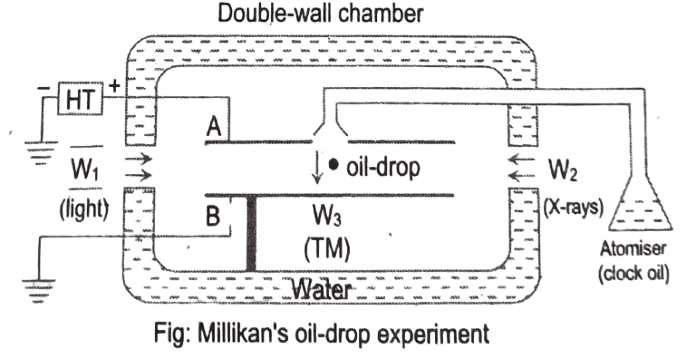
Draw free body diagram of oil drop falling through air in Millikan’s oil drop experiment for both cases; when field is given and when field is absent. What is the conclusion of this experiment? [3]
The figure below shows the experimental set up of Millikan’s oil drop experiment.
Using free body diagram, obtain an expression for a charge of an oil drop of radius r moving with constant velocity ‘v’ in a downward diraction.
Compare the specific charge of an alpha particle to that of a proton. [2]
In Thomson’s Method, Specific charge of an electron is determined.
i. Why is electric field kept perpendicular to the magnetic field in this method?
ii. What is the ratio of electric to the magnetic field? [1]
What is meant by specific charge of an electron? Its value is constant for cathode rays but not for positive rays, why? [2]
In what way Millikan’s experiment lead to the quantum nature of electric charge? [2]
A horizontal beam of electrons moving with velocity v passes between two parallel plates as shown in the figure.
i. Describe the motion of electron and show that the path followed by it is parabolic. [3]
ii. What is cross field? Write on use of cross field. [2]
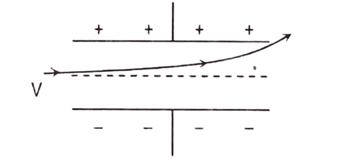
Figure represents the experimental arrangement for Millikan’s oil drop experiment.
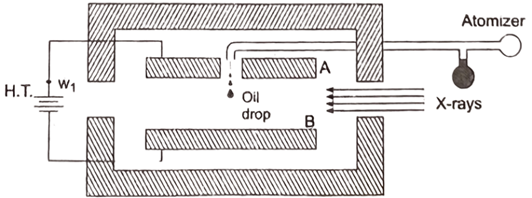
Can we use water instead of clock oil in Millikan’s oil drop experiment? Justify your answer. [2]
Electron is deviated in electric and magnetic fields.
Beams of protons and electrons with the same initial K.E. enter normally into an electric field. Which one will deflect more and why?
Why does the electric discharge take place at reduced pressure? Explain. [2]
Why discharge does not take place at very low pressure?
Explain why electric discharge through a gas takes place at low pressure.
Gases are insulators at ordinary pressures and start conducting at low pressures. Why?
Why is a magnetic field used to deflect electron beam but no an electric field in a T.V. picture tube?
Gases become conducting at low pressure. Why?
The value of e/m is constant for cathode rays but not for positive rays, why?
An electron and a proton move with the same speed in a uniform magnetic field of equal magnitude, Compare the radii of their circular path.
Beams of electrons and protons having the same initial K.E. enter normally into an electric field, which beam will be more curved? Justify.
Explain why electric discharge through a gas takes place at low pressure.
Describe with necessary theory, Millikan’s oil drop experiment to determine the value of charge associated with an electron.
Describe J.J. Thomson’s experiment for measuring the specific charge (e/m) of an electron.
Discuss the motion of electrons in an electric field and obtain the expression of vertical deflection when it leaves the electric field.
Discuss the motion of electrons in a magnetic field and show that time period is independent of electron velocity.
What is quantization of charge? Describe the theory of Millikan’s oil drop experiment to determine the number of charges on an oil drop.
Describe with necessary theory Thomson’s method to determine specific charge of an electron.
OR Describe an experiment to determine the specific charge of an electron.
OR Describe the laboratory method to determine the specific charge of an electron by J.J. Thomson’s method.
OR Describe an experiment to determine the ratio of the charge to mass (e/m) for an electron. Show how the result is derived from the observations.
Describe the theory of Millikan’s oil drop experiment to determine the charge of an electron.
What are cathode rays? How are they produced? Mention two of properties.
Numerical problems
An electron moves in a circular path of radius 20 cm in a uniform magnetic field of [latex]2\times 10^{-3}[/latex] T. Calculate the time period of revolution of electron. [2]
[Mass of electron = [latex]9.1\times 10^{-31}\ kg[/latex], Charge on electron = [latex]1.6\times 10^{-19}\ C[/latex]] Ans: [latex]7\times 10^7\ m/sec, 2\times 10^{-8}\ sec[/latex]
A beam of electron is under the effect of potential difference of [latex]1.36\times 10^4[/latex] volt applied across two parallel plates 4cm apart and a magnetic field of 0.002 [latex]Wbm^{-2}[/latex] at right angles to each other.
i. Under what condition the electron beam passes undeviated? Explain. [1]
ii. What will be the radius of the orbit in which the beam will move if the electric field is made zero? [2] Ans: (ii) 0.48 m
An oil drop of mass [latex]3\times 10^{-11}\ g[/latex] and of radius [latex]2\times 10^{-4}[/latex] cm carries 10 excess electrons. What is its terminal velocity when
i. falling in a region in which there is no electric field? [1]
ii. falling in an electric field of [latex]3\times 10^5\ Vm^{-1}[/latex] directed downward? [1]
(Viscosity of air = [latex]1.8\times 10^{-5}\ Nsm^{-2})[/latex]. Ans: [latex]4.5\times 10^{-5}\ m/s[/latex]
In a Millikan’s oil drop experiment, an oil drop of weight [latex]1.5\times 10^{-14}\ N[/latex] is held stationary between two horizontal plates 10mm apart by applying p.d. of 470 volts between the plates. Calculate the number of electrons attached with the drop. [3] Ans: 2
An ion of specific charge [latex]4.40\times 10^7\ C/kg[/latex] is moving in a circular orbit in a magnetic field of flux density 0.4 T with velocity of [latex]3.52\times 10^5\ ms^{-1}[/latex]. Calculate the radius of this orbit. [2] Ans: 0.02 m
An electron moves in a circular path of radius 20 cm in a uniform magnetic field of [latex]2\times 10^3\ T[/latex]. Calculate the speed of electron and period of revolution. (Mass of electron = [latex]9.1\times 10^{-31}\ kg)[/latex]. [3] Ans: [latex]7\times 10^7\ m/s, 2\times 10^{-8}\ s[/latex]
A beam of electron is under the effect of potential difference [latex]1.36\times 10^4[/latex] volt applied across two parallel plates 4 cm apart and a magnetic field of [latex]2\times 10^{-3}[/latex] wb/m2 at right angles to each other.
i. Calculate velocity of electrons if the two fields produce no deflection in the beam. [1]
ii. What will be the radius of the orbit in which the beam will move if the electric field is made zero? [2] Ans: (i) [latex]1.7\times 10^8\ m/s[/latex] (ii) 0.48 m
A beam of electrons moving with a velocity of [latex]1\times 10^7[/latex] m/s enters midway between two horizontal parallel plates in a direction parallel to the plates. Each plate is 5cm long which are kept 2cm apart and a p.d. of 90 V is applied between them. Calculate the velocity of the electron beam with which it just grazes the edge of the positive plate. (e/m = [latex]1.8\times 10^{11}\ C/kg[/latex]). [3] Ans: [latex]1.079\times 10^7[/latex], 22.04o
In an experiment, voltage across two parallel plates is 50 V and distance between them is 3 cm. The magnetic field applied to make the beam undeflected is [latex]10^{-4}[/latex] Tesla.
i. Why electron beam remains undeflected? [1]
ii. Calculate the velocity of electron passing through the fields? [2] Ans: [latex]1.67\times 10^7\ m/s[/latex]
Taking electronic charge to be [latex]1.6\times 10^{-19}\ C[/latex] C, calculate the potential difference (in volts) necessary to be maintained between two horizontal conducting plates, one 5mm above the other so that a small oil drop of mass [latex]1.31\times 10^{-14}\ kg[/latex] with two electrons attached to it remains in equilibrium between them. [2] Ans: 2006 V
An ion for which the charge per unit mass is 4.40 x 10⁷ c/kg has velocity of 3.52 x 10⁵ m/s and moves in a circular orbit in a magnetic field of flux density 0.4 T. What will be the radius of this orbit? Ans: 2 x 10⁻² m
Two plane metal plates 4 cm long are held horizontally 3 cm apart in a vacuum, one being vertically above the other. The upper plate is at a potential of 300 V and the lower is earthed. Electrons having a velocity of 107 m/s are injected horizontally midway between the plates and in a direction parallel to the 4 cm edge. Calculate the vertical deflection of the electron beam as it emerges from the plates. (e/m for electron = 1.8 x 10¹¹ CKg-1). Ans: 1.44 x 10⁻² m
An electron moving with a speed of 107 m/s is passed into a magnetic field of intensity 0.1 T normally. What is the radius of the path of the electron inside the field? If the strength of the magnetic field is doubled, what is the radius of the new path? (e/m = 1.8 x 10¹¹ C/kg). Ans: 5.56 x 10⁻⁴ m, 2.78 x 10⁻⁴ m
Calculate the potential difference to be maintained between two horizontal conducting plates separated by a distance of 10 mm so that a small charged oil drop of mass 1.31 x 10⁻¹⁴ Kg will remain in equilibrium. Charge in the oil drop is 6.4 x 10⁻¹⁹ C, g = 10 m/s2. Ans: 2046.88 V
An electron moves in a circular path of radius 20 cm in a uniform magnetic field of 2 x 10⁻³ T. Find the speed of the electron and period of revolution. (Mass of electron = 9.1 x 10⁻³¹ Kg). Ans: 7.03 x 10⁷ m/s, 1.78 x 10⁻⁸ sec
An electron having 500 eV energy enters at right angle to a uniform magnetic field of 10-4 Tesla. If its specific charge is 1.75 x 10¹¹ CKg-1. Calculate the radius of its circular orbit. Ans: 0.75 m
In a Millikan’s oil drop experiment, a drop is observed to fall with a terminal speed 1.4 mm/s in the absence of electric field. When a vertical electric field of 4.9 x 10⁵ V/m is applied, the droplet is observed to continue to move downward at a lower terminal speed of 1.21 mm/s. Calculate the charge on the drop. (Density of oil = 750 kg/m3, viscosity of air = 1.81 x 10⁻⁵ kg/ms, density of air = 1.29 kg/m3). Ans: 5.16 x 10⁻¹⁹ C
A beam of electrons, moving with velocity of 107 m/s enters midway between two horizontal parallel plates in the direction parallel to the plates which are 5 cm long and 2 cm apart and have a p.d. of V volts between then. Calculate V if the beam if deflected so that it just grazes the edge of the plate. (Assume e/m = 1.76 x 10¹¹ C/Kg). Ans: 90.9 V
An electron is accelerated through a potential difference of 2000 V and then it enters a uniform magnetic field of 0.02 Tesla in a direction perpendicular to it. Find the radius of the path of the electron in the magnetic field. Mass of an electron is [latex]9.1\times 10^{-31}\ Kg[/latex], charge of an electron is [latex]1.6\times 10^{-19}\ C[/latex]. Ans: [latex]7.5\times 10^{-4}\ m[/latex]
Calculate the radius of a water drop which would just remain suspended in an electric field of 300 V/cm and charged with one electron. Ans: [latex]4.9\times 10^{-7}\ m[/latex]
An electron beam after being accelerated from rest through a potential difference of 5kV in vacuum is allowed to impinge normally on the fixed surface. If the incident current is [latex]50\mu A[/latex]. Determine the force exerted on the surface assuming that it brings the electrons to rest. Take mass of electron is [latex]9.1\times 10^{-31}\ kg.[/latex] Ans: [latex]1.2\times 10^{-3}\ N[/latex]
A beam of electrons, moving with a velocity of 107 m/s, enters midway between two horizontal parallel plates in a direction parallel to the plates. Each plate is 5 cm long. These plates are kept 2 cm apart and a potential difference of 90 V is applied between them. Calculate the velocity of the electron – beam with which it just grazes the edge of the positive plate. (e/m = [latex]1.8\times 10^{11}\ c/kg[/latex]) Ans: 107 m/sec, 22o
In a Millikan apparatus, the horizontal plates are 1.5 cm apart. With the electric field switched off an oil drop is observed to fall with the steady velocity [latex]2.5\times 10^{-2}\ cms^{-1}[/latex]. When the field is switched on the upper plate being positive, the drop just remains stationary when the potential difference between the plates is 1500 V. Calculate the radius of the drop and the number of electronic charges neglecting air density. (Given: density of oil = 900 [latex]kgm^{-3}[/latex] and viscosity of air = [latex]1.8\times 10^{-5}\ Nsm^{-2})[/latex] Ans: [latex]1.5\times 10^{-6}\ m,\ 8[/latex]
An electron is accelerated through a potential difference of 2 kV and then it enters a uniform magnetic field of 0.02T, in a direction perpendicular to it. Find the radius of the path of the electron in the magnetic field. (mass of electron = [latex]9.1\times 10^{-31}kg)[/latex] Ans: [latex]7.5\times 10^{-3}\ m[/latex]
In a Thomson experiment, voltage across the plates is 50 V and the distance between them is 3 cm. The magnetic field applied to make the beam undeflected is [latex]10^{-4}[/latex] T. What is the velocity of the electron passing between the plates? Ans: [latex]1.6\times 10^7\ m/s[/latex]
A beam of electrons, moving with a velocity of 106 m/s enters midway between two horizontal parallel plates in a direction parallel to the plates. Each plate is 4cm long. These plates are kept 2cm apart and a potential difference V is applied between them. Calculate V if the beam is deflected so that it just grazes the edge of positive plate. (Given e/m for the electron is [latex]1.8\times 10^{11}\ C/kg[/latex]). Ans: 1.38 V
An electron having 450 eV of energy moves at right angled to a uniform magnetic field of flux density [latex]1.50\times 10^{-3}\ T.[/latex] Find the radius of its circular orbit. [Given: specific charge of the electron = [latex]1.76\times 10^{11}\ C/kg][/latex] Ans: 0.048 m
A beam of electrons is under potential difference of [latex]1.36\times 10^4\ V[/latex] applied across two parallel plates 4 cm apart and a magnetic field [latex]2\times 10^{-3}\ T[/latex] at right angles to each other. If two fields produce no deflection in the electronic beam, calculate (i) The velocity of electrons (ii) the radius of the orbit in which the beam will move, if the electric field is made zero. [Given: mass of electron = [latex]9.1\times 10^{-31}\ kg][/latex]. Ans: [latex]1.7\times 10^8[/latex] m/s, 0.48 m
In Millikan-type apparatus, the horizontal plates are 1.5 cm apart. With the electric field switched off an oil drop is observed to fall with the steady velocity [latex]2.5\times 10^{-2}[/latex] cm/s. When the electric field is switched on the upper plate being positive, the drop just remains stationary when the p.d. between plates is 1500V. (a) Calculate the radius of the drop (b) How many electronic charges does it carry? Ans: (a) [latex]1.5\times 10^{-6}\ m[/latex] (b) 8
A beam of proton is accelerated from rest through a potential difference of 2000V and then enters a uniform magnetic field which is perpendicular to the direction of the proton beam. If the flux density is 0.2T, calculate the radius of the path which the beam describes. (proton mass = [latex]1.7\times 10^{-27}[/latex] kg, Electronic charge = [latex]-1.6\times 10^{-19}\ C)[/latex] Ans: 0.03 m
Calculate the p.d. in volt necessary to be maintained between two horizontal conducting plates, one 5 mm above the other, so that a small oil drop of mass [latex]1.31\times 10^{-14}\ kg[/latex] with two electrons attached to it remains in equilibrium. (g = 9.8 ms^{-2}, charge of electron = [latex]-1.6\times 10^{-19}\ C[/latex]) Ans: 2005.94 V
Find the electric field required to keep a water drop of radius [latex]10^{-5}\ cm[/latex] just suspended in vacuum when charged with one electron. (electronic charge = [latex]-1.6\times 10^{-19}\ C[/latex]) [density of water = 1000 kg/m3] Ans: 257 V
A beam of proton is accelerated from rest through a p.d. of 2000V and then enters a uniform magnetic field which is perpendicular to the direction of the proton beam. If the flux density is 0.4T, calculate the radius of the path which the beam describes. (Proton mass = [latex]1.7\times 10^{-27}\ kg[/latex] electronic charge = [latex]-1.6\times 10^{-19}\ C)[/latex] Ans: [latex]1.629\times 10^{-2}[/latex] m
An oil drop of mass [latex]3.25\times 10^{-15}[/latex] kg falls vertically with uniform velocity, through the air between vertical parallel plates which are 2cm apart. When a p.d. of 1000V is applied to the plates the drop moves to the positively charged plates being inclined at 45o to be vertical. Calculate the charge on the drop. Ans: [latex]6.37\times 10^{-19}\ C[/latex]