
Electric Field
SYLLABUS
Electric field due to point charges; Field lines, Gauss Law: Electric Flux, Application of Gauss law: Field of a charge sphere, line charge, charged plane conductor
What is This Chapter About?
In Chapter 19, we learned that charges exert forces on each other through Coulomb’s Law. But this raises a puzzling question: how does one charge “know” that another charge is nearby? How does the force reach across empty space? The answer lies in the concept of the electric field — one of the most powerful and far-reaching ideas in all of physics.
Rather than thinking of charges acting directly on each other at a distance, we think of each charge as creating a field throughout the surrounding space, and other charges then interact with this field. This shift from direct action-at-a-distance to field theory was one of the greatest conceptual revolutions in the history of physics, and it forms the foundation not just of electrostatics but of all of electromagnetism and even modern quantum field theory.
Chapter 20 of NEB Grade 11 Physics develops the electric field concept quantitatively — defining field strength, representing fields graphically through field lines, calculating fields for important charge distributions using Gauss’s Law, and analysing the motion of charged particles in uniform fields. Carrying 3 teaching hours, this chapter is conceptually rich and mathematically precise.
Key Concepts You Will Learn
Electric Field as a Region of Influence
The electric field at a point in space is defined as the force per unit positive charge experienced by a small test charge placed at that point:
[latex]\vec{E} = \frac{\vec{F}}{q_0}[/latex]
The test charge must be small enough not to disturb the field-creating charges. The electric field is a vector quantity — it has both magnitude and direction at every point in space. The direction of E at any point is the direction of force that would act on a positive test charge placed there.
For the field due to a point charge Q at distance r:
[latex]E = \frac{Q}{4\pi\epsilon_0 r^2}[/latex]
This inverse square dependence on distance mirrors Coulomb’s Law exactly — because E is just the force per unit charge, and the force obeys an inverse square law.
Electric Field Strength and Force on Charges
Once the electric field at a point is known, the force on any charge q placed at that point is simply:
[latex]\vec{F} = q\vec{E}[/latex]
For positive q, the force is in the direction of E. For negative q, the force is opposite to E. This elegant relationship makes the electric field enormously useful — calculate E once for a given charge distribution, and then find the force on any charge placed in that field by simple multiplication.
Electric Field Lines
The electric field is visualised through field lines — imaginary curves whose tangent at every point gives the direction of E, and whose density (how closely spaced they are) indicates the magnitude of E. Field lines have several important properties: they start on positive charges and end on negative charges; they never cross each other (because E has a unique direction at every point); they are closer together where the field is stronger; and between parallel plates, they are parallel and equally spaced — indicating a uniform field.
For a positive point charge, field lines radiate outward in all directions. For a negative point charge, they converge inward. For two equal and opposite charges (an electric dipole), the field lines form beautiful curved arcs from the positive to the negative charge.
Effect of Uniform Electric Field on Charged Particles
A charged particle placed in a uniform electric field experiences a constant force
[latex]F = qE[/latex]
and therefore a constant acceleration
[latex]a = \frac{qE}{m}[/latex]
. The subsequent motion depends on the initial velocity:
If the particle moves parallel to the field, it undergoes uniform acceleration (like a ball in gravity) — it speeds up if moving in the direction of force, slows down if opposing it.
If the particle moves perpendicular to the field, it follows a parabolic path — exactly analogous to projectile motion in gravity. This is the principle behind cathode ray tubes (old television screens) and particle deflectors in physics experiments.
Electric Flux
Electric flux ([latex]\Phi_E[/latex]) through a surface is a measure of the total number of electric field lines passing through it:
[latex]\Phi_E = \vec{E} \cdot \vec{A} = EA\cos\theta[/latex]
where A is the area vector (perpendicular to the surface) and [latex]\theta[/latex] is the angle between E and the area vector. Flux is maximum when E is perpendicular to the surface (parallel to area vector) and zero when E is parallel to the surface (perpendicular to area vector).
Gauss’s Law
Gauss’s Law is one of the four fundamental equations of electromagnetism (Maxwell’s equations). It states that the total electric flux through any closed surface (called a Gaussian surface) is equal to the total charge enclosed divided by
[latex]\epsilon_0[/latex]
:
[latex]\oint \vec{E} \cdot d\vec{A} = \frac{Q_{enc}}{\epsilon_0}[/latex]
Gauss’s Law is equivalent to Coulomb’s Law but far more powerful for symmetric charge distributions. By choosing a Gaussian surface that matches the symmetry of the charge distribution, the integral becomes simple and the electric field can be found immediately.
Applications of Gauss’s Law
For a uniformly charged sphere (radius R, total charge Q), the field outside (r > R) is identical to that of a point charge:
[latex]E = \frac{Q}{4\pi\epsilon_0 r^2}[/latex]
. Inside a conducting sphere, E = 0 — all charge resides on the surface and the interior is field-free. This result explains why the inside of a metal cage (Faraday cage) is shielded from external electric fields.
For an infinite line charge with linear charge density [latex]\lambda[/latex], the field at distance r is:
[latex]E = \frac{\lambda}{2\pi\epsilon_0 r}[/latex]
— varying as 1/r rather than 1/r².
For an infinite plane of charge with surface charge density
[latex]\sigma[/latex]
, the field is uniform:
[latex]E = \frac{\sigma}{2\epsilon_0}[/latex]
— independent of distance from the plane. Between two oppositely charged parallel plates, the fields add:
[latex]E = \frac{\sigma}{\epsilon_0}[/latex]
— this is the uniform field inside a parallel plate capacitor.
Uniform Electric Field Between Parallel Plates
The uniform field between charged parallel plates is one of the most practically important configurations in electrostatics. It is produced when equal and opposite charges are placed on two parallel conducting plates. The field is uniform everywhere between the plates (except near the edges), perpendicular to the plates, and equal to
[latex]E = \frac{V}{d}[/latex]
, where V is the potential difference and d is the separation. This configuration is the basis of the capacitor (Chapter 22) and of particle accelerators.
Why This Chapter Matters for NEB Exams
Electric Field is examined thoroughly in NEB Grade 11 Physics. Calculating the electric field due to a point charge, superposition of fields from multiple charges, and the field between parallel plates are standard numerical problems. Gauss’s Law — stating it and applying it to find the field of a charged sphere, line charge, and infinite plane — is a classic long-answer question. Drawing and interpreting electric field line patterns is a standard short-answer question. The motion of a charged particle in a uniform electric field — finding acceleration, velocity, and path — generates numerical problems analogous to projectile motion.
Important Topics to Focus On
- Definition of electric field:
[latex]\vec{E} = \frac{\vec{F}}{q_0}[/latex]
— force per unit positive charge Electric field due to a point charge:
[latex]E = \frac{Q}{4\pi\epsilon_0 r^2}[/latex]
Force on a charge in an electric field:
[latex]\vec{F} = q\vec{E}[/latex]
Properties and drawing of electric field lines Superposition of electric fields from multiple charges Effect of uniform field on charged particles — parabolic motion Electric flux:
[latex]\Phi_E = EA\cos\theta[/latex]
Gauss’s Law:
[latex]\oint \vec{E} \cdot d\vec{A} = \frac{Q_{enc}}{\epsilon_0}[/latex]
Application to field of a charged sphere — inside (E = 0) and outside Application to field of a line charge:
[latex]E = \frac{\lambda}{2\pi\epsilon_0 r}[/latex]
Application to field of a charged plane and parallel plates Uniform field between parallel plates: [latex]E = \frac{V}{d}[/latex] Numerical problems on all of the above
Connection to Other Chapters
Electric Field builds directly on Chapter 19 (Electric Charges) — the electric field is the mechanism by which charges exert forces on each other. Chapter 21 (Potential) introduces the energy perspective — potential is the work done per unit charge in the electric field, and the field is the negative gradient of potential. Chapter 22 (Capacitor) uses the uniform field between parallel plates to derive capacitance. In Grade 12, Chapter 16 (Magnetic Field) mirrors the electric field concept — magnetic field lines, flux, and Ampere’s Law are magnetic analogues of the concepts developed here. The Gauss’s Law framework connects to Chapter 18 (Electromagnetic Induction) — Faraday’s Law is the magnetic analogue of Gauss’s Law for changing fields. The motion of charges in electric fields connects to Grade 12 Chapter 20 (Electrons) where Thomson’s experiment uses electric deflection of electron beams.
Electric Field
It is defined as a region or a space around a charge within which any other charged particle experiences electrostatic force. It is strong near the charge and decreases gradually when distance increases from the charge.
Electric field intensity (at a point):
It is defined as the force experienced by a unit positive charge placed at the point. It measures the strength of electric field at the point.
If ‘F’ be the force experienced by a small test charge ‘q’ placed at a point in an electric field then, the electric field intensity at that point is E. i.e.
E = [latex]\frac{F}{q’}[/latex].
The electric field intensity is a vector quantity whose direction is a vector quantity whose direction is in the direction of force. Its unit is [latex]NC^{-1}[/latex] or N/C.
Electric field intensity due to a point charge:
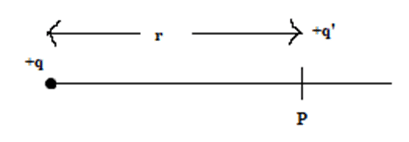
Consider, a point charge ‘+q’ kept in free space (air or vacuum). To find the electric field intensity at a point P at a distance ‘r’ from the charge ‘+q’. Put a ‘+q’ charge at the point P. Now, the force between the two charges is F. i.e.
F = [latex]\frac{1}{4\pi\epsilon_o} \frac{qq’}{r^2}[/latex] ………………….. (i)
If ‘E’ be the electric field intensity at P due to charge +q, then, from the definition,
E = [latex]\frac{F}{q’} = \frac{1}{4\pi\epsilon_o} \frac{qq’}{r^2 q’}[/latex] [∵ From (i)]
∴ E = [latex]\frac{1}{4\pi\epsilon_o} \frac{q}{r^2}[/latex]
If the charge is placed in a medium having permittivity [latex]\epsilon[/latex], then, the electric field intensity becomes E, i.e.
E = [latex]\frac{1}{4\pi\epsilon} \frac{q}{r^2}[/latex]
Electric lines of force:
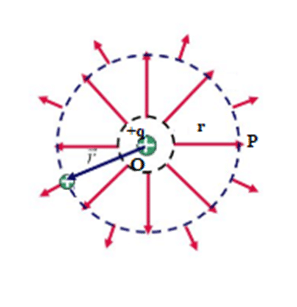
Electric field is represented by electric lines of force. The electric lines of force as an imaginary path along which a small positive test charge is supposed to move when free to do so in an electric field.
Properties of electric lines of force
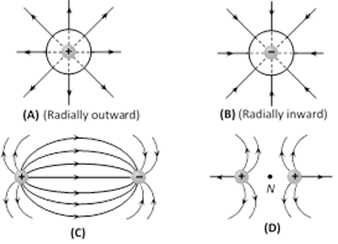
i) The electric lines of force start from positive charges and end on a negative charge.
ii) The tangent at any point to the electric lines of force gives the direction of electric field at that point.
iii) Two electric lines of force never intersect each other.
iv) Electric lines of force have tendency to contract longitudinally or length wise. This explains attraction between unlike charge.
v) They have tendency to exert lateral pressure upon each other which explains repulsion between two like charge.
vi) The lines of force are always perpendicular to the surface of the charged conductor.
vii) The electric line do not pass through a closed conductor that means no electric lines of force exist within the conductor.
Electric flux:
The number of electric lines of force passing through a surface area in a direction normal to the surface is called electric flux through that surface. It is denoted by [latex]\phi[/latex]. Its unit is [latex]Nm^2C^{-1}[/latex] or Vm.
It is found that electric lines of force are more crowded in the region where the electric field intensity is high and less crowded where it is low. Hence, the electric field intensity at a point in the electric lines of force passing per unit area through a surface held perpendicular to the direction of the lines of force at the point.
If [latex]\phi[/latex] be the flux passing perpendicularly through the surface area A, then, the electric field intensity at that point is:
E = [latex]\frac{\phi}{A}[/latex]
[latex]\phi = E \times A[/latex]
Electric flux due to a point charge:
Consider, a point charge +q is placed at center of an imaginary sphere of radius ‘r’. The lines of force from the charge are radially outward and so are normal to the surface. Hence, the total flux passing through the surface is [latex]\phi[/latex]. i.e., [latex]\phi = E \times A[/latex]
Where, E = Electric field intensity which is at the distance ‘r’ and A = Area of the sphere = [latex]4\pi r^2[/latex]
Again, electric field intensity due to a point charge at distance ‘r’ is given by:
E = [latex]\frac{1}{4\pi\epsilon_o} \frac{q}{r^2}[/latex], where, [latex]\epsilon_o = Permittivity\ of\ a\ free\ space[/latex].
Substituting the value of E, we get,
[latex]\phi = \frac{1}{4\pi\epsilon_o} \frac{q}{r^2} \times 4\pi r^2[/latex]
[latex]\phi_T = \frac{q}{\epsilon_o}[/latex]
If charge is placed in a medium having permittivity [latex]\epsilon[/latex], then, the flux is:
[latex]\phi_T = \frac{q}{\epsilon}[/latex]
Gauss’s Theorem:
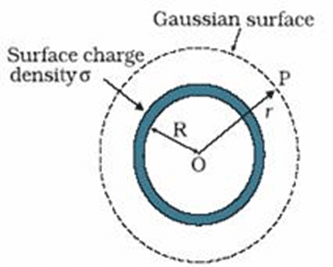
It states that the total flux passing through any close surface is equal to [latex]\frac{1}{\epsilon_o}[/latex] times the total charge enclosed by the surface. If [latex]\phi[/latex] be the total flux and q be the charge enclosed by the surface, then, [latex]\phi[/latex] is
[latex]\phi = \frac{1}{\epsilon_o} \times q[/latex]
[latex]\phi = \frac{q}{\epsilon_o}[/latex]
Where, [latex]\epsilon_o[/latex] = Permittivity of the free space.
If charge is placed in a medium having permittivity [latex]\epsilon[/latex], then, the Gauss’s theorem becomes,
[latex]\phi = \frac{q}{\epsilon}[/latex]
The imaginary or hypothetical closed surface considered in Gauss’s theorem which may be of any shape is called Gaussian surface.
Application of Gauss’s theorem:
a) To find the electric field intensity due to a charged sphere and outside it.
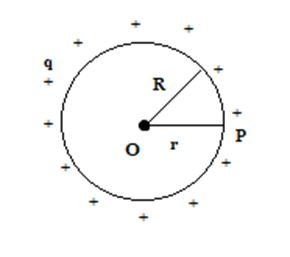
Consider, a charged sphere having radius ‘r’ and carrying charge q. To find the electric field intensity at point P outside the sphere and at a distance R from the centre of the sphere. Draw a concentric sphere passing through the point P as a Gaussian surface. Now, from Gauss’s theorem, the total flux passing through the sphere is [latex]\phi. i.e.[/latex]
[latex]\phi = \frac{q}{\epsilon_o}[/latex] ………………… (i)
Where, [latex]\epsilon_o[/latex] = Permittivity of the free space.
But the total flux passing through a surface area A, where, electric field intensity is E, is given by: [latex]\phi = A \times E[/latex] ……………… (ii)
From eqn. (i) and (ii), we get,
E x A = [latex]\frac{q}{\epsilon_o}[/latex]
Or, E = [latex]\frac{q}{A . \epsilon_o} = \frac{q}{\epsilon_o 4\pi R^2}[/latex]
∴ E = [latex]\frac{1}{4\pi\epsilon_o} . \frac{q}{R^2}[/latex]
b) To find the electric field intensity due to a charged sphere and on the surface of it:
Consider, a charged sphere having radius ‘r’ and carrying a charge q.
To find electric field intensity at point P and on the surface of it and at a distance R from the centre of the sphere. Draw a concentric sphere passing through the point P as a Gaussian’s surface. Now, from the Gauss’s theorem, the total flux passing through the surface is
[latex]\phi = \frac{q}{\epsilon_o}[/latex] …………………… (i)
Where, [latex]\epsilon_o = Permittivity\ of\ free\ space[/latex].
But the total flux passing through a surface area ‘A’ where electric field intensity is E, which is given by:
[latex]\phi = E \times A[/latex] ……………………….. (ii)
From eqn. (i) and (ii), we get,
E x A = [latex]\frac{q}{\epsilon_o}[/latex]
Or, E = [latex]\frac{q}{\epsilon_o A} = \frac{q}{\epsilon_o} . \frac{1}{4\pi R^2}[/latex]
∴ E = [latex]\frac{1}{4\pi\epsilon_o} . \frac{q}{R^2}[/latex]
c) To find the electric field intensity due to a charged sphere and inside it:
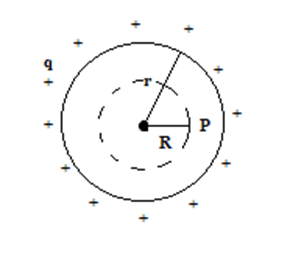
Consider, a charged sphere having radius r and carrying a charge q. To find electric field intensity at point P and inside the surface and at a distance R from the centre of the sphere. Draw a concentric circle passing through the point P as the Gaussian’s surface. Now, from the Gauss’s theorem, we get,
[latex]\phi = \frac{q}{\epsilon_o}[/latex] ………………… (i)
But, the total flux passing through the surface area A and electric field intensity E is:
[latex]\phi = E \times A[/latex] ……………. (ii)
We have,
E x A = [latex]\frac{q}{\epsilon_o}[/latex]
∴ E = [latex]\frac{q}{R^2} \times \frac{1}{4\pi\epsilon_o}[/latex]
= 0 [∵ q = 0, No charge]
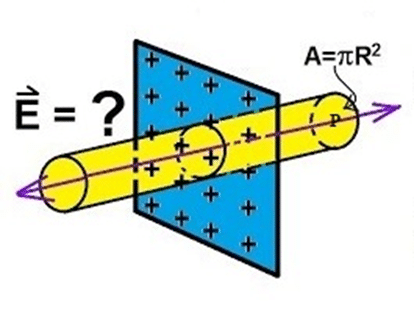
d) To find the electric field intensity due to a plane charged conductor:
Consider, a plane charged conductor having surface charge density [latex]\sigma[/latex]. To find the electric field intensity at point P. suppose, a cylindrical surface having base area A and perpendicular to the plane charged conductor as a Gaussian surface. The charge enclosed by the Gaussian’s surface is q. i.e. q = [latex]\sigma A[/latex]
From Gaussian theorem, the total flux is given by:
[latex]\phi = \frac{q}{\epsilon_o}[/latex] ………………….. (i)
Where, [latex]\epsilon_o[/latex] = Permittivity of the free space.
But, [latex]\phi = E \times A[/latex] …………… (ii)
Where, E = Electric field intensity.
From (i) and (ii),
E x A = [latex]\frac{q}{\epsilon_o} = \frac{\sigma A}{\epsilon_o}[/latex]
∴ E = [latex]\frac{\sigma}{\epsilon_o}[/latex]
e) To find the electric field intensity due to a line charged conductor:
Consider, an infinite long charged conductor (line charge) having linear charge density [latex]\lambda[/latex] to find the electric field intensity at P at the distance r from the line charge. Suppose, a cylindrical surface of length ‘l’ and radius ‘r’ and coaxial with wire as a Gaussian surface. The charge enclosed by this surface, is q, i.e.
q = [latex]\lambda l[/latex]
Since, no flux passes through the cross – sectional areas, the area through which the flux passes is the curved surface of the cylinder, which is equal to [latex]2\pi r l[/latex]. Now,
From Gauss’s theorem,
[latex]\phi = \frac{q}{\epsilon_o} = \frac{\lambda l}{\epsilon_o}[/latex] …………… (i)
But, the flux in terms of electric field is given by:
[latex]\phi = E \times A[/latex] …………….. (ii)
From (i) and (ii), we get,
E x A = [latex]\frac{\lambda l}{\epsilon_o}[/latex]
Or, E = [latex]\frac{\lambda l}{\epsilon_o A} = \frac{\lambda l}{\epsilon_o} . \frac{1}{2\pi r l}[/latex]
∴ E = [latex]\frac{\lambda}{2\pi r \epsilon_o}[/latex]
MCQs
A body of mass 1 kg carrying a charge of 1 coulomb falls in an electric field through a potential difference of 1 volt. Its velocity is
Show answer
The force between two charges in air is 10 N. On inserting dielectric, the force becomes 4 N. Then dielectric constant of medium is
Show answer
The energy per unit volume is given by
Show answer
[latex]NC^{-1}[/latex] has the same unit as
Show answer
Maximum value of electric intensity due to charged sphere is at
Show answer
An electric dipole kept in uniform electric field. It experiences
Show answer
The electric field intensity at the surface of charged conductor is
Show answer
Electric intensity at a point varies as [latex]r^{-1}[/latex] for
Show answer
If one penetrates a uniformly charged hollow sphere, the electric field strength E
Show answer
If electric field is uniform, the electric lines of forces are
Show answer
Theoretical questions
Define electric field and electric field intensity.
Can two electric lines of force intersect each other? Explain.
What is the magnitude of an electric field which will balance the weight of an electron on the surface of earth?
Two positive charges separated by a distance create an electrostatic field. Can electric field intensity be zero at a point between the charges? Justify your answer.
Under what conditions, the electric lines of force are curved?
A charge particle is free to move in an electric field. Will it always move along an electric lines of force?
When an iron plate is placed between two charges, what will be the electrostatic force of attraction between them?
An electron and a proton are placed in a uniform electric field; will their acceleration be same?
What will be the electric field strength at a point mid-way between two equal and opposite charges?
State gauss theorem. What is Gaussian surface?
Would Gauss law be helpful for determining the electric field of a dipole?
Why do the electrostatic field lines not form closed loops?
Draw lines of force to represent a uniform electric field.
State Gauss’s theorem in electrostatics. Use this theorem to calculate electric field due to a solid charged sphere at a point inside it.
State and explain Gauss’s theorem in electrostatics and use it to find the electric field intensity due to a hollow charged spherical conductor.
State and explain Gauss’s theorem in electrostatics. Use it to obtain an expression for electric field intensity due to a linearly charged body.
State and explain Gauss’s theorem in electrostatics. Use this theorem to find the electric field intensity due to a plane charged conductor.
Numerical problems
Two large parallel metal plates carry opposite charges. They are separated by 0.20 m and the p.d. between them is 500V. What is the magnitude of electric field, if it is uniform, in the region between them? Ans: 2500 V/m
An electron of mass [latex]9.1\times 10^{-31}[/latex] kg charge [latex]1.6\times 10^{-19}[/latex] C is situated in uniform electric field of intensity [latex]1.2\times 10^4\ Vm^{-1}[/latex]. Find the time it takes to travel 1 cm from rest. Ans: [latex]3.1\times 10^{-9}[/latex] s
Two charges [latex]+1\times 10^{-6}[/latex] C and [latex]-4\times 10^{-6}[/latex] C are separated by a distance of 2m. Determine the position of the null point. Ans: 2m outside from smaller one
A hollow spherical conductor of radius 12 cm is charged to [latex]6\times 10^{-6}[/latex] C. Find the electric field strength at the surface of sphere, inside the sphere at 8 cm and at distance 15 cm from the sphere. Ans: [latex]3.75\times 10^6\ NC^{-1}[/latex], 0, [latex]7.41\times 10^5\ NC^{-1}[/latex]
Two small spheres of charge [latex]+10\ \mu C[/latex] and [latex]+40\ \mu C[/latex] are placed 6 cm apart. Find the location of point between them where the field strength is zero. Ans: 0.02 m from [latex]+10\ \mu C[/latex]
Two charges [latex]-1\mu C[/latex] and [latex]+2\mu C[/latex] are placed at the corners A and B of an equilateral triangle ABC of side 2m. Calculate the electric field at C. Ans: 3897.11 N/C
Two large parallel metal plates carry opposite charges. They are separated by 0.20 m and the p.d. between them is 500V. What is the magnitude of electric field, if it is uniform, in the region between them?
Solution
Separation between the plates (d) = 0.20 m
P.d. between them (V) = 500 V
Electric field (E) =?
We know that,
[latex]E=\frac{V}{d}[/latex]
= [latex]\frac{500}{0.2} = 2500\ V/m[/latex]
An electron of mass kg charge C is situated in uniform electric field of intensity . Find the time it takes to travel 1 cm from rest.
Solution
Mass of electron (m) = [latex]9.1\times 10^{-31}\ kg[/latex]
Charge of electron (q) = [latex]1.6\times 10^{-19}[/latex] C
Electric field intensity (E) = [latex]1.2\times 10^4\ Vm^{-1}[/latex]
Time (t) =?
Distance travelled (s) = 1 cm = 0.01 m
First,
Acceleration of motion (a) = [latex]\frac{F}{m} = \frac{eE}{m}[/latex]
= [latex]\frac{(1.6\times 10^{-19})\times (1.2\times 10^4)}{9.1\times 10^{-31}}[/latex]
= [latex]2.109\times 10^{15}[/latex] m/s2
Again,
s = [latex]ut+\frac{1}{2}at^2[/latex]
Or, [latex]s = 0 + \frac{1}{2}at^2[/latex]
Or, [latex]2s = at^2[/latex]
Or, [latex]t = \sqrt{\frac{2s}{a}}[/latex]
= [latex]\sqrt{\frac{2\times 0.01}{2.109\times 10^{15}}} = 3.079\times 10^{-9}\ s[/latex]