
Refraction at Plane Surfaces
SYLLABUS
Laws of refraction: Refractive index, Relation between refractive indices, Lateral shift, Total internal reflection.
What is This Chapter About?
Place a straight straw in a glass of water and look at it from the side. The straw appears bent at the water surface — even though it is perfectly straight. Put a coin at the bottom of an empty bowl, step back until the coin just disappears below the rim, then pour water in — the coin becomes visible again. These everyday illusions reveal a fundamental property of light: when it passes from one transparent medium into another, it changes direction. This phenomenon is called refraction.
Chapter 15 of NEB Grade 11 Physics explores refraction at plane (flat) surfaces quantitatively. It introduces Snell’s Law, the refractive index, lateral shift, and the remarkable phenomenon of total internal reflection — the principle behind optical fibres that carry internet data around the world at the speed of light. Carrying 4 teaching hours, this chapter is both mathematically rich and practically essential, forming the foundation for the subsequent study of prisms and lenses.
Key Concepts You Will Learn
Laws of Refraction
Refraction at a boundary between two media follows two laws. The first law states that the incident ray, refracted ray, and the normal at the point of incidence all lie in the same plane. The second law — Snell’s Law — states that the ratio of the sine of the angle of incidence to the sine of the angle of refraction is a constant for a given pair of media:
[latex]\frac{\sin\theta_1}{\sin\theta_2} = \frac{n_2}{n_1} = n_{12}[/latex]
where [latex]n_1[/latex] and [latex]n_2[/latex] are the absolute refractive indices of the first and second media respectively, and [latex]n_{12}[/latex] is the relative refractive index of the second medium with respect to the first.
The absolute refractive index n of a medium is defined as the ratio of the speed of light in vacuum to the speed in that medium: [latex]n = \frac{c}{v}[/latex]. Since light always slows down when entering a denser optical medium (higher n), it bends toward the normal. When it enters a less dense medium, it speeds up and bends away from the normal.
Lateral Shift
When a ray of light passes through a parallel-sided glass slab, it emerges parallel to its original direction but displaced sideways — this displacement is called the lateral shift (or lateral displacement). The magnitude of the lateral shift depends on the thickness of the slab, the refractive index of the glass, and the angle of incidence:
[latex]d = \frac{t\sin(\theta_1 – \theta_2)}{\cos\theta_2}[/latex]
where t is the thickness of the slab, [latex]\theta_1[/latex] is the angle of incidence, and [latex]\theta_2[/latex] is the angle of refraction. Lateral shift increases with increasing angle of incidence and increasing slab thickness. At normal incidence ([latex]\theta_1 = 0[/latex]), there is no lateral shift — the ray passes straight through without displacement.
Relation Between Refractive Indices
The refractive indices of different media are related through a simple reciprocal relationship. If [latex]n_{12}[/latex] is the refractive index of medium 2 relative to medium 1, then:
[latex]n_{12} = \frac{n_2}{n_1}[/latex] and [latex]n_{21} = \frac{n_1}{n_2} = \frac{1}{n_{12}}[/latex]
Also, for three media 1, 2, and 3: [latex]n_{13} = n_{12} \times n_{23}[/latex]. These relations allow the refraction at any boundary to be calculated if the absolute refractive indices of both media are known.
Total Internal Reflection
When light travels from a denser optical medium (higher n) to a less dense medium (lower n), it bends away from the normal — the refracted angle is larger than the incident angle. As the angle of incidence increases, the refracted angle also increases, until at a specific angle called the critical angle ([latex]\theta_c[/latex]), the refracted ray lies exactly along the boundary ([latex]\theta_2 = 90°[/latex]). Beyond this critical angle, no refraction occurs — all the light is reflected back into the denser medium. This is total internal reflection.
The critical angle is related to the refractive index by:
[latex]\sin\theta_c = \frac{n_2}{n_1} = \frac{1}{n}[/latex] (when going from medium of index n to air)
Total internal reflection occurs only when light travels from a denser to a less dense medium, and the angle of incidence exceeds the critical angle. Both conditions must be satisfied simultaneously.
Applications of Total Internal Reflection
Total internal reflection has several important and fascinating applications.
Optical fibres use total internal reflection to transmit light (and therefore information) along thin glass or plastic fibres with virtually no loss, even around bends. Light entering one end of the fibre strikes the glass-air boundary at angles greater than the critical angle and is totally internally reflected repeatedly along the fibre’s length. Optical fibres carry telephone calls, internet data, and television signals around the world.
Diamonds are cut with faces at specific angles to maximise total internal reflection inside the stone, causing light to bounce multiple times before emerging — producing the characteristic sparkle and brilliance.
Periscopes and binoculars use right-angled glass prisms instead of mirrors, exploiting total internal reflection to redirect light. Prisms give brighter, sharper images than silvered mirrors because total internal reflection is 100% efficient — no light is absorbed.
Endoscopes used in medicine transmit images from inside the body to a camera outside using bundles of optical fibres.
Working Principle of Optical Fibre
An optical fibre consists of a central core of glass with higher refractive index surrounded by a cladding of glass with lower refractive index. Light entering the core at a small enough angle to the axis strikes the core-cladding boundary at an angle exceeding the critical angle and undergoes total internal reflection, bouncing along the fibre. The numerical aperture of the fibre determines the maximum angle at which light can enter and still be totally internally reflected.
Why This Chapter Matters for NEB Exams
Refraction at Plane Surfaces is examined consistently in NEB Grade 11 Physics. Snell’s Law — applying it to find angles, refractive indices, or speeds — generates standard numerical problems. The lateral shift formula and its variation with angle and thickness are classic examination questions. Total internal reflection — explaining the phenomenon, deriving the critical angle formula, and applying it numerically — appears in virtually every board paper. The working principle of optical fibres is a popular application-based question. Relations between refractive indices are tested through both short answers and numerical problems.
Important Topics to Focus On
- Laws of refraction — first law (coplanarity) and second law (Snell’s Law)
- Absolute refractive index: [latex]n = \frac{c}{v}[/latex]
- Snell’s Law: [latex]n_1\sin\theta_1 = n_2\sin\theta_2[/latex]
- Why light bends toward normal in denser medium (speed decreases)
- Lateral shift formula: [latex]d = \frac{t\sin(\theta_1 – \theta_2)}{\cos\theta_2}[/latex]
- Relations between refractive indices: [latex]n_{12} = \frac{1}{n_{21}}[/latex] and [latex]n_{13} = n_{12} \times n_{23}[/latex]
- Critical angle — definition and derivation: [latex]\sin\theta_c = \frac{1}{n}[/latex]
- Conditions for total internal reflection — both must be satisfied
- Applications: optical fibres, diamonds, prisms in periscopes, endoscopes
- Working principle of optical fibre — core, cladding, and repeated total internal reflection
- Numerical problems on Snell’s Law, critical angle, and lateral shift
Connection to Other Chapters
Refraction at Plane Surfaces connects backward to Chapter 14 (Reflection at Curved Mirrors) — both chapters deal with how light behaves at boundaries, and the sign conventions carry over. It connects forward to Chapter 16 (Refraction through Prisms) and Chapter 17 (Lenses), where refraction at curved surfaces produces the focusing and dispersing effects studied in those chapters. In Grade 12, Snell’s Law is derived from Huygens’ Principle in Chapter 10 (Nature and Propagation of Light), providing a deeper wave-based explanation for what is introduced here through a geometric/empirical approach. Optical fibres connect to Chapter 26 (Recent Trends in Physics) through modern communication technology.
Refraction of light
When a ray of light passes from one medium to another, it bends from its original direction (or path). The bending of light is called the refraction of light.
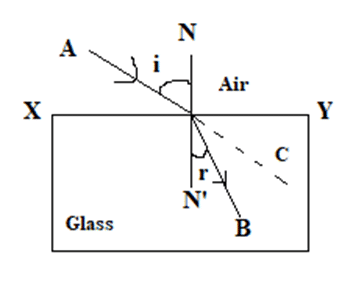
Let us consider, a ray of light AO is passing from air to glass, incident at O on the refracting surface XY. In-stead of passing through its original path, it bends through OB. The bending is due to refraction of light.
Why refraction occurs?
When light from rarer medium passes to denser medium, its speed decreases. Similarly, when light from denser medium passes to rarer medium, its speed increases. Due to such sudden change in the speed of light, it bends from its original path and hence, refraction occurs.
Laws of refraction
- The incident ray, normal and the refracted ray all lie on the same plane.
- For two media, the ratio of sine of the angle of incidence (i) to the sine of the angle of refraction (r) always gives a constant value. It is called the refractive index of second medium w.r.t. the first one. i.e.
Refractive index of glass w.r.t. air (aμg) = [latex]\frac{sini}{sinr}[/latex]
Principle of Reversibility of light
Let us consider, light is passing from air to water. A ray of light AO is incident at O between two media, after refraction, it passes through OB. In the figure,
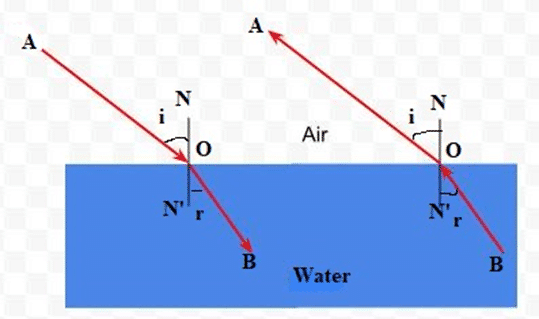
∠AON = Angle of incidence = i &
∠BON’ = Angle of refraction = r. So,
aμw = [latex]\frac{sini}{sinr}[/latex] …………………. (i)
Now, if the ray of light OB is incident at O, making an angle of incidence (r) and after refraction, the ray of light passes through OA making an angle of refraction (i), So,
wμa = [latex]\frac{sinr}{sini}[/latex] …………………… (ii)
from equations (i) and (ii), we get,
aμw . wμa = [latex]\frac{sini}{sinr}\times \frac{sinr}{sini}[/latex]
So, aμw = 1/wμa
This is the principle of reversibility of light.
Refraction through many media
Rarer to Denser: air → Water → glass.
Let us consider, ray of light is passing from air to water, from water to glass and from glass to air as shown in figure.
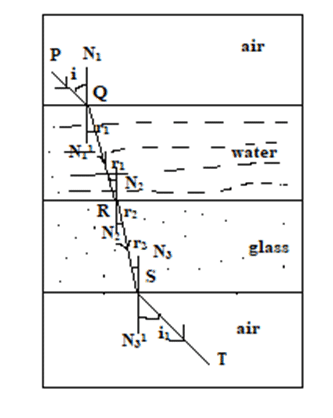
Let, PQ be the incident ray for air water media, it after refraction passes along QR. For water glass boundary, QR be the incident ray and RS be the refracted ray. But, for glass air boundary, RS acts as incident ray and ST be the refracted ray.
Case 1
For air-water boundary,
∠i = ∠PQN = angle of incidence.
∠r1 = ∠RQN ‘ = angle of refraction.
[latex]\therefore[/latex] refractive index of water w.r.t. air,
aμw = [latex]\frac{sini}{sinr_1}[/latex] ……….. (i)
Case 2
For water-glass boundary,
∠r1 = angle of incidence.
∠r2 = angle of refraction.
[latex]\therefore[/latex] refractive index of glass w.r.t. water,
wμg = [latex]\frac{sinr_1}{sinr_2}[/latex] ……………….. (ii)
Case 3
For glass-air boundary,
∠r2 = angle of incidence.
∠i = angle of refraction.
[latex]\therefore[/latex] refractive index of air w.r.t. glass,
gμa = [latex]\frac{sinr_2}{sini}[/latex] ……………….. (ii)
Now,
aμw x wμg x gμa = [latex]\frac{sini}{sinr_1}\times \frac{sinr_1}{sinr_2}\times \frac{sinr_2}{sini}[/latex]
[latex]\therefore[/latex] aμw x wμg = 1/gμa = aμg
So, aμg = aμw x wμg
Lateral Shift
It is defined as the distance of the light shifted from its original direction, i.e. it is the perpendicular distance between the direction of incident rays produced and emergent ray.
[latex]\therefore[/latex] Lateral shift (L) = t. [latex]\frac{sin(i-r)}{cosr}[/latex], where, L = lateral shift, t = thickness of the glass slab, i = angle of incidence and r = angle of refraction.
Derivation
Let us consider, a glass slab where, AB is the incident ray incident at the point B and refracted along BC by making an angle of incidence ‘i’ and angle of refraction ‘r’ respectively. CE is the distance between incident ray produced & emergent ray.
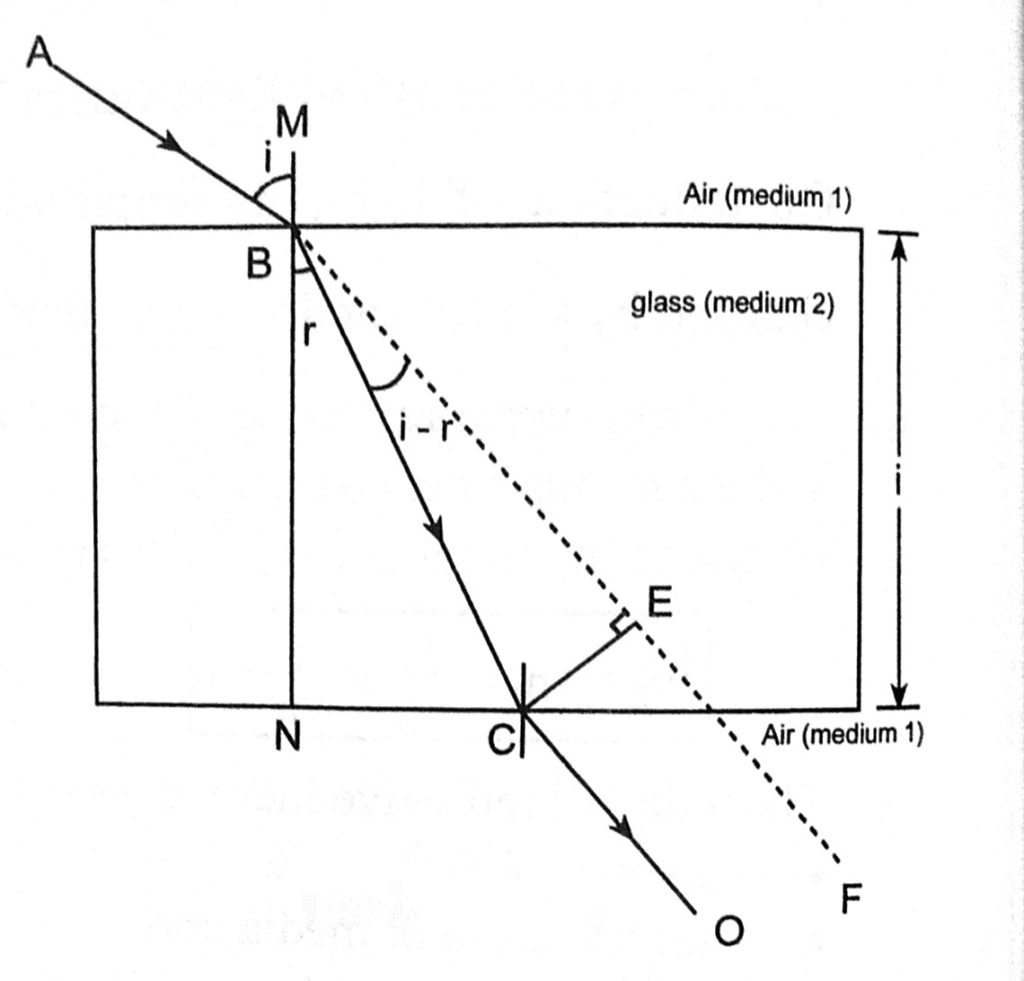
From figure, ∠ABM = i.
∠NBC = r.
[latex]\therefore[/latex] ∠CBE = ∠NBE – ∠NBC = i – r.
From right angled [latex]\Delta[/latex]CBE, sin(i-r) = [latex]\frac{CE}{BC}[/latex]
[latex]\therefore[/latex] CE = BC. sin(i-r) …………….. (i)
From right angled [latex]\Delta[/latex]NBC,
cosr = [latex]\frac{NB}{BC}[/latex]
[latex]\therefore BC = \frac{t}{cosr}[/latex] ………………. (ii)
From eqn. (i) and (ii), we get,
CE = [latex]\frac{t}{cosr}.sin(i-r)[/latex]
[latex]\therefore L = t.\frac{sin(i-r)}{cosr}[/latex] ………………… (iii)
This is the required relation for lateral shift in terms of thickness for the glass slab, angle of incidence and the angle of refraction.
The maximum value of lateral shift is the thickness of the glass slab when i = 90o, shown in graph.
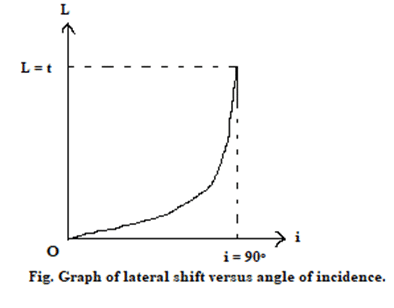
L = t.[latex]\frac{sin(90-r)}{cosr} = t\frac{cosr}{cosr}[/latex].
[latex]\therefore[/latex] L = t …………….. (iv)
This relation shows that the lateral shift is equal to the thickness of the glass slab when the angle of incidence is equal to 90o.
Real and Apparent Depth
Let us consider, a coin is viewed from rarer medium. A ray of light OA passes normally through the air-water boundary, after refraction passes undeviated. Another ray OB is incident at B, after refraction passes away from the normal. These two rays appear to be coming from O‘ instead of O. So, the depth of the apparent position of the object from the surface of the medium is called apparent depth. Hence, in the figure, AO = real depth (the actual depth of the object).
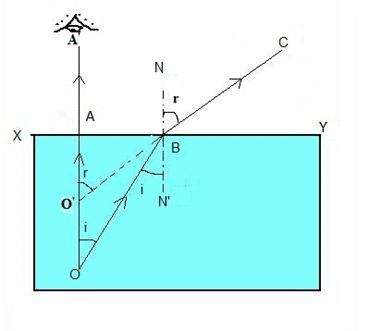
AO‘ = apparent depth.
The refractive index of air w.r.t. water is:
wμa = [latex]\frac{sini}{sinr}[/latex] ……………….. (i)
Also, the refractive index of water w.r.t. air is:
aμw = 1/wμa = [latex]\frac{sinr}{sini}[/latex] ………………… (ii)
From figure, ∠AOB = ∠OBN’ = i
& ∠AO’B = ∠NBC = r
In [latex]\Delta AOB, Sin i = \frac{AB}{OB}[/latex] and, In [latex]\Delta AO’B, Sinr = \frac{AB}{O’B}[/latex]
So, eqn. (ii) becomes,
aμw = [latex]\frac{AB}{O’B}\times \frac{OB}{AB} = \frac{OB}{O’B}[/latex]
Now, since, the coin is viewed from A’, the points A & B must be very close to each other, otherwise the ray OB may not fall on the eye. So,
O‘B = O‘A = apparent depth &
OB = OA = real depth.
So, aμw = [latex]\frac{Real\ depth}{Apparent\ depth}[/latex]
Effects of Refraction of light
- A stick dipped partially in water appears to be bent.
- A coin placed at the bottom of a pot containing water appears to be lifted up.
- The sun appears flattened at sun rise and sun set.
- The stars appear to twinkle in night.
Critical angle (c)
It is defined as an angle of incidence in denser medium for which angle of refraction is 90o.
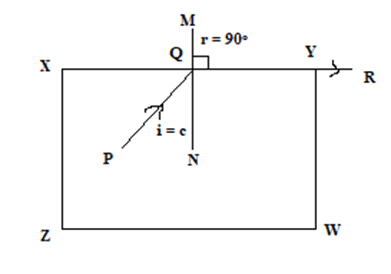
[latex]\therefore c = sin^{-1}(\frac{1}{\mu})[/latex], for example, critical angle of glass = 42o.
Total internal reflection
It is defined as phenomenon in which all light rays reflected into the same denser medium when the light ray passing through the denser medium to rarer medium at angle of incidence greater than the critical angle.
Relation between critical angle and refractive index
To derive a relation between critical angle and refractive index, we consider a glass slab WXYZ. Form figure (i), PQ is the incident ray incident at the point Q by making angle of incidence i1 < c and refracted along QR by making angle of refraction r1. In this case, the light ray refracted as shown in figure.
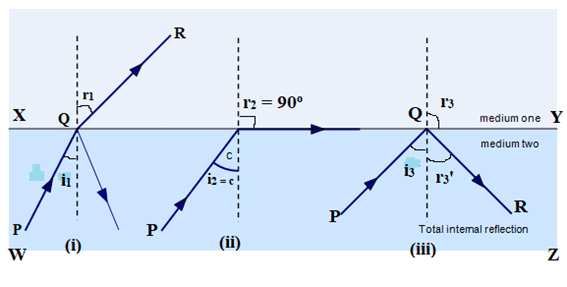
In figure (iii), as the angle of incidence (i2) is equal to the critical angle, the angle of refraction (r2) is 90o. In such condition, we have,
The refractive index of glass,
aμg = 1/gμa = [latex]\frac{1}{\frac{sini_2}{sinr_2}} = \frac{sinr_2}{sini_2}[/latex]
= [latex]\frac{sin90^o}{sini_2} = \frac{1}{sinc}[/latex]
aμg = [latex]\frac{1}{sinc}[/latex]
In figure (iii), as the angle of incidence is increased greater than critical angle, then, the refracted ray does not refract but it is reflected in same medium that phenomenon is known as total internal reflection. In such condition, i3 > c, r3 > 90o and i3 = r3.
Examples of Total internal Reflection
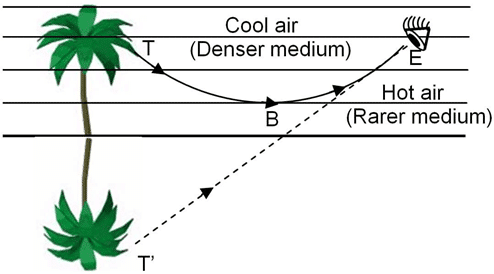
- Mirage
The optical illusion produced on hot places like desert and pitched road during summer hot days is called mirage. The layer of air near the earth’s surface becomes very hot and upper layers becomes relatively denser.
Suppose, the ray from the top of tree passes from denser to rarer layers successively and bending occurs away from normal. The rays get totally internally reflected when the angle of incidence is greater than the critical angle & a person sitting away from it sees an inverted image of the tree which produces the feeling of water on the earth’s surface. - Total reflecting prism
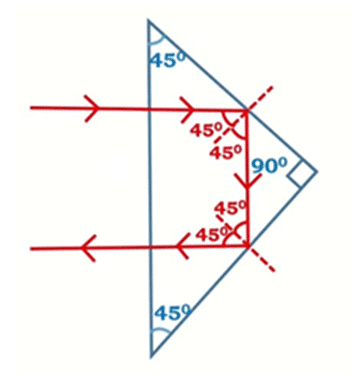
This is an isosceles right angled (45o – 45o – 90o) prism where a ray of light is incident perpendicular to a face, then, the refracted ray in another face makes an angle greater than critical angle and hence, TIR occurs. The ray comes out from the same face. These types of prisms are used in binocular and submarine.
- Brilliancy of diamond
The refractive index of diamond is 2.4 and hence, its critical angle is small about 24.6o. The edges of diamond are cut such that the light falling on it undergoes multiple total internal reflection and hence makes brilliancy of diamond. - Optical fibers
Optical fiber is a flexible, transparent fiber whose central part is called core. The core is surrounded by a transparent material called cladding. The refractive index of core is greater than cladding. When a ray of light is incident at a small angle of incidence at one end, the light undergoes TIR at the core cladding boundary and it is trapped within the rod even if the rod is curved and finally comes out of the fiber at the other end without much loss of intensity.
MCQs
Critical angle of light passing from glass to air is minimum for
Show answer
The index of reflection of diamond is 2.4, velocity of light in diamond is
Show answer
The refractive index of glass is 1.5. Then velocity of which light is minimum in the glass?
Show answer
The refractive index of glass is 1.5 and water is 1.33. Then what is the critical angle for glass water interface?
Show answer
The refractive index [latex](\mu)[/latex] and wavelength of light [latex](\lambda)[/latex] when light passes from one medium to another medium
Show answer
Refractive index of glass with respect to air is 1.5. What is the velocity of light in the material?
Show answer
A person inside water can see the sun setting at an angle of
Show answer
Light from vacuum enters to a medium of [latex]\mu = 1.5[/latex]. If it crosses the glass within a nanosecond, the thickness of the medium is
Show answer
Optical fibres are based on the principle of
Show answer
If refractive index of water is 4/3 and that of given slab of glass immersed in it is 5/3. What is the critical angle for a ray of light tending to go from glass to water?
Show answer
Theoretical questions
Why does the bottom of a swimming pool always appear shallower than it actually is? [2]
Why does the sun look slightly oval when it is near the horizon? [2]
A stick partially dipped in water seems to be bent. Why? [2]
Why do stars twinkle? [2]
Is it possible to describe two situations of total internal reflection in a right-angled isosceles glass prism? Explain with diagram. [2]
Why an object appears raised if placed at the bottom of a container filled with water? [2]
Can total internal reflection be achieved if object originates in rarer medium? Explain with a diagram to justify you answer. [2]
A ray of light in air strikes a glass surface. Is there a range of angles for which total internal reflection takes place? [2]
Why does diamond sparkle? [2]
Define critical angle and total internal reflection. [2]
Why does a clear pool of water always appear to be shallower than it actually is? [2]
Why do in summer, roads often appear to be covered with water when seen from a distance? Explain. [2]
Define lateral shift and derive an expression for it due to a parallel edged glass slab. [3]
Define lateral shift. Derive an expression for it. Show in a graph the variation of lateral shift with the angle of incidence. [3]
What do you mean by critical angles and total internal reflection? Derive a relation between critical angle and refractive index. [3]
Numerical problems
Calculate the critical angle of (i) glass – water and (ii) water – air interfaces if object lies in the denser medium. Ans: 62.5o, 48.8o
An optical fiber with refractive index 1.72 is surrounded by a glass coating having refractive index 1.50. Find the critical angle for total internal reflection at the fiber glass interface. Ans: 60.7o
The critical angle for total internal reflection at a liquid air interface is 42.5o. If a ray of light travelling from the liquid has an angle of incidence at the interface of 35.0o, what angle does the refracted ray in the air make with the normal? Ans: 58.1o
Light from a luminous point on the lower face of a rectangular glass slab, 2 cm thick, strikes the upper face and the totally reflected rays outline a circle of 3.2 cm radius on the lower face. What is refractive index of the glass? Ans: 1.6
How long will the light take in travelling a distance of 500 m in water? Refractive index for water is 1.33 and velocity of light in vacuum is 3 x 10⁸ m/s. Ans: 2.2 x 10⁻⁶ s
Light travelling from a pool of water in a parallel beam is incident on the horizontal surface. Its speed in water is 2.2 x 10⁸ m/s. Calculate the maximum angle which the beam can make with the vertical of light to escape into the air where its speed is 3 x 10⁸ m/s. Ans: 47.2o
A transparent cube of 12 cm edge contains a small air bubble. Its apparent depth when viewed through one face of the cube is 6 cm and when viewed through the opposite face is 2 cm. What is the actual distance of the bubble from the first face?
Solution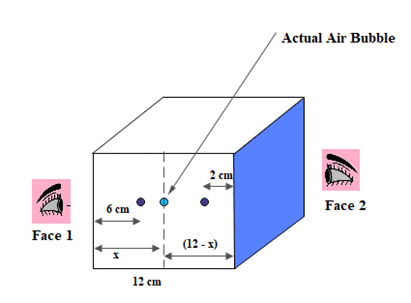
Sides of cube = 12 cm
Apparent depth from first face = 6 cm
Apparent depth from second face = 2 cm
Suppose, actual depth = x cm from first face.
So, actual depth = (12 – x) cm from the second face.
Now, for 1st face,
Refractive index [latex](\mu) = \frac{Actual\ depth}{Apparent\ depth}[/latex]
= [latex]\frac{x}{6}[/latex] ……………… (i)
Similarly, for 2nd face,
Refractive index [latex](\mu) = \frac{Actual\ depth}{Apparent\ depth}[/latex]
= [latex]\frac{12-x}{2}[/latex] ………………. (ii)
So, from eqns. (i) & (ii), we get,
[latex]\frac{x}{6} = \frac{12 – x}{2}[/latex]
Or, 2x = 72 – 6x
Or, 8x = 72
Or, x = [latex]\frac{72}{8}[/latex]
= 9 cm.
So, actual depth of the air bubble = 9 cm from the first face.
Calculate the critical angle of (i) glass – water and (ii) water – air interfaces if object lies in the denser medium.
Solution
Given,
(i) Critical angle of glass – water interface (c) =?
We know that,
[latex]\mu_g^w = \frac{\mu_g^a}{\mu_w^a}[/latex]
= [latex]\frac{1.5}{1.33} = 1.127[/latex]
Now, [latex]\mu_g^w = \frac{1}{sinc}[/latex]
Or, 1.127 = [latex]\frac{1}{sinc}[/latex]
Or, sinc = [latex]\frac{1}{1.127} = 0.887[/latex]
Or, c = sin-1(0.887) = 62.53o
(ii) Critical angle of water – air interface (c) =?
We have,
[latex]\mu_w^a = \frac{1}{sinc}[/latex]
Or, 1.33 = [latex]\frac{1}{sinc}[/latex]
Or, sinc = [latex]\frac{1}{1.33} = 0.752[/latex]
Or, c = sin-1(0.752)
= 48.76o.
An optical fiber with refractive index 1.72 is surrounded by a glass coating having refractive index 1.50. Find the critical angle for total internal reflection at the fiber glass interface.
Solution
Refractive index of optical fibre [latex](\mu_o^a)[/latex] = 1.72
Refractive index of glass [latex](\mu_g^a)[/latex] = 1.5
Critical angle (c) =?
We know that,
[latex]\mu_o^g = \dfrac{\mu_o^a}{\mu_g^a} = \dfrac{1.72}{1.5} = 1.147[/latex]
Now,
[latex]\mu_o^g = \dfrac{1}{\sin c}[/latex]
[latex]1.147 = \dfrac{1}{\sin c}[/latex]
[latex]\sin c = \dfrac{1}{1.147} = 0.872[/latex]
[latex]c = \sin^{-1}(0.872) = 60.67^o[/latex]
What is the apparent position of an object below a rectangular glass slab of refractive index 1.45 and the thickness 0.06 m if a layer of water 0.05 m thick is on the top of the glass slab?
Solution
Apparent position of an object (p) =?
Refractive index of glass [latex](\mu_g)[/latex] = 1.45
Thickness of glass [latex](t_g)[/latex] = 0.06 m
Refractive index of water [latex](\mu_w)[/latex] = 1.33
Thickness of water [latex](t_w)[/latex] = 0.05 m
Apparent displacement due to glass [latex](d_g) = t_g\left(1 – \dfrac{1}{\mu_g}\right)[/latex]
[latex]= 0.019\ m[/latex]
Apparent displacement due to water [latex](d_w) = t_w\left(1 – \dfrac{1}{\mu_w}\right)[/latex]
[latex]= 0.013\ m[/latex]
Total apparent displacement (d) = [latex]d_g + d_w[/latex]
[latex]= 0.032\ m[/latex]
Total thickness (t) = [latex]t_g + t_w[/latex]
[latex]= 0.06 + 0.05[/latex]
[latex]= 0.11\ m[/latex]
So, apparent position (p) = t – d
[latex]= 0.078\ m[/latex] below the top.
What is the apparent position of an object below a rectangular block of glass 6 cm thick if a layer of water 4 cm thick is on the top of the glass? (Refractive index of glass = [latex]\dfrac{3}{2}[/latex] and that of water = [latex]\dfrac{4}{3}[/latex]).
Solution
Apparent position of an object (p) =?
Refractive index of glass [latex](\mu_g)[/latex] = 3/2
Thickness of glass (tg) = 6 cm = 0.06 m
Refractive index of water [latex](\mu_w)[/latex] = 4/3
Thickness of water [latex](t_w)[/latex] = 4 cm = 0.04 m
Apparent displacement due to glass [latex](d_g) = t_g\left(1 – \dfrac{1}{\mu_g}\right)[/latex]
[latex]= 0.06\left(1 – \dfrac{1}{\frac{3}{2}}\right) = 0.02\ m[/latex]
Apparent displacement due to water [latex](d_w) = t_w\left(1 – \dfrac{1}{\mu_w}\right)[/latex]
[latex]= 0.04\left(1 – \dfrac{1}{\frac{4}{3}}\right) = 0.01\ m[/latex]
Total apparent displacement (d) = [latex]d_g + d_w[/latex]
[latex]= 0.02 + 0.01 = 0.03\ m[/latex]
Total thickness (t) = [latex]t_g + t_w[/latex]
[latex]= 0.06 + 0.04[/latex]
[latex]= 0.1\ m[/latex]
So, apparent position (p) = t – d
[latex]= 0.1 – 0.03 = 0.07\ m[/latex] below the top.
What is the apparent position of an object below a rectangular glass slab 6 cm thick if a layer of water 4 cm thick is on the top of the glass slab?
Solution
Apparent position of an object (p) =?
Refractive index of glass [latex](\mu_g)[/latex] = 3/2
Thickness of glass [latex](t_g)[/latex] = 6 cm
Refractive index of water [latex](\mu_w)[/latex] = 4/3
Thickness of water [latex](t_w)[/latex] = 4 cm
Apparent displacement due to glass [latex](d_g) = t_g\left(1 – \dfrac{1}{\mu_g}\right)[/latex]
[latex]= 6\left(1 – \dfrac{1}{\frac{3}{2}}\right) = 2\ cm[/latex]
Apparent displacement due to water [latex](d_w) = t_w\left(1 – \dfrac{1}{\mu_w}\right)[/latex]
[latex]= 4\left(1 – \dfrac{1}{\frac{4}{3}}\right) = 1\ cm[/latex]
Total apparent displacement (d) = [latex]d_g + d_w[/latex]
[latex]= 2 + 1 = 3\ cm[/latex] above from bottom.
Light from a luminous point on the lower face of a rectangular glass slab, 2 cm thick, strikes the upper face and the totally reflected rays outline a circle of 3.2 cm radius on the lower face. What is refractive index of the glass?
Solution
From the figure,
[latex]OB = \dfrac{3.2}{2} = 1.6\ cm[/latex]
AB = 2 cm
Now, in ΔOAB,
[latex]\tan c = \dfrac{OB}{AB} = \dfrac{1.6}{2} = 0.8[/latex]
[latex]c = \tan^{-1}(0.8)[/latex]
[latex]= 38.66^o[/latex]
Again, [latex]\mu = \dfrac{1}{\sin c} = \dfrac{1}{\sin 38.66^o} = 1.6[/latex]
A microscope is focused on a scratch on the bottom of a beaker. Turpentine is poured into the beaker to a depth of 4 cm, and it is found necessary to raise the microscope through a vertical distance of 1.25 cm to bring the scratch again into focus. Find the refractive index of turpentine.
Solution
Real depth (R.D.) = 4 cm
Apparent depth (A.D.) = 4 – 1.25 = 2.75 cm
We know that,
Refractive index [latex](\mu) = \dfrac{R.D.}{A.D.} = \dfrac{4}{2.75} = 1.45[/latex]
How long will the light take in travelling a distance of 500 m in water? Refractive index for water is 1.33 and velocity of light in vacuum is [latex]3 \times 10^8[/latex] m/s.
Solution
Time taken (t) =?
Distance (d) = 500 m
Refractive index of water [latex](\mu)[/latex] = 1.33
Velocity of light in vacuum (c) = 3 x 10⁸ m/s
We know that,
[latex]\mu = \dfrac{c}{v}[/latex]
[latex]1.33 = \dfrac{3 \times 10^8}{v}[/latex]
[latex]v = 2.256 \times 10^8\ m/s[/latex]
Again, [latex]v = \dfrac{d}{t}[/latex]
[latex]t = \dfrac{500}{2.256 \times 10^8} = 2.217 \times 10^{-6}\ s.[/latex]
Light travelling through a pool of water in a parallel beam is incident on the horizontal surface. Its speed in water is [latex]2.2 \times 10^8[/latex] m/s. Calculate the maximum angle which the beam can make with the vertical of light to escape into the air where its speed is [latex]3 \times 10^8[/latex] m/s.
Solution
Speed of light in water (v) = [latex]2.2 \times 10^8[/latex] m/s
Maximum angle which the beam make is the critical angle.
So, critical angle (c) =?
Speed of light in air (c) = [latex]3 \times 10^8[/latex] m/s
We know that,
[latex]\mu = \dfrac{c}{v} = \dfrac{3 \times 10^8}{2.2 \times 10^8} = 1.36[/latex]
Again, [latex]\mu = \dfrac{1}{\sin c}[/latex]
[latex]\sin c = \dfrac{1}{1.36} = 0.733[/latex]
[latex]c = \sin^{-1}(0.733) = 47.17^o.[/latex]
Test what you’ve learned in this chapter with a quick self-graded quiz.
Start MCQ Quiz